Your Child Turns 18 in Georgia. Your Legal Authority Disappears. Now What?
One day you're signing IEP documents, scheduling medical appointments, and managing your child's SSI benefits. The next day — their 18th birthday — Georgia law says you're a stranger. No automatic access to medical records. No automatic decision-making authority at school. No automatic authority over bank accounts or government benefits. It doesn't matter that your child has a developmental disability. The legal presumption of competence applies to every 18-year-old in the state.
Most parents hear about this through a transfer-of-rights notice from the school district, provided on or before their child's 17th birthday. The notice explains that educational decision-making is shifting to the student. What it doesn't explain is that the same shift is happening across every other domain simultaneously — and that a poorly planned response can leave your family in a legal dead zone that's expensive and time-consuming to fix.
The Georgia Alternatives-First Decision System
This isn't a generic guardianship form packet. It's a structured decision system built specifically for Georgia families navigating the turning-18 transition — designed around one principle: match the least restrictive legal tool to each domain where your child actually needs support.
Georgia law requires probate courts to consider less-restrictive alternatives before granting a guardianship (O.C.G.A. § 29-4-1(f)). Most families don't realize that supported decision-making agreements, powers of attorney, healthcare directives, and representative payee appointments can cover many of the same practical needs — without a court proceeding and without stripping your child's civil rights. The guide walks you through every option in order, from least to most restrictive, with the specific Georgia requirements for each one.
What's Inside
- Capacity Assessment Framework — the same functional standards Georgia probate evaluators use, adapted into a self-guided questionnaire. Know which legal tools your child can validly execute before you spend money on the wrong approach.
- Supported Decision-Making Agreement Builder — Georgia doesn't have a comprehensive SDM statute, but SDM agreements are still powerful tools. The guide shows how to document one as a less-restrictive alternative for the court's consideration under O.C.G.A. § 29-4-1(f).
- Georgia Power of Attorney Signing Requirements — the exact signature, witness, and notary requirements under the Georgia Uniform Power of Attorney Act (O.C.G.A. § 10-6B-5), plus guidance on signing capacity. Including what happens when a school or doctor questions whether your child had capacity when signing.
- Healthcare Advance Directive + HIPAA/FERPA Releases — step-by-step instructions for maintaining medical and educational access without court intervention, with the specific Georgia statutory forms.
- IEP Consent Strategy — how to stay involved in educational decisions after 18. Georgia hasn't adopted the optional IDEA representative provision, so the guide covers what actually works: IEP guest invitations, valid POAs in school settings, and when guardianship is the only path to consent authority.
- Selected-County Probate Filing Guide — examples of filing fees, bundled service costs, local evaluation requirements, and procedural quirks in selected Georgia counties. Check your local court's current schedule before filing.
- DBHDD Waiver Navigation — clear confirmation that NOW and COMP waivers do not require guardianship, plus instructions for participant-directed care models that keep families in control without a court order.
- SSI Transition & Representative Payee Setup — how to maintain benefit management through the SSA's own representative payee process instead of a conservatorship.
- STABLE Account and Special Needs Trust Basics — asset-building options that won't disqualify your child from means-tested benefits.
- Emergency Guardianship Protocol — what qualifies under O.C.G.A. § 29-4-14, the clear-and-convincing hearing standard and 60/90-day duration limits based on jurisdiction under § 29-4-16.
- Guardianship Restoration Process — if circumstances change, how to petition for termination and restoration of rights using GPCSF 65.
Who This Is For
This guide is built for Georgia families whose child's 18th birthday is approaching — or has already passed — and who need a structured way to figure out which legal tools fit their situation. It's for parents who:
- Just received the IEP transfer-of-rights notification and aren't sure what to do next
- Have been told they "need guardianship" but want to understand the alternatives first
- Can't afford a $3,000–$5,000 attorney retainer but need more than a brochure
- Want to preserve their child's autonomy and rights as much as possible
- Are navigating DBHDD waiver services and hearing conflicting advice about whether guardianship is required
- Live outside Metro Atlanta and need county-specific guidance for their local probate court
Why Free Resources Fall Short
The free information available to Georgia families has three structural gaps that a scattered Google search can't fill:
The county variation gap. National legal form sites assume Georgia runs a uniform system. It doesn't. Georgia has a Probate Court in each of its 159 counties, with local procedures and additional costs that vary. A parent in Clayton County faces an $853 adult-guardianship petition total with bundled services. In Wayne County, $175 is the statutory base petition fee; other fees and service costs may apply. Those cost differences can shape what a family can afford, so check current local schedules before filing.
The capacity trap. General estate planning advice tells families to "just have your child sign a power of attorney." That advice ignores that Georgia courts treat the principal's mental capacity to execute a power of attorney as a fact question. A diagnosis alone does not decide whether the signer understood the document. Schools and medical providers can also question whether a POA meets their requirements or grants the authority they need. Free resources rarely explain this distinction, leaving families with documents that may not work as expected.
The myth gap. Parents are routinely told that DBHDD requires guardianship for waiver services. They're told that SDM agreements "don't work" in Georgia. They're told that guardianship is a simple administrative filing. None of these are accurate, but the correct information is scattered across state agency websites, probate court instructions, and legal aid resources that most families never find.
Satisfaction Guarantee
If the guide doesn't help you build a clearer plan for your child's transition, email us for a full refund, no time limit. No forms, no justification needed.
What You Get
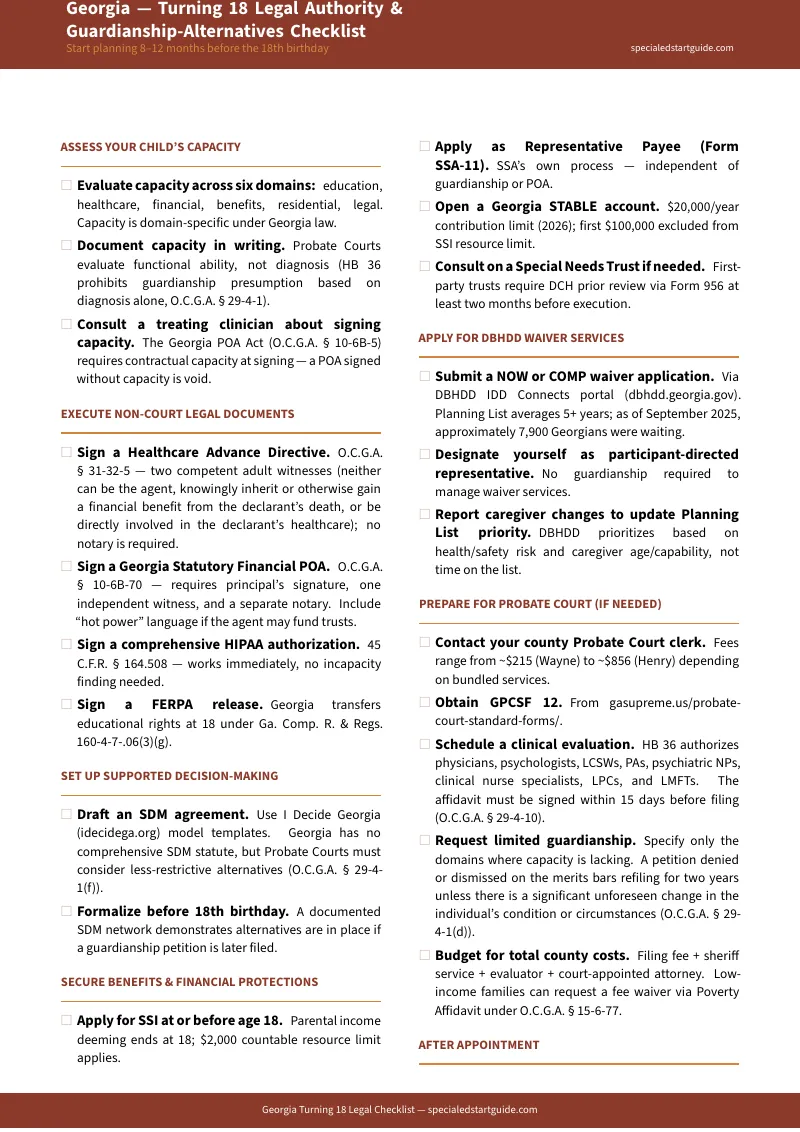
The full toolkit includes 7 PDFs: the 54-page guide, the turning-18 checklist with 24 action items, plus 5 standalone planning worksheets — a decision framework worksheet, capacity assessment checklist, county filing preparation checklist, agency communication log, and annual compliance calendar. Each worksheet is designed to be printed and used at the stage of the process where you need it.
Start Building Your Child's Transition Plan
Download the free turning-18 checklist to see the decision framework. If you want the complete guide — every alternative, every filing step, every county comparison — get the full toolkit.
Get the Georgia Guardianship & Alternatives Guide →
Frequently Asked Questions
What if the rules change after I buy?
We update the guide when the rules change. Email us any time, even years later, and we'll send you the current edition free.