The School Said "Too High-Functioning." The IEP Reads Like a Template. This Toolkit Gives You the Exact Goals, Accommodations, and Scripts to Make Them Actually Support Your Autistic Child.
You sat across the table from six professionals with clipboards. They told you your child "doesn't qualify" because their grades are fine. They offered a 504 Plan — no measurable goals, no progress monitoring, no enforceable services. Or they handed you an IEP full of goals like "will maintain eye contact for 30 seconds" and "will sit still without fidgeting for 20 minutes" — goals that train your child to perform neurotypicality instead of building actual independence. You pushed back on the restraint incident and the team looked at you like you were being difficult.
Meanwhile, your child masks their way through six hours of sensory overload, holds everything together until the car door shuts, and falls apart at home every single night. The school calls that "doing fine." You call it unsustainable.
Free resources from Autism Speaks and the Autism Society explain what autism is. Wrightslaw explains the law in 400 pages of legal text. Etsy sells $5 IEP binder covers. None of them hand you the neurodiversity-affirming goals to demand, the accommodation checklist to print, or the exact script for when the school psychologist says "he's too high-functioning for services." Private educational advocates who carry those tools charge $150 to $300 per hour.
The Autism IEP & Accommodation Toolkit is the Neuro-Affirming Advocacy System — the complete tactical framework that turns overwhelmed parents into effective advocates by providing autism-specific accommodation menus, a neurodiversity-affirming goal bank organized by support level, and a pushback script library for the exact institutional language schools use to deny services. It covers IEPs in the United States and Canada, EHCPs in England, and NCCD-based plans in Australia — because the acronyms change across borders but the institutional resistance is identical.
What's Inside the Toolkit
The Neurodiversity-Affirming Goal Bank
This is the toolkit's core. Traditional IEP goals train your child to suppress who they are: "will maintain eye contact," "will keep hands quiet," "will sit still." These goals enforce masking, accelerate burnout, and teach the child that their natural communication style is wrong. The toolkit replaces every compliance-based goal with a neurodiversity-affirming alternative. "Will demonstrate active engagement through verbal response, body orientation, or a mutually agreed-upon signal" replaces forced eye contact. "Will use a self-selected regulation tool and complete assigned tasks" replaces forced stillness. Goals are organized by domain — social communication, sensory regulation, self-advocacy, executive function, transitions — and differentiated by support level and age. For Level 1 students fighting the "too high-functioning" label. For Level 2 students needing structured daily living goals. For Level 3 students who communicate through AAC devices and deserve goals that presume competence. Each goal is SMART-formatted: specific, measurable, attainable, relevant, and time-bound. You choose the goals that match your child, print them, and bring them to the meeting.
Evidence-Based Accommodation Menus by Domain
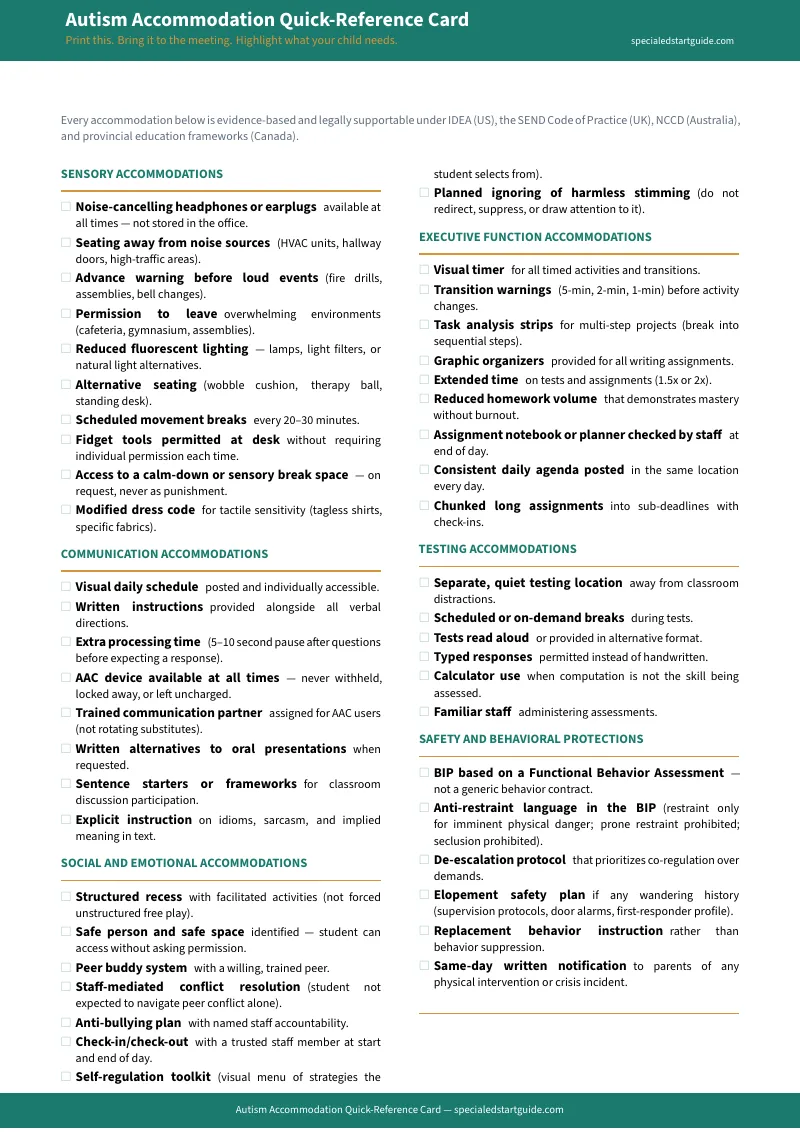
Not a generic list of "preferential seating and extra time." A comprehensive accommodation menu organized by sensory processing (auditory, visual, proprioceptive, tactile, olfactory), communication supports (visual schedules, AAC integration, pragmatic language), executive function (visual timers, task analysis strips, chunked assignments), social supports (structured recess, peer buddy systems, anti-bullying plans), testing accommodations, and behavioral and emotional protections. Each domain includes specific interventions with implementation details a teacher can actually follow — not vague categories, but "noise-cancelling headphones available at all times, not stored in the office" and "AAC device treated as the student's voice, never withheld as discipline."
The Pushback Script Library
Seven fill-in-the-blank scripts for the institutional language schools use to block services. When the school says "your child is too high-functioning for an IEP," you respond with the specific case law (Endrew F. v. Douglas County, 2017) and the legal definition of educational performance that includes social development, emotional regulation, and adaptive behavior. When they push a 504 Plan instead of an IEP, you explain why accommodations alone are insufficient when your child needs specially designed instruction. When they say "we don't have the budget," you cite the legal principle that cost cannot determine FAPE. When they tell you "the teacher says they're doing fine," you request the specific observational data across social interactions, independent task completion, and sensory regulation. Each script includes US, UK, and Australian jurisdiction variants.
Anti-Restraint and Seclusion Mandates
For parents of Level 2 and Level 3 children, this is not optional — it is the most critical section of the toolkit. Copy-and-paste clauses to embed directly into the Behavior Intervention Plan that legally restrict the school's ability to use physical holds, prone restraints, or isolation rooms. The language specifies that physical restraint is prohibited except when there is an immediate serious physical threat, that prone restraint is prohibited under all circumstances, that seclusion is prohibited under all circumstances, and that any emergency physical intervention must be documented and reported to parents the same day. Includes jurisdiction-specific context for US state-by-state regulations, UK recording requirements, and Australian standards.
Cross-Jurisdiction Legal Framework
One toolkit covering four legal systems. In the US: IDEA, Section 504, FAPE, IEP vs. 504 Plan decision criteria, Prior Written Notice, Independent Educational Evaluations, due process, and Manifestation Determination Reviews. In the UK: the EHCP framework, the SEND Code of Practice, Annual Reviews, and the First-tier Tribunal (SEND). In Australia: NCCD adjustment levels, state-specific frameworks, and NDIS coordination. In Canada: provincial variations across Ontario, British Columbia, Alberta, and others. Includes a terminology translation matrix so you can apply the advocacy principles regardless of which country you are fighting in.
Meeting Preparation and Documentation
The post-meeting follow-up email template that documents what the school proposed, what you requested, and what was denied — creating the paper trail that wins disputes. Evaluation checklists covering the full assessment battery (ADOS-2, ADI-R, CARS-2, SRS-2, SPM-2, Vineland-3, BRIEF-2). Guidance on requesting Independent Educational Evaluations at public expense. A complete chapter on the masking problem — how high-masking students, especially girls, are systematically missed by school-based evaluations and what instruments can quantify the hidden cognitive load.
Transition Planning for the "Services Cliff"
When your child ages out of the school system, educational entitlements stop. The toolkit covers when transition planning must begin (age 16 in the US, Year 9 in the UK), what measurable post-secondary goals to include (employment readiness, post-secondary education, independent living, self-advocacy), and how to build the transition folder — diagnostic evaluations, accommodation histories, adult disability services applications — before you hit the cliff edge.
Who This Toolkit Is For
- Parents of newly diagnosed autistic children preparing for their first IEP, EHCP, or school-based education plan — who need to walk in with specific goals and accommodations, not a vague hope that the school will figure it out
- Parents told their child is "too high-functioning" for an IEP — whose child masks at school and melts down at home — who need the legal language and case law to challenge the denial
- Parents of Level 2 and Level 3 children fighting for sensory accommodations, 1:1 aide support, or AAC device integration that the school claims it "cannot provide"
- Parents whose child has been subjected to physical restraint or seclusion at school — who need enforceable anti-restraint language for the Behavior Intervention Plan
- Parents whose child's IEP is full of compliance-based goals — "quiet hands," forced eye contact, "sit still" — who want neurodiversity-affirming alternatives that build independence, not performance
- Parents of autistic girls diagnosed late because their masking was mistaken for shyness or anxiety
- Parents of twice-exceptional (2e) students whose giftedness masks their disability and whose disability blocks access to gifted programs
- Parents of Black autistic children navigating higher rates of misdiagnosis, later identification, and disproportionate discipline
- Families who have relocated — or are about to relocate — between states, provinces, or countries, and need to transfer educational support across jurisdictions
- Parents who cannot afford $150 to $300 per hour for a professional educational advocate and need to self-advocate effectively
Why Not Free Resources?
Free autism resources are well-intentioned and informational. They are also passive, generic, and carefully neutral toward the school districts they depend on for institutional relationships. Here is where each one fails at the moment you need it most:
- Autism Speaks provides 100 Day Kits and School Community Toolkits — designed to educate teachers about autism, not to arm parents against institutional resistance. These guides explain what sensory processing is. They do not provide the specific accommodation language for a BIP that legally prevents the school from restraining your child during a meltdown. They explain what an IEP meeting is. They do not give you the pushback script for when the school says your child's grades are too good for services. And a significant segment of the autism community actively boycotts Autism Speaks over its history of compliance-focused, deficit-based framing.
- IPSEA provides exceptional UK SEND law guidance and template letters — but it is UK-only and does not include autism-specific accommodation menus or goal banks. IPSEA tells you how to legally demand an EHCP. It does not tell you what neurodiversity-affirming goals to write inside that EHCP. This toolkit does both.
- Wrightslaw is the gold standard for US special education law — but it covers all disabilities broadly and reads like a legal textbook. You cannot extract a menu of sensory accommodations for an autistic Level 1 student from a 400-page legal treatise the night before a meeting. Wrightslaw tells you the law. This toolkit gives you the specific goals, accommodations, and scripts that translate the law into action.
- Amaze (Australia) offers excellent neurodiversity-affirming resources and the School Can't Toolkit — but it is geographically specific and lacks the adversarial advocacy tools needed when a school refuses to cooperate. Amaze validates your child's experience. This toolkit equips you to force the school to act on that validation.
- Etsy and Teachers Pay Teachers sell IEP binders and checklists for $5 to $20 — built for teachers managing caseloads, not parents fighting denials. These products organize your paperwork. They do not provide neurodiversity-affirming goal alternatives, anti-restraint BIP clauses, or jurisdiction-specific dispute scripts. If the school says "no," the binder is useless.
Free resources explain what autism is. This toolkit gives you the exact words to say, the precise goals to demand, and the specific accommodations to require when the school tells you "no."
— Less Than Fifteen Minutes of an Educational Advocate's Time
Professional special education advocates charge $150 to $300 per hour in the US, £75 to £150 per hour in the UK, and $150 to $250 AUD in Australia. A single consultation to review your child's IEP costs more than this entire toolkit. A legal retainer for a due process hearing can exceed $30,000. This toolkit provides the accommodation menus, goal banks, and pushback scripts that professional advocates use — so you can handle most meetings and disputes yourself, and only engage a professional for the cases that genuinely require legal representation.
Your download includes the complete guide plus five standalone printables — pull them out, print them, and bring them to the meeting:
- Complete Autism IEP & Accommodation Toolkit (guide.pdf) — 12 chapters covering evaluation and diagnostic tools, your legal rights framework across US/UK/Australia/Canada, evidence-based accommodations by domain and support level, the neurodiversity-affirming goal bank with side-by-side replacements for compliance-based goals, placement and least restrictive environment guidance, crisis prevention with anti-restraint and anti-seclusion mandates, the pushback script library for seven school pushback scenarios, transition planning, intersectional considerations (girls, racial disparities, twice-exceptional students, non-speaking students), cross-jurisdiction portability, and a complete resources directory
- Accommodation Menus by Domain (accommodation-menus.pdf) — Every evidence-based accommodation from the toolkit organized by sensory, communication, executive function, social, testing, and behavioral domains — highlight what applies and hand it to the IEP team
- Neurodiversity-Affirming Goal Bank (goal-bank.pdf) — Side-by-side tables replacing every compliance-based goal with an affirming alternative, plus level-specific goal examples for Level 1, Level 2, and Level 3 students by age group
- Pushback Script Library (pushback-scripts.pdf) — All seven word-for-word scripts for when the school says "too high-functioning," pushes a 504, claims budget constraints, or dismisses your concerns — with the post-meeting follow-up email template
- Anti-Restraint & Seclusion Mandates (anti-restraint-clauses.pdf) — Copy-and-paste BIP clauses that legally restrict physical holds and seclusion, plus the Manifestation Determination Review framework and elopement safety plan checklist
- Autism Accommodation Quick-Reference Card (checklist.pdf) — A printable one-page card of the most effective classroom and testing accommodations organized by sensory, communication, social, executive function, testing, and safety domains — designed to be highlighted and handed directly to the IEP team
Instant PDF download. Print the accommodation menus, the goal bank, and the pushback scripts before your next meeting. Walk in with specific goals, not just hope.
Money-back guarantee, no time limit. If the toolkit doesn't change how you advocate for your child's education, email us for a full refund.
Not ready for the full toolkit? Download the free Autism Accommodation Quick-Reference Card — a one-page printable of the most effective classroom accommodations organized by sensory, communication, social, executive function, testing, and safety domains. Highlight what applies to your child. Bring it to the meeting. It covers what to ask for — and the full toolkit covers exactly how to get it when the school says no.
Your child's neurotype is not a defect to be corrected. It is a difference the school is legally required to support. This toolkit makes sure they do.