The School Calls It a "Behavior Problem." The Law Calls It an Unmet Need. This Toolkit Gives You the Checklists, Scripts, and Templates to Force a Real Plan.
Your child got suspended again. The principal said "we've tried everything" — but everything was just punishments in different wrappers. Loss of recess. Time-out in the hallway. A one-page "behavior contract" that lists consequences but teaches nothing. Maybe they called you at work and told you to come pick them up — again — because the classroom aide "isn't trained" to handle your child. Maybe you found bruises on your child's arms and the school said they had to restrain them "for safety." Maybe the letter threatening expulsion arrived yesterday, and the hearing is next week.
You are not a bad parent. Your child is not a bad kid. The school is punishing a disability, and they are legally required to do the opposite — to identify why your child behaves this way and build a plan that addresses the cause, not just the symptoms.
Free government fact sheets explain what a Functional Behavioral Assessment is. Wrightslaw explains the law in 400 pages of legal text. Etsy sells $5 IEP binders. None of them hand you the checklist to audit whether the school's FBA actually identified a function, the template to document a restraint incident before the school "loses" the report, or the word-for-word script for the Manifestation Determination hearing that decides whether your child is expelled. Professional special education advocates who carry those tools charge $150 to $300 per hour. A private FBA from a Board Certified Behavior Analyst runs $1,500 to $3,000.
The Behavior Support & FBA/BIP Toolkit is the Function-First Advocacy System — the complete tactical framework that translates behavioral science and special education law into the fill-in-the-blank checklists, audit tools, and meeting scripts that parents actually need when the school treats behavior as a discipline problem instead of a communication.
What's Inside the Toolkit
The FBA Adequacy Audit Checklist
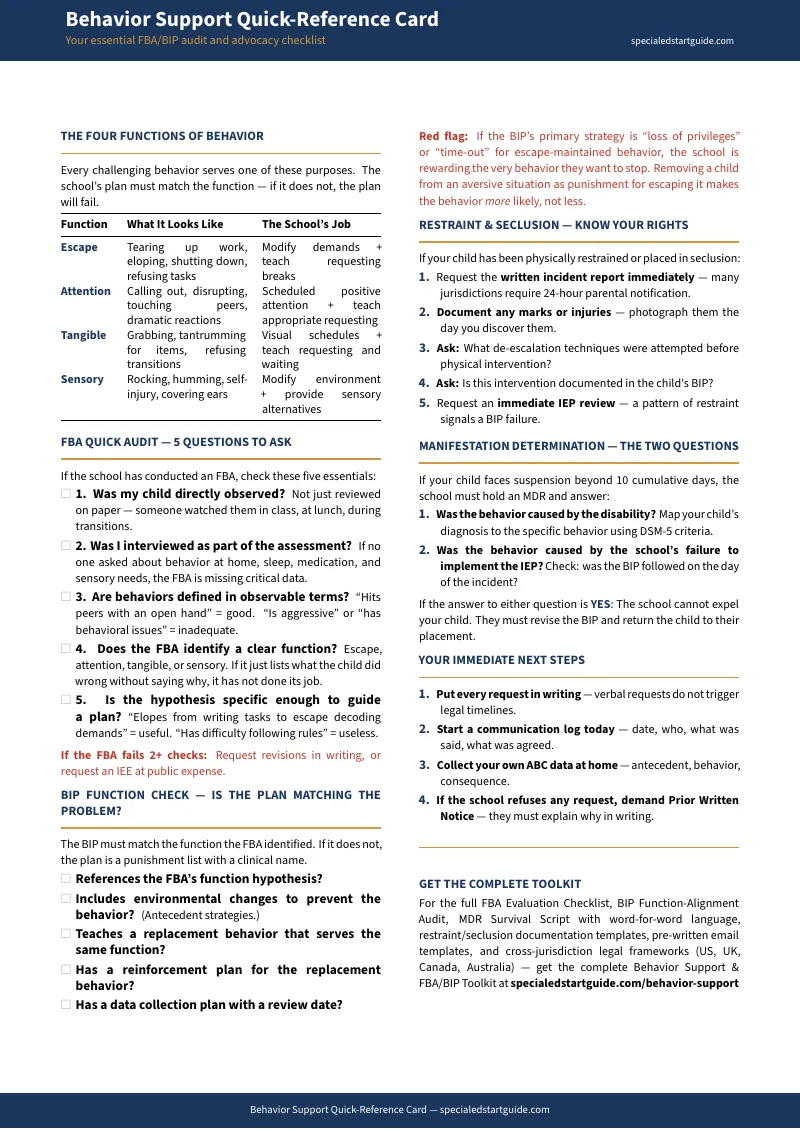
The school conducted a Functional Behavioral Assessment. But did it actually do what the law requires? This checklist lets you grade it. Was your child directly observed in their natural environment — not just reviewed on paper? Were you interviewed as part of the assessment? Are the target behaviors defined in observable, measurable terms — "hits peers with an open hand during unstructured time" — or vague labels like "is aggressive"? Does the FBA identify a clear function (escape, attention, tangible, or sensory)? Is the hypothesis specific enough to guide a real plan? If the FBA fails two or more of these checks, the toolkit walks you through requesting revisions in writing or demanding an Independent Educational Evaluation at public expense.
The BIP Function-Alignment Audit
A Behavior Intervention Plan that does not match the function identified by the FBA is not a support plan — it is a punishment list with a clinical name. If your child's behavior is escape-maintained and the BIP's primary strategy is removing privileges, the school is rewarding the very behavior it claims to be stopping. This audit tool checks whether the BIP references the FBA's function hypothesis, includes antecedent modifications to prevent the behavior before it starts, teaches a functionally equivalent replacement behavior, provides a reinforcement schedule for the replacement, and includes a data collection plan with a review date. If it fails, you have the documentation to demand a rewrite.
The MDR Survival Script
When a child with an IEP accumulates more than ten days of suspension, the school must hold a Manifestation Determination Review — the meeting that decides whether your child is expelled or returned to their placement. This is not a conversation. It is a legal proceeding with two yes-or-no questions: Was the behavior caused by the disability? Was it caused by the school's failure to implement the IEP? The toolkit gives you the exact language to map your child's diagnosis to the specific behavior using DSM-5 criteria, the questions to ask that force the team to produce implementation records, and the sentence starters that reframe the narrative from "your child is dangerous" to "the plan was inadequate."
Restraint and Seclusion Documentation Templates
If your child has been physically held down or locked in a room at school, the clock is already ticking. These templates walk you through requesting the written incident report (many jurisdictions require 24-hour parental notification), documenting physical marks or injuries with photographs, requesting written confirmation of what de-escalation techniques were attempted before physical intervention, and demanding an immediate IEP review when a pattern of restraint signals a BIP failure. Includes jurisdiction-specific notification requirements and state-by-state reporting mandates.
Pre-Written Email Templates and Verbal Scripts
Every major confrontation point has a template: requesting an FBA when the school refuses, challenging an inadequate BIP, demanding incident reports after restraint or seclusion, invoking your rights under Child Find when the school insists your child is "just defiant," and following up after meetings to create the paper trail that wins disputes. Each template includes the specific statutory citations for US (IDEA/Section 504), UK (SEND Code of Practice), Canada (provincial Human Rights Codes), and Australia (Disability Standards for Education).
Cross-Jurisdiction Legal Framework
One toolkit covering four legal systems. In the US: IDEA discipline protections, the ten-day rule, MDR procedures, interim alternative educational settings, and state-by-state restraint and seclusion statutes. In the UK: suspension and exclusion rules under the SEND Code of Practice, managed moves, and SEND Tribunal rights. In Canada: provincial discipline frameworks, Human Rights Code protections, and parental advocacy rights. In Australia: Disability Standards for Education, the NCCD framework, state-specific restrictive practices legislation, and complaint pathways. Includes a terminology translation matrix so you can apply the advocacy strategies regardless of which country you are fighting in.
Trauma-Informed Behavioral Support
For children whose behavior stems from trauma — abuse, neglect, chronic instability, medical trauma — punishment-based behavior plans are not just ineffective, they are actively harmful. This chapter covers how trauma rewires the nervous system, why trauma responses look identical to "defiance" and "attention-seeking," and how to ensure the BIP addresses the trauma rather than re-traumatizing the child.
The School-to-Prison Pipeline Defense
Black and Hispanic students with disabilities are suspended at two to three times the rate of their white peers with disabilities. The toolkit addresses this head-on: how implicit bias drives subjective behavioral referrals, how to demand objective, data-driven FBAs that replace staff perceptions with functional analysis, and how to challenge School Resource Officer involvement in disability-related behavioral incidents.
Who This Toolkit Is For
- Parents whose child is trapped in the suspension cycle — repeated suspensions without an FBA, or with a BIP that is clearly not working — who need to force the school to identify the function and build a real plan
- Parents preparing for a Manifestation Determination Review who need the word-for-word script to prove the behavior is a manifestation of the disability and prevent expulsion
- Parents who discovered their child was physically restrained or placed in seclusion at school — who need to document the incident, demand accountability, and prevent it from happening again
- Parents told their child is "just defiant" or "willfully disobedient" — whose child does not yet have a diagnosis — who need to invoke Child Find and force a comprehensive evaluation
- Parents of Black and Hispanic children disproportionately targeted by exclusionary discipline — who need tools to challenge implicit bias with objective behavioral data
- Parents whose child has a BIP that reads like a punishment list — loss of privileges, time-out, parent calls — with no replacement behavior teaching and no antecedent strategies
- Parents navigating the intersection of behavior and trauma, where the child's fight-or-flight responses are treated as "choices" deserving punishment
- Parents in the US, UK, Canada, or Australia who need advocacy tools that work across jurisdictions
- Parents who cannot afford $150 to $300 per hour for a professional educational advocate and need to self-advocate at IEP meetings and disciplinary hearings
Why Not Free Resources?
Free behavior and discipline resources are well-intentioned and informational. They are also passive, generic, and carefully neutral toward the school districts that publish them. Here is where each one fails at the moment you need it most:
- The Center for Parent Information and Resources (CPIR) explains that an MDR must occur within ten days of a placement change — but does not give you the script for what to say at that meeting. It tells you the law exists. It does not tell you how to use it when six administrators are across the table insisting your child is dangerous.
- The National Disability Rights Network (NDRN) publishes powerful reports on restraint and seclusion abuse — but they are policy white papers aimed at Congress, not step-by-step guides for a parent trying to force a principal to document an incident. These reports prove the system is broken. This toolkit gives you the tools to protect your child within it.
- IPSEA (UK) clearly explains unlawful exclusions — but is UK-only and does not include FBA evaluation tools or BIP function-alignment audits. IPSEA tells you when the school has broken the rules. This toolkit gives you the checklists to prove the school's behavioral plan is fundamentally inadequate.
- Teachers Pay Teachers sells behavior tracking sheets, token economy systems, and reward charts — designed for teachers managing classrooms, not parents advocating for one child. These tools help teachers run behavior systems. They do not help you evaluate whether those systems are actually addressing your child's needs.
- Wrightslaw is the gold standard for US special education law — but it covers all of IDEA in 400 pages and does not provide fill-in-the-blank meeting scripts or FBA grading checklists. Wrightslaw tells you the law. This toolkit gives you the specific templates that translate the law into action at the meeting table.
Free resources explain what an FBA is. This toolkit gives you the checklist to grade whether the school's FBA actually did its job — and the scripts to demand a real one when it didn't.
— Less Than Ten Minutes of an Educational Advocate's Time
Professional special education advocates charge $150 to $300 per hour. A private Functional Behavioral Assessment from a Board Certified Behavior Analyst costs $1,500 to $3,000. A legal retainer for a due process hearing can exceed $10,000. This toolkit provides the FBA evaluation checklists, BIP audit tools, MDR scripts, and documentation templates that professional advocates use — so you can handle most meetings and discipline disputes yourself, and only engage a professional for the cases that genuinely require legal representation.
Your download includes the complete guide plus 8 standalone printable tools:
- Complete Behavior Support & FBA/BIP Toolkit (guide.pdf) — 15 chapters covering why behavior is communication, the four functions of behavior (SEAT), how to request and evaluate an FBA, auditing a BIP for function alignment, evidence-based strategies by function, MDR preparation with word-for-word scripts, restraint and seclusion documentation, legal rights across US/UK/Canada/Australia, parent advocacy and dispute strategies, multi-tiered frameworks (PBIS/MTSS), trauma-informed behavioral support, the school-to-prison pipeline, building your advocacy team, and ongoing monitoring
- FBA Adequacy Audit Checklist (fba-audit-checklist.pdf) — Grade the school's Functional Behavioral Assessment point by point across six categories: behavioral definitions, data collection, parent involvement, setting events, functional hypothesis, and evaluator qualifications. Includes the IEE request letter template when the FBA fails
- BIP Function-Alignment Audit (bip-function-audit.pdf) — Eight-item checklist to determine whether the Behavior Intervention Plan matches the function the FBA identified, plus the replacement behavior function table and four common BIP failure patterns to watch for
- MDR Survival Script (mdr-survival-script.pdf) — Before, during, and after the Manifestation Determination Review: the two-prong test, DSM-5 criteria mapping table, discipline packet request letter, five word-for-word reframes for the meeting, and the 45-day exception rules
- Restraint & Seclusion Documentation Log (restraint-seclusion-log.pdf) — Fillable incident documentation log with all 11 fields, incident report request letter, four-step response protocol, and jurisdiction-specific complaint bodies for the US, UK, Canada, and Australia
- Email & Letter Templates (email-templates.pdf) — Seven pre-written templates: requesting an FBA (US and UK versions), requesting an IEE at public expense, requesting the discipline packet before an MDR, demanding a restraint incident report, demanding Prior Written Notice, and the follow-up email that turns verbal conversations into legal records
- Behavior Tracking Logs (behavior-tracking-logs.pdf) — Three printable tracking tools: Communication Log (date every interaction), Behavior Pattern Tracker (collect your own ABC data at home), and IEP/BIP Implementation Tracker (document whether the school is following the plan — your evidence for MDR Prong 2)
- Strategies by Function Reference Card (strategies-by-function.pdf) — A meeting-ready two-page reference showing the evidence-based antecedent strategies, replacement behaviors, and consequence strategies for each of the four behavioral functions
- Behavior Support Quick-Reference Card (checklist.pdf) — A printable one-page card with the FBA Quick Audit (5 essential questions), BIP Function Check, restraint and seclusion rights, and the two MDR questions that matter — designed to be printed and brought to every meeting
Instant PDF download — 9 files total. Print the standalone tools before your next meeting. Walk in with the audit checklists completed, the tracking logs started, and the advocacy scripts ready.
Money-back guarantee, no time limit. If the toolkit doesn't change how you advocate for your child, email us for a full refund.
Not ready for the full toolkit? Download the free Behavior Support Quick-Reference Card — a one-page printable covering the FBA Quick Audit, BIP Function Check, restraint and seclusion rights, and the two MDR questions that decide everything. It tells you what to look for — and the full toolkit gives you the scripts, templates, and legal frameworks to act on what you find.
Behavior is communication. Your child is not "the problem." The system that punishes instead of understanding is the problem — and now you have the tools to change the conversation.