The School Heard "ADHD." They Decided "Try Harder." This Playbook Gives You the Exact Scripts, Goals, and Legal Leverage to Make Them Actually Accommodate Your Child.
The pediatrician confirmed ADHD. You walked into the school expecting help. Instead, you got: "He just needs to try harder." Or: "She's doing fine — her grades are average." Or the one that makes your blood pressure spike: "We don't do IEPs for ADHD."
So you went home and Googled. You found Understood.org, which told you to "collaborate with the school" — the same school that just told you your child's executive dysfunction is a character flaw. You found ADDitude Magazine, which gave you a list of accommodations buried under pop-up ads and supplement promotions. You found Wrightslaw, which is brilliant if you have a law degree and 40 free hours. You found Etsy checklists that help you organize the binder but never tell you what to do when the school says no.
You are not looking for more information about ADHD. You are looking for someone to hand you the exact words to write in the email, the exact goals to demand in the IEP, and the exact legal phrases that make the school district stop treating your child's neurological condition as a discipline problem.
The ADHD Advocacy & Accommodation Playbook is the Pushback-Ready Advocacy System — the complete tactical framework that professional educational advocates use (and charge $150–$300 per hour for), compressed into a single document you can use before your next meeting. Every script, every goal, every template is mapped to your child's specific ADHD subtype and your specific jurisdiction — not a generic "accommodations for ADHD" list that assumes every child is hyperactive and every parent is American.
What's Inside the Playbook
ADHD Subtype-Specific Accommodation Menus
Most accommodation lists treat ADHD as one thing. They hand you a fidget spinner and preferential seating and call it done. But your Inattentive child who freezes at multi-step tasks needs entirely different interventions than the Hyperactive-Impulsive child getting suspended for emotional outbursts. The playbook provides a complete accommodation matrix organized by executive function deficit — task initiation, working memory, time perception, impulse control, emotional regulation — with specific interventions matched to each presentation. When you walk into the meeting, you are not asking for vague "ADHD support." You are requesting accommodation #7 for working memory and accommodation #14 for time management, with implementation details the teacher can actually follow.
IEP Goal Banks by Domain and Age
The school handed you an IEP with goals like "student will improve focus" and "student will demonstrate appropriate behavior." Those are not goals. Those are wishes. This playbook provides dozens of SMART-formatted IEP goals across executive function, self-regulation, social communication, self-advocacy, and academic access — differentiated for elementary, middle, and high school. Each goal is specific enough that you can measure progress and hold the school accountable. "Given a multi-step assignment, the student will independently break it into three components and begin the first step within two minutes, four out of five opportunities, as measured by teacher observation."
The "Pushback" Script Library
This is the core of the playbook, and it is the one thing free resources will never give you. Five complete email templates and verbal scripts for the exact scenarios you are facing right now: requesting an initial evaluation (and triggering the legal timeline the school hopes you don't know about), responding to a denied IEP when the school claims grades are sufficient, escalating when a teacher refuses to follow an existing 504 Plan, challenging a suspension that is a direct manifestation of your child's ADHD, and demanding an Independent Educational Evaluation at public expense when the school's assessment misses executive function deficits entirely.
The 504 vs. IEP Decision Tree
A 504 Plan gives your child accommodations. An IEP gives your child specialized instruction, measurable goals, progress monitoring, and legal due process rights. Schools push 504s because they are cheaper and require less accountability. Sometimes a 504 genuinely is enough. Often it is not. The decision tree maps the exact criteria — based on your child's functional impairment, not just academic grades — that determine when to accept a 504, when to demand an IEP, and how to force the conversion when the school is stonewalling.
Cross-Jurisdiction Legal Framework
If you are in the US, your rights come from IDEA, Section 504, and FAPE. In the UK, it is the EHCP, the SEND Code of Practice, and the First-tier Tribunal. In Canada, it varies by province — Ontario uses IPRCs, British Columbia uses designations, and some provinces leave it entirely to individual school boards. In Australia, it is ILPs, the Nationally Consistent Collection of Data, and the Disability Standards for Education. The playbook bridges all four systems with a translation glossary, jurisdiction-specific evaluation timelines, and escalation pathways that work in your country. One playbook. Four legal systems. No wasted pages on laws that do not apply to you.
Girls and ADHD — Advocacy for the Invisible Presentation
Girls with Inattentive ADHD are diagnosed on average five years later than boys. Their teachers describe them as "dreamy" rather than disabled. They internalize their failures — not as school problems, but as personal deficiencies. Their anxiety and perfectionism mask the underlying executive dysfunction until the workload in middle school becomes unmanageable and everything collapses at once. The playbook dedicates an entire chapter to advocating for girls whose ADHD has been systematically overlooked, including the specific evaluation instruments that reveal inattentive deficits schools routinely miss.
Discipline Defense Tools
Your child was suspended for an outburst that was a direct symptom of ADHD. The school treated it as defiance. Before the next disciplinary action, you need to know about Manifestation Determination Reviews, Functional Behavior Assessments, and Positive Behavior Intervention Plans — and you need the exact script for requesting them. The discipline chapter covers suspension rights, exclusion challenges, and the legal threshold that separates a behavioral consequence from disability discrimination.
Comorbidity Advocacy
ADHD rarely travels alone. Anxiety, dyslexia, autism, oppositional defiant disorder — each comorbidity changes the accommodation picture and complicates the IEP process. The playbook provides targeted advocacy strategies for the most common co-occurring conditions, including how to ensure both diagnoses are addressed in a single plan rather than the school picking the "easier" one and ignoring the rest.
Who This Playbook Is For
- Parents who have a child with a confirmed ADHD diagnosis and a school that is not providing adequate support — or is actively denying it
- Parents preparing for an IEP or 504 Plan meeting who want to walk in with specific, measurable goals and the legal knowledge to push back when the school offers vague promises
- Parents whose child has been suspended, put on behavioral contracts, or removed from activities for behavior directly linked to ADHD
- Parents caught in the 504 vs. IEP gap — told the 504 is "enough" when their child is clearly drowning
- Parents of girls with Inattentive ADHD who have been told their daughter is "just anxious" or "needs to pay more attention"
- Parents in the UK navigating the EHCP waiting crisis, the two-year assessment queue, and schools that reject private diagnoses
- Parents in Canada dealing with school boards that claim "ADHD doesn't get an IEP" and offer no formal alternative
- Parents in Australia frustrated by copy-paste ILPs that look good on paper but are never implemented in the classroom
- Parents who have already hired a professional advocate and want to understand the process themselves — or parents who cannot afford $200/hour rates and need to self-advocate effectively
Why Not Free Resources?
Free ADHD resources are abundant. They are also fragmented, passive, and jurisdiction-blind. Here is exactly where each one fails at the moment you need it most:
- Understood.org explains what accommodations exist — not how to get them when the school says no. Their tone assumes the school is acting in good faith. Their guides explain the IEP process step by step. But they do not give you the email template for when the school denies the evaluation, and they do not provide counter-arguments for the five most common refusal scripts schools use. This playbook does.
- ADDitude Magazine covers ADHD broadly — but its advocacy advice is scattered across hundreds of articles and its editorial credibility is compromised. You would need to read forty different articles to assemble one coherent strategy, and you would find supplement advertisements sitting alongside psychiatric research. The playbook is a single, cohesive document with no ads and no pseudoscience.
- Wrightslaw is the gold standard for US special education law — but it reads like a law school textbook. It covers all disabilities broadly, requires hours of reading to extract one actionable script, and says nothing about UK, Canadian, or Australian systems. The playbook distills the legal leverage into fill-in-the-blank templates a stressed parent can use tonight.
- CHADD, CPIR, and IPSEA explain your rights — but not the words to enforce them. Government and nonprofit organizations tell you that you have the right to request an evaluation. They do not provide the exact email. They tell you that you can appeal a denied IEP. They do not provide the letter. The playbook provides every template you need.
- Etsy and Teachers Pay Teachers sell binder covers and meeting prep kits — designed for teachers, not for parents fighting denials. A $5 "504 Plan Kit" helps you organize your folder. It does not tell you what to say when the school psychologist claims your child's average grades disqualify them from an IEP. The playbook does.
— Less Than Fifteen Minutes of an Educational Advocate's Time
Professional special education advocates charge $150 to $300 per hour in the US, £75 to £145 in the UK, and $150 to $250 AUD in Australia. Most families spend thousands before the first dispute hearing. This playbook gives you the same frameworks, scripts, and goal banks those advocates use — for less than the cost of a single phone consultation. It does not replace an attorney for due process hearings. It equips you to handle 90% of school meetings, emails, and pushback scenarios independently, so you only need professional help for the 10% that requires legal representation.
Your download includes 9 PDFs:
- Complete ADHD Advocacy & Accommodation Playbook (guide.pdf) — 18 chapters covering the medical-educational divide, subtype-specific accommodation menus, SMART IEP goal banks by domain and age, the "Pushback" Script Library with five dispute templates, the 504 vs. IEP decision tree, cross-jurisdiction legal frameworks for US/UK/Canada/Australia, girls and ADHD advocacy, comorbidity strategies, medication and school policies, discipline defense and Manifestation Determination Reviews, dispute resolution pathways, transition planning, and a full resources directory
- ADHD Accommodation Menu (accommodation-menu.pdf) — Standalone printable of every accommodation organized by executive function deficit, matched to your child's ADHD subtype, with counter-arguments for accommodations schools commonly resist
- IEP Goal Bank (iep-goal-bank.pdf) — Every SMART-formatted goal from the playbook on a standalone reference card, organized by domain and age group, so you can select goals before your next IEP meeting
- Pushback Script Library (pushback-scripts.pdf) — All five fill-in-the-blank email templates as a standalone document you can print, customize, and send tonight
- IEP/EHCP Meeting Preparation Guide (meeting-prep.pdf) — Before, during, and after checklists with the critical questions to ask, the post-meeting summary email template, and the Prior Written Notice demand script
- Discipline Defense Toolkit (discipline-defense.pdf) — Manifestation Determination Review preparation, the infraction-to-ADHD argument table, suspension challenge scripts, and jurisdiction-specific exclusion defense for US, UK, Canada, and Australia
- Cross-Jurisdiction Translation Glossary (translation-glossary.pdf) — A landscape reference card mapping equivalent terms, processes, and legal standards across all four jurisdictions, plus portability rules when relocating
- Documentation & Evidence Tracker (documentation-tracker.pdf) — Evidence binder organization checklists, a fillable communication log, and an accommodation implementation tracker you can print and use immediately
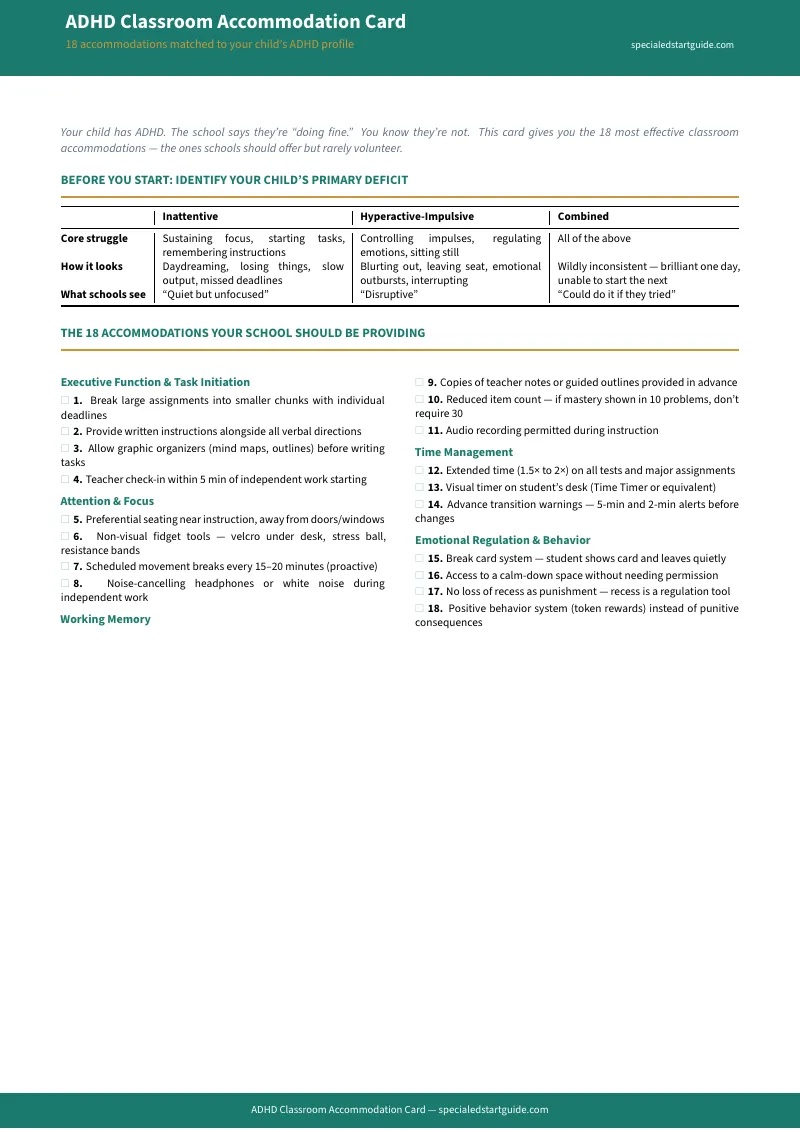
- ADHD Classroom Accommodation Card (checklist.pdf) — A one-page printable card with 18 classroom accommodations organized by executive function, attention, working memory, time management, and emotional regulation — matched to Inattentive, Hyperactive-Impulsive, and Combined presentations, with three "Power Phrases" for when the school pushes back
You can also download the ADHD Classroom Accommodation Card for free — a standalone checklist of the 18 accommodations your school should be providing, organized by your child's ADHD subtype, with three scripts for when the school says no.