You Have More Legal Power Than the School Told You. The Problem Is You Don't Know How to Use It.
You sat in the IEP meeting. Six school staff on one side. You on the other. The special education coordinator rattled off acronyms — FAPE, LRE, FBA, BIP, PWN — and you nodded like you understood. When you asked why your child's reading goals have not changed in two years, someone said "we'll take that into consideration." When you asked for an independent evaluation, someone said "that's not really how it works." You left with no answers, no changes, and a sinking feeling that the meeting was theatre.
Then you went home and started Googling. You found a 485-page Wrightslaw textbook written for attorneys. You found Understood.org articles scattered across 200 separate web pages with no unified strategy. You found Reddit threads from parents in California giving advice that does not apply in Texas. You found your state's Procedural Safeguards Notice — a 30-page legal document that tells you what the school should do without ever telling you what to do when they don't.
The school has legal counsel, compliance officers, and decades of institutional experience. You have Google and a growing sense that nobody designed this system with parents in mind. You are correct. Nobody did.
The United States Special Ed Parent Rights Compass is the Federal Rights Enforcement System — a tactical, plain-English guide to IDEA, Section 504, and the ADA that translates federal statute into the scripts, strategies, and leverage points that turn a confused parent into an advocate schools take seriously. It covers the three landmark Supreme Court decisions that most parents have never heard of, the procedural tools schools hope you never learn to use, and the documentation system that makes every verbal "no" a legal liability.
What's Inside the Compass
The Prior Written Notice Enforcement Strategy
Free resources define Prior Written Notice as "a document the school sends you." That definition is useless. PWN is your most powerful documentation weapon under 34 CFR §300.503 — and most parents never learn to wield it. When the school verbally denies speech therapy, an aide, or a placement change, that denial vanishes the moment the meeting ends. But when you demand a formal Prior Written Notice, the school must put the refusal in writing, explain the data they relied on, describe the alternatives they considered, and provide a cogent, responsive justification. Schools routinely reverse verbal denials rather than create a written record that exposes them in a future dispute. The Compass gives you the exact language to force a PWN and the follow-up template that ensures the school cannot claim you never asked.
The IEE Power Play
If you disagree with the school's evaluation, 34 CFR §300.502 gives you the right to request an Independent Educational Evaluation at the district's expense. Here is what free resources never explain: the school must either pay for the private evaluation or immediately file for a due process hearing to defend their own. Due process hearings cost districts tens of thousands of dollars. Requesting an IEE is not a polite suggestion — it is a forced binary choice where the math overwhelmingly favours you. The Compass walks you through when to use this leverage, how to phrase the request, and what to do if the district tries to delay or attach conditions that are not in the regulation.
The Endrew F. Standard That Killed "Barely More Than Nothing"
For 35 years after Board of Education v. Rowley (1982), schools could legally offer IEPs that provided a "basic floor of opportunity" — interpreted by most districts as permission to do the bare minimum. In 2017, the Supreme Court unanimously destroyed that standard in Endrew F. v. Douglas County. IEPs must now be "appropriately ambitious" and "reasonably calculated to enable a child to make progress appropriate in light of the child's circumstances." Research shows a majority of parents are completely unaware of this decision. The Compass explains exactly how to use Endrew F. to reject recycled goals, demand data-driven progress monitoring, and hold the IEP team to the legal standard the Supreme Court set — not the lower standard your school may still be operating under.
The Perez Damages Breakthrough (2023)
Most parent guides on the market were written before this decision existed. In Perez v. Sturgis Public Schools (2023), the Supreme Court unanimously ruled that parents can seek compensatory monetary damages under the ADA without first exhausting IDEA's lengthy administrative due process. For the first time, active discrimination by a school district — not just inadequate services — carries the threat of financial liability without years of administrative hearings. This fundamentally changes the negotiation calculus. The Compass explains when Perez applies, when it does not, and how the existence of this precedent strengthens your position even if you never file suit.
The Schaffer Burden of Proof Reality Check
Here is the truth that free resources do not emphasise: under Schaffer v. Weast (2005), the parent bears the burden of proof in a due process hearing. The school does not have to prove they provided FAPE — you have to prove they didn't. This single fact is why every documentation strategy in this guide exists. Without a systematic paper trail — follow-up emails after every conversation, PWN requests after every denial, service delivery logs tracking every missed session — you lose. The Compass builds your evidence-gathering system from day one so that if you ever need to file a complaint, your case is already built.
The Complete IDEA Architecture in Plain English
The six foundational principles of IDEA — FAPE, Appropriate Evaluation, the IEP, Least Restrictive Environment, Parent Participation, and Procedural Safeguards — explained with specific Code of Federal Regulations citations you can reference in meetings. Not the watered-down version from a state education department website. The actual legal framework, translated from statute into strategy.
The Discipline Protection Playbook
If your child faces suspension or expulsion, the 10-day rule, Manifestation Determination Reviews under 34 CFR §300.530, the 45-day special circumstances exception, Functional Behavioral Assessments, Behavior Intervention Plans, and the "not yet identified" protections that cover children suspected of having a disability even before formal evaluation. Schools with zero-tolerance policies regularly violate these requirements. The Compass tells you exactly what to demand and when.
Section 504 and the ADA — The Parallel Protections
IDEA is not the only federal law protecting your child. Section 504 of the Rehabilitation Act provides accommodations for students who have a disability but do not need specialised instruction. The ADA adds anti-discrimination protections that apply regardless of IDEA eligibility. The Compass covers the eligibility differences, when a 504 Plan is more protective than an IEP, when it is less, and how the three laws interact when a school claims "we already have a 504 Plan, so we don't need to evaluate for an IEP."
Who This Compass Is For
- Parents who just left an IEP meeting feeling outnumbered and overruled — who were told "we'll take that into consideration" and want to know what the law actually requires the school to do when you make a request
- Parents whose child has been on the same IEP goals for two or more years with no measurable progress — who do not know that the Supreme Court's Endrew F. standard makes recycled goals a potential denial of FAPE
- Parents told their child "doesn't qualify" for special education because they earn passing grades — who need to understand that IDEA's definition of "educational performance" includes functional, behavioural, and social-emotional needs, not just academics
- Parents whose child was suspended, restrained, or placed on a shortened school day for behaviour related to their disability — who need the discipline protections under IDEA and the Manifestation Determination Review process
- Parents who disagree with the school's evaluation but do not know they have the legal right to request an Independent Educational Evaluation at the district's expense — or how to use that request as leverage
- Parents who have been told "we don't have the budget" or "we don't have staff" for a requested service — who need to know that resource constraints are not a legal defence to a denial of FAPE
- Parents preparing for mediation or a due process hearing who need to understand the burden of proof, the evidence standard, and why documentation built from day one determines whether they win or lose
- Families relocating between states who need to understand the federal baseline that follows their child regardless of which state they move to
- Parents who searched for "special education rights" and spent hours reading conflicting advice from different states, different organisations, and different years — who need one current, unified, strategically organised reference
Why Not Just Use the Free Resources?
The United States has more free special education information than any other country. Government websites, Parent Training and Information Centers, Understood.org, PACER, Wrightslaw. Here is why parents remain confused and outmatched after consulting all of them:
- Government resources explain what should happen. They never explain what to do when it doesn't. The Center for Parent Information and Resources is federally funded and diplomatically restrained. They will accurately describe what a Prior Written Notice is. They will never teach you how to use it as leverage to reverse a denial — because their institutional mandate requires them to promote "collaboration" and "teamwork," not adversarial strategy.
- Understood.org is scattered across hundreds of pages with no unified strategy. The content is excellent. The format is fragmented. To assemble a coherent understanding of IDEA, Section 504, evaluation rights, dispute resolution, and discipline protections, you would need to open dozens of separate articles, read them in the right order, and synthesise the strategy yourself. A parent preparing for an IEP meeting tomorrow morning does not have time for a research project.
- Wrightslaw is a 485-page law textbook. It is the authoritative reference for attorneys and special education directors. It is not a tactical field manual for a parent who needs to know exactly what to say, what to email, and what to demand before Friday's meeting. Parents consistently describe Wrightslaw as "brilliant but overwhelming."
- Etsy and Teachers Pay Teachers sell organisation, not law. A $12 IEP binder keeps your paperwork tidy. It does not teach you that requesting an IEE at public expense forces the district into a legal binary where the economics favour you. It does not explain the Endrew F. standard. It does not include advocacy templates with statutory citations.
- A special education advocate charges $150 to $250 per hour. An attorney charges $300 to $700 per hour. A due process hearing runs $40,000 to $50,000. For the vast majority of disputes, the issue resolves at the school level when the parent demonstrates knowledge of the correct legal framework. This Compass gives you that knowledge for less than the first fifteen minutes of a professional consultation — and if you do need a professional, it saves significant billable hours by handing them an organised case with correct statutory citations.
The free resources explain what the law says. This Compass translates your rights into the specific strategies, scripts, and leverage points that make the law work in practice.
— Less Than Fifteen Minutes of an Advocate
A special education advocate charges $150 to $250 per hour. A specialised attorney charges $300 to $700 per hour. Making a single procedural mistake — signing an IEP without understanding the stay-put provision, failing to request an IEE within the proper window, not demanding a PWN after a verbal denial — can cost your child an entire academic year of appropriate services. This Compass costs less than a brief phone call with a professional — and covers what no single consultation can: the complete federal rights framework organised for rapid reference.
Your download includes the complete 14-chapter Compass plus standalone printable tools — ready to print and use tonight.
- Complete Rights Compass Guide — 14 chapters covering the adversarial system, the six IDEA principles, FAPE and the Endrew F. standard, evaluation rights and the IEE power play, the IEP as a binding contract, Least Restrictive Environment, the Prior Written Notice enforcement strategy, discipline protections and manifestation determination, Section 504 and the ADA, the dispute resolution continuum, eight landmark Supreme Court decisions including Perez (2023), the paper trail system, and the advocacy action plan
- Federal Regulations Quick Reference — one-page card with all 18 CFR citations you need at IEP meetings, from FAPE (§300.17) to transition (§300.320(b)) — print it and bring it to the table
- Advocacy Letter Templates — three fill-in-the-blank letters citing federal law: requesting an initial evaluation, demanding Prior Written Notice after a denial, and requesting an IEE at public expense
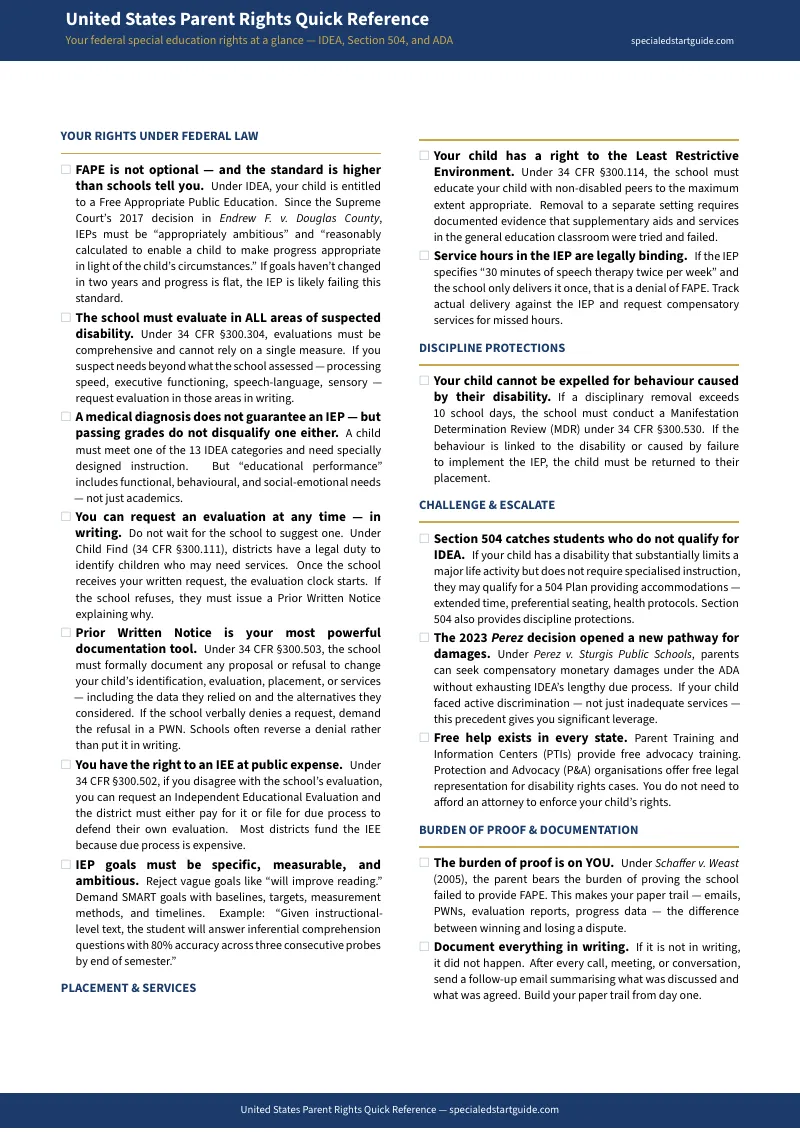
- United States Parent Rights Quick Reference — the printable checklist covering your 15 core federal rights at a glance, the key federal regulations table, a sample advocacy email template, and a link to your state's free Parent Training and Information Center
Instant PDF download. Print the advocacy checklist tonight. Send your first Prior Written Notice request tomorrow morning.
Money-back guarantee, no time limit. If the Compass does not change how you advocate for your child's education, email us for a full refund. No questions asked.
Not ready for the full Compass? Download the free United States Parent Rights Quick Reference — a printable checklist covering your 15 core federal rights under IDEA, Section 504, and the ADA, the key regulations table with CFR citations, a sample advocacy email, and links to your state's free Parent Training and Information Center. It is enough to walk into your next IEP meeting knowing more about your federal rights than most school staff expect — and it is free.
Your child has a federally mandated right to a Free Appropriate Public Education. The Supreme Court has ruled it must be "appropriately ambitious." IDEA says the school must evaluate in all areas of suspected disability. Federal regulation says the school must put every denial in writing. This Compass makes sure you know how to enforce every one of those rights.