
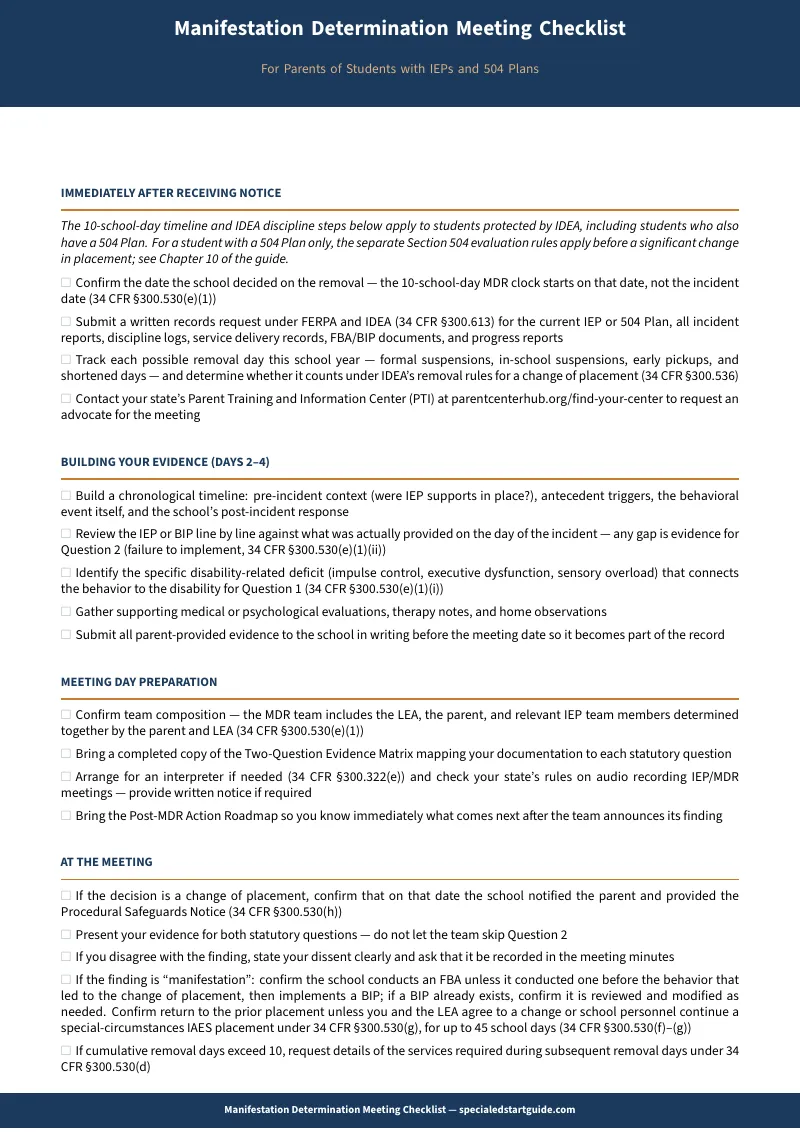
Your child's MDR meeting is days away. Here's how to walk in prepared.
The school just told you a manifestation determination review is happening. For an IDEA change of placement, the school must hold the review within 10 school days of its decision. You're searching for answers at midnight, reading legal text that wasn't written for parents, and trying to figure out what records to bring, what the team will decide, and what happens after.
The free flyers tell you what IDEA's two questions are. They don't show you how to organize your child's records so the evidence actually addresses those questions. They don't walk you through tracking possible informal removals under IDEA's 10-day and pattern rules. And they stop at the meeting — they don't cover what happens next when the finding goes either way.
The MDR Evidence System: structured preparation for IDEA's 10-school-day review window
The Manifestation Determination Review Guide is a 49-page preparation system built around the two statutory questions IDEA requires the MDR team to answer. Instead of reading hundreds of pages of legal text and assembling your own plan, you get a step-by-step workflow designed to work within the compressed timeline parents actually face.
This isn't a legal reference book. It's a meeting preparation kit — the kind of structured, fillable system that a lay advocate would bring, organized so you can prepare on your own even if you can't get professional help before the meeting date.
What's inside
- Removal counting guide with an informal pickup tracker — Formal suspensions are obvious, but early pickups, in-school suspensions, bus suspensions, and administratively shortened days may also count under IDEA's removal rules. The guide explains IDEA's 10-day and pattern tests, then gives you a structured log to track possible removals.
- Two-question evidence organizer — Under IDEA, the MDR team must answer two questions: (1) was the conduct caused by, or did it have a direct and substantial relationship to, the child's disability; and (2) was it the direct result of the school's failure to implement the IEP. The guide maps the types of evidence that apply to each question — medical evaluations, BIP tracking logs, classroom incident records — so you present documentation that addresses what the team is actually deciding.
- IEP/BIP implementation audit checklist — Under IDEA, Question 2 asks whether the conduct was the direct result of the school's failure to implement the IEP. This checklist helps you compare the IEP and any incorporated behavior plan against what actually happened — scheduled services, accommodations, counseling minutes, de-escalation protocols.
- Incident narrative framework — A structure for presenting your child's account of the incident factually, without escalating the meeting into a confrontation. The framework accounts for the child's perspective while respecting that the school has safety responsibilities too.
- Section 504 evaluation procedures — If your child has a 504 Plan instead of an IEP, the procedural rules differ. The guide covers Section 504's evaluation requirements before a significant change in placement, including where the protections are narrower than IDEA's and what options you still have.
- Special circumstances chapter — Under IDEA, school personnel may use an interim alternative setting for up to 45 school days, regardless of the manifestation finding, if a student carries a dangerous weapon to or possesses one at school, on school premises, or to or at a school function under state or local educational agency jurisdiction; knowingly possesses or uses illegal drugs, or sells or solicits the sale of a controlled substance at one of those locations; or inflicts serious bodily injury on another person at one of those locations. The guide explains what services continue and what your appeal rights are.
- Basis of knowledge protections — Your child doesn't need a formal IEP to qualify for MDR protections. If the school had reason to suspect a disability before the incident — a parent's written concern, an evaluation request, or a teacher's documented behavioral concerns — IDEA's discipline safeguards may apply. The guide walks through the three qualifying conditions and what to do if the school claims it had no basis of knowledge.
- Post-MDR action roadmap — After the meeting, the path splits. Under IDEA, a positive manifestation finding generally requires return to placement and FBA/BIP steps, subject to the special-circumstances and parent-LEA-agreement exceptions. A negative finding may allow discipline, while IDEA services continue as required and parents may request expedited due process. Section 504 follows its separate evaluation and procedural-safeguard rules.
- Free resource directory — Contact information and intake guidance for Parent Training and Information Centers, Protection and Advocacy agencies, legal aid clinics, and state bar referral services. The guide encourages you to reach out to these free resources immediately — the guide works alongside professional help, not instead of it.
Who this guide is for
You're a parent — or grandparent, foster parent, or guardian — of a child with an IEP or 504 Plan who has been suspended, recommended for expulsion, or moved to an alternative placement. The school has scheduled an MDR meeting, or you believe one should be scheduled. You need to understand the rules and prepare your documentation before the meeting date.
Or your child hasn't been formally identified, but you believe the school had reason to suspect a disability before the incident. You need to know whether the basis-of-knowledge protections apply and how to assert them.
This guide is written for parents handling the process themselves. If you're able to hire an attorney or advocate, the guide still works — it organizes your records in the same framework a professional would use, and several chapters note where professional representation makes the biggest difference.
What free resources miss
State Parent Training and Information Centers, Protection and Advocacy agencies, and organizations like Wrightslaw and Understood publish excellent overviews of MDR rights. Those resources explain the law. What they typically don't provide is a preparation workflow — a structured sequence that takes you from "the meeting is next Thursday" to "here is my organized evidence binder."
Free agency flyers describe IDEA's two statutory questions in a paragraph. They don't show you how to map your child's evaluation reports, medical records, BIP tracking data, and incident documentation to each question. They don't include a removal tracking log that accounts for informal exclusions. And most stop at the meeting itself — they don't cover the branching paths afterward, from return-to-placement procedures to expedited due process filing requirements.
The legal text at 34 CFR 300.530 through 300.536 is free and public. What it isn't is a meeting preparation system. This guide bridges that gap.
Not legal advice — and when to get it
This guide is an educational self-advocacy tool. It does not provide legal advice or representation, and it cannot guarantee any particular outcome. MDR results depend entirely on the evidence the team reviews and the two statutory questions.
If your child's situation involves criminal charges, a school resource officer, or a 45-school-day IAES removal under IDEA for one of the qualifying incidents described above, you should contact a special education attorney or your state's Protection and Advocacy agency immediately. The guide includes referrals and explains when professional help is the right step.
Full refund, no time limit. If the guide doesn't help you prepare, email hello@specialedstartguide.com for a refund — no questions, no deadline.
What you get
Your download includes six PDFs:
- The full MDR Guide — 49 pages covering both IDEA and Section 504 frameworks, all 12 chapters, and the post-meeting action roadmap
- Removal & Informal Pickup Tracking Log — a fillable 2-page worksheet to document every formal suspension and possible behavior-related informal removal toward IDEA's 10-day threshold
- Two-Question Evidence Matrix — a structured prep sheet mapping your records directly to IDEA's two statutory questions, plus an incident summary and document submission log
- IEP/BIP Implementation Audit — a fillable 3-page checklist comparing scheduled services, accommodations, BIP interventions, and staffing against what actually happened on the incident day
- Post-MDR Action Roadmap — a 3-page decision flowchart showing what happens after a positive or negative finding, the special-circumstances override, and your immediate post-meeting actions
- MDR Meeting Preparation Checklist — a standalone 2-page quick-reference sheet with the IDEA timeline, the two questions, the records to bring, and the questions to ask the team
Or start with the free checklist — the same two-page MDR meeting preparation overview, yours instantly with no purchase required.
Frequently Asked Questions
What if the rules change after I buy?
We update the guide when the rules change. Email us any time, even years later, and we'll send you the current edition free.