The IEP Transition Section Says "Will Explore Career Interests." Meanwhile, the Medicaid Waiver Waitlist Is 15 Years Long and the SSI Redetermination Clock Starts at 18. This Is the Roadmap That Actually Gets Your Child From School to Adulthood.
Your child's IEP has a transition section. You read it after the last meeting. It says something about "exploring post-secondary options" and "developing independent living skills." It does not mention that 181,697 people are waiting for a Developmental Disabilities waiver in Texas alone. It does not tell you that turning 18 triggers a mandatory SSI redetermination under a drastically stricter adult standard — and that missing the 10-day appeal window means your child loses both cash benefits and Medicaid during the months-long review. It does not explain that every year you delay opening an ABLE account is a year your child's savings sit exposed above the $2,000 SSI resource limit.
So you started Googling. You found SSA.gov — which explains SSI rules but never mentions ABLE accounts. You found your state's Vocational Rehabilitation website — thorough on Pre-ETS but silent on how VR services interact with the IEP timeline. You found Think College — excellent for students with intellectual disabilities pursuing college, but it does not address SSI, housing, or guardianship alternatives. You found Wrightslaw — legendary for IEP disputes, but focused on fighting the school rather than navigating the six adult systems that replace it. You found PACER — dozens of high-quality PDF handouts scattered across separate web pages with no chronological structure. You found NTACT:C — deeply rigorous and written entirely for professionals, not parents.
You are not missing information. You are drowning in it — scattered across dozens of federal and state websites, each covering one agency, one program, and one slice of the puzzle. What you need is someone to connect the IEP transition plan, Vocational Rehabilitation, SSI and SSDI, ABLE accounts and Special Needs Trusts, Medicaid waivers, college disability services, and legal decision-making into a single chronological action plan. You need to know exactly what to do at age 14, 16, 17, 18, and 21 — and what it costs you if you start late.
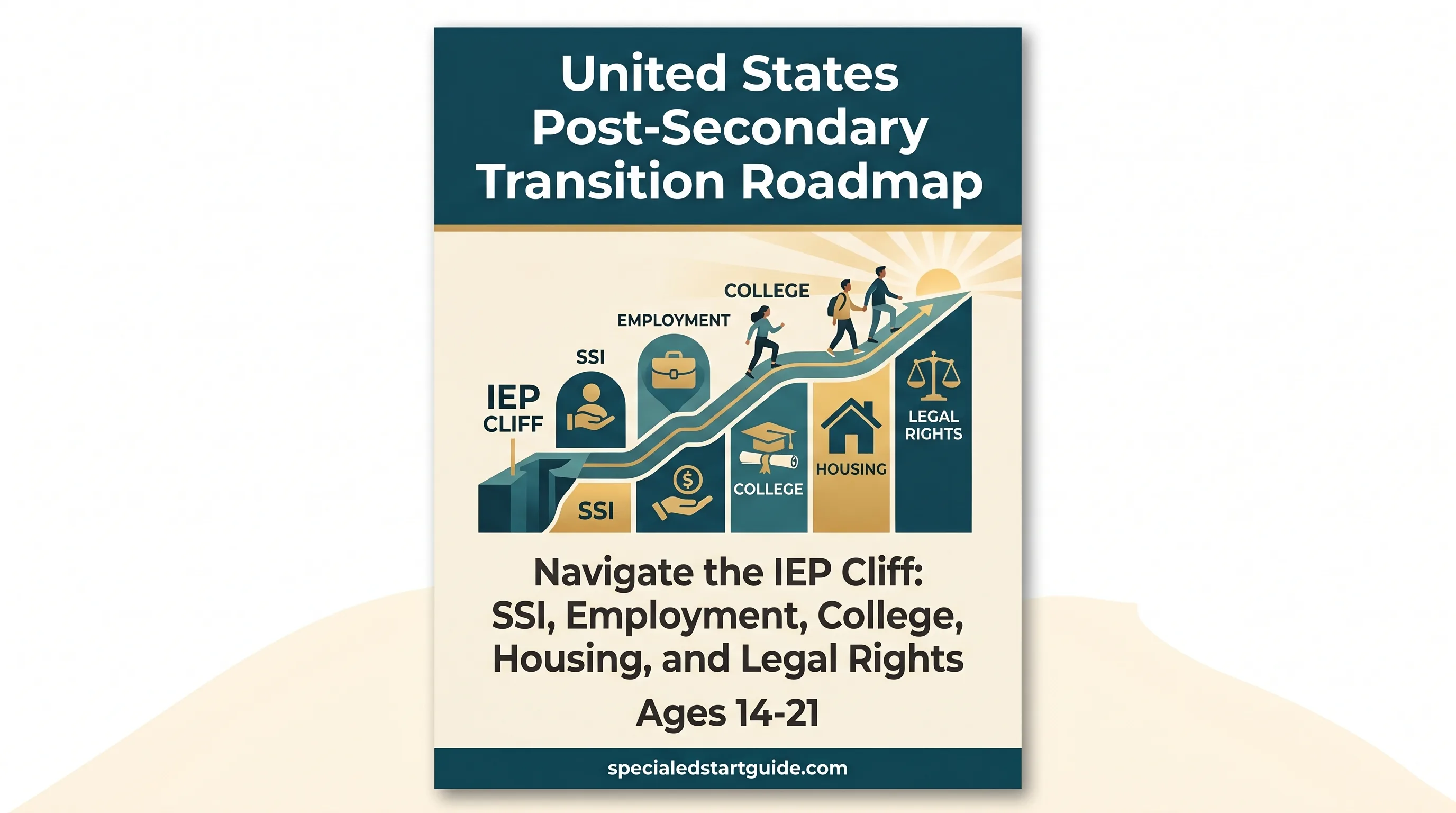
The United States Post-Secondary Transition Roadmap is the IEP Cliff Survival System — the 10-chapter operational manual that replaces the school's vague transition goals with year-by-year instructions, the complete federal benefits bridge from childhood SSI to adult SSI and SSDI, the ABLE-versus-SNT decision matrix, the Medicaid waiver waitlist strategy, every legal alternative to guardianship, and ready-to-use action checklists for every milestone between now and your child's 21st birthday.
What's Inside the Roadmap
The Entitlement-to-Eligibility Collapse — Quantified, Not Theorised
Every parent hears that things "change at 18." This chapter shows you exactly how much they change. Only 13.4% of working-age adults with disabilities hold a four-year degree. Full-time workers with disabilities earn approximately 83 cents for every dollar their non-disabled peers earn — a gap that totals roughly $470,000 over a career. These are not scare tactics. These are the downstream consequences of families who approached the cliff without a plan — families who trusted the school to handle transition, only to discover the school's legal obligation ends at the schoolhouse door.
IDEA Transition Requirements — What the Law Actually Demands
Federal law mandates measurable post-secondary goals and transition services starting no later than age 16 — but California, Texas, New York, Wisconsin, and Iowa start at 14. The chapter walks you through the three required goal domains (education, employment, independent living), the formal transition assessments worth demanding instead of the interest surveys schools default to, the Summary of Performance document that colleges and VR agencies need but schools often botch, and the transfer of rights at the age of majority that strips your decision-making authority unless legal protections are in place.
Post-Secondary Education for Every Ability Level
The moment your child enters college, IDEA no longer applies and the IEP no longer exists. The legal framework shifts to the ADA and Section 504 — which guarantee access, not individualised programming. The student must self-identify, provide documentation, and manage their own accommodations. The chapter covers the IEP-to-college handoff, SAT and ACT accommodation requests, the 350+ Comprehensive Transition Programs that allow students with intellectual disabilities to attend college courses and access Pell Grants even without a standard diploma, and the disability scholarships worth thousands that most families never apply for — including the $10,000 Anne Ford Scholarship and the $10,000 Johnson & Johnson Lime Scholarship.
Vocational Rehabilitation and the Employment Pipeline
Pre-Employment Transition Services are available starting at age 14 and do not require a formal VR application — yet most families miss them entirely because no one tells them they exist. The chapter covers Pre-ETS, the full VR application process, Project SEARCH internship programs, the competitive integrated employment mandate under WIOA, the state-by-state phase-out of subminimum wage workshops, the Ticket to Work program for adults on benefits, and employer hiring incentives including the Work Opportunity Tax Credit. One critical move: getting the VR counsellor to attend IEP meetings so the Individualized Plan for Employment aligns with the school transition plan before graduation.
The SSI Age-18 Redetermination — The 10-Day Window That Decides Everything
At 18, parental income deeming ends — meaning families who were previously ineligible may suddenly qualify for SSI. But for children already receiving SSI, the mandatory redetermination applies a drastically stricter adult standard. Roughly 14% of childhood recipients lose benefits. If denied, you have 10 days — not 10 business days — to request continuation of benefits during the appeal. Miss that window and your child loses both income and Medicaid for the months the appeal takes. The chapter walks through the documentation strategy, the formal rental agreement that prevents In-Kind Support and Maintenance from reducing benefits by one-third, Section 301 protections for students still in school, Disabled Adult Child benefits drawn from parental earnings records, and every work incentive that prevents the benefits cliff from being as steep as everyone fears.
ABLE Accounts versus Special Needs Trusts — The Decision Matrix
Every means-tested benefit your child depends on enforces a $2,000 countable resource limit. One birthday cheque from a grandparent can blow it. ABLE accounts exempt the first $100,000 from SSI resource limits, grow tax-free, and — critically — using ABLE funds for housing does not trigger the ISM reduction that devastates other savings strategies. Special Needs Trusts protect larger amounts without contribution caps but carry Medicaid payback provisions and cost $2,000 to $5,000 to establish. The chapter explains when to use each, how they interact, and why most families need both — the ABLE for day-to-day autonomous spending and the third-party SNT for estate planning and large gifts.
The Medicaid Waiver Waitlist Warning That Can Save Your Family a Decade
More than 607,000 Americans with disabilities are on waitlists for Home and Community-Based Services. Texas: 181,697 people, 5-15 year wait. North Carolina: 9.5 years average. Georgia: 15+ years with roughly 100 new slots per year. If your child will need adult support services — personal care, residential habilitation, day programs, supported employment — and you have not applied by age 14, they will still be waiting at 25 or 30. The chapter explains which waiver to apply for, how to navigate priority-based systems, what interim services to pursue while waiting, and how self-directed waiver models give families more control.
Guardianship Alternatives That Preserve Rights and Save Thousands
Someone will tell you to get guardianship. Before you spend $3,000 to $10,000 on legal fees to strip your child of their civil rights, read this chapter. Supported Decision-Making agreements — now recognised in over 40 states — let your child retain all legal rights while formally designating supporters who help them understand and communicate decisions. Powers of Attorney address specific domains without court proceedings. Healthcare directives cover medical emergencies. Representative Payee designations handle SSI management. The chapter maps each option to the level of support your child actually needs, from maximum autonomy to maximum protection.
Independent Living, Housing, and Transportation
HUD Section 811 vouchers for extremely low-income adults with disabilities. HCBS waiver-funded group homes and supported living. Paratransit eligibility under the ADA. Travel training programs that dramatically expand the employment radius. Community-based day programs. Centres for Independent Living that provide peer mentoring, skills training, and advocacy. Everything your child needs to build a life in the community — and every waitlist you need to get on now.
The Year-by-Year Action Checklist
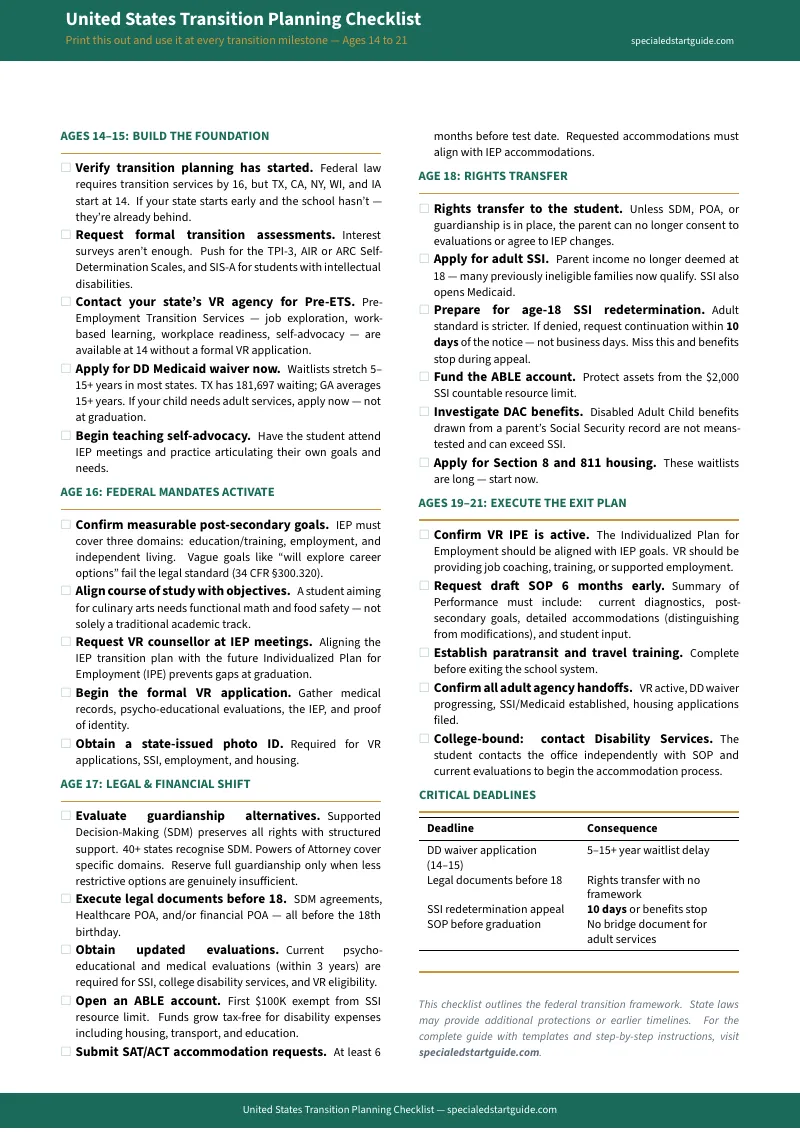
Age 14: apply for the DD waiver, start Pre-ETS, begin teaching self-advocacy. Age 16: formalise IEP transition goals, start the VR application. Age 17: execute legal documents, open the ABLE account, obtain updated evaluations. Age 18: apply for or prepare for SSI, manage the redetermination, fund the ABLE account. Ages 19-21: activate the employment plan, secure the SOP, establish housing and paratransit, confirm all adult agency handoffs. Every action dated. Every deadline explained. Every consequence of delay quantified.
Who This Roadmap Is For
- American parents of teenagers (ages 13-21) with any disability — autism, ADHD, learning disabilities, intellectual disabilities, physical impairments, mental health conditions — who need a unified plan for what happens after high school
- Parents whose child's IEP transition plan feels generic, vague, or disconnected from the realities of adult services, employment, and financial planning
- Parents who just learned about "the cliff" and are realising the school's legal obligation expires but their child's needs do not
- Parents who discovered that adult Medicaid waiver waitlists are 5-15+ years and need to know which applications to submit now
- Parents navigating SSI, ABLE accounts, Special Needs Trusts, and Vocational Rehabilitation for the first time — and confused about how they connect
- Parents of students with significant support needs who are agonising over who will manage care, housing, and finances after they are gone
- Parents of college-bound students who need to understand how IEP accommodations translate to the ADA/Section 504 college environment
- Parents who cannot afford a private transition consultant at $75-$125 per hour but refuse to figure this out by trial and error
Why Not Free Resources?
Free transition resources are not bad — some are excellent. They are structurally incomplete. Here is exactly where each one stops:
- SSA.gov explains SSI rules — in complete isolation from every other program. It will tell you the $2,000 resource limit exists but not how an ABLE account protects assets from it. It will tell you the age-18 redetermination happens but not how a formal rental agreement prevents the In-Kind Support and Maintenance reduction. It will never mention Vocational Rehabilitation, ABLE accounts, Medicaid waivers, or transition planning. This Roadmap connects SSI to every other system it interacts with.
- PACER Centre distributes dozens of excellent handouts — scattered across separate web pages with no unified timeline. Each handout covers one topic well. But piecing together the chronological action plan — when to apply for what, in which order, and how each step affects the next — requires weeks of reading and cross-referencing. This Roadmap is the unified timeline PACER's library was never designed to be.
- Think College is the national authority on college for students with intellectual disabilities — and nothing else. It maps CTP programs beautifully but does not address SSI, employment, housing, financial planning, or guardianship alternatives. If your child is heading to the workforce rather than a CTP, Think College cannot help you. This Roadmap covers every pathway.
- Wrightslaw focuses on IEP law and disputes — not the adult systems that replace the IEP. Wrightslaw is brilliant for fighting the school. But transition is not about fighting the school — it is about building the adult support network that takes over when the school is done. Wrightslaw will not help you navigate SSI redeterminations, Medicaid waivers, or Supported Decision-Making agreements. This Roadmap covers the adult side.
- NTACT:C provides rigorous transition toolkits — written entirely for professionals. The language is bureaucratic, the audience is transition specialists and rehabilitation counsellors, and the materials assume institutional knowledge that parents do not have. This Roadmap translates NTACT:C's professional frameworks into plain-language parent action.
— Less Than Twenty Minutes of a Transition Consultant's Time
Private transition consultants charge $75 to $125 per hour. Comprehensive multi-week transition packages cost up to $2,999. Estate lawyers drafting Special Needs Trusts and guardianship petitions charge $300 to $500 per hour. A single private psycho-educational evaluation runs $2,000 to $4,000 out of pocket.
This Roadmap gives you the same cross-system knowledge, the same financial planning strategy, and the same year-by-year action plan those professionals use — for less than the cost of a single consultation phone call. It does not replace a lawyer for complex estate planning or an attorney for due process hearings. It equips you to handle the transition planning, benefits applications, agency coordination, and legal decision-making that account for 90% of the work — so you only pay professional rates for the 10% that genuinely requires legal counsel.
Your download includes 9 PDFs:
- United States Post-Secondary Transition Roadmap (guide.pdf) — The full 10-chapter guide covering the entitlement-to-eligibility collapse, IDEA transition requirements, post-secondary education pathways (including CTP programs and disability scholarships), Vocational Rehabilitation and Pre-ETS, SSI and SSDI benefits planning, ABLE accounts versus Special Needs Trusts, Medicaid waiver navigation, guardianship alternatives, independent living and housing, and the complete year-by-year checklist from age 14 through 21
- Transition Planning Checklist (checklist.pdf) — One-page age-by-age action plan covering every critical deadline from age 14 through 21, designed to be printed and posted on the refrigerator
- Year-by-Year Transition Checklist (year-by-year-checklist.pdf) — Expanded checklist with every action item from the guide organised by age bracket (14–15, 16, 17, 18, 19–21, post-exit), with checkboxes for tracking progress
- SSI Age-18 Redetermination Guide (ssi-redetermination-guide.pdf) — The documentation strategy, the 10-day appeal window, the formal rental agreement that prevents benefit reduction, Section 301 protections, DAC benefits, and every work incentive
- ABLE Account vs Special Needs Trust Matrix (able-vs-snt-matrix.pdf) — Side-by-side comparison showing contribution limits, SSI exemptions, tax treatment, Medicaid payback rules, housing advantages, and when to use each
- Medicaid Waiver Waitlist Strategy (medicaid-waiver-strategy.pdf) — State-by-state waitlist data, when to apply, how to navigate priority systems, interim services, and housing options
- Guardianship Alternatives Framework (guardianship-alternatives.pdf) — The full spectrum from Supported Decision-Making to full guardianship, with rights impact, cost, and best-use guidance for each option
- Vocational Rehabilitation Action Plan (vr-action-plan.pdf) — Pre-ETS checklist, VR application packet requirements, IPE alignment strategy, subminimum wage protections, and key employment programs
- Agency Contact Worksheet (agency-contact-worksheet.pdf) — Fillable one-page table for centralising contact information for all 15 transition agencies, from VR to housing to benefits planning
You can also download the United States Transition Planning Checklist for free — a standalone age-by-age action plan with the critical deadlines table, so you can see exactly what needs to happen at 14, 16, 17, 18, and 21 before committing to the full Roadmap.