Your Child Turns 18 — and Florida Law Stops Seeing You as Their Parent
On the morning of your child's 18th birthday, every system your family depends on resets. The hospital invokes HIPAA and refuses to share medical records. The school transfers all IEP authority to a student who may not understand what an IEP is. The bank freezes accounts you have managed for a decade. The APD demands a signature your child cannot provide.
Most families discover this cliff at the worst possible moment — in a hospital lobby, on the phone with Social Security, or sitting across from a school administrator who tells them they no longer have a seat at the table.
The standard advice? "Get guardianship." But a Chapter 744 adult guardianship means a court proceeding, attorney fees that can exceed $5,000, a three-member examining committee, and court-ordered removal of specific rights, with a legal process to seek restoration. For many families, that is not protection — it is overkill.
The Dignity-First Transition System
The Florida Adult Guardianship & Alternatives Guide replaces guesswork with a structured framework. It walks through every legal instrument available to Florida families — from least restrictive to most restrictive — so you can match the right tool to your child's actual needs, not their diagnosis label.
Florida's 2024 HB 73 changed the rules. Courts must consider Supported Decision-Making and other less restrictive alternatives in Guardian Advocacy and adult guardianship proceedings. This guide is built for the post-HB 73 landscape — where starting with the least restrictive option is not just ethical, it is the law.
What's Inside
- Five-Domain Functional Assessment — rate your child's actual decision-making abilities across medical, educational, financial, daily living, and social vulnerability domains, so you know which domains need legal coverage and which do not
- SDM Agreement Walkthrough — the execution requirements under F.S. §§ 709.2105 and 709.2209 (notarization, two subscribing witnesses, any durability language has no effect), what supporters can and cannot do, and a link to Disability Rights Florida's sample agreement
- Private Document Package — Durable Power of Attorney, Healthcare Surrogate designation, HIPAA releases, and FERPA waivers. No court, no filing fees, no annual reporting
- Guardian Advocacy Filing Guide — step-by-step pro se instructions for every required form (Petition, Application, Oath, Initial Plan), the eight qualifying developmental conditions, including Tatton-Brown-Rahman syndrome, and how to determine if you are a "person-only" case eligible to file without an attorney
- Chapter 744 Standard Guardianship — when and why you need it, the three-member examining committee process, limited vs. plenary options, and the mandatory attorney requirement
- Two Worked Cost Examples — real dollar figures for a pro se Guardian Advocacy filing (including the Civil Indigent Status fee waiver) and an attorney-represented Chapter 744 proceeding, so you know what each path actually costs before you start
- Multi-Agency Coordination Maps — IEP rights transfer under F.S. § 1003.5716, HIPAA document hierarchy, SSI Representative Payee setup, APD/iBudget waiver navigation, and HB 1103's statewide expansion of the ICMC Program, its iBudget waitlist effect, and disenrollment rules
- Financial Protection Tools — first-party and third-party Special Needs Trusts, ABLE accounts, and convenience bank accounts under F.S. § 655.80
- Emergency Procedures — Emergency Temporary Guardianship for crisis situations, and successor guardian advocacy designations for caregiver continuity
- Circuit-by-Circuit Variations — local administrative orders, electronic filing requirements, and mandatory education class rules that vary across Florida's 20 judicial circuits
- Five Printable Planning Tools — a Five-Domain Capacity Assessment worksheet, transition timeline planner, court filing checklist, agency communication log, and annual reporting calendar — all fillable PDFs you can print and use immediately
Who This Guide Is For
This guide is for Florida parents whose child with a disability is approaching — or has recently passed — their 18th birthday. It works for:
- Families exploring alternatives to guardianship (SDM, POA, healthcare surrogacy) who want to preserve as many of their child's rights as possible
- Parents who need Guardian Advocacy and want to file pro se to minimize costs
- Families facing a Chapter 744 proceeding who need to understand the process, timeline, and realistic costs before hiring an attorney
- Parents who already have a guardianship in place and want to explore restoration of rights under Florida's updated SDM framework
Why Not Rely on Free Resources?
Free resources exist — and the good ones are scattered across state agency websites, court clerk portals, advocacy group toolkits, and attorney blogs. Here is what they get wrong:
- Disability Rights Florida publishes an excellent SDM sample agreement but does not provide circuit-specific filing instructions or cost breakdowns for families who need court action
- Attorney blogs explain Guardian Advocacy clearly — and then funnel you toward representation that costs thousands of dollars, even when the law allows you to file on your own
- Court clerk portals provide the official forms but are legally prohibited from giving advice. Forms vary by circuit, are not organized by pathway, and arrive without instructions
- National publishers promise a "2-to-4 month timeline" that ignores the fact that the 13th Circuit (Hillsborough) has automated case tracking, the 19th Circuit (including Indian River) uses an online scheduling calendar and directs hearing requests to the judicial assistant when no time is available, and Florida requires guardians to complete 8 hours of training within four months of appointment, though courts may waive some or all requirements case by case
This guide pulls those fragments into one ordered system — so you spend an afternoon with a clear plan instead of weeks piecing together conflicting information from a dozen sources.
Satisfaction Guarantee
If the guide does not save you time and confusion navigating Florida's turning-18 transition, email us for a full refund, no time limit.
Get Started
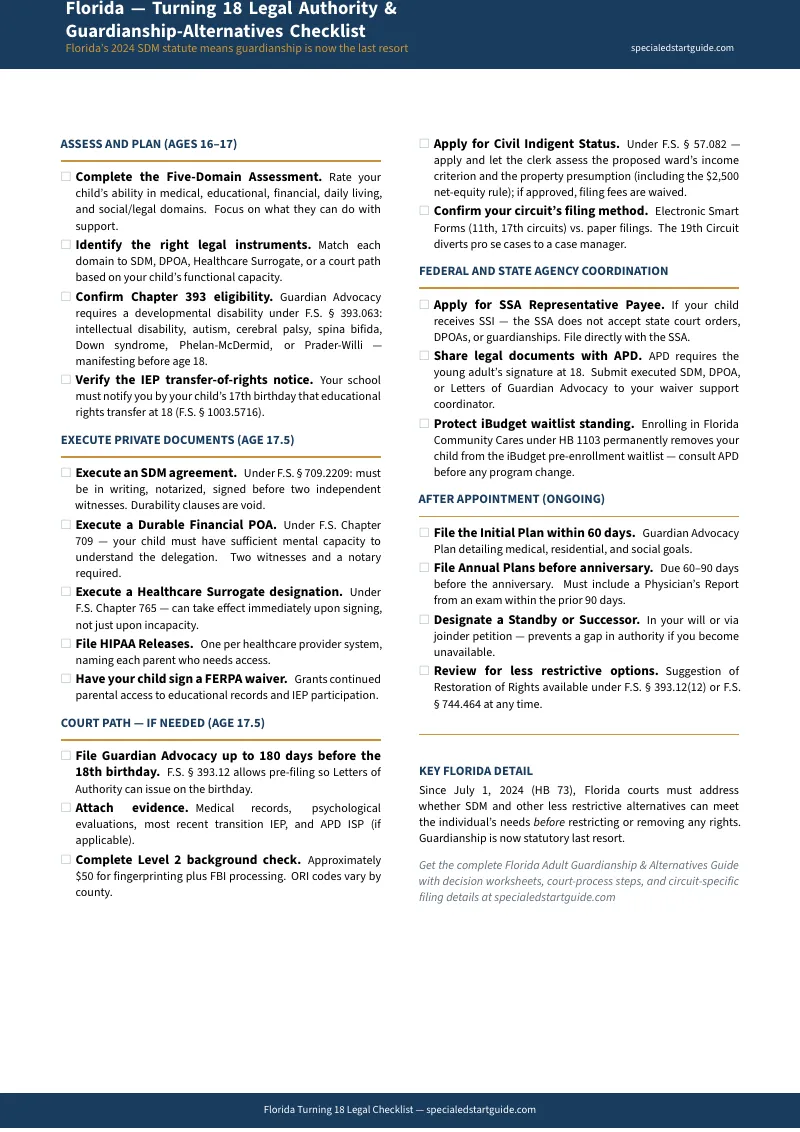
The free checklist gives you a one-page overview of every legal authority decision point. The full guide gives you the step-by-step instructions, worked cost examples, circuit-by-circuit filing details, and the five-domain assessment framework to build your child's transition plan.
For , you get the complete Dignity-First Transition System — every chapter, every worked example, every form instruction — as a downloadable PDF you can reference whenever you need it.
Frequently Asked Questions
What if the rules change after I buy?
We update the guide when the rules change. Email us any time, even years later, and we'll send you the current edition free.