Your Child's School Knows How to Graduate Them. Nobody Has Shown You What Happens Next.
Your child is approaching 18. The school has mentioned "transition planning" and "post-school pathways" and handed you a folder of brochures. You attended the meeting with the Transition Planning Coordinator, who said words like "Day Activity Centre" and "School-to-Work Programme" and "vocational training" — and then sent you home to figure out how those words turn into an actual plan for your child's adult life.
You went to the SG Enable website and found the Enabling Guide — a comprehensive directory that lists dozens of adult services without telling you that DAC waitlists average 9 months, with some centres running two- to three-year queues. You found the MOE transition planning framework — a 100-page document written for educators, not for you. You searched KiasuParents and found threads where parents share their heartbreak about the "cliff edge" — the moment at 18 when daily routines, peer networks, and therapeutic support all disappear overnight.
Then you started researching the financial and legal side. SNTC trusts. CPF SNSS nominations. Deputyship applications at age 21. Each scheme lives on a different government website, with different eligibility criteria, different application processes, and no resource explaining how they fit together. You need a trust setup, a CPF nomination, and a legal guardianship application — but nobody has given you a clear sequence for when to do each, how they interact, or what happens if you get one wrong.
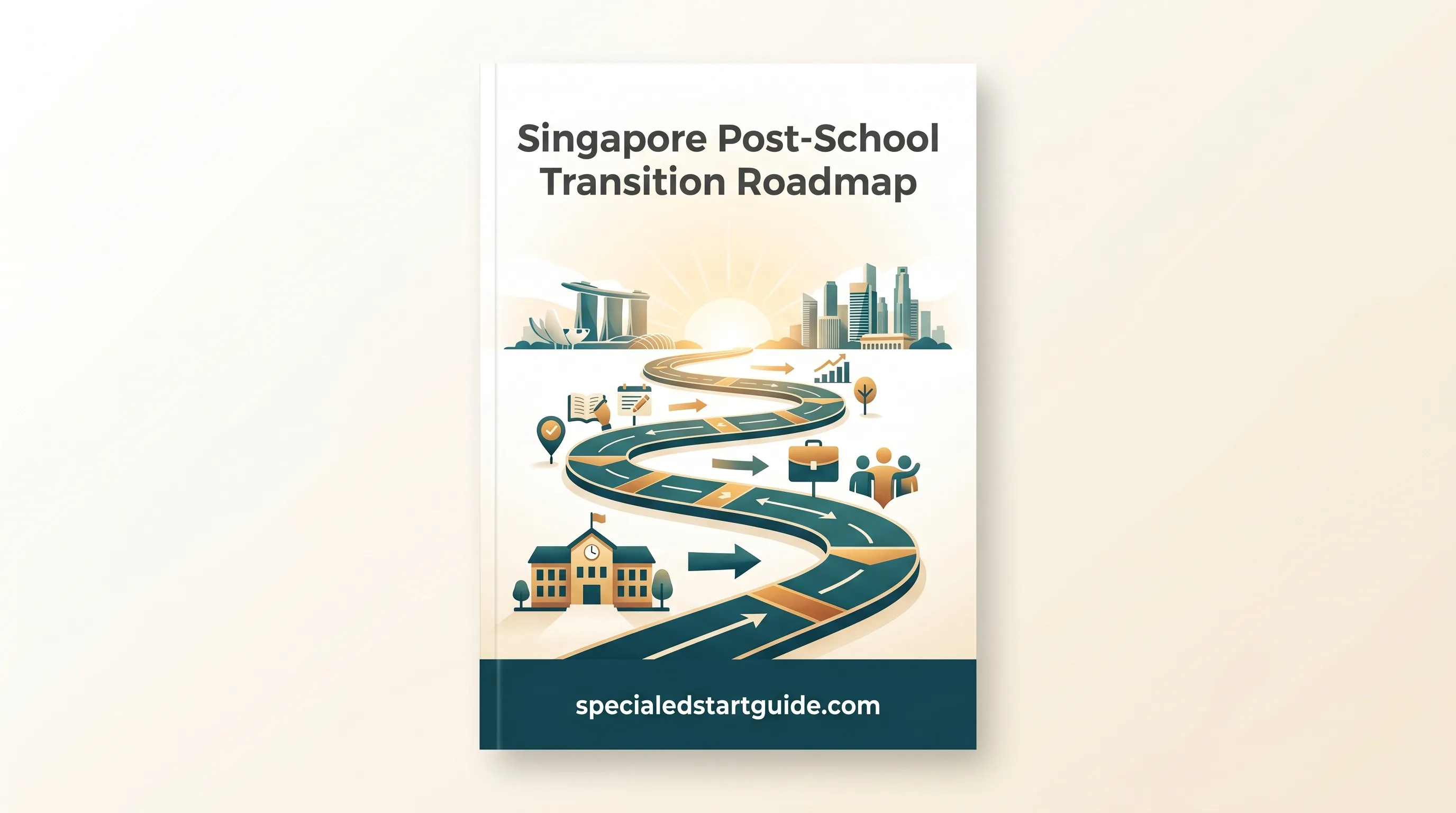
The Singapore Post-School Transition Roadmap is the Cliff Edge Prevention System — a 12-chapter guide that reverse-engineers the entire post-18 transition from the deadlines backward. It maps every employment pathway (open, supported, sheltered, social enterprise), every adult service (DACs, ESHs, residential), every IHL access route (ITE, Polytechnic, SEN Support Offices), and the complete SNTC-CPF-Deputyship financial architecture into one year-by-year action plan — built for parents who need to know what to do at age 13, 15, 17, 18, and 21, in what order, and what breaks if they start late.
What's Inside the Roadmap
The Master Timeline That Prevents the Cliff Edge
No existing Singapore resource provides a chronological planning framework with deadlines reverse-engineered from systemic delays. If your child needs a DAC spot at 18, you must apply at 15 — because the average waitlist is 9 months and specific centres stretch to 3 years. If your child lacks mental capacity, you must initiate ADAP deputyship at 17 — because the process takes 3 to 4 months. If you want an SNTC trust, you need the $5,000 minimum deposit ready or GOAL sponsorship applied for well in advance. The Roadmap maps every deadline for ages 13 through 21, so you never discover a requirement after the window has closed.
The ITP Parent Toolkit — Because the Meeting Is Your Leverage
MOE mandates Individual Transition Plans starting at age 13. Your child's school has a Transition Planning Coordinator. They will invite you to the Family Envisioning Meeting. But the official guides are written for educators — they tell the school how to run the meeting, not you how to shape it. The Roadmap includes the 10 questions you must ask your TPC before age 15, the specific red flags in proposed S2W pathways, how to challenge a vocational goal that does not match market realities, and the exact framework for evaluating whether an ITP prepares your child for actual post-school life or just satisfies the school's administrative compliance.
Employment Pathways Mapped to Your Child's Profile
Open employment, School-to-Work programme (90 places per year — limited intake), supported and customised employment through SG Enable, social enterprises like Dignity Kitchen, sheltered workshops, and vocational training at APSN Centre for Adults and SPD Ability Centre. Each pathway is profiled with realistic eligibility criteria, typical industries, wage expectations, and the specific application steps and timelines. Because a school career counsellor can list the options — but cannot tell you which one matches your child's specific capacity, or that applying to S2W three months late means missing the annual cohort entirely.
The Adult Services Waitlist Strategy
The Enabling Guide tells you Day Activity Centres exist. It does not tell you that 130 adults with autism are currently on waitlists, or that SUN-DAC in Choa Chu Kang has a two- to three-year queue. The Roadmap covers DAC application timing, fees (subsidised as low as $50-100 per month after means testing), Enabling Services Hubs for higher-functioning adults, residential options including Adult Disability Homes and the Enabling Living Programme, and the critical bridging strategies — Rainbow Centre STEP and ESH drop-in sessions — that keep your child engaged while waiting for permanent placement.
The SNTC vs CPF SNSS Decision Matrix
Two systems, overlapping functions, no single resource explaining how they interact. The SNTC Trust handles liquid assets, requires a $5,000 minimum deposit (subsidised 90% by MSF down to $150 setup fee), and assigns a case manager who develops a personalised Care Plan. The CPF SNSS handles CPF savings, requires no minimum deposit, and distributes a fixed monthly amount without case management. You might need one or both. The Roadmap provides the comparative decision framework: which to use based on your asset liquidity, your child's dependency level, and how to link a CPF nomination to an SNTC trust through a Letter of Intent — the step that the CPF Board website warns you about but does not explain how to execute.
Legal Planning — Deputyship, LPA, and the Age-21 Threshold
At 21, your child reaches the legal age of majority. If they lack the mental capacity to manage their own affairs, you lose all legal authority to make decisions for them — unless you have secured Deputyship through the Family Justice Courts. Private applications cost $3,000 to $4,500 through a family lawyer. The Assisted Deputyship Application Programme (ADAP) provides a streamlined, lower-cost route for straightforward cases — but it must be initiated during the final school years. If your child retains capacity, the Lasting Power of Attorney (LPA Form 1) is free for citizens. The Roadmap covers the decision framework, the timeline, the documentation, and what exactly Deputyship and LPA authorise you to do.
Further Education — ITE, Polytechnic, and Beyond
For the 80% of SEN students in mainstream schools, the transition may lead to ITE, Polytechnic, or even university. But SEN support does not transfer automatically between institutions. Each IHL has its own SEN Support Office, its own application process for accommodations, and its own criteria for assistive technology funding. The MOE SEN Fund provides up to $5,000 for students with learning and behavioural conditions, and up to $70,000 for high-needs students with severe sensory impairments. The Roadmap covers how to access these offices, secure exam accommodations, prepare for EAE admissions, and ensure your child's support does not evaporate on the first day of tertiary education.
Independent Living Skills — The Practical Gap Nobody Fills
Financial literacy, transport independence, personal safety, meal preparation, household management — these skills determine whether your child can participate in adult life or remain entirely dependent on full-time care. The school teaches some of these in a classroom setting. The Roadmap provides the home independence checklist for real-world practice: using a CashCard or EZ-Link for purchases, navigating public transport independently, managing a weekly allowance, and the specific skills matrix that employment agencies assess during placement interviews.
Who This Roadmap Is For
- Parents of teenagers in SPED schools who have been told about the ITP process but have no idea what questions to ask, what to challenge, or how to evaluate whether the school's proposed pathway actually matches post-school realities
- Parents whose child is approaching 18 and who just discovered that DAC waitlists can stretch to three years — meaning applying at 18 guarantees their child sits at home for years with no structured engagement
- Parents who know SNTC and CPF SNSS exist but cannot figure out which one they need, whether they need both, or how to link a CPF nomination to a trust — because the information is spread across three different government websites that do not cross-reference each other
- Parents terrified about what happens when they are no longer around — who need a clear path for Deputyship or LPA, trust-funded care management, and insurance payouts directed to the right entity
- Parents of mainstream SEN students aiming for ITE or Polytechnic who need to know how to access SEN Support Offices, secure the MOE SEN Fund, and ensure accommodations transfer between institutions
- Parents who spent hours on the SG Enable website, the MOE transition guide, and KiasuParents forums and came away more overwhelmed than when they started — because the system has all the right pieces scattered across all the wrong places
Why Not Just Use the Free Resources?
- SG Enable's Enabling Guide is a directory, not a strategy. It lists adult services, employment schemes, and transport subsidies — and that is the problem. It does not tell you that the service you are reading about has a 36-month waitlist, or that the application must be initiated years before graduation. It presents the system as if it flows seamlessly. It does not.
- The MOE Transition Planning Guide is written for teachers, not parents. It is a 100-page framework that instructs educators on how to run ITP meetings. It explicitly states that families must be "empowered contributors" — then provides no parent-facing checklists, no tactical questions, and no framework for challenging a proposed pathway. Parents are invited to participate. This Roadmap teaches you how to lead.
- Free resources explain each financial scheme in isolation. Nobody shows you how they fit together. The SNTC website explains trusts. The CPF website explains SNSS. The OPG website explains LPA. But the parent who needs all three must independently architect the interplay between liquid asset trusts, CPF monthly payouts, legal guardianship, and insurance beneficiary designations — with zero guidance on the optimal sequence or the specific traps (like the CPF Board's explicit warning that they cannot enforce how a trust company uses nominated funds).
- KiasuParents forums offer raw solidarity and frequently outdated advice. Other parents share their experiences generously. But forum advice reflects individual situations that may not match yours, references programmes that have changed eligibility criteria, and mixes mainstream and SPED pathways without distinction. A guide that covers both pathways comprehensively — updated for 2025-2026 deadlines and the Enabling Masterplan 2030 targets — saves you from building your child's future on someone else's anecdote.
- A private transition counsellor charges SGD 95 to 150 per hour. A family lawyer for Deputyship charges SGD 3,000 to 4,500. This Roadmap costs less than a single counselling session and covers what no single appointment can: the complete post-school ecosystem — employment, education, adult services, financial trusts, and legal guardianship — organised into a year-by-year action plan that starts at 13 and runs through 21.
Free resources describe what programmes exist. This Roadmap tells you when to act, in what order, and what breaks if you wait.
— Less Than a Single Counselling Session
A private transition counsellor charges SGD 95 to 150 per hour. Missing the ADAP deputyship window costs your family $3,000 to $4,500 in private legal fees. Missing a DAC application window by one year means 12 more months of full-time caregiving at home — potentially forcing a parent to quit work entirely. For , you receive the strategic equivalent of multiple professional consultations: the complete post-school transition framework, the financial decision matrices, the ITP advocacy toolkit, and the year-by-year timeline that ensures you never discover a deadline after it has passed.
Your download includes the complete 12-chapter Roadmap plus 8 standalone printable tools — ready to use tonight.
- Complete Transition Roadmap Guide — 12 chapters covering the cliff edge reality, ITP advocacy, all employment pathways, ITE and Polytechnic access, adult disability services, independent living skills, SNTC vs CPF SNSS financial planning, Deputyship and LPA legal planning, the master timeline from age 13 to 21, common scenarios, and key contacts
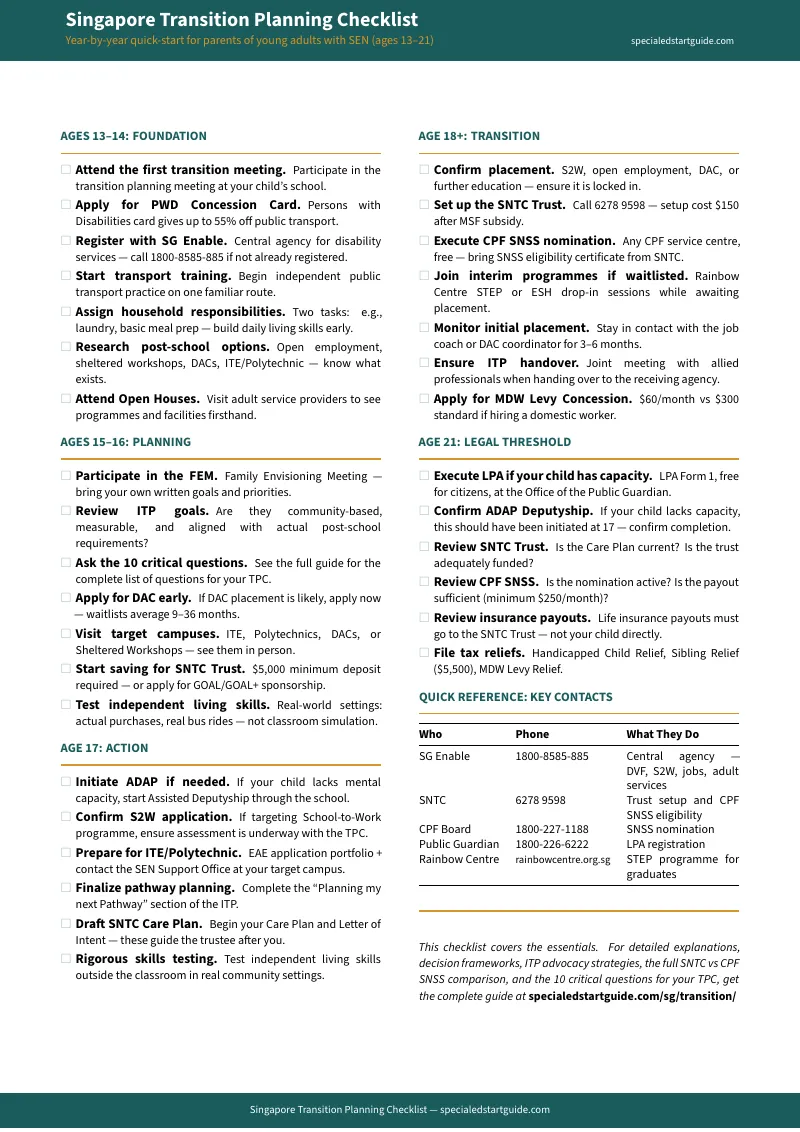
- Singapore Transition Planning Checklist — printable year-by-year checklist covering the specific actions required at ages 13-14, 15-16, 17, 18+, and 21
- ITP Parent Toolkit — the 10 questions to ask your TPC before age 15, plus the common ITP pitfalls to challenge
- Employment Pathways Reference Card — side-by-side comparison of open employment, S2W, supported, social enterprise, and sheltered workshops with eligibility, wages, and application steps
- Independent Living Skills Checklist — the essential skills matrix, home independence checklist with checkboxes, and transport training steps
- SNTC vs CPF SNSS Decision Matrix — side-by-side comparison, decision guide, the Letter of Intent trap, and GOAL/GOAL+ sponsorship details
- Deputyship & LPA Planning Guide — decision flowchart, ADAP vs private application, LPA Form 1 vs Form 2, and the critical timing at ages 17 and 21
- Master Timeline: Ages 13 to 21 — every critical deadline on one printable fridge sheet with checkboxes for administrative actions
- Key Contacts Directory — phone numbers and websites for SG Enable, SNTC, CPF Board, OPG, all SPED operators, IHL SEN Support Offices, and community groups
Instant PDF download. Print the Checklist tonight. Bring the ITP Toolkit to your next school meeting this week.
Money-back guarantee, no time limit. If the Roadmap does not change how you plan for your child's post-school future, email us for a full refund. No questions asked.
Not ready for the full Roadmap? Download the free Singapore Transition Planning Checklist — a printable year-by-year checklist covering the critical actions at ages 13-14, 15-16, 17, 18+, and 21, with key contacts for SG Enable, SNTC, CPF Board, and the Office of the Public Guardian. It is enough to see the full timeline and identify which deadlines are approaching — and it is free.
Over 40% of SPED graduates do not enter employment or further education within six months. DAC waitlists stretch to three years. Deputyship applications take 3-4 months. SNTC trust setup requires weeks of preparation. The ITP process begins at 13. This Roadmap ensures you are ahead of every deadline — not behind it.