The EIPIC Waitlist Is 12 Months. The MOE Guide Doesn't Mention Private Assessment Costs. Your Child's IEP Says "Improve Communication." This Blueprint Replaces All the Guesswork Tonight.
You're staring at a polyclinic referral letter that says your child has been placed on a waitlist for developmental assessment at KKH. The estimated wait is 6 to 18 months. Your child is 3 years old. You know — because every parent forum, every WhatsApp group, every speech therapist you've spoken to has said it — that early intervention before age 4 yields the strongest returns. The system agrees. The system also has a 12-month queue.
Meanwhile, you've spent evenings scrolling through the Enabling Guide, the MOE parents' guide, the ECDA portal, and 400 pages of KiasuParents threads. You've learned that EIPIC exists but not how long the waitlist actually is. You've learned that subsidies exist but not which ones you qualify for based on your household income. You've found IEP templates on Etsy — written for the American IDEA framework, referencing 504 Plans and Common Core Standards that have zero relevance in Singapore.
Here's the structural problem: Singapore has excellent free resources that explain what SEN support is available in principle. The MOE publishes a parents' guide. The Enabling Guide is an encyclopedia. ECDA has pages on EIPIC. But none of them give you the ground-level mechanics — the actual wait times nobody publishes, the private assessment costs nobody warns you about, the subsidy stacking strategies nobody maps out in one place, or the IEP meeting scripts that turn you from a passive observer into an active co-creator of your child's educational plan.
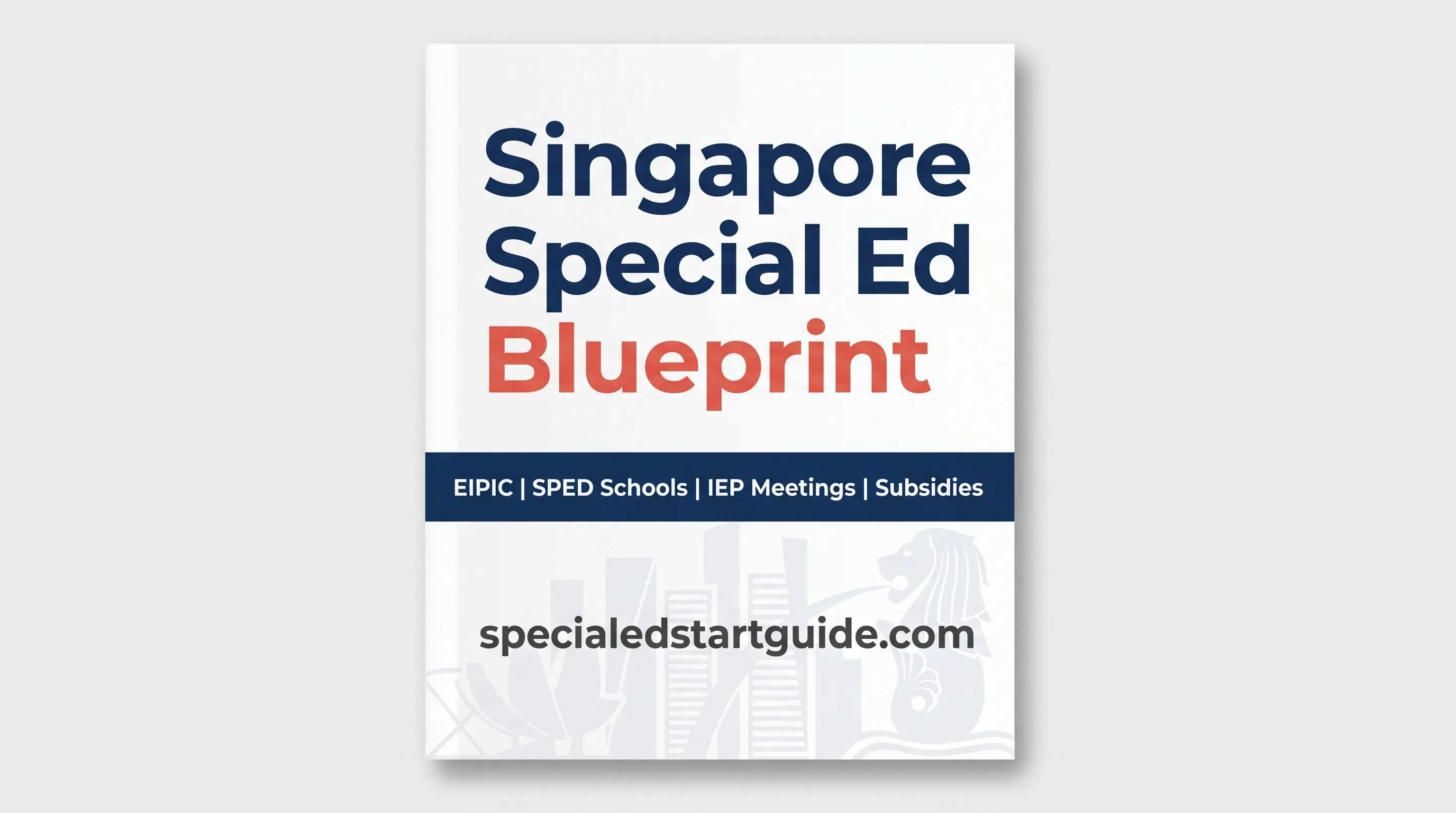
The Singapore Special Ed Blueprint is the single tactical document that bridges the gap between government policy and parental reality. Not summaries. Not policy overviews. The actual costs, timelines, decision frameworks, meeting scripts, and subsidy maps that would cost you 40 hours of fragmented research across 15 different portals — or a single session with a private developmental paediatrician at $200 per hour — delivered in one document you can read tonight.
What's Inside the Blueprint
The Two-Speed Diagnosis System
The MOE guide tells you to "get a professional assessment." It does not tell you that the public pathway through KKH or NUH takes 6 to 18 months while your child misses critical developmental windows — or that the private pathway costs $2,000 to $3,200 but delivers results in 1 to 3 months. This guide lays out both pathways side by side, with actual costs, actual wait times, and a framework for calculating whether six months of lost early intervention is worth saving $2,500. Because that is the real decision nobody frames honestly.
The Complete EIPIC Roadmap
EIPIC is not one programme — it is six tiers (EIPIC Under-2s, EIPIC@Centre, DS-Plus, EIPIC-P, EIPIC-Care, DS-LS) with different eligibility criteria, waitlists, and subsidy structures. The guide explains each tier, who qualifies, what the wait looks like, and — critically — what to do while you're on the waitlist so your child doesn't lose months of intervention time. Because applying and waiting is not a strategy. Applying, starting private therapy, enrolling in EIPIC-Care, and applying for EIPIC-P simultaneously is a strategy.
The Mainstream vs. SPED Decision Framework
The most consequential decision you will make is whether your child enters a mainstream MOE school or one of Singapore's 20 SPED schools. The guide replaces opinion and stigma with a structured framework based on curriculum access, class size tolerance, self-care independence, and cognitive profile. It covers the "in-between" child who is too high-functioning for SPED but too dysregulated for a mainstream class of 40 — the largest underserved group in the system — with specific strategies for shadow teachers, private supplementary therapy, and SEAB Access Arrangements.
Every SPED School Mapped by Disability Profile
Singapore's 20 SPED schools (expanding to 30 by the early 2030s) are highly specialised. Pathlight serves ASD students who can access the national curriculum. Eden serves ASD with intellectual impairment. Rainbow Centre serves multiple disabilities with intensive therapy integration. The guide maps every school by operator, disability profile, and curricular approach — because MOE centrally allocates placement based on diagnosis, and understanding the landscape before you apply means understanding what your child's school day will actually look like.
How IEPs Actually Work in Singapore
If your child is in a SPED school, the Individualised Education Plan is the central document governing their education. The guide explains the MOE-mandated IEP structure: APISN profiles, Present Level of Performance baselines, priority goals with condition-behaviour-criteria formatting, and the Assess-Plan-Implement-Evaluate cycle. It shows you what a meaningful IEP looks like versus a tick-box exercise — and provides the specific questions to ask when the goals say "improve communication" with no measurable criteria, no data collection method, and no accountability timeline.
IEP Meeting Prep Scripts
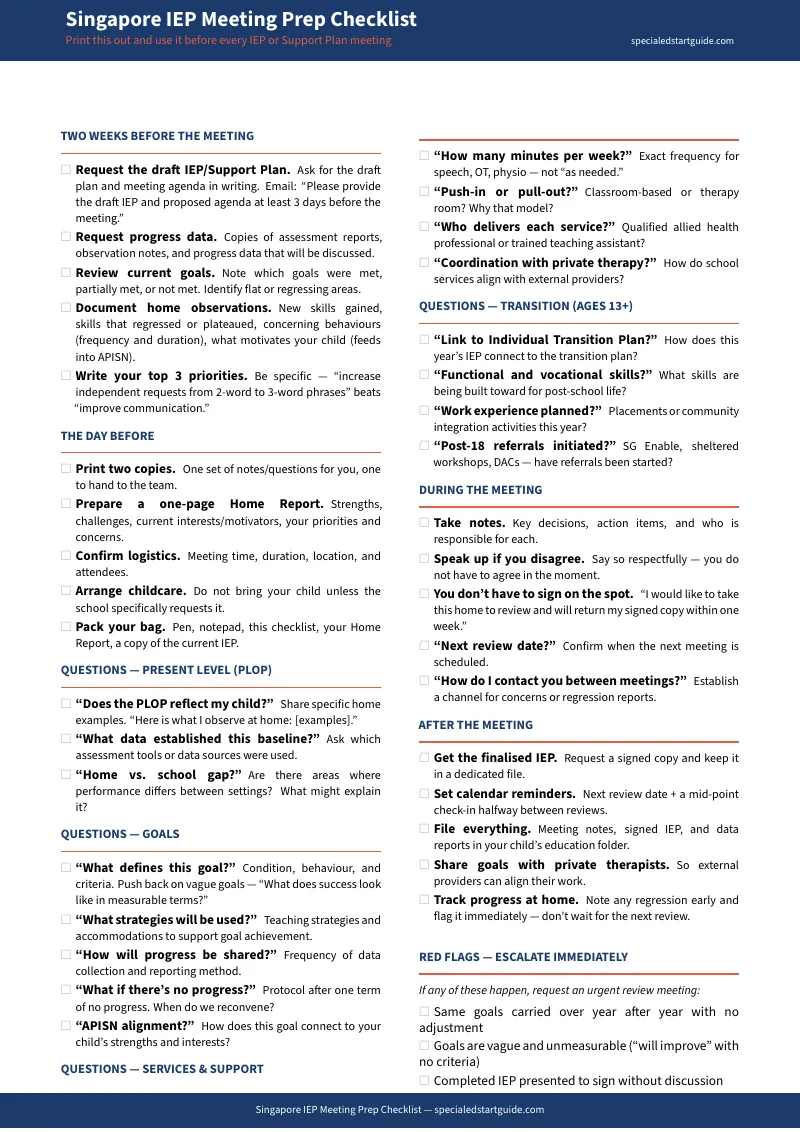
Walking into an IEP meeting unprepared means the school controls the narrative. The guide provides a complete meeting preparation checklist — what to request two weeks before, what to prepare the day before, specific questions to ask about PLOP accuracy, goal measurability, service delivery models (push-in versus pull-out), and the exact phrase to use when you disagree: "I would like to take this home to review." Because you never have to sign an IEP on the spot.
SEAB Access Arrangements for PSLE, N-Levels, and O-Levels
Extended time, separate rooms, human readers, word processors — SEAB provides real accommodations for national exams, but the application process requires evidence that the accommodation is already embedded in daily classroom practice. The guide maps the full timeline from P3 documentation through P6 February application deadline, including the assessment recertification trap: if your child was assessed at age 4, the report expires before PSLE. You need a new one. Budget $2,000-$3,200 for private, or start the public hospital process 18 months early.
The Financial Navigation System
Financial assistance in Singapore is generous but scattered across MOE FAS, MediSave, the Assistive Technology Fund, SNTC, SNSS, GOAL+, ComCare, and the Baby Bonus scheme — each with different eligibility criteria based on Gross Household Income or Per Capita Household Income. The guide provides a unified financial map showing which subsidies to apply for, in what order, and how to stack them. Because cumulative private therapy costs can exceed $200,000 over a child's school years, and every subsidy you miss is money you cannot recover.
The Post-18 Transition Plan
When your child ages out of SPED at 18, the structured daily programme ends. This is the "Post-18 Cliff." The guide covers the Individual Transition Plan framework (mandated for all SPED schools since 2017), the three post-school pathways (open employment, sheltered workshops, Day Activity Centres), and the long-term financial trust mechanisms (SNTC and SNSS) that answer the question every SEN parent eventually asks: "What happens to my child when I die?"
The Expatriate Chapter
If you are on an Employment Pass or Dependant's Pass, the publicly funded SEN system is largely closed to you. No subsidised EIPIC. No ATF grants. No priority SPED placement. The guide provides a dedicated chapter covering international school SEN programmes (The Winstedt School, IIS, Dover Court, SAS, UWCSEA), realistic annual cost projections ($55,000 to $129,000 including therapy), insurance navigation, and immigration requirements — so you know exactly what you're facing before you accept the posting.
Who This Blueprint Is For
- Parents who just received a diagnosis of ASD, ADHD, Global Developmental Delay, or Intellectual Disability and have no idea what happens next — which agency to contact, which programme to apply for, or how long anything takes
- Parents sitting on a 6-to-18-month public assessment waitlist at KKH or NUH, wondering whether to wait or pay $2,000-$3,200 for a private assessment — and needing a framework to make that decision with data
- Parents approaching Primary 1 registration who must choose between mainstream and SPED, and who need the decision framework that separates data from stigma
- Parents whose child is in the "in-between" — too high-functioning for SPED, too dysregulated for a mainstream class of 40 — and who need strategies for shadow teachers, private therapy, and SEN Officer support
- Parents attending IEP or Intervention Plan meetings at SPED or mainstream schools who want to arrive with specific questions, written priorities, and the confidence to say "this goal is not measurable"
- Parents who know subsidies exist but cannot figure out which ones their family qualifies for, how to apply, or how to stack multiple schemes together
- Expatriate families relocating to Singapore with a neurodivergent child who need to know exactly what is and isn't available to non-citizens before they arrive
- Parents of teenagers approaching the Post-18 Cliff who need to start ITP conversations and long-term financial planning now
Why Not Just Use the Free Resources?
Singapore has genuinely useful free resources for SEN families. Here's why parents still struggle after reading all of them:
- The MOE parents' guide explains what exists — not what it actually costs or how long it takes. It lists 22 SPED schools without mentioning waitlists. It describes EIPIC without acknowledging the 6-to-18-month wait. It advises getting an assessment without warning you about the $2,000-$3,200 private cost or the 6-month public delay. The Blueprint provides the unvarnished numbers: actual wait times, actual costs, actual subsidy thresholds.
- The Enabling Guide is an encyclopedia, not a roadmap. It lists every scheme, every agency, every fund. But a sleep-deprived parent at midnight does not need a search portal with 200 pages of schemes — they need a step-by-step sequence: apply for this first, then this, stack this on top. The Blueprint converts the encyclopedia into a linear action plan.
- KiasuParents and Reddit give unfiltered reality — buried in 800-page threads. The critical PSLE access arrangement tip is on page 412 of the "All About Autism" thread. The private assessment recommendation is contradicted three posts later. The subsidy advice is from 2022 and the thresholds have changed. The Blueprint extracts the verified, current, actionable information and organises it chronologically — without the anxiety spiral.
- Etsy and Gumroad sell IEP planners built for the American system. References to 504 Plans, IDEA due process hearings, and Common Core Standards have zero relevance in Singapore. An American IEP goal template does not prepare you for a Singapore SPED school IEP structured around APISN profiles and MOE-mandated condition-behaviour-criteria goals. The Blueprint uses exclusively Singapore terminology — EIPIC, SEAB, SEN Officers, SPED, APISN, SNTC — because that is the system you are navigating.
The free resources explain what the system offers. This Blueprint gives you the roadmap to actually navigate it.
— Less Than 15 Minutes With a Private Developmental Paediatrician
Private developmental paediatricians in Singapore charge $200 or more per consultation. A comprehensive psycho-educational assessment runs $2,000 to $3,200. A single hour of private speech therapy costs $170 to $240. The strategies, timelines, subsidy maps, and meeting scripts in this Blueprint are the same administrative frameworks that educational consultants and developmental paediatricians share piecemeal across multiple expensive appointments — assembled into one document you can use tonight.
Your download includes the complete Blueprint guide, the IEP Meeting Prep Checklist, and 9 standalone printable reference sheets:
- Complete Blueprint Guide (guide.pdf) — 15 chapters covering the Singapore SEN landscape, the two-speed diagnosis system, the complete EIPIC ecosystem, mainstream vs. SPED decision framework, every SPED school mapped by disability profile, how IEPs work in Singapore, SEAB Access Arrangements, financial navigation (MOE FAS, MediSave, ATF, SNTC, SNSS, GOAL+), private therapy costs, Individual Transition Plans, the expatriate reality, caregiver respite, IEP meeting preparation scripts, edge-case scenarios, and key contacts
- IEP Meeting Prep Checklist (checklist.pdf) — Printable before/during/after meeting checklist with specific questions for PLOP accuracy, goal measurability, service delivery, transition planning, your rights summary, and red flags to escalate immediately
- Assessment Pathway Map (assessment-pathway-map.pdf) — Public vs. private diagnosis pathways side by side with actual costs, wait times, and a documentation checklist for your appointment
- EIPIC Programme Comparison (eipic-programme-comparison.pdf) — All 6 EIPIC tiers in one table with eligibility, intensity, and what to do while you wait
- Mainstream vs. SPED Decision Framework (mainstream-vs-sped-framework.pdf) — Data-driven decision criteria, "in-between" child strategies, and the transfer process
- SPED School Directory (sped-school-directory.pdf) — Every SPED school mapped by disability profile, operator, and curricular approach
- Financial Assistance Map (financial-assistance-map.pdf) — Every subsidy, grant, and trust mechanism with eligibility thresholds, application sequences, and SNTC vs. SNSS comparison
- SEAB Access Arrangements Timeline (seab-access-arrangements-timeline.pdf) — Available accommodations, the P3-to-PSLE documentation timeline, and the assessment recertification deadline
- IEP Meeting Questions (iep-meeting-questions.pdf) — The specific questions to ask about PLOP, goals, services, and what to do when you disagree
- Post-18 Transition Checklist (post-18-transition-checklist.pdf) — ITP phases, post-school pathways compared, and action items to start now
- Key Contacts Directory (key-contacts-directory.pdf) — Government agencies, social service organisations, and online communities in one reference sheet
You can also download the Singapore IEP Meeting Prep Checklist for free — a standalone printable covering meeting preparation, key questions, and your rights as a parent in SEN planning meetings.