The School Has Institutional Knowledge. You Need the Policy-vs-Law Boundary They Will Never Volunteer.
You sat in the meeting with the SEN Officer and the form teacher. They used phrases like "school-based support" and "we will do our best" and "every child is different." You asked whether your child could get extra time for exams and someone said "we will look into it." You asked about a shadow teacher and someone said "that is not really how it works in our school." You asked what you are entitled to and received a long answer about MOE's "whole-school approach" that somehow ended without anyone telling you what the school is actually required to do.
Then you went home and started searching. You found the MOE Parent Guide — a document that describes the system as if it works seamlessly and never mentions what to do when it does not. You found the SG Enable Enabling Guide — an overwhelming directory of schemes that tells you what exists without explaining how to claim it when an application is denied. You found KiasuParents threads where half the advice references IDEA, 504 Plans, and "due process" — American legal concepts with zero standing in Singapore. You found Wrightslaw and IPSEA — the gold standards of parent advocacy in the US and UK — and discovered that their entire frameworks are built on legislation that does not exist here.
Private education consultants charge SGD 120 to 180 per hour. Family lawyers charge SGD 350 to 600 per hour. Most parents cannot afford either — and most disputes resolve the moment the school realises the parent understands which provisions are law and which are administrative discretion.
The Singapore Special Ed Parent Rights Compass is the Statutory-vs-Policy Navigation System — a 14-chapter guide that maps the exact boundary between enforceable law and discretionary school policy for every major SEN provision in Singapore. It covers the Compulsory Education Act, SEAB exam accommodations, SPED school IEP rights, financial entitlements scattered across six government agencies, the five-level dispute escalation ladder from Form Teacher to MOE Special Educational Needs Division, culturally calibrated advocacy templates, the Private Education Act framework for expatriate families, and the 10 things every Singapore SEN parent must know — written for exhausted parents who need to hold their school accountable without hiring a lawyer.
What's Inside the Compass
The Policy-vs-Law Matrix That Changes How You Advocate
Singapore does not have an equivalent to the US IDEA Act or the UK SEND Code of Practice. There is no Special Needs Education Act. Instead, a small number of provisions carry the force of law while the vast majority of SEN support is governed by MOE administrative guidelines. When you confuse the two — demanding legal enforcement of a discretionary policy, or accepting policy denial of a statutory right — you lose all leverage. The Compass maps exactly which provisions are statute and which are policy, and teaches you how to use each type of leverage differently. Because asking for something the school is legally required to provide sounds very different from negotiating something that depends on the principal's goodwill.
The Compulsory Education Act — What It Guarantees and Where It Stops
The CE Act mandates school attendance and guarantees your child a school place. The 2019 amendment extended compulsory education to children with moderate-to-severe SEN, requiring SPED school placement. But the Act says nothing about the quality, nature, or extent of support your child receives once enrolled. The gap between "must attend school" and "must be supported at school" is where all advocacy battles happen. The Compass explains exactly what this means for mainstream placement decisions, exemption criteria, and the specific argument structure that works when a school tries to push your child toward SPED without proper clinical justification.
The Financial Entitlements Audit — Money You Are Probably Leaving on the Table
Subsidies are scattered across MOE, MSF, MOH, SG Enable, IRAS, and CPF — and no existing resource shows you how to stack them. EIPIC subsidies that can reduce early intervention to SGD 10 to 50 per month. Medisave for qualifying SEN conditions under CDMP with a SGD 500 to 700 annual limit. The Assistive Technology Fund covering up to 90% of devices with a SGD 40,000 lifetime cap — and with the PCHI threshold raised to $4,800 in 2026, many previously ineligible families now qualify. IRAS Qualifying Child Relief at $7,500 instead of the standard $4,000. The SNTC trust subsidised up to 90% by MSF. The Compass provides the complete financial audit checklist so you can verify you are claiming everything your family is eligible for — because the agencies that administer these schemes do not cross-check whether you have applied to the others.
SEAB Exam Accommodations — The Timeline, Evidence, and Strategy
Extra time, separate rooms, enlarged print, readers, scribes, word processors — these accommodations exist for the PSLE and GCE O/N/A-Levels. But the application process is opaque and time-sensitive. The psycho-educational report must be dated within three years of the exam. It must detail functional limitations under exam conditions — a diagnosis alone is insufficient. Applications should be submitted at least one year before the exam. The Compass covers the exact documentation requirements, the difference between what justifies extra time and what justifies a reader, how to handle a school that will not submit the paperwork, and why you should start building your case years before PSLE rather than scrambling in Primary 6.
The Dispute Escalation Ladder — When the School Says No
The MOE Parent Guide does not contain a dispute resolution procedure. The Compass provides one. Five levels: Form Teacher and SEN Officer, Case Management Team, Principal, School Management Committee (for government-aided schools), and MOE Special Educational Needs Division. Each level includes who to contact, what documentation to bring, the language that works at that stage, and the specific trigger that justifies escalation to the next level. The system is non-adversarial by design — there is no independent SEN tribunal in Singapore. Understanding how to work within the collaborative framework while maintaining documented persistence is the skill that separates parents who get results from parents who get placated.
Common Scenarios with Specific Guidance
What to do when the school suggests your child would be "better suited" to SPED. What to do when your private psychologist's SGD 3,000 report is dismissed by the SEN Officer. What to do when accommodations are agreed verbally but never implemented. What to do when the school refuses to allow a parent-funded shadow teacher. What to do when promised therapy services are not delivered. Each scenario maps to the specific statutory or policy provision that governs it and the exact escalation pathway to pursue.
The Expatriate Chapter — Private Education Act Framework
International school parents operate under entirely different rules. The PEA requires schools to maintain formal grievance procedures, respond to complaints within 21 working days, and participate in mediation-arbitration through SkillsFuture Singapore if unresolved. Your leverage is contractual, not administrative. The Compass covers what "inclusive admissions" actually obligates the school to deliver, how to negotiate shadow teacher terms, what to do when the school suggests your child is "not the right fit," and the specific escalation pathway — which is entirely different from the MOE hierarchy for mainstream schools.
Culturally Calibrated Advocacy Templates
Fill-in-the-blank letters and emails for every stage: requesting a meeting to discuss SEN concerns, following up after a meeting to create a paper trail, requesting SEAB exam accommodations, and escalating to the MOE Special Educational Needs Division. Each template uses partnership language designed for Singapore's institutional culture — firm on substance, respectful in tone. Because the "difficult parent" label is real, and the combination of persistent courtesy and meticulous documentation is the most effective advocacy strategy in this system.
Who This Compass Is For
- Parents whose school suggested SPED transfer and who do not know whether this is a recommendation they can negotiate or a decision that has already been made — because the Compulsory Education Act and MOE policy guidelines govern different parts of the placement process
- Parents whose child's SEN Officer dismissed the recommendations from a private psychologist's report that cost SGD 3,000 — and who do not know which provisions require the school to respond to clinical evidence and which give the school discretion to override it
- Parents who spent hours on the SG Enable website and the MOE Parent Guide and came away more confused than when they started — because these resources describe the architecture of the system without explaining what to do when the architecture fails
- Parents who found KiasuParents and HardwareZone threads where half the advice references IDEA, 504 Plans, and "due process" — terms with zero legal standing in Singapore — while the other half says to "just be patient" while their child falls further behind
- Parents who know financial subsidies exist but cannot figure out which they qualify for, whether they are claiming the right ones, or how to stack EIPIC subsidies, Medisave claims, IRAS relief, and the Assistive Technology Fund — because the information is scattered across six different agencies
- Parents whose school has not mentioned SEAB Access Arrangements for the PSLE even though their child has a diagnosis — and who do not know the timeline, the evidence requirements, or what to do if the school refuses to submit the application
- Expatriate parents paying full international school fees who discovered that "inclusive education" in the prospectus does not match the reality in the classroom — and who do not know what the Private Education Act actually requires the school to provide
- Parents who want to advocate effectively but are terrified of being labelled the "difficult parent" in a system where their child will spend six or more years with the same school community
Why Not Just Use the Free Resources?
- The MOE Parent Guide describes the system as it should work — not what happens when it doesn't. It assumes cooperative professionals and grateful parents. It does not include a dispute resolution procedure, an escalation pathway, or a single template for what to write when the SEN Officer dismisses your private psychologist's recommendations. It is a government document written for the government's administrative efficiency, not a parent advocacy tool.
- SG Enable's Enabling Guide is a directory, not a strategy. It lists dozens of financial schemes and support services — and that is the problem. It does not explain how to sequence applications, stack complementary subsidies, or appeal a rejection. A parent navigating the ATF, EIPIC, Medisave CDMP, IRAS relief, and MOE FAS needs a strategic checklist, not an encyclopaedia.
- KiasuParents and HardwareZone offer raw solidarity but frequently dangerous advice. Parents on these forums routinely mix up American IDEA rights with Singapore's entirely different framework. Citing "due process" or demanding a "504 Plan" at a Singapore school signals immediately that you do not understand the local system — and the school will respond accordingly.
- International resources like Wrightslaw and IPSEA are the gold standard — for the wrong country. Wrightslaw teaches IDEA, Section 504, and FAPE. IPSEA teaches the SEND Code of Practice and EHCPs. None of these concepts exist in Singapore law. A parent attempting to use Wrightslaw tactics in an MOE school will meet immediate administrative resistance.
- A private consultant charges SGD 120 to 180 per hour. A lawyer charges SGD 350 to 600 per hour. For the vast majority of school disputes — which are policy disagreements, not actionable legal breaches — this Compass resolves the issue at the school or MOE level for a fraction of a single consultation fee. For disputes that do require legal counsel, it saves significant billable hours by handing the lawyer an organised case instead of a folder of frustration.
Free resources describe what services exist. This Compass tells you what to do when they are not being delivered.
— Less Than Twenty Minutes of a Consultant
A private SEN consultant charges SGD 120 to 180 per hour. A single misstep — accepting a SPED transfer recommendation without requesting clinical documentation, missing the SEAB exam accommodation deadline, or failing to claim a financial subsidy with a SGD 40,000 lifetime cap — can cost your child years of appropriate support. This Compass costs less than a brief phone consultation and covers what no single appointment can: the complete statutory and policy framework organised for a parent who needs answers before the next meeting.
Your download includes the complete 14-chapter Compass plus 7 standalone printable tools — ready to print and use tonight.
- Complete Rights Compass Guide — 14 chapters covering the legal framework, the policy-vs-law matrix, mainstream school support, SEAB exam accommodations, the SPED school system, financial entitlements across six agencies, dispute escalation, common scenarios, the Private Education Act for expatriate families, after-school and student care, transition planning, fill-in-the-blank advocacy templates, key contacts and resources, and the 10 things every Singapore SEN parent must know
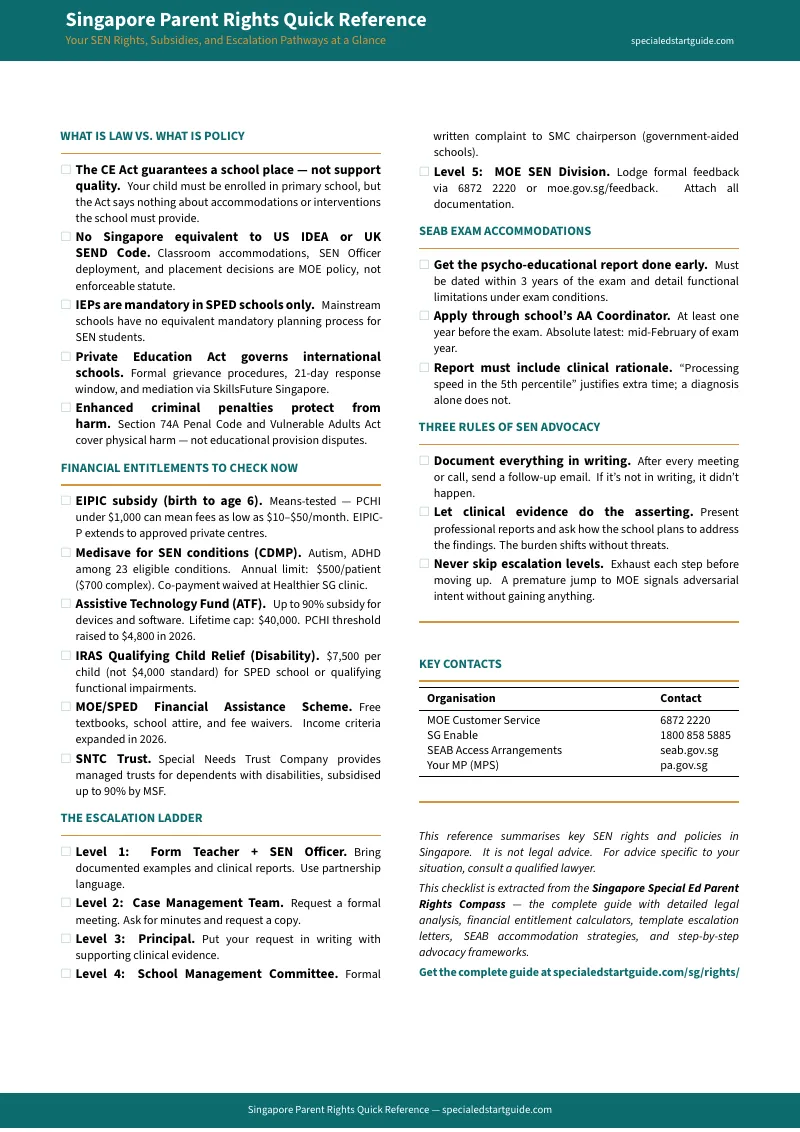
- Singapore Parent Rights Quick Reference — a printable one-page checklist covering statutory vs. discretionary rights, financial entitlements to check immediately, the five-level escalation ladder, SEAB exam accommodation timelines, and the three rules of Singapore SEN advocacy
- Statutory vs. Policy Matrix — a one-page reference mapping every major SEN provision to either enforceable law or discretionary policy — print it and place it on the table at your next school meeting
- Financial Audit Checklist — a printable checklist covering every subsidy your family may be eligible for across MOE, MSF, MOH, SG Enable, IRAS, and CPF — with eligibility criteria and action steps for each
- Dispute Escalation Ladder — the five-level pathway from Form Teacher to MOE Special Educational Needs Division, with documentation tips and cultural calibration guidance at each step
- SEAB Exam Accommodations Guide — the timeline, evidence requirements, and application strategy for PSLE and GCE Access Arrangements — start years early, not months
- Advocacy Letter Templates — four fill-in-the-blank letters for requesting meetings, requesting SEAB accommodations, creating a paper trail after meetings, and escalating to MOE
- Key Contacts Directory — a one-page reference card with phone numbers and websites for every government agency, social service agency, and parent community relevant to SEN in Singapore
Instant PDF download. 8 PDFs total. Print the Quick Reference tonight. Send your first follow-up email after the next school meeting tomorrow.
Money-back guarantee, no time limit. If the Compass does not change how you advocate for your child's education, email us for a full refund. No questions asked.
Not ready for the full Compass? Download the free Singapore Parent Rights Quick Reference — a printable checklist covering what is law vs. what is policy, the financial entitlements you should check immediately, the escalation ladder, SEAB exam accommodation timelines, and the three rules of advocacy that work within Singapore's institutional culture. It is enough to walk into your next school meeting knowing which provisions are enforceable and which depend on the principal's goodwill — and it is free.
86% of Singapore SEN parents surveyed were unclear about what their child was actually entitled to. The Compulsory Education Act guarantees a school place. Medisave covers qualifying SEN conditions. The Assistive Technology Fund covers up to 90% of devices. IEPs are mandatory in SPED schools. The MOE Special Educational Needs Division is your final escalation point. This Compass makes sure you know these provisions and every other one that governs your child's education.