Your Child Turns Eighteen and the Entire System Disappears
You have spent years navigating IEP meetings, SENO allocations, SNA support, and Children's Disability Network Team appointments. Your child's school provides structure, routine, and accountability. Then they reach eighteen. And every support they depend on simply ends.
In Ireland, this moment has a name. Parents, advocacy groups, and researchers all call it the "cliff edge." It is not a metaphor. The Department of Education stops. The NCSE's mandate expires. The CDNT discharges your child. The SNA goes home. And your family is left facing a fragmented adult system split across the HSE, the Department of Social Protection, the Decision Support Service, and a half-dozen application processes — each with its own deadlines, its own eligibility rules, and its own waitlists that stretch for years.
Free resources exist. The NCSE publishes research papers. AHEAD covers the DARE scheme. Citizens Information lists benefits. Inclusion Ireland produces policy briefings. But these resources sit in separate silos, written in policy language, structured as reference encyclopaedias. They explain what services exist. They do not tell you what to do, in what order, or when to start. They certainly do not tell you what happens when the system fails — because the state does not advertise its own capacity shortfalls.
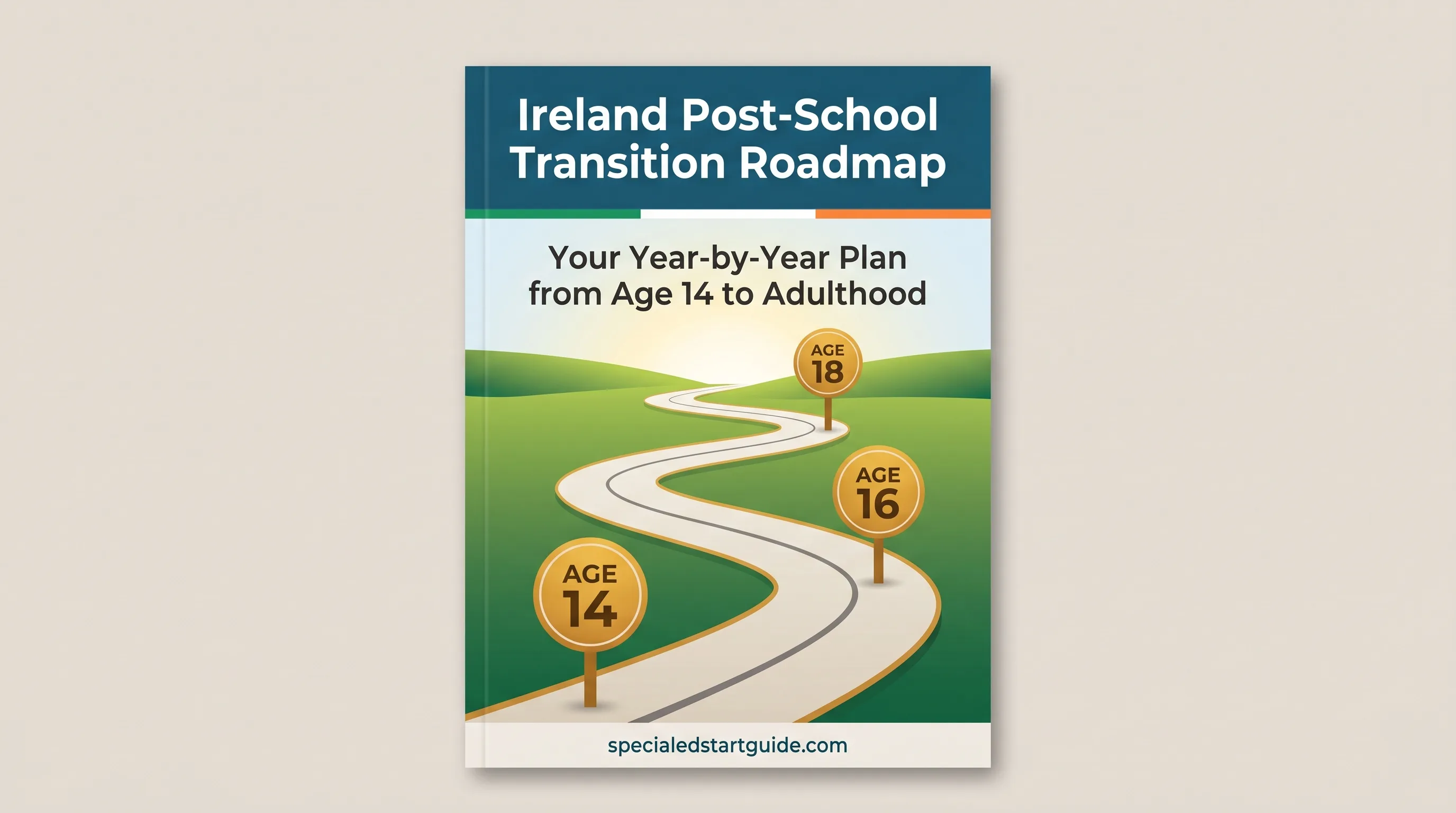
The Ireland Post-School Transition Roadmap is the Cliff Edge Prevention System — the guide that consolidates every post-school pathway, every financial entitlement, every legal framework, and every critical deadline into a single, year-by-year action plan that starts at age fourteen and runs through your child's first year as an adult. Whether your child is heading for university through DARE, vocational training through the NLN, or HSE Adult Day Services, the Roadmap covers the specific track — with the exact steps, the exact deadlines, and the exact agency contacts you need at each stage.
What's Inside the Roadmap
The Year-by-Year Action Plan (Ages 14–19)
No free resource in Ireland provides a chronological transition framework adapted to the parent's lived experience. This guide does. At age fourteen: which Senior Cycle pathway to choose and what each one closes off. At age sixteen: the Domiciliary Care Allowance stops automatically, and you must have the Disability Allowance application submitted at least twelve weeks before your child's birthday — because there is no grace period and no automatic transfer. At seventeen: DARE documentation must be assembled months before the March deadline, because the Irish healthcare system's waiting lists mean a late booking for a psychologist or consultant may not produce a report in time. At eighteen: CAO deadlines, ADMA registration, clinical discharge, HSE placement. Every step, every deadline, every agency — sequenced so you execute the right task at the right time instead of discovering deadlines after they pass.
Senior Cycle Pathways — The Choice That Shapes Everything
The decision between the traditional Leaving Certificate, the Leaving Certificate Applied, and Level 1/Level 2 Learning Programmes determines your child's post-school options for years. The guide explains what each pathway qualifies your child for and what it closes off. The LCA does not generate CAO points — which means no direct university entry. L2LPs lead toward HSE-funded adult services, not traditional employment. Parents making this choice in Third Year rarely understand the downstream consequences. This chapter makes them visible before the decision is locked in.
RACE Exam Accommodations — The November Deadline Nobody Warns You About
The Reasonable Accommodations at Certificate Examinations scheme provides readers, scribes, spelling waivers, word processors, and separate centres. But applications must be submitted by early November of the year before the exam — and for the 2026 Leaving Certificate, students with direct intervention accommodations automatically receive an extra ten minutes per paper. The guide covers what qualifies, what documentation the school needs, and what to do if an application is refused.
DARE and CAO — Three Deadlines That Cannot Slip
The Disability Access Route to Education reduces the CAO points threshold for eligible students. But the application has three absolute deadlines that fall in rapid succession: the CAO application by 1 February, DARE indication by 1 March, and Supplementary Information Form Sections B and C posted to the CAO by 10 March. Missing any one locks your child out of the scheme entirely. The guide details the three-section SIF structure, explains exactly what medical and educational evidence is required, and provides the preparation timeline that ensures you are not scrambling in February with missing documentation.
The DCA-to-DA Financial Transition — The Panic That Hits at Sixteen
When your child approaches their sixteenth birthday, the Department of Social Protection sends a letter informing you that the Domiciliary Care Allowance — a non-means-tested payment to the parent — will cease. Your child must then independently apply for the Disability Allowance, which is means-tested on the child's income, not the parents'. Most families qualify for the full rate. But if you do not begin the application twelve weeks before the birthday, you face a gap in payments that compounds every month. The guide covers the exact application procedure, the medical evidence required, and the downstream entitlements that unlock once DA is approved: the Free Travel Pass, the Companion Pass, and the earnings disregard that lets your child work without losing benefits.
The Earnings Disregard — The Calculation That Removes the Fear
Parents across Irish forums express terror that a part-time job will cost their child the Disability Allowance. The guide provides the exact numbers: the first EUR 165 per week earned from employment is completely disregarded. Earnings between EUR 165 and EUR 375 are assessed at a 50% disregard rate. A young adult earning EUR 250 per week retains their full DA payment minus only EUR 42.50. Understanding this calculation is the difference between encouraging vocational development and keeping your child home out of financial fear.
The Assisted Decision-Making Act 2015 — What Happens to Your Parental Rights at Eighteen
When your child turns eighteen, you legally lose the right to make medical, financial, and welfare decisions on their behalf. The old Wards of Court system was abolished in April 2023. In its place, the Assisted Decision-Making (Capacity) Act 2015 created three tiers of formal support agreements that must be registered with the Decision Support Service before the eighteenth birthday: Decision-Making Assistance (EUR 15 fee), Co-Decision-Making (EUR 90 fee), and Decision-Making Representation (court application). Banks enforce these rules strictly — you may be locked out of your adult child's account on their birthday without a registered agreement. The guide translates the dense legalese of the ADMA into plain English and provides the sequential steps to register the correct tier before the deadline arrives.
HSE Adult Services — Both Tracks Covered
If your child is heading for HSE Adult Day Services, the guide covers the School Leaver Referral Form, the Day Opportunities Officer assignment, the Support Profile, sampling periods at prospective service providers, and what to do when the placement does not materialise on time. If your child is heading for Rehabilitative Training, it covers the two-to-four-year programme structure and what happens after training ends. Both tracks are detailed separately because the anxiety, the agencies, and the timelines are completely different.
Employment Pathways — Beyond the Disability Allowance
For young adults heading toward open or supported employment, the guide covers EmployAbility services, the Wage Subsidy Scheme (which pays employers up to EUR 6.30/hour as an incentive), the Workplace Equipment Adaptation Grant, the WALK PEER programme, and how to navigate disclosure in the workplace. Employment outcomes for people with disabilities in Ireland are among the worst in the EU — 49.3% employment versus 70.8% for the general population. The guide provides the specific programmes and incentives that improve those odds.
Who This Roadmap Is For
- Parents of teenagers with any Special Educational Need in Ireland — autism, intellectual disability, dyslexia, ADHD, physical disability, sensory impairment — who know the school-based support system is ending and need to know what comes after
- Parents whose child is between fourteen and seventeen who want to start planning before the deadlines arrive — because by the time you discover a deadline has passed, there is no mechanism to recover the lost time
- Parents whose child is already seventeen or eighteen and who need the consolidated action plan immediately — the guide is structured so you can jump directly to the age that matches your situation
- Parents whose child is on the higher education track (DARE, CAO, PLC courses) and parents whose child is on the health and social care track (HSE Adult Day Services, Rehabilitative Training) — the guide covers both pathways in full because a single-track resource alienates half the families who need it
- Parents who have already visited Citizens Information, the NCSE website, AHEAD, and Inclusion Ireland — and have 47 browser tabs open, conflicting advice, and no idea what to do first
Why Not Just Use the Free Resources?
Ireland has excellent advocacy organisations. The NCSE produces authoritative research. AHEAD provides free DARE guidance. Citizens Information details every benefit. Here is what none of them provide:
- State agencies describe services, not strategy. The NCSE writes primarily for educators, policymakers, and researchers. Its parent-facing documents explain what Adult Day Services are but not how to secure a placement when only 700 school-leaver places exist nationally for a much larger cohort. Citizens Information tells you the Disability Allowance exists. It does not tell you to start the application twelve weeks before the sixteenth birthday, to open a bank account in the child's name beforehand, or to gather specific medical evidence months in advance. Free resources are structured as reference material for parents who already know the right question to ask.
- AHEAD covers one track. The HSE covers the other. Nobody covers both. If your child is heading for university, AHEAD is superb. If your child needs Adult Day Services, the HSE has guidelines. If you are not yet certain which track your child will follow — which is the reality for most families at age fourteen — no free resource helps you plan for both possibilities simultaneously.
- Advocacy organisations lobby government, not guide individual families. Inclusion Ireland, AsIAm, and Down Syndrome Ireland produce vital policy submissions and accessible guides. They do not provide a chronological, age-by-age planning framework that tells you what to submit, to whom, and by when. Their mission is systemic change. Your mission is getting your individual child through a broken system before the systemic change arrives.
- UK resources cite the wrong law. The English-language internet is flooded with SEN transition resources from the UK — EHCPs, Local Authorities, CCGs. None of these structures exist in the Republic of Ireland. An Irish parent following UK guidance will contact bodies that do not exist, cite legislation that does not apply, and waste months discovering the mismatch.
- Private consultants charge EUR 80 to EUR 300. Financial Wellbeing Ireland charges EUR 300 for a bespoke financial plan and EUR 80-100 per hour for advisory work. Pathways Therapy runs synchronous transition workshops. For a fraction of a single consultation fee, this Roadmap provides the consolidated planning framework across all pathways.
Free resources explain what the system looks like from the inside. This guide tells you what to do, from the outside, when the system is not working.
— Less Than One Hour of a Private Transition Consultant
A single session with a private SEN consultant in Ireland starts at EUR 80. A comprehensive financial plan costs EUR 300. Specialised workshops require synchronous attendance and higher fees. This entire Roadmap covers what multiple consultants charge separately for — and it starts working the minute you download it.
Your download includes the complete 14-chapter Transition Roadmap plus 7 standalone printable tools — ready to use tonight.
- Complete Transition Roadmap (guide.pdf) — 14 chapters covering Senior Cycle pathways, RACE exam accommodations, DARE and CAO deadlines, the DCA-to-DA financial transition, earnings disregard calculations, the Assisted Decision-Making Act 2015, HSE Adult Day Services, Rehabilitative Training, further and higher education supports, employment pathways, housing and transport entitlements, clinical transition from CDNT to adult services, and building the Transition Portfolio
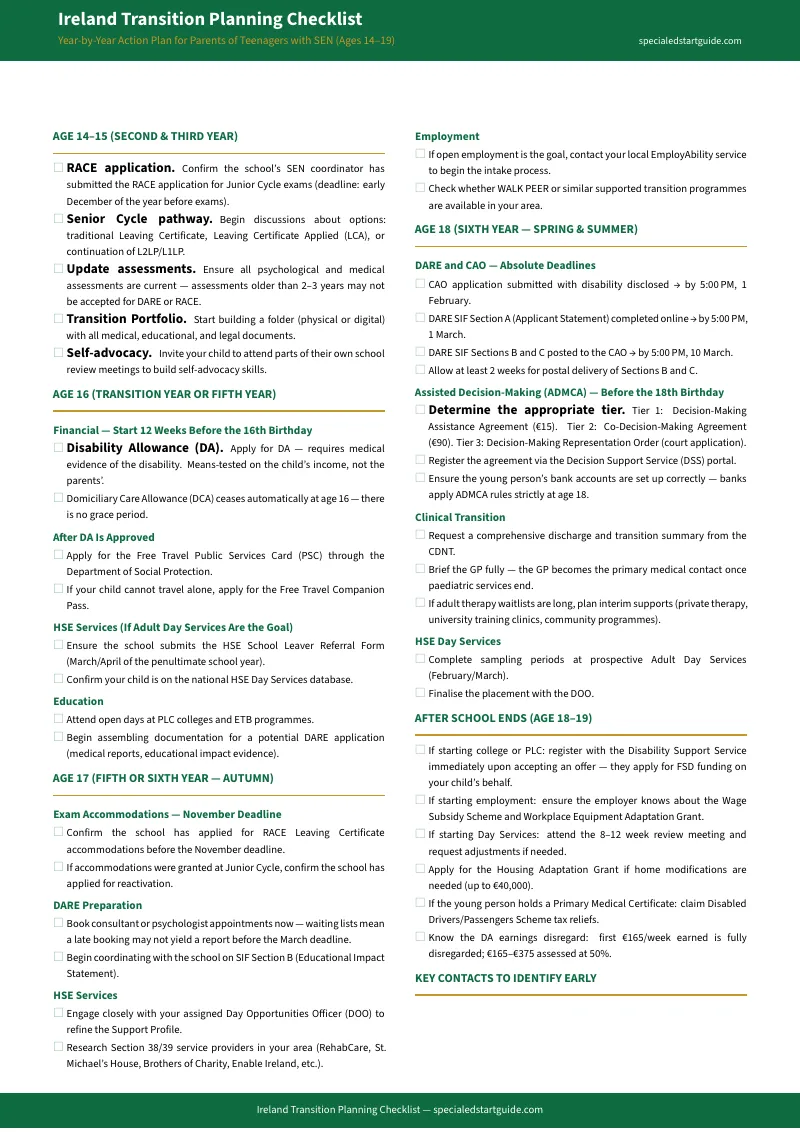
- Year-by-Year Transition Planning Checklist (checklist.pdf) — the printable action plan from age 14 to 19 with every deadline, every application, every agency contact, and every document you need — structured so you can tick items off as you complete them
- Master Timeline Fridge Sheet (master-timeline.pdf) — the detailed age-by-age action plan with checkboxes for every milestone from age 14 through 18+, colour-coded by urgency — print it, stick it on the fridge, and tick items off as you go
- Financial Entitlements Reference (financial-entitlements.pdf) — the DCA-to-DA transition timeline, earnings disregard calculation with worked example, Free Travel Pass, Carer's Allowance, Primary Medical Certificate, and Housing Adaptation Grant income tables — bring this to your DSP meeting
- DARE Deadline Tracker (dare-deadline-tracker.pdf) — the three absolute DARE deadlines, complete SIF documentation checklist, and what to do if the school will not cooperate — print and pin above your desk from November through March
- ADMA Reference Card (adma-reference-card.pdf) — the Assisted Decision-Making Act 2015 explained in plain English with the three-tier comparison, registration fees, and the steps to complete before the eighteenth birthday
- Organisations Directory (organisations-directory.pdf) — every statutory body, higher education support service, employment programme, and advocacy group relevant to transition, with what each one actually does
- Transition Portfolio Checklist (transition-portfolio-checklist.pdf) — the complete document organiser for your transition binder, with checkboxes for every medical, educational, financial, legal, and planning document you need to collect
Instant PDF download. Eight files, ready to print. Find the age that matches your child and start the first action item tonight.
Money-back guarantee, no time limit. If the Roadmap does not change how you plan your child's post-school transition, email us for a full refund. No questions asked.
Not ready for the full Roadmap? Download the free Ireland Transition Planning Checklist — a year-by-year action plan from age 14 to 19 covering key deadlines, agency contacts, and planning milestones for every post-secondary pathway. It shows you what to do and when. It is enough to walk into your next planning meeting with a clear timeline — and it is free.
Your child's school-based support system has an expiry date. The cliff edge is not a metaphor — it is a policy reality. This Roadmap ensures you are already on the other side when the support disappears.