The EPSEN Act Promised Your Child a Legally Binding IEP. Twenty Years Later, It Still Hasn't Delivered. This Blueprint Gives You the Laws That Actually Work.
You've sat in School Support Plan meetings where the principal explained they "don't have the resources" for your child. You've been promised the SENO would "look into" the SNA allocation and never heard back. You've watched your child's Support Plan promise targets like "access to SET support" and "ongoing monitoring" — phrases that sound official but commit the school to absolutely nothing.
Meanwhile, the Assessment of Need that was supposed to take six months is now past eighteen months. Your child is falling further behind every week. And you're not sure whether the next email should go to the school, the SENO, the NCSE, the HSE, or your local TD — because nobody in this system seems to be in charge.
Here's what nobody tells you: the EPSEN Act 2004 — the law that was supposed to guarantee your child a legally binding Individual Education Plan, an independent assessment, and a dedicated appeals board — has never been fully commenced. Eighteen critical sections remain switched off. School Support Plans are administrative documents, not legal contracts. If a school fails to deliver what it promised, you cannot invoke the EPSEN Act to compel compliance.
But you are not powerless. The Ireland NEPS & SEN Blueprint is the tactical toolkit that pivots your advocacy away from the broken EPSEN promise and onto the Irish laws that actually carry teeth — the Education Act 1998, the Equal Status Acts, and the Disability Act 2005 — with every template, script, and checklist written specifically for the Irish system.
What's Inside the Blueprint
The EPSEN Workaround Strategy
State resources explain the system as if the EPSEN Act works. Charities explain what the law says in principle. Neither tells you that eighteen sections were never commenced and your child's Support Plan has no statutory enforcement mechanism. This guide explains exactly which laws carry real weight in Ireland today — Section 15(2)(d) of the Education Act 1998 (the Board of Management's statutory duty to use State SEN funding), the Equal Status Acts (the WRC discrimination route that awarded €40,000 in a landmark 2026 decision), and the Disability Act 2005 (statutory Assessment of Need timelines with legal escalation when the HSE breaches them). Stop citing the wrong law. Start citing the ones that trigger obligations.
The Vague-Wording Hitlist
Schools save time and avoid accountability by filling Support Plans with phrases that sound like commitments but are legally meaningless. "Access to SET support" doesn't specify hours. "Ongoing monitoring" is observation, not intervention. "Differentiated work" describes nothing actionable. "Support as needed" has no definition. The hitlist identifies every one of these phrases and gives you the specific, measurable replacement to demand — exact weekly SET hours, named intervention programmes, scheduled review dates, and SMART targets with defined success criteria. Open your child's SSP, scan it against the list, and highlight every phrase that fails.
Cut-and-Paste Letter Templates
Five template letters, each pre-loaded with the specific Irish legal citations that create a paper trail the moment you send them. Request a formal School Support Plan meeting with the SET and Principal. Apply to the Board of Management for SNA support, citing the Board's statutory duty under the Education Act 1998. Challenge an unapproved reduced timetable — with the Department guidelines that make it indefensible. Lodge a formal complaint when Support Plan commitments aren't delivered. Cover an HSE Assessment of Need application with the Disability Act 2005 language that puts the six-month clock on record. These aren't American IEP templates with the terminology swapped out — they cite Irish legislation, address Irish bodies, and follow Irish escalation procedures.
The Meeting Survival Guide
What to do two weeks before the meeting: request documents, prepare your written submission, update your parental diary. What to do during the meeting: open by stating what you want (not waiting for the school to set the agenda), ask questions that demand data instead of impressions, challenge vague commitments in real time. What to do within 48 hours after: send the confirmation email that becomes your evidence when verbal promises evaporate. The guide includes the specific questions that force accountability — "How many SET hours is my child receiving per week, and in what format?" instead of "How is my child getting on?"
The Escalation Ladder
When the school says no, you need to know the next step immediately — not after weeks of Googling. The guide maps the complete Irish escalation pathway: internal school complaint to the Board of Management → SENO and NCSE intervention → Section 29 appeal for enrolment refusal or expulsion → Workplace Relations Commission for disability discrimination → Ombudsman for Children for administrative unfairness → High Court judicial review as the final option. Each step includes the filing mechanism, the statutory timeline, and the evidence you need before proceeding.
Assessment Pathway Breakdown
Ireland has three overlapping assessment routes, and most parents are stuck waiting on the wrong one. The HSE Assessment of Need has a statutory six-month limit — but over 20,000 applications were overdue by end of 2025. Private assessments cost €650 to €2,000 — and a diagnosis alone doesn't increase school resources under the current SET model. The school's own Continuum of Support framework can start immediately without any external report. The guide explains when to pursue each pathway, what each one actually triggers, and how to use the school-based route to get support now while the HSE catches up.
Transition Planning Framework
The move from primary to post-primary is where SNA allocations get reassessed, Support Plans fall through the cracks, and children who were coping in one classroom with one teacher suddenly face multiple subjects, teachers, and social dynamics. The guide covers the Year 6 preparation timeline, how to request a School Passport, what to demand from both the sending and receiving schools, and how to monitor and escalate during the first term when transition difficulties surface.
Who This Blueprint Is For
- Parents whose child's School Support Plan is full of vague phrases like "access to support" and "regular review" — and who need to know exactly why those words are worthless and what to demand instead
- Parents who've been told the school "can't help" without an HSE diagnosis — even though Circular 0002/2024 explicitly decoupled SET resources from medical reports
- Parents whose child has been placed on a reduced timetable without written consent — and who need the Department guidelines that make it indefensible
- Parents waiting 12, 18, or 24 months for an Assessment of Need while the statutory limit is six months — and who need the escalation route from HSE complaint to Disability Appeals Officer
- Parents whose child was refused enrolment or is being pushed out — and who need the Section 29 appeal process, timelines, and evidence requirements
- Parents approaching the primary-to-post-primary transition who know from other parents that SNA hours get cut and Support Plans vanish
- Parents who've spent €1,000+ on private psychological assessments and need the school to actually implement the recommendations — not file the report and carry on as before
- Parents who are exhausted from cross-referencing NCSE booklets, AsIAm guides, Citizens Information summaries, Department circulars, and Facebook groups — and need everything in one tactical toolkit
Why Not Just Use the Free Resources?
Ireland has dedicated, high-quality free resources for SEN families. Here's why parents still struggle after consulting all of them:
- NCSE parent booklets explain how the system is supposed to work — not what to do when it doesn't. The tone is bureaucratic and defensive of the state apparatus. SENOs are presented as collaborative partners. The booklets offer zero advice on what to write when a school says "no." This Blueprint gives you the templates for when the system breaks down — because that's when you actually need them.
- AsIAm provides outstanding advocacy information — at a macro level. Their Same Chance Report documented that 70% of respondents said the system is not inclusive. Their policy work is essential. But a parent facing a hostile principal tomorrow morning doesn't need systemic policy analysis — they need the exact legal phrase to put in tonight's email. This Blueprint provides the granular, combative, ready-to-send tools that charities can't offer.
- Inclusion Ireland outlines the legal frameworks — without the fill-in-the-blank templates. They'll tell you to "write a letter to the SENO." But expecting a parent in a state of cognitive overload to draft a legally sound, professional letter from scratch based on a bulleted list is unrealistic. This Blueprint provides the actual letters.
- Citizens Information provides sterile legal summaries — without the strategic edge. They accurately cite the Education Act and the Equal Status Acts. They don't tell you that citing the EPSEN Act is a dead end, that the WRC route carries €40,000 penalties, or that the Board of Management's "no resources" excuse directly contradicts their statutory duty under Section 15(2)(d).
- Etsy and Gumroad IEP planners are written for the US or UK. References to "504 plans," "due process hearings," and "local education authorities" have zero legal standing in Ireland. A €5 American template won't help you challenge a SENO or file a Section 29 appeal. This Blueprint uses exclusively Irish nomenclature — NEPS, SENO, NCSE, CDNT, AON, SET — because that's the system you're navigating.
The free resources explain what the law says. This Blueprint gives you the tools to make the school follow it.
— Less Than 15 Minutes With a Private SEN Consultant
Private educational psychology assessments in Ireland cost €650 to €2,000. SEN advocacy webinars cost €35 to €90 for passive viewing. Private advocacy services run into the thousands. If you eventually need professional help, the paper trail you build with this Blueprint saves hours of billable time — because you're handing your consultant an organised case, not a folder of unsigned Support Plans and half-remembered meeting notes.
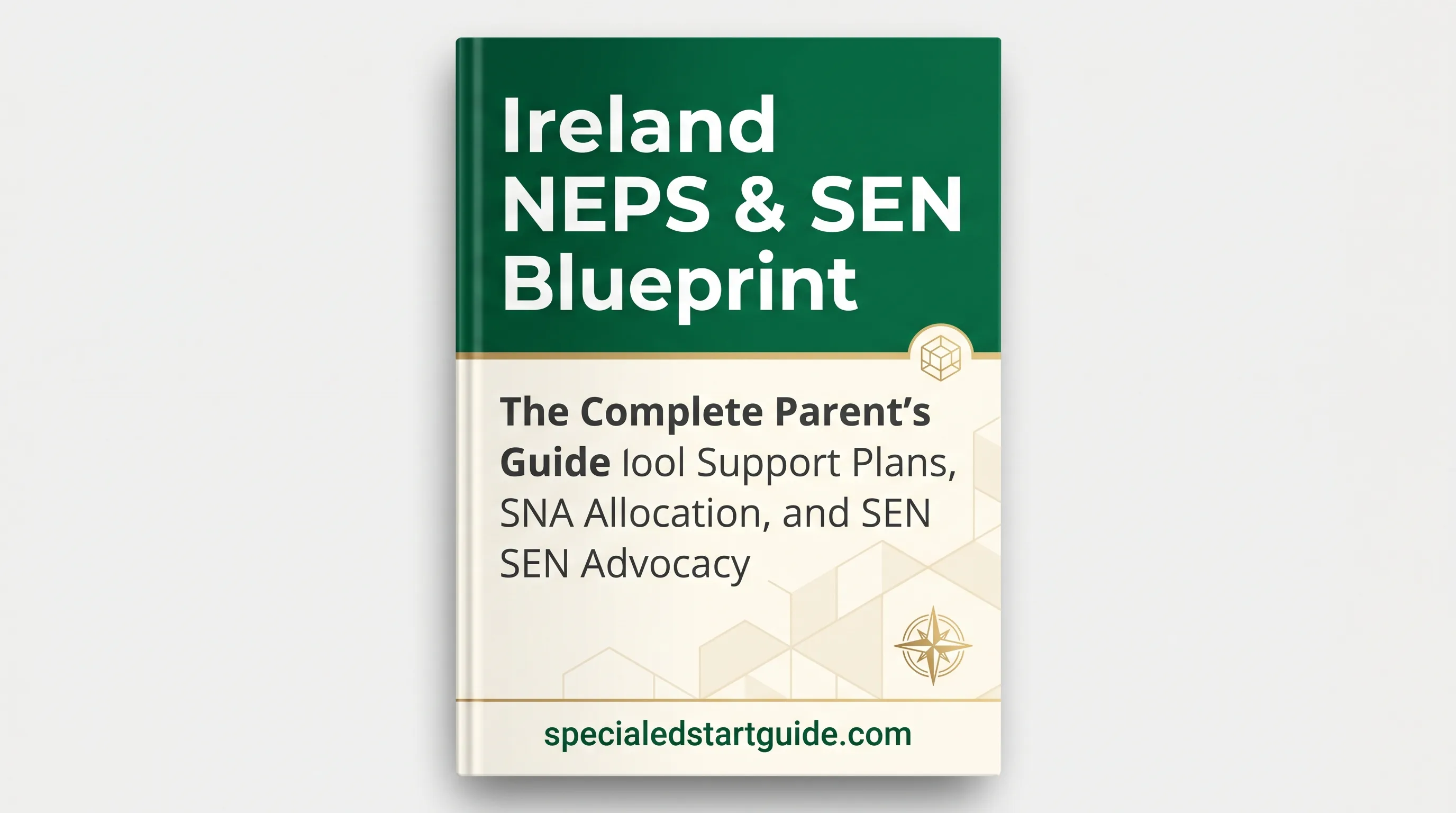
Your download includes 6 printable PDFs — the complete Blueprint guide plus five standalone reference tools, each ready to print and bring to your next meeting.
- Complete Blueprint Guide (guide.pdf) — 11 chapters covering the Irish legal framework, resource allocation (NCSE, SETs, SNAs), assessment pathways (HSE AON, private, school-based), School Support Plan quality standards, meeting preparation and advocacy tactics, dispute resolution and escalation, common scenarios with specific actions, transition planning, template letters, evidence file building, and key contacts
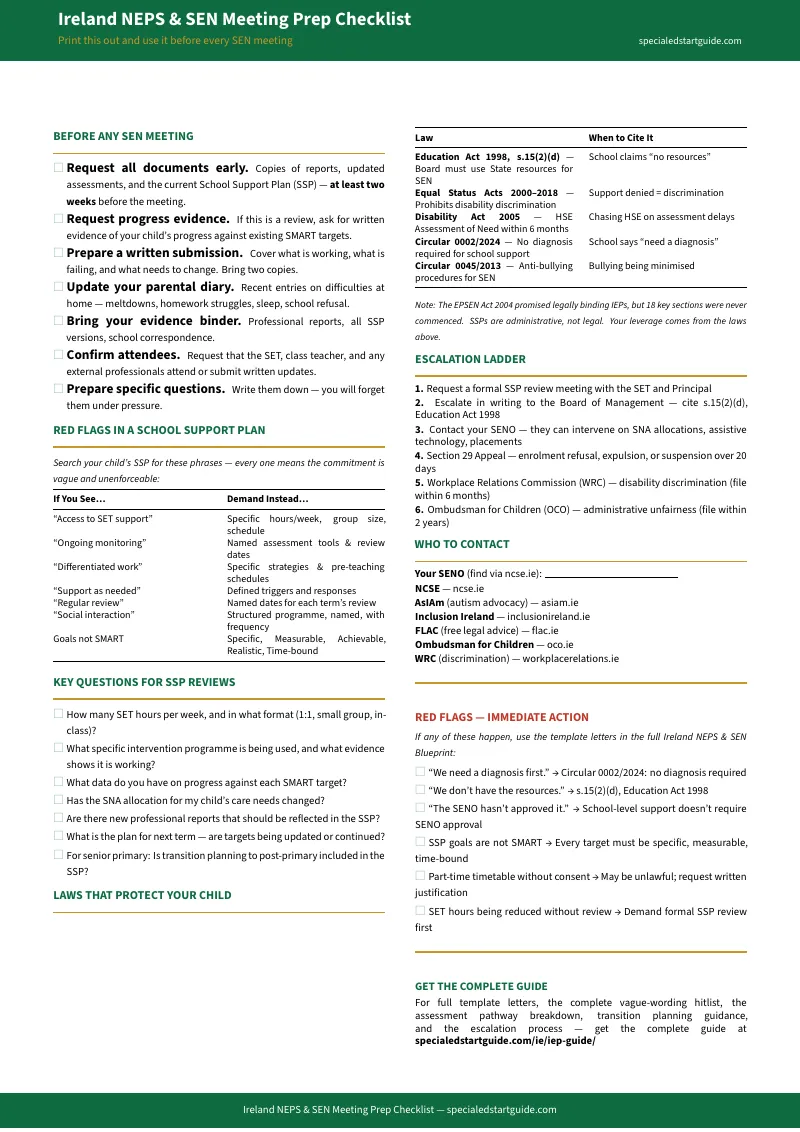
- Meeting Prep Checklist (checklist.pdf) — before/during/after checklists for SSP meetings, the vague-wording hitlist, key questions for review meetings, the laws that actually protect your child, the escalation ladder, and key contacts with fill-in fields for your SENO
- SSP Vague-Wording Hitlist (vague-wording-hitlist.pdf) — one-page reference card listing the six weak SSP phrases next to their specific, measurable replacements — hold it next to your child's Support Plan and highlight every phrase that fails
- Advocacy Letter Templates (letter-templates.pdf) — all five cut-and-paste letter templates extracted as a standalone document with Irish legal citations, ready to personalise and email tonight
- Escalation Pathway (escalation-pathway.pdf) — the complete six-step dispute resolution ladder from school complaint through High Court judicial review, with critical filing deadlines highlighted
- Key Contacts Directory (key-contacts.pdf) — national bodies, advocacy organisations, and fill-in fields for your SENO, CDNT, principal, and SET coordinator — print and keep in your evidence binder
Instant PDF download. Print the checklist and vague-wording hitlist tonight. Walk into tomorrow's meeting with the law on your side.
Money-back guarantee, no time limit. If the Blueprint doesn't change how you approach SEN meetings, email us for a full refund. No questions asked.
Not ready for the full Blueprint? Download the free Ireland NEPS & SEN Meeting Prep Checklist — a printable pre-meeting checklist covering what to review before Support Plan meetings, SSP red flags, key questions for SEN reviews, and the escalation ladder. It's enough to walk into your next meeting prepared, and it's free.
Your child's support isn't a favour the school grants when resources allow. It's a statutory obligation backed by laws that carry real consequences. After tonight, you'll know exactly which ones.