
You Have Been Fighting the Wrong Law for Years
You have spent years arguing over IEP commitments that the school quietly ignored. You attended every meeting, took notes, followed up by email, escalated to the SENO. And nothing changed. The school nodded sympathetically, mentioned budget constraints, promised to "review the situation next term" — and your child lost another year.
Here is what nobody told you plainly: an IEP in Ireland is not a legally binding document. The Education for Persons with Special Educational Needs (EPSEN) Act 2004 was supposed to give IEPs statutory force, create a Special Education Appeals Board, and mandate independent assessments. But eighteen critical sections of that Act were never commenced. More than two decades later, the enforcement architecture that was supposed to protect your child does not exist. Every hour you spent fighting over IEP contents was spent fighting a battle with no legal mechanism to win it.
The NCSE's publications, the school's guidelines, and even well-meaning SENOs describe the system as it was designed to work — not as it actually operates. Free resources from state agencies explain government policy under optimal, fully funded conditions. They do not tell you what to do when the system fails, because the state does not advertise its own legal liabilities.
But three other laws are fully active, fully enforceable, and carry severe consequences for non-compliance. The Ireland Special Ed Parent Rights Compass is the Enforceable Rights System — the guide that redirects your energy from the uncommenced EPSEN Act to the statutes that actually work: the Disability Act 2005, the Equal Status Acts 2000-2018, and the Education Act 1998. It gives you the exact legal templates, procedural timelines, case law citations, and dispute resolution pathways to make those laws work for your child — starting tonight.
What's Inside the Compass
The EPSEN Illusion — Exposed
A blunt, section-by-section breakdown of what was commenced and what was not. Why IEPs carry no statutory weight. Why the promised Special Education Appeals Board was never created. Why the mandatory mediation process does not exist. The guide does not soften this — it gives you the structural truth so you can stop wasting energy on a framework that cannot deliver what it promised and pivot to the laws that can.
The Disability Act 2005 — Your Most Powerful Legal Tool
The Assessment of Need process is the one area where the state gave parents enforceable statutory timelines and then could not avoid honouring them — because the High Court enforces compliance. Who can apply (you do not need permission from a GP, school, or SENO). The strict deadlines: 14-day acknowledgement, 3-month commencement, 6-month completion, 1-month Service Statement. The 90-minute SOP scandal and the High Court ruling that struck it down. And the full three-step enforcement pathway when the HSE misses the deadline: Disability Complaints Officer, Disability Appeals Officer, High Court judicial review. In 2023, 100% of appeals for missed timelines were upheld against the HSE.
The Equal Status Acts — Turning School Failures into Discrimination Claims
When a school fails to provide reasonable accommodation for your child's disability, that is not just poor practice — it is potentially unlawful discrimination. The guide covers the mandatory ES.1 notification form (strict 2-month deadline from the last act of discrimination), the 1-month response window, escalation to the WRC e-Complaint, and the case law that shows the WRC awards substantial financial compensation. Recent rulings include EUR 5,000 for excluding a blind student from Summer Provision and EUR 9,000 against a primary school for failing to accommodate medical needs. Schools know about the Equality Act — Mason Hayes & Curran runs seminars training principals how to defend against parent complaints. This guide puts you on equal footing.
The Section 29 Appeal — When Exclusion Becomes Your Lever
Section 29 of the Education Act 1998 gives you the right to appeal expulsion, cumulative suspension exceeding 20 days, and refusal to enrol. The guide covers the 63-day filing deadline, the mandatory 21-day Board of Management review, what evidence to present, how to demonstrate the school failed to make "exhaustive efforts," and the 2024 statistics showing 29% of post-primary expulsion appeals were overturned. Critically, it covers reduced timetables: Department of Education guidelines state that a reduced timetable without your written consent effectively constitutes an unlawful suspension — triggering Section 29 rights that the school hoped you did not know about.
Ten Ready-to-Send Advocacy Letter Templates
You do not need to start with a blank page when facing a 63-day Section 29 deadline or a 2-month ES.1 window. The Compass includes ten professionally drafted templates with the exact statutory citations, correct addressees, and fill-in-the-blank fields for your child's details: Assessment of Need application, HSE deadline breach complaint, ES.1 discrimination notification, Section 29 appeal submission, Board of Management review request, SNA allocation challenge, reduced timetable objection, GDPR Subject Access Request, Home Tuition application, and Ombudsman for Children complaint. Insert your details and send.
The Complete Dispute Resolution Map
Free resources operate in silos. The Department of Education explains Section 29. The WRC explains discrimination complaints. The HSE explains the Assessment of Need. Nowhere in the Irish system are these pathways synthesised into a single, chronological escalation matrix. The Compass maps every problem type to the correct body, the correct procedure, and the hard deadline you must not miss — in one reference table you can print and keep beside your laptop.
Who This Compass Is For
- Parents who have spent years attending IEP meetings and watching commitments evaporate — who have just discovered that an IEP in Ireland carries no statutory enforcement mechanism, and who need to know which laws actually give them leverage
- Parents whose child has been waiting months or years beyond the six-month statutory deadline for an Assessment of Need — who are told the HSE is "working through the backlog" and need the enforcement pathway that forces compliance
- Parents whose child was placed on a reduced timetable without written consent — who do not know this constitutes an unlawful suspension with immediate Section 29 appeal rights
- Parents whose child is facing expulsion or cumulative suspension for behaviour directly related to their disability — who need to file a Section 29 appeal but do not know the 63-day deadline, the evidence requirements, or the Board of Management review procedure
- Parents who were told "we don't have the SNA allocation" or watched resource teaching hours get quietly reduced — who need to know whether this constitutes a failure to provide reasonable accommodation under the Equal Status Acts
- Parents who have read everything on the NCSE website, Inclusion Ireland, AsIAm, and Citizens Information — and still do not have the actual letter templates, statutory citations, and procedural steps to file a formal complaint or appeal
- Parents who considered hiring a solicitor but found that a single consultation costs EUR 200 to EUR 350 — and who need to know their legal position before deciding whether professional representation is necessary
Why Not Just Use the Free Resources?
Ireland has respected advocacy organisations. Inclusion Ireland produces policy briefings that drive national debate. AsIAm provides detailed explainers on the EPSEN review and autism-specific policy. Citizens Information outlines the education system. The NCSE publishes parent guides. Here is what none of them provide:
- State agencies describe policy, not leverage. The NCSE is an organ of the state, responsible for managing finite, constrained budgets. Its publications meticulously avoid highlighting the state's legal liabilities or your enforceable rights when the system fails. They explain how the system is hypothetically designed to work. They do not provide the combative mechanisms you need when the system inevitably breaks down — because the state does not advertise its own vulnerabilities.
- Advocacy organisations lobby government, not school boards. Inclusion Ireland and AsIAm produce powerful submissions to the Oireachtas and align strategy with the UNCRPD. When your child is facing an illegal suspension on Tuesday and you have a statutory deadline on Thursday, a 40-page policy briefing on inclusive education principles is not what you need. These organisations explain what the law should ideally be in the future. This guide gives you the templates to enforce what the law currently is today.
- Citizens Information explains that rights exist. It does not explain how to exercise them under pressure. It tells you that you can make a Section 29 appeal. It does not tell you how to construct a legally robust argument that will withstand the scrutiny of an independent appeals committee. It outlines the existence of SNAs. It offers no tactical advice on how to secure one when your application is denied.
- Etsy planners cite the wrong country's law. Digital download marketplaces are flooded with "IEP Planners" and "Special Education Trackers" priced between EUR 3 and EUR 15. Almost all reference the US IDEA Act, 504 plans, and American IEP structures. Citing foreign legislation to an Irish school principal does not just fail — it immediately destroys your credibility at the exact moment you need it most.
- Education law solicitors charge EUR 200 to EUR 350 per hour. Specialised legal textbooks cost EUR 175 to EUR 325 per volume. Independent SEN advocates charge EUR 90 to EUR 140 per session. For a one-time purchase, this Compass gives you the legal framework to self-advocate — and if you do eventually need a solicitor, an organised case file with properly cited correspondence will save thousands in billable hours.
Free resources tell you how the system is supposed to work. This guide gives you the legal templates to use when the system fails you.
— Less Than Ten Minutes of an Education Law Solicitor
A single consultation with a specialised education solicitor in Ireland starts at EUR 200. An independent SEN advocate charges EUR 90 to EUR 140 per session. Specialised legal textbooks run EUR 175 to EUR 325. This entire Compass costs less than a brief phone call with any of them — and covers what none of them do: every enforceable right, every dispute pathway, and every template in one tactical reference.
Your download includes the complete 10-chapter Rights Compass plus three standalone printables — ready to use tonight.
- Complete Rights Compass Guide — 10 chapters covering the EPSEN Act reality, the Disability Act 2005 enforcement pathway (Assessment of Need timelines and three-step escalation to the High Court), the Equal Status Acts complaint procedure (ES.1 form, WRC e-Complaint, case law with compensation amounts), Section 29 appeal strategy (expulsion, suspension, refusal to enrol), practical school rights (reduced timetables, SNA allocation, SET hours, exam accommodations, GDPR access), funding entitlements (SEN Transport, Assistive Technology, Home Tuition, DCA), the complete dispute resolution map, the EPSEN review and future legislation, ten ready-to-send advocacy letter templates, and the documentation system
- 10 Advocacy Letter Templates — standalone printable with every template ready to fill in and send: Assessment of Need application, HSE deadline breach complaint, ES.1 discrimination notification, Section 29 appeal, Board of Management review, SNA allocation challenge, reduced timetable objection, GDPR Subject Access Request, Home Tuition application, and Ombudsman for Children complaint
- Dispute Resolution Map — one-page reference card mapping every problem type to the correct body, procedure, form, and hard deadline — print it and keep it beside your laptop
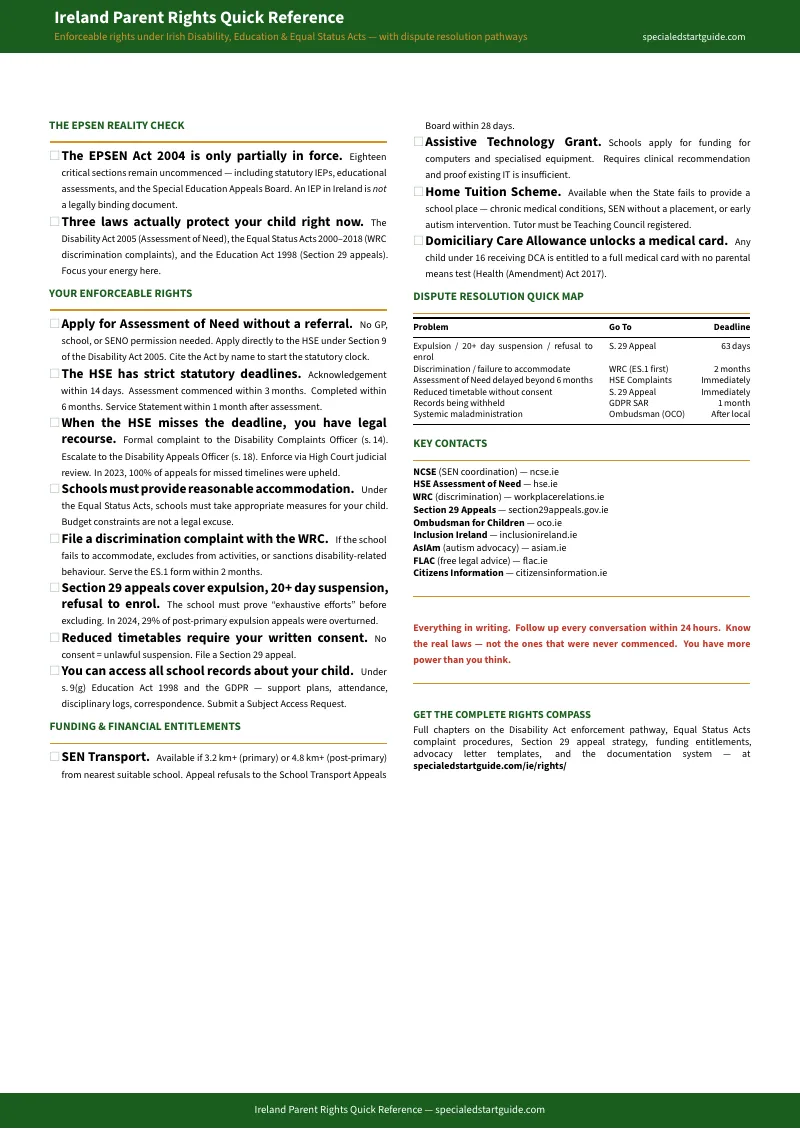
- Ireland Parent Rights Quick Reference — the printable checklist covering your core enforceable rights at a glance, the dispute resolution quick map, key contacts for the NCSE, HSE, WRC, Section 29 Appeals Board, Ombudsman for Children, Inclusion Ireland, AsIAm, FLAC, and Citizens Information
Instant PDF download. Four files, ready to print. Find the advocacy letter that matches your situation tonight. Send it tomorrow morning.
Money-back guarantee, no time limit. If the Compass does not change how you advocate for your child's education, email us for a full refund. No questions asked.
Not ready for the full Compass? Download the free Ireland Parent Rights Quick Reference — a one-page summary of enforceable rights under the Disability Act, Equal Status Acts, and Education Act, with the dispute resolution quick map showing which body to contact, which form to file, and which deadline applies for every common problem. It is enough to walk into your next school meeting knowing which laws actually protect your child — and it is free.
Your child has enforceable legal rights under the Disability Act 2005, the Equal Status Acts, and the Education Act 1998. The EPSEN Act's promises were never switched on. These laws were. This Compass makes sure you know how to use them.