The School Provided Structure for 12 Years. Then It Stopped. Nobody Handed You a Plan.
Your child's Care Dependency Grant — R2,090 every month — terminates the month they turn 18. The school's obligation to educate them expires. The Individual Support Plan that took years to negotiate becomes a historical document. And the government departments responsible for adult services — Social Development, Higher Education, Labour — operate in entirely separate silos that do not communicate with each other.
There is no automatic transfer from the Care Dependency Grant to the adult Disability Grant. There is no formal handoff from the school to a post-school institution. There is no single government office that coordinates the transition. The information you need exists — scattered across the SASSA website, the NSFAS portal, 21 different SETA websites, the Department of Higher Education, and dozens of NGO publications — each written in policy language, each assuming you already understand the system.
A private educational psychologist can assess your child's aptitude for R3,000 to R5,000 per consultation. They will not tell you how to fill out NSFAS Disability Annexure A, survive a SASSA medical assessment, or navigate a SETA learnership portal. The school's SBST says "we'll look into it" and never follows up. Academic research consistently confirms that South African special schools fail to provide structured transition planning — parents describe being "hit hard" by the sudden reality of the post-school cliff edge.
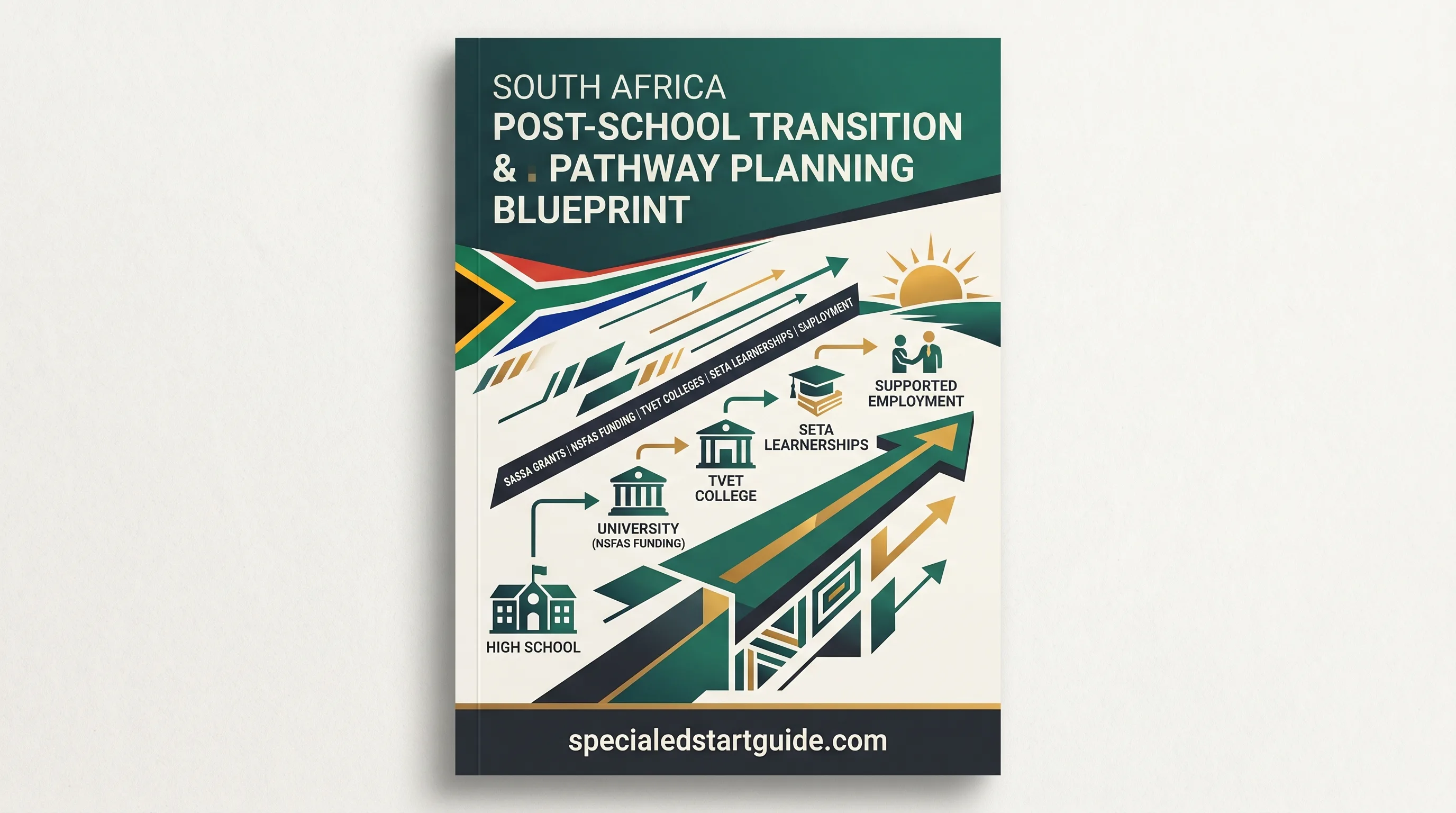
The Post-School Transition Blueprint is the Bureaucratic Decoder System — the single document that replaces 200 hours of scattered government websites with a step-by-step roadmap covering every post-school pathway, every funding source, every application form, and every deadline your child faces between age 14 and adulthood.
What's Inside the Blueprint
Every Post-School Pathway Mapped and Compared
Seven distinct pathways — because university is not the only option, and for many learners, it is not the right one. University Disability Rights Units with contact details for nine major institutions. TVET colleges and the NCV/NATED distinction — what the entry requirements actually are, which campuses have functioning disability support, and how to audit a college before enrolling. SETA learnerships with stipend information and disability quota obligations. Community Education and Training colleges. Supported Employment Enterprises. Protective workshops and day care programmes. Self-employment through NYDA grants. Plus a structured comparison matrix that lets you evaluate each option side by side — entry requirements, cost, funding availability, support level, and realistic employment outcomes.
The SASSA Grant Switch — Medical Evidence Preparation Checklist
The Care Dependency Grant stops at 18. The adult Disability Grant application starts from scratch. Medical assessments are subjective — assessing doctors frequently struggle with the forms and sometimes reject applicants whose disabilities are severe but not visible. The Blueprint includes a medical evidence preparation checklist that tells your doctor exactly what to write regarding "functional impairment" and "permanence" to prevent bureaucratic rejection, what documents to bring to the SASSA appointment, what happens during the means test, and the 90-day appeal process if your application is denied. This section alone can prevent a loss of R2,090 per month — R25,080 per year — from a botched application.
NSFAS Disability Funding — Annexure A Walkthrough
Disabled students qualify for NSFAS under a household income threshold of R600,000 — compared to R350,000 for other students. NSFAS covers tuition, accommodation, living allowance, assistive devices (up to R54,080), and human support costs. But the application lives or dies on Disability Annexure A — a form your doctor must complete using specific Washington Group disability categories, with specific language about functional limitations. The Blueprint walks you through Annexure A step by step — what the doctor must certify, which categories to address, how to prepare the documentation — so your application is approved the first time. Plus the N+3 academic progression rule, what happens if your child fails a year, and the appeal process.
The Section 12H Employer Pitch Template
South African companies receive up to R120,000 in tax rebates under Section 12H of the Income Tax Act for hiring disabled youth on SETA learnerships. The Employment Tax Incentive provides monthly wage subsidies. Disabled employees contribute to B-BBEE scorecard targets under the Employment Equity element. The Blueprint includes an employer pitch template — a one-page document you hand directly to prospective employers showing the financial incentives for hiring your child. It transforms your child from a perceived liability into a documented financial advantage.
Legal Capacity at 18 — Curatorship and Administrator Options
The day your child turns 18, you lose the legal authority to make decisions on their behalf. For young adults with intellectual or psychosocial disabilities who cannot manage their own affairs, you need a legal mechanism. The Blueprint covers High Court curatorship applications, the faster Master's Administrator alternative, what each costs, when to start the process, and which option fits your child's level of support need.
The Transition Timeline — Year by Year from Age 14
When to request a transition meeting with the SBST. When to arrange vocational assessments. When to apply for the adult ID document at Home Affairs. When to submit NSFAS applications. When to start the Disability Grant application. When to begin curatorship proceedings. Every milestone mapped to a specific age, with the exact actions and forms required at each step.
Disability-Specific Pathway Planning
Five dedicated sections covering autism (sensory-friendly environments, online learning, technology-focused learnerships), deaf and hard of hearing (SASL interpretation, SETA programmes with visual learning, university accommodations), blind and visually impaired (JAWS software, Braille support, assistive technology funding), intellectual disabilities (protective workshops, AIST screening, supported employment), and physical disabilities (infrastructure accessibility audits, assistive device funding, QASA employment networks). Your child's disability type determines which pathways are realistic — the Blueprint maps each one specifically.
The Rural Divide — Options When You Live Far from Services
Services concentrate in Gauteng, the Western Cape, and KwaZulu-Natal. If you live outside those metros, your options shrink dramatically — but they do not disappear. Distance learning through UNISA and CET colleges. Remote SETA learnerships. The subsistence agriculture pathway. And an honest assessment of when relocation is worth considering.
Who This Blueprint Is For
- Your child turns 18 in the next two years and you have just learned that the Care Dependency Grant stops entirely — with no automatic transfer to the adult Disability Grant — and you do not know what documentation you need or what the medical assessor will ask
- The school has no formal transition plan for your child — no pathway mapping, no vocational assessment, no connection to post-school institutions — and you have been told "we don't do that here"
- You know NSFAS offers disability funding but you have no idea how to complete Annexure A, what the doctor must write, or what happens if your child fails the academic progression requirement
- You have spent hours on SETA websites and cannot determine which learnerships accept disabled applicants, what the stipend is, or whether the entry requirements match your child's NQF level
- You have heard about TVET colleges but cannot establish whether the campus your child would attend has a functioning Disability Rights Unit, accessible infrastructure, or any track record of supporting learners with your child's specific disability
- You live outside Gauteng, the Western Cape, or KwaZulu-Natal and have discovered that supported employment, protective workshops, and disability NGOs are overwhelmingly concentrated in those three metros
- You have been told your child needs a curator or legal administrator after turning 18 but you do not know the difference, what each costs, or when to start the process
- You are terrified about what happens when you are no longer here — whether your child's Disability Grant will be protected, whether a special trust is worth the legal fees, and how to have the conversation with your other children about long-term responsibility
Why Not Just Use Government Websites?
You can. It will take you approximately 200 hours reading the SASSA website, the NSFAS portal, 21 SETA websites, the DHET Strategic Policy Framework, individual TVET college pages, the Department of Social Development guidelines, and dozens of NGO publications. Here is why parents still miss deadlines and lose grants after consulting all of them:
- The information is scattered across departments that do not communicate. SASSA handles grants. NSFAS handles funding. SETAs handle learnerships. DHET handles TVET colleges. The Department of Social Development handles protective workshops. Each has its own website, its own application process, its own eligibility rules, and its own deadlines. None of them reference each other. There is no single timeline that connects them.
- Everything is written in policy language. Parliamentary gazettes, strategic frameworks, annual reports. The SIAS policy is 100 pages. The DHET Strategic Policy Framework on Disability spans the entire post-school system. None of these documents are formatted as step-by-step guides for parents.
- No government website provides a medical evidence preparation checklist. The SASSA site tells you that a medical assessment is required. It does not tell you what your doctor must write about "functional impairment" and "permanence" to prevent the assessor from rejecting your child. It does not warn you that assessing doctors frequently struggle with the forms and sometimes reject applicants whose disabilities are severe but not visible.
- No free resource provides an employer pitch template. The Section 12H tax rebate and Employment Tax Incentive exist in the Income Tax Act. SETA disability quotas exist in legislation. But no government website consolidates these into a one-page document you can hand to a prospective employer showing why hiring your child is a financial advantage.
- Missing a deadline costs far more than this Blueprint. A botched SASSA transition means losing R2,090 per month. Missing the NSFAS application window means losing an entire academic year of fully funded education. A rejected Annexure A means repeating a process that takes months. You are not paying for the raw information — you are paying for 200 hours of consolidation, translation, and sequencing compressed into a document with actionable checklists and the deadlines that matter.
— Less Than a Week of the Grant You Are Trying to Protect
A private educational psychologist charges R3,000 to R5,000 per consultation. They assess your child's aptitude and personality — intrinsic factors. They almost never provide the extrinsic bureaucratic roadmap — the SASSA medical evidence checklist, the NSFAS Annexure A walkthrough, the SETA application navigation, or the employer pitch template. This Blueprint is the companion piece that turns a psychologist's assessment into an actual post-school placement.
Your download includes 8 PDFs:
- Complete 13-Chapter Transition Blueprint — Every post-school pathway mapped and compared, the SASSA grant switch with medical evidence checklists, NSFAS disability funding with Annexure A walkthrough, SETA learnership navigation, employer tax incentives with pitch template, legal capacity at 18, year-by-year timeline from age 14, disability-specific pathway planning for five categories, the rural service divide, long-term financial planning (wills, trusts, special trusts), self-advocacy skills, and a province-by-province resource directory
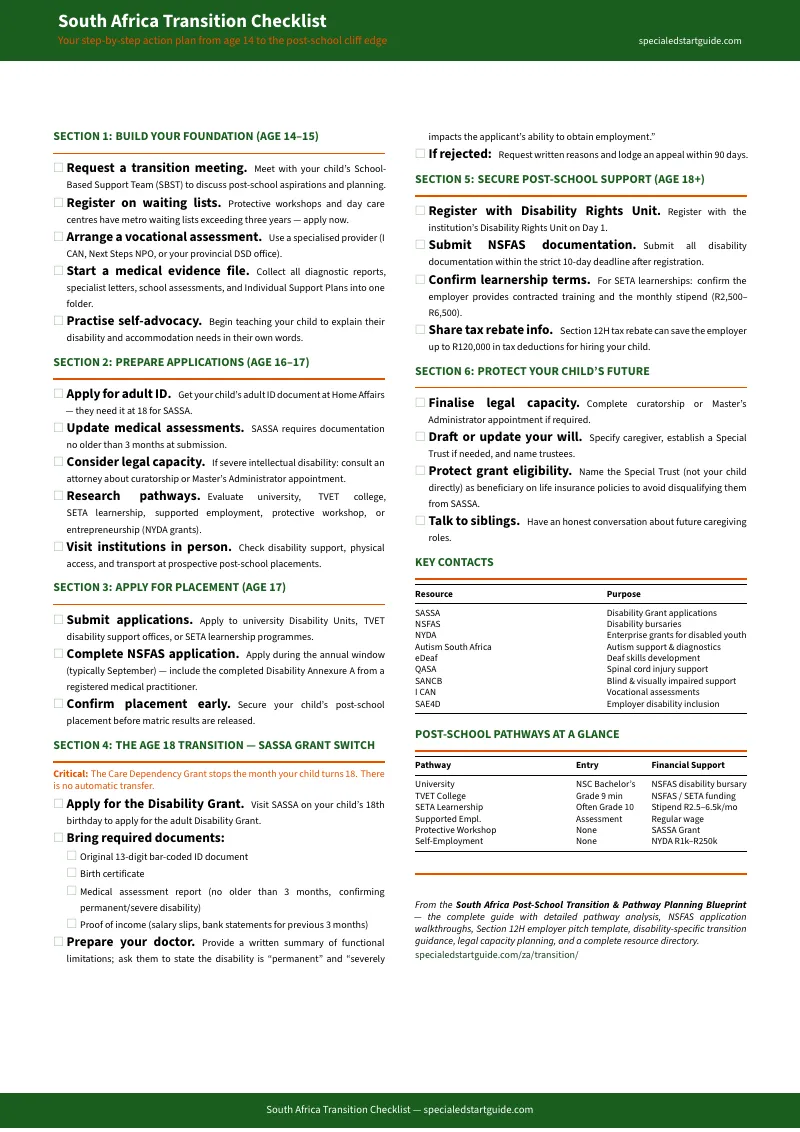
- South Africa Transition Checklist — Printable action plan covering every critical step from age 14 through the SASSA grant switch at 18 and beyond — foundation building, application preparation, post-school placement, the grant transition, NSFAS applications, employer engagement, and ongoing monitoring in a checkbox format
- SASSA Medical Evidence Preparation Checklist — Print-and-bring checklist for your doctor: exactly what to write about functional impairment and permanence, documents required, means test thresholds, and the 90-day appeal process
- NSFAS Disability Annexure A Walkthrough — Step-by-step guide to the disability funding application: Washington Group categories, doctor certification requirements, the 10-day submission deadline, enhanced allowances table, and the N+3 academic progression rule
- Section 12H Employer Pitch Template — One-page document you hand directly to employers showing the R120,000 tax rebate, Employment Tax Incentive, B-BBEE scorecard benefits, and SETA funding — with fill-in fields for your child's details
- Post-School Pathway Comparison Matrix — All eight pathways compared side by side: entry requirements, financial support, best suited for, and key contacts — one landscape page for quick reference
- Transition Timeline (Age 14–18+) — Year-by-year checklist from Grade 8 through adulthood: every milestone, every deadline, every form — designed to pin to your wall
- Support Networks & Resource Directory — Contact details for national organisations, government agencies, university Disability Rights Units, provincial DSD offices, and online communities
Instant PDF download. No video courses, no memberships — PDFs you can search on your phone, print at home, or take to a SASSA appointment.
Money-back guarantee, no time limit. If the Blueprint does not change how you plan your child's post-school future, email us for a full refund. No questions asked.
Not ready for the full Blueprint? Download the free South Africa Transition Checklist — a printable action plan covering every critical step from age 14 through the SASSA grant switch at 18 and beyond. It maps the timeline. The full Blueprint provides the step-by-step instructions, checklists, templates, and evidence preparation guides for every item on that timeline.
Every month without a transition plan is a month closer to the cliff edge — the SASSA grant termination, the NSFAS application deadline, the SETA learnership intake window, the school exit with no documented pathway. The information exists, but it is scattered across dozens of government websites that were not designed for parents. This Blueprint puts it all in one place.