The School Told You to "Be Patient." Here's the Letter That Ends the Waiting.
You asked the teacher about support for your child three months ago. She said she'd "flag it with the SBST." Nothing happened. You emailed the principal. He said "these things take time." You called the District Office. Nobody picked up. You called again. The line was busy. You tried a third time and someone told you to "come to the office in person" — during school hours, when you're at work.
Meanwhile, your child is sitting in a classroom of 45 learners with no differentiated instruction, no extra time, no sensory breaks, and no Individual Support Plan. The school hasn't completed an SNA 1 form. The SBST hasn't met. And every week that passes is another week of falling behind — academically, emotionally, and socially.
You've done the research. You've read about SIAS and White Paper 6 and the Constitutional right to basic education. You know your child has rights. But knowing the law and enforcing the law are two completely different things — and the South African education system is built to outlast parents who only know how to ask politely.
The SIAS Compliance Enforcement System gives you the exact written instruments — pre-drafted letters, escalation scripts, and legal citations — that force schools and districts to act. Not information about what the system should do. The actual tools that make it do it.
What's Inside
The Legal Architecture — Every Law the School Hopes You Don't Know
Section 29 of the Constitution. SASA Sections 5, 9, and 12. Education White Paper 6. The SIAS Policy (Gazette 38357). PEPUDA. The Western Cape Forum judgment. The BELA Act. Each one decoded into the specific clause you cite in the specific letter you send — so when a principal says "we can't accommodate your child," you know whether that's a legal impossibility or an administrative excuse.
Forcing the SIAS Process to Start
The school has legal obligations the moment they receive a written SIAS request citing Gazette 38357. Most parents never put it in writing because nobody tells them to. This chapter gives you the exact letter, the 10-day follow-up timeline, the escalation to the District Director when the school ignores you, and the pathway to the Provincial MEC when the district ignores you too. Each step builds a documented paper trail that makes the next escalation impossible to dismiss.
Challenging Unlawful Enrolment Refusals
A public school cannot lawfully refuse your child because of disability. SASA Section 5 prohibits it. The Constitutional Court has ruled that "resource constraints" is not a valid defence. This chapter walks you through getting the refusal in writing, filing an MEC appeal within the provincial deadline, submitting the Unplaced Learner form that triggers a placement obligation, and escalating to the Equality Court when the system still says no.
Stopping Informal Exclusions
The school doesn't formally expel your child. Instead, they call you at 10am to collect them because they're "struggling today." They suggest a shorter school day. They say your child "might be happier at home for a while." These are unlawful exclusions dressed up as concern. This chapter documents the tactics, gives you the letter that forces the school to acknowledge the pattern in writing, and escalates to the District Director when the pattern continues.
Disability-Related Discipline Protection
Your child cannot be suspended or expelled for behavioural manifestations of their disability — ADHD impulsivity, autistic meltdowns, anxiety-driven withdrawal — unless the school has first exhausted all ISP-based behavioural interventions. SASA Section 9 requires it. This chapter gives you the written response to a suspension notice, the documentation protocol that proves the ISP wasn't implemented, and the escalation pathway when the school disciplines first and asks questions never.
The Full Escalation Ladder
Class Teacher to HOD to Principal to SBST Coordinator to District Director to Provincial MEC to the South African Human Rights Commission. Each rung documented with who to write to, what to cite, what evidence to attach, and the timeline before moving to the next level. Most parents stall at the principal because they don't know there are seven more steps. The escalation ladder makes every step actionable.
Using the Equality Court Under PEPUDA
PEPUDA defines the denial of reasonable accommodation as unfair discrimination on the grounds of disability. Unlike education complaints that disappear into administrative processes, the Equality Court is a division of the Magistrate's Court where you do not need a lawyer to file. This chapter covers when to file, how to file, what the court can order, and where to get free legal help if you need it.
Reasonable Accommodation — What to Request and How
Extra time. A scribe. A separate venue. Assistive technology. Differentiated instruction. Sensory breaks. Curriculum modifications. The specific accommodations available for different barrier categories, the formal request process, and the written template that frames the request as a legal obligation rather than a favour the school can decline.
Matric Concessions — The Deadline You Cannot Miss
The Grade 10 submission deadline for matric concession applications catches parents every year. Form DBE 124. Form DBE 126. The difference between DBE, IEB, and SACAI examination bodies. What happens if the school missed the deadline. The endorsed NSC pathway. If your child is approaching the FET phase, this chapter is the difference between facing the NSC with legally mandated accommodations and facing it without them.
6 Copy-Paste Advocacy Letter Templates
SIAS initiation request. District Director escalation. Unlawful admission refusal challenge. Reasonable accommodation demand. Informal exclusion recording. SAHRC complaint. Each letter pre-loaded with the specific constitutional, SASA, and SIAS citations that trigger legal obligations. Fill in your child's details, the school's name, and the specific incident — and send. These are not samples to study. They are enforcement instruments to deploy.
Who This Is For
- Parents whose SBST hasn't convened in months, whose child has no ISP, and whose every request is met with "be patient" or "the process takes time"
- Parents whose child has been refused admission to a public school because the school "doesn't have the resources" — and who don't know this defence is constitutionally invalid
- Parents whose child keeps getting sent home for "behavioural incidents" that are manifestations of their disability — and the school has never initiated the SIAS process
- Parents told to "find a Special School" without evidence that all support levels have been exhausted, without a documented ISP, and without the SIAS escalation procedures being followed
- Parents in Grade 9 or 10 who've just learned that matric concessions require Form DBE 124, a recent psychological report, and years of documented evidence — and nobody mentioned the deadline
- Parents who've been quoted R6,000 for a private psycho-educational assessment and R2,000 per hour for an education attorney, and need an affordable first line of defence
- Parents who've read Section27's Basic Education Rights Handbook and IESA's fact sheets and still don't have the exact words to write when the principal ignores their request
- Parents in Gauteng, Western Cape, KwaZulu-Natal, Limpopo, the Eastern Cape, or any other province — SIAS applies nationally, but the practical barriers are different in an urban district with an overloaded DBST versus a rural school with no Learning Support Educator
Why Not Just Use the Free Resources?
South Africa has genuinely excellent free resources on inclusive education rights. Here's what they don't give you:
- The SIAS policy document tells schools what to do. It doesn't tell you what to do when schools don't do it. Over 100 pages of gazetted policy written for district officials. It describes the process in a fully functioning system — which is not the system your child is in. The Advocacy Toolkit gives you the enforcement instruments for the broken system your child is actually navigating.
- Section27's Basic Education Rights Handbook is a legal textbook, not a Tuesday-morning tool. It covers 23 chapters of constitutional jurisprudence. If you need to understand the theoretical legal basis for inclusive education, it is essential. If you need the email to send to the District Director tonight when the school has ignored your SIAS request for three months — that's what the Toolkit's templates provide.
- IESA explains how the system is supposed to work. The Toolkit arms you for when it doesn't. Inclusive Education South Africa publishes excellent fact sheets on SIAS and parental rights. They explain the collaborative process. But when the process breaks down — when the SBST won't meet, when the ISP sits in a drawer, when the principal says "find another school" — collaboration has failed. You need escalation instruments, not process diagrams.
- International guides use the wrong framework entirely. Etsy, Amazon, and Takealot are filled with "Special Education Toolkits" built around American IEPs and Section 504 plans. None reference SIAS, CAPS, Umalusi, or the South African Schools Act. Walking into an SBST meeting with an American IEP template tells the principal you don't understand the local system.
Free resources explain the law. The Toolkit enforces it.
— Less Than 15 Minutes With an Educational Psychologist
A single consultation with an educational psychologist costs R800 to R1,380 per hour. A comprehensive psycho-educational assessment — the kind schools unlawfully demand before providing support — costs R6,000 to R7,000. Private education consultants charge R450 to R2,500 per hour to attend SBST meetings on your behalf. Education attorneys start at R2,000 per hour. Private remedial schools cost R80,000 to R150,000 per year.
The Toolkit is the first line of defence — the documented paper trail and legal enforcement tools that often resolve the issue without any of those costs. And if you eventually need professional help, you arrive with an organised case file and correct legal citations instead of a folder of frustration — saving thousands of Rands in billable hours.
Your download includes 8 printable PDFs — the complete guide plus 6 standalone reference tools and the advocacy checklist:
- Complete Advocacy Guide (guide.pdf) — 18 chapters plus 3 appendices covering the legal framework, forcing the SIAS process, challenging enrolment refusals, stopping informal exclusions, disability discipline protection, the escalation ladder, PEPUDA and the Equality Court, reasonable accommodation, matric concessions, assessments, financial support, provincial realities, language barriers, inter-provincial transfers, post-school transition, building your advocacy file, and support organisations
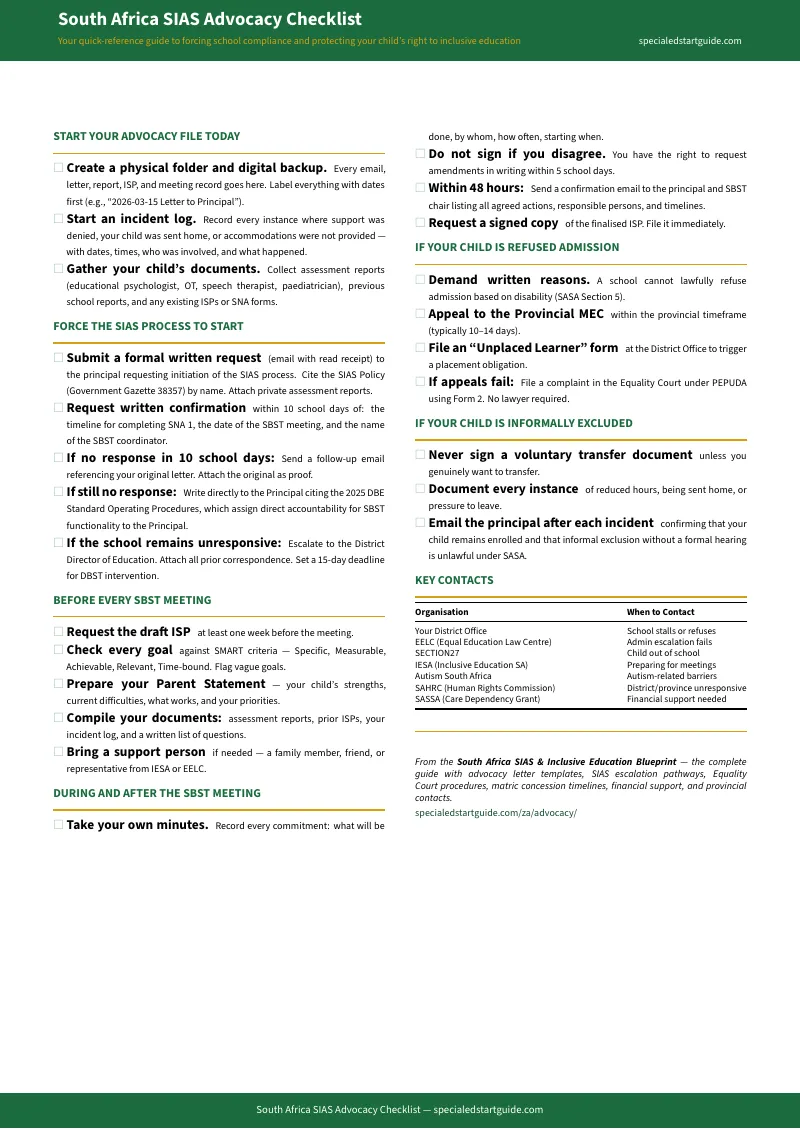
- SIAS Advocacy Checklist (checklist.pdf) — 20-item printable quick-reference guide covering how to start your advocacy file, forcing the SIAS process, SBST meeting preparation, admission refusal responses, ISP monitoring, matric concession timelines, and escalation triggers
- Advocacy Letter Templates (letter-templates.pdf) — All 6 enforcement letters extracted as a standalone printable for quick access
- SIAS Escalation Ladder (escalation-ladder.pdf) — The 10-step pathway from class teacher to High Court on a single reference card
- Accommodation Reference (accommodation-checklist.pdf) — Accommodations by barrier category with checkboxes to bring to your SBST meeting
- Forms & Legislation Reference (forms-legislation-reference.pdf) — Every DBE form number and every key law with section references on one page
- Support Directory (support-directory.pdf) — Contact details for IESA, EELC, Section27, SAHRC, and government offices
- Matric Concessions Timeline (matric-concessions-timeline.pdf) — Critical deadlines, required forms, and emergency steps if the school missed the Grade 10 deadline
Instant PDF download. Print the checklist. Send your first enforcement letter before the school week starts.
Money-back guarantee, no time limit. If the Toolkit doesn't change how you navigate the SIAS process and hold your child's school accountable, email us for a full refund. No questions asked.
Not ready for the full Toolkit? Download the free SIAS Advocacy Checklist — a 20-item printable quick-reference covering how to start your advocacy file, force the SIAS process, prepare for SBST meetings, challenge admission refusals, and know when to escalate. It's the same checklist included in the full Toolkit, and it's free.
Your child's right to inclusive education is in the Constitution. The school relies on you not knowing how to enforce it. After tonight, that advantage is gone.