
The District Brought a Team of Specialists. You Brought a Folder of Report Cards and a 37% Chance They'll Ignore the Law.
You sat at one side of the table — across from the special education coordinator, the LEA representative, the general education teacher, and maybe a school psychologist from the ESU who drove in from two counties over and will leave for another building in 40 minutes. They used acronyms you'd never heard — PLAAFP, LRE, SDI, ESY, MDT. They slid a pre-written IEP across the table and pointed to the signature line. When you asked about service minutes, the coordinator said "we'll do what we can with the staff we have." When you asked for a specific therapy frequency, the ESU representative said "you'll need to talk to your district about that."
When you got home you Googled "Nebraska IEP rights" and found Rule 51 — a 180-page administrative code written for district compliance auditors, not parents. PTI Nebraska offers excellent support, but their intake process takes days when your meeting is tomorrow. Disability Rights Nebraska handles severe civil rights cases, not routine IEP strategy. A special education advocate in Nebraska charges $100 to $300 per hour. An attorney demands a $5,000 retainer. If you earn too much for free legal aid but not enough for a retainer, you are on your own — navigating a system where 37% of school districts failed to provide legally sound Prior Written Notices when refusing parent requests.
The Nebraska IEP & 504 Blueprint is the Rule 51 Enforcement System — the tactical toolkit that bridges the gap between knowing your rights in theory and exercising them at the IEP table, with every template, script, and checklist grounded in Nebraska Administrative Code Title 92, Chapter 51 (Rule 51), Nebraska Revised Statutes, and IDEA.
What's Inside the Blueprint
The ESU Service Delivery Decoder
Nebraska operates 17 Educational Service Units serving multi-county rural consortia. Your child attends a local school governed by a local board, but the speech-language pathologist, school psychologist, or occupational therapist delivering IEP services may be employed by the ESU — rotating through districts weekly, driving 80 miles between buildings. When services are late, cancelled, or inconsistent, the principal says "talk to the ESU" and the ESU says "the district is the LEA." The Blueprint maps exactly who controls scheduling, who bears legal responsibility for FAPE, when to pressure the local superintendent, and when to escalate to the ESU director — so you stop getting bounced between two bureaucracies while your child's services slip.
The Prior Written Notice Enforcement Kit
Recent NDE compliance data shows 37% of procedural safeguard issues involved districts failing to provide legally compliant Prior Written Notices when refusing parent requests. When a school verbally denies your request for an evaluation, additional service minutes, an IEE, or a placement change — and fails to document the refusal properly — they are violating Rule 51. The Blueprint gives you the PWN demand template that forces the district to provide a written response addressing all seven required legal elements: description, explanation, basis, safeguards, contacts, alternatives considered, and relevant factors.
The 45-School-Day Timeline Enforcer
The moment you sign consent for an evaluation, Nebraska gives the district exactly 45 school days — not calendar days — to complete the comprehensive evaluation and convene the eligibility determination. Districts exploit this by initiating consent in late spring knowing summer pauses the clock, scheduling assessments around ESU staff rotations, or claiming the school psychologist "won't be available until next month." The Blueprint gives you the evaluation request letter that starts the clock, follow-up templates at each checkpoint, and the compliance demand letter citing Rule 51 (92 NAC 51-006.05) when the 45 school days expire without an eligibility meeting.
The Option Enrollment Defense Kit
Nebraska students with IEPs are rejected from option enrollment at disproportionate rates — while IEP students make up 17% of the population, they account for 38% of rejections. Districts claim "lack of capacity" to justify denials. The Blueprint explains your appeal rights, the legal standard the receiving district must meet, and how to document discriminatory patterns that form the basis of an OCR complaint.
The Copy-Paste Advocacy Letter Library
Every letter cites the exact Nebraska regulation. Request a formal evaluation and start the 45-school-day clock. Demand an Independent Educational Evaluation at public expense. Request a Functional Behavioral Assessment. Document informal removal when the school sends your child home early without logging it as a suspension. Demand Prior Written Notice when the district verbally refuses a service. These are Nebraska enforcement tools that create a legally binding paper trail the moment you hit send.
IEP Meeting Scripts and Checklists
What to say when the team tells you your child doesn't qualify because their grades are passing. What to say when they push a 504 instead of an IEP. What to say when the LEA representative claims they can't add service minutes "because of staffing." What to say when the ESU therapist wasn't invited to the meeting. Each script cites the Rule 51 regulation that proves them wrong — so you're not arguing opinions at the table, you're citing Nebraska law. The pre-meeting checklist covers Nebraska's one-party consent recording rules, required IEP team composition, and the specific documents to bring.
The NeMTSS Bypass Protocol
Nebraska's Multi-Tiered System of Support (NeMTSS) is designed to provide early intervention — but districts routinely use it to indefinitely delay special education evaluations, insisting on months of additional Tier 2 or Tier 3 interventions while your child falls further behind. Rule 51 explicitly states that the SAT/NeMTSS process cannot be used to unlawfully delay or deny an evaluation. The Blueprint gives you the exact language to demand an evaluation while NeMTSS is ongoing — and the regulatory citation proving the district cannot refuse.
Goal-Tracking Worksheets
IEP goals are legally required to be measurable — with baselines, targets, and mastery criteria that meet the Endrew F. standard. But many goals in Nebraska are written so vaguely that progress is impossible to track, especially when ESU-employed therapists rotate between districts. The worksheets give you a structured format to log data between meetings, compare school-reported progress against your own observations, and arrive at the annual review with documentation that either confirms the program is working or proves it isn't.
Who This Blueprint Is For
- Parents preparing for their first IEP meeting who don't want to walk in blind against a team that does this every day — and who need to understand the IEP document before it's discussed at the table
- Parents whose child has been pushed into a 504 Plan when they should be receiving specially designed instruction under an IEP — especially when the school says "let's try accommodations first"
- Parents in Omaha and Lincoln where districts are well-staffed but massive bureaucracies move slowly, overcrowded caseloads delay evaluations, and option enrollment denials lock IEP students out of better-resourced schools
- Parents in rural Nebraska — districts served by ESUs where the itinerant SLP visits once a week, the school psychologist covers four counties, and you're told "we don't have the staff" for every unmet service
- Parents navigating the IFSP-to-IEP transition at age three — moving from the family-centered Early Development Network into the formal Rule 51 school system, where children who qualified for early intervention may not automatically qualify for preschool special education
- Parents whose child has ADHD, autism, dyslexia, or anxiety and was told they're "too smart for special education" or "grades are too high" — and who need to understand that academic performance is not the legal standard
- Parents whose child was suspended without a Manifestation Determination Review — or who is being sent home early every week without anyone calling it a suspension
- Parents stuck in NeMTSS purgatory — the school insists on prolonged multi-tiered interventions while the child falls further behind, and you need the legal citation proving NeMTSS cannot delay an evaluation request
Why Not Just Use the Free Resources?
Nebraska has genuine free special education resources. PTI Nebraska provides training and one-on-one support. Disability Rights Nebraska offers legal advocacy for severe cases. The NDE publishes Rule 51 and procedural safeguard documents. Here's why parents still struggle after consulting all of them:
- Rule 51 is 180 pages written for district compliance auditors. It covers financial reimbursement formulas, federal reporting requirements, and administrative procedures alongside parent rights. Finding the one regulation that applies to your situation — and knowing how to cite it at the table — requires translating lawyer language into parent strategy. NDE materials explain what the law says, but don't tell you what to do when the school ignores it.
- PTI Nebraska requires an intake process. Their support is excellent — but when you have an IEP meeting in 48 hours and need specific strategies tonight, you cannot wait for a callback. PTI's resources are hosted as fragmented PDFs and archived workshops, not a cohesive tactical toolkit you can print and bring to the table.
- Disability Rights Nebraska handles severe civil rights cases. They provide "law-in-brief" fact sheets and sample letters, but their resources are geared toward formal dispute resolution — state complaints, due process hearings, systemic violations. Most parents want to navigate an annual IEP meeting successfully without needing to file a formal complaint.
- NDE tip sheets explain compliance — not strategy. The NDE publishes tip sheets on Prior Written Notice, IEP Overview, and Shortened Day Guidance. These accurately describe what districts should do, but offer zero tactical advice on how to respond when a district acts out of compliance. They lack defensive positioning.
- Wrightslaw covers federal law — not Rule 51. Wrightslaw doesn't address Nebraska's ESU service delivery model, the 45-school-day evaluation timeline, option enrollment discrimination, or NeMTSS bypass rights. Using national terminology without understanding Nebraska's implementation signals to the district that you don't know your local rights.
- Etsy and TPT planners organize paperwork — they don't enforce rights. A pastel IEP binder won't explain why the school is pushing a 504, how to hold the ESU accountable for missed sessions, or how to cite Rule 51 (92 NAC 51-006.05) when the 45-day evaluation timeline expires.
- Private advocates cost $100–$300 per hour in Nebraska. Attorneys demand $5,000 retainers. Most families can't afford that — and advocates prefer cases where a solid paper trail already exists. The Blueprint is how you build that trail.
The free resources explain what Nebraska law says. The Blueprint gives you the tools to make the district follow it.
— Less Than One Hour of a Special Education Advocate
Private advocates in Nebraska charge $100–$300 per hour. Special education attorneys run $250–$500. If you hand an advocate a disorganized pile of papers, you'll spend hundreds just for them to review the file and formulate a strategy. The Blueprint teaches you how to organize the binder, decode the IEP document, and draft the initial requests — either empowering you to advocate effectively without an advocate, or saving significant billable hours if you do hire one.
Your download includes the complete Blueprint guide, the meeting prep checklist, and standalone printables — every template, script, and reference ready to print and bring to your next IEP meeting.
- Complete Blueprint Guide — 15 chapters covering the Nebraska special education landscape (including the 2025 federal audit findings), IEP vs. 504, referral and evaluation timelines (45-school-day evaluation clock), the IEP document walkthrough, goals and progress monitoring, Educational Service Units and rural FAPE, the IFSP-to-IEP transition at age three, ESY services, transition planning (Nebraska's age 14 advantage), discipline and Manifestation Determinations, Prior Written Notice enforcement, Independent Educational Evaluations, dispute resolution through NDE, special situations (option enrollment, NeMTSS bypass, informal removals, shortened days), Nebraska resources, and a complete documentation system
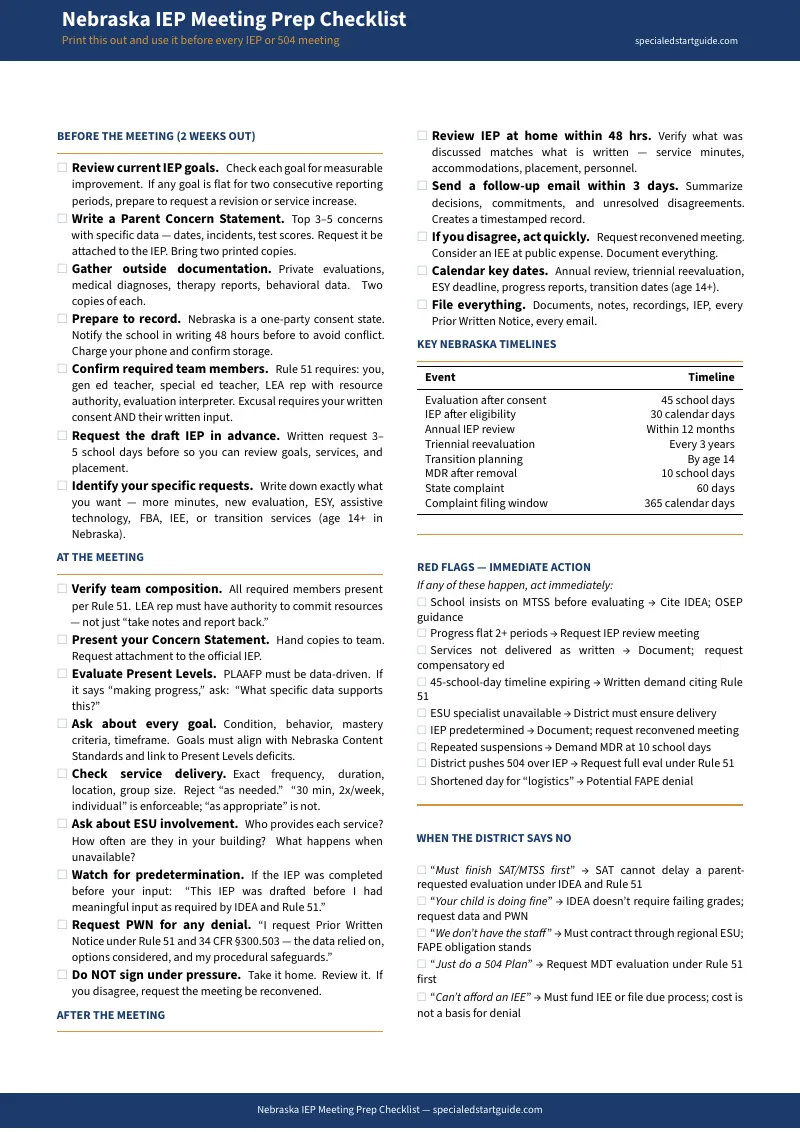
- IEP Meeting Prep Checklist — the before/during/after checklist with Nebraska timelines, IEP team composition requirements, and one-party consent recording guidance
- 45-Day Timeline Enforcer — the complete evaluation-to-services timeline on one printable sheet, with checkpoint actions and the NeMTSS bypass script
- Copy-Paste Advocacy Letters — fill-in-the-blank templates ready to send: Evaluation Request, Prior Written Notice Demand, IEE Request, ESU Service Complaint, Option Enrollment Appeal, and Follow-Up Email
- IEP Meeting Scripts — word-for-word responses to "we need to do NeMTSS first," IEP-to-504 downgrades, staffing excuses, and ESU buck-passing
- Goal-Tracking Worksheets — structured progress monitoring for up to 6 IEP goals with data collection rows, a service delivery log, and annual review summary
- ESU Accountability Reference — the escalation ladder for Nebraska's Educational Service Unit model, who bears responsibility for FAPE, and the buck-passing script
- PWN Enforcement Reference — the seven required legal elements of a Prior Written Notice, the demand template, and the compliance timeline when the district fails to respond
- Dispute Resolution Roadmap — the full escalation path from reconvened IEP meeting through NDE State Complaint, IEP Facilitation, mediation, and due process hearing
Instant PDF download. Print the standalone templates tonight. Walk into tomorrow's IEP meeting with the law on your side.
Money-back guarantee, no time limit. If the Blueprint doesn't change how you approach IEP meetings in Nebraska, email us for a full refund. No questions asked.
Not ready for the full Blueprint? Download the free Nebraska IEP Meeting Prep Checklist — a printable pre-meeting checklist with Nebraska timelines, IEP team composition requirements, one-party consent recording guidance, and red flags that require immediate action. It's enough to walk into your next meeting prepared, and it's free.
Your child's education is a legal right, not a favor. The district knows Rule 51. After tonight, so will you.