The District Knows Michigan's MARSE Rules. After Tonight, So Will You.
You walked into that IEP meeting as prepared as you could be. You called the Michigan Alliance for Families. You downloaded the MDE Procedural Safeguards notice. You even attended a virtual learning opportunity from your Intermediate School District — and they explained what MARSE stands for, and what the REED process involves, and how the Multidisciplinary Evaluation Team works. But nobody told you what to do when the district refuses to evaluate because your child has "passing grades." Nobody gave you the exact words to force Prior Written Notice within Michigan's 10-school-day deadline. Nobody explained that Michigan extends special education services to age 26 — and how to use that to your advantage.
So you sat across from the school psychologist, the special education teacher, the LEA representative, and the general ed teacher — and they told you your child was "making progress" while the data showed two years of stagnation. They offered a 504 Plan when your child needs specially designed instruction. They said they'd "look into it" and send you something "soon." And you didn't know enough to demand Prior Written Notice documenting their refusal — because no free resource in Michigan teaches you how to weaponize the procedural safeguards the state wrote for compliance officers.
The problem isn't that you lack effort. The problem is that Michigan's special education system operates on two overlapping legal frameworks — federal IDEA and the Michigan Administrative Rules for Special Education (MARSE) — layered on top of a decentralized structure of 56 Intermediate School Districts that creates wild variation from Wayne RESA to the Upper Peninsula. The state spends $3 billion annually on special education yet earned a federal "Needs Assistance" designation — meaning Michigan itself acknowledges its districts aren't consistently following the law. And parents absorb the consequences.
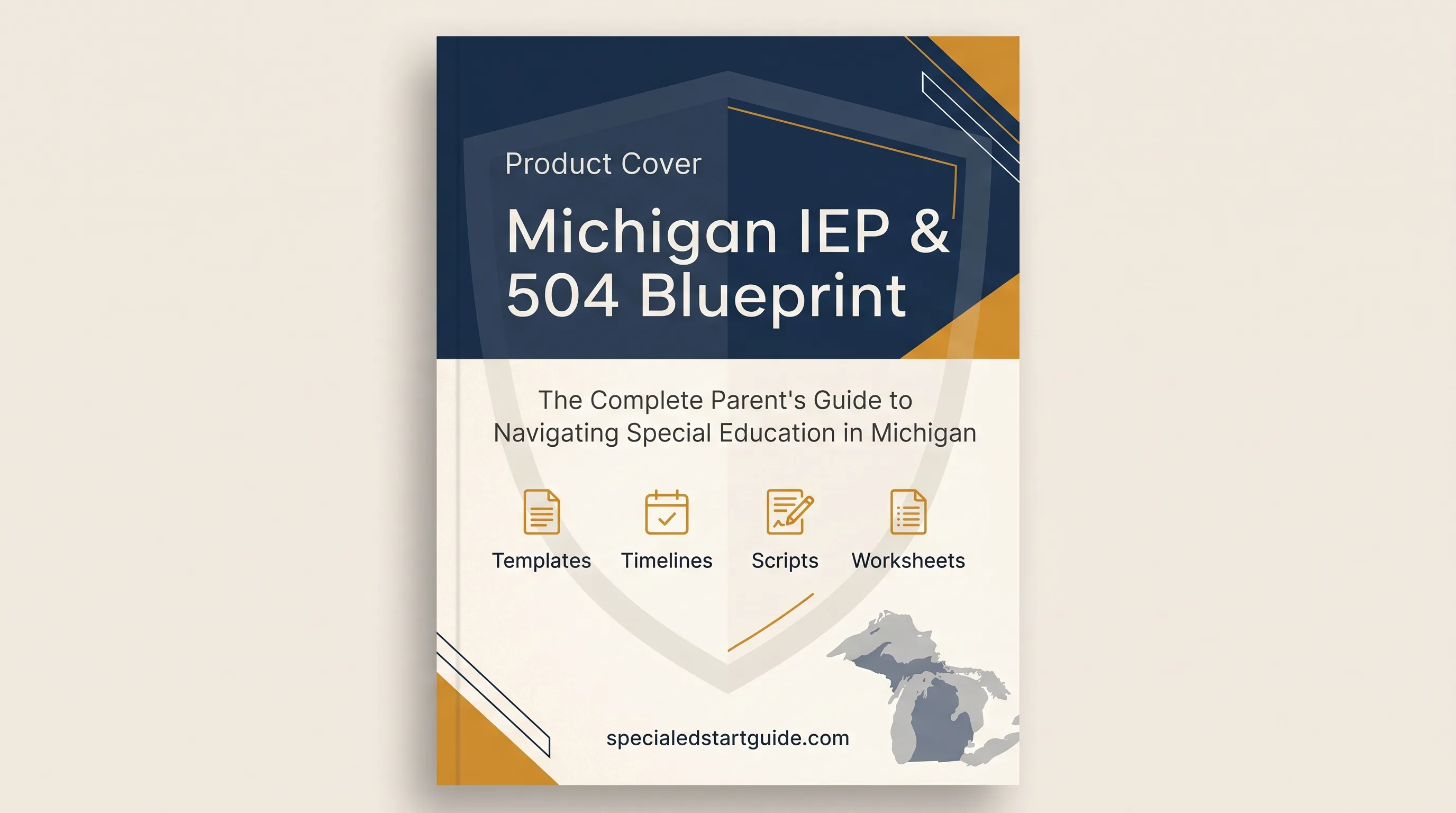
The Michigan IEP & 504 Blueprint is the tactical enforcement toolkit that bridges the gap between knowing your rights exist and actually exercising them — with every template, script, and checklist grounded in MARSE rules and Michigan statute.
What's Inside the Blueprint
Copy-Paste Advocacy Letter Library
Every letter cites the exact MARSE rule. Request an evaluation under MARSE R 340.1721b and start the district's 30-school-day clock. Demand Prior Written Notice when the team refuses anything — because under MARSE, the district must issue PWN within 10 school days of proposing or refusing any change to identification, evaluation, placement, or FAPE. Request an Independent Educational Evaluation at public expense under 34 CFR § 300.502 when you disagree with the district's assessment. Formally request service delivery logs to verify whether the therapy minutes written in the IEP are actually being delivered. These aren't generic national samples — they're Michigan-specific enforcement tools that create a legally binding record the moment you hit send.
The 30/10 Michigan Timeline Decoder
Michigan's evaluation timeline is 30 school days from consent to eligibility determination — not the federal 60 calendar days. The district has 10 school days to issue Prior Written Notice after any parental request. The IEP must be implemented within 15 school days of development. The Blueprint maps every Michigan-specific deadline so you know the exact date the district's obligation expires — and what to do when they miss it.
IEP Meeting Scripts and Checklists
What to say when the team tells you your child is "making progress" but the data shows otherwise. What to say when they offer a 504 instead of an IEP. What to say when the LEA representative claims the district "doesn't have the resources" for your requested services. Each script cites the MARSE rule that proves them wrong — so you're not arguing opinions, you're citing law. The pre-meeting checklist covers Michigan's one-party recording consent (MCL 750.539c), team composition verification under MARSE, and the specific documents to bring.
Michigan's 13 Eligibility Categories Decoded
Federal IDEA provides broad disability categories. MARSE defines 13 specific eligibility categories with precise criteria — Early Childhood Developmental Delay (only through age 7), Specific Learning Disability, Autism Spectrum Disorder under R 340.1715, Cognitive Impairment, Emotional Impairment, and nine others. The Blueprint explains each category in plain English, shows how MET teams evaluate eligibility, and identifies the common gaps where schools deny services despite qualifying conditions.
The ISD Navigation Guide
Michigan's 56 Intermediate School Districts are the operational backbone of special education — deploying specialists, running center-based programs, distributing federal funding, and conducting compliance monitoring. When your local district says "we don't have that here," the ISD is the backstop. The Blueprint explains how to leverage ISD resources from Wayne RESA to Kent ISD to the Upper Peninsula ISDs, regardless of where in Michigan you live.
The Behavior Crisis Toolkit
When a child faces suspension for behavior caused by their disability, Michigan law triggers specific protections. The Blueprint covers Functional Behavioral Assessment requirements, Behavior Intervention Plans, the Manifestation Determination Review process when suspensions exceed 10 cumulative school days, and Michigan's restraint and seclusion rules under MARSE R 340.1746. It also addresses shadow suspensions — schools sending children home without documentation to avoid triggering an MDR.
The Age 26 Transition Strategy
Michigan uniquely extends special education eligibility through age 26 for students who have not earned a regular high school diploma — five years beyond the federal mandate. The Blueprint covers transition planning from age 16, the Personal Curriculum option for modifying Michigan Merit Curriculum requirements, coordination with Michigan Rehabilitation Services (MRS), and strategies for maximizing those extended years of eligibility that most parents don't know exist.
Goal-Tracking Worksheets
IEP goals are legally required to be measurable — with baselines, targets, and mastery criteria meeting the Endrew F. standard. But many goals are written so vaguely that progress is impossible to track. The worksheets give you a structured format to log data between meetings, compare school-reported progress against your own observations, and arrive at the annual review with documentation that either confirms the program is working or proves it isn't.
The Dispute Resolution Roadmap
When advocacy fails, you have three formal options in Michigan: filing a state complaint with the MDE Office of Special Education, requesting mediation through the Michigan Special Education Mediation Program (MSEMP), or filing for a due process hearing before an Administrative Law Judge. The Blueprint explains when each option is appropriate, the timeline and costs involved, and how the paper trail you've been building with the advocacy templates becomes the evidence that wins your case — or convinces the district to settle before you ever reach a hearing.
Who This Blueprint Is For
- Parents preparing for their first IEP meeting who don't want to walk in blind against a team that does this every day
- Parents whose child has been "stuck in the MET process" for months while the district collects more data — and who need the MARSE citation to enforce the 30-school-day evaluation timeline
- Parents in Wayne, Oakland, or Macomb County where large caseloads mean evaluations are backlogged and meetings keep getting rescheduled
- Parents in rural Michigan — the Upper Peninsula, the northern Lower Peninsula, the Thumb — where the nearest school psychologist is shared across five districts and wait times stretch for months
- Parents who've been told their child "doesn't qualify" despite holding a medical diagnosis — and who need the MARSE language to challenge that determination
- Parents navigating the 504-to-IEP question — unsure whether their child's current plan is legally sufficient or whether they should push for a full special education evaluation
- Parents whose child was suspended and the school never mentioned a Manifestation Determination Review — even though the behavior is clearly tied to the disability
- Parents of students approaching age 16 who need transition planning — or approaching age 21 who don't realize Michigan extends eligibility through age 26
- Parents whose child is transitioning from Early On (Part C) to Part B preschool services and facing a dramatic reduction in therapies
Why Not Just Use the Free Resources?
Michigan has legitimate free special education resources. The Michigan Alliance for Families runs workshops and provides parent mentors. The MDE publishes procedural safeguards. Disability Rights Michigan publishes an extensive advocate's manual. Here's why parents still struggle after consulting all of them:
- Michigan Alliance for Families is state-funded — and mandate-constrained. MAF is the federally funded Parent Training and Information Center for Michigan. Their workshops are excellent for understanding the basics. But because they are grant-funded by the state education department, their mandate is to promote collaboration and mediation. They cannot provide aggressive adversarial strategy, write binding advocacy letters, or tell you how to outmaneuver a hostile special education director. When the district acts in bad faith, MAF cannot say "you're wrong."
- MDE publications protect the state, not you. The official Procedural Safeguards notice and ISD parent handbooks are written in dense bureaucratic prose for compliance officers. They tell you the rules exist. They provide zero tactical instruction on how to enforce them when a school is non-compliant. A stressed parent does not need to decipher MARSE regulations — they need the exact phrasing to put in an email tonight.
- Disability Rights Michigan writes for attorneys, not parents. DRM's 180-page advocate's manual is legally comprehensive and genuinely valuable — for social workers and attorneys. A parent trying to survive a combative Tuesday morning IEP meeting needs a script, not a case law summary.
- Etsy and TPT binders organize paperwork — they don't enforce rights. A pastel IEP binder helps you sort documents. It won't tell you that Michigan's evaluation timeline is 30 school days, how to cite MARSE R 340.1721b to force an evaluation, or what to do when the district offers a 504 instead of an IEP. Generic federal templates miss every Michigan nuance that actually determines your outcome.
The free resources explain what the law says. The Blueprint gives you the tools to make the district follow it.
— Less Than 2 Minutes of a Special Education Advocate
Special education advocates in Michigan charge $150–$175 per hour. Retainers start at $750. Special education attorneys bill $200–$500 per hour, with litigation running into the tens of thousands. Even if you eventually need professional help, the meticulous paper trail you build with this Blueprint saves thousands in billable hours — because you're handing your advocate an organized case, not a shoebox of unsigned IEP copies and half-remembered conversations.
Your download includes the complete Blueprint guide plus standalone printable PDFs — every template, worksheet, script, and reference card, ready to print and bring to your next meeting.
- Complete Blueprint Guide — 13 chapters and 3 appendices covering IEP vs. 504, Michigan's 13 eligibility categories, the 30-school-day evaluation timeline, IEP development, the 15-school-day implementation rule, procedural rights, discipline and MDR protections, dispute resolution, age 26 transition planning, charter schools and Schools of Choice, IEP meeting preparation, key Michigan resources, Michigan timelines, sample letters and scripts, and the 2024 MARSE updates
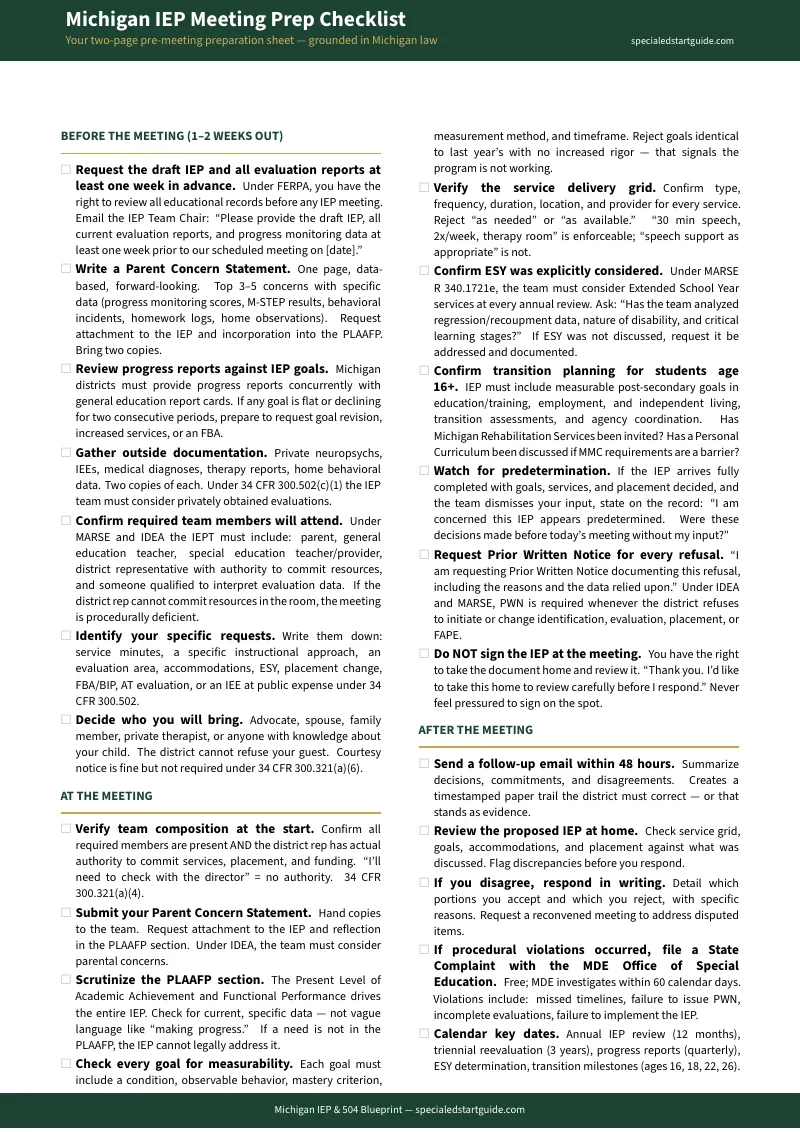
- IEP Meeting Prep Checklist — the before/during/after checklist with MARSE timelines, team composition requirements, and red flags that require immediate action
- Advocacy Letter Templates — copy-paste letters citing exact MARSE rules for evaluation requests, IEEs, Prior Written Notice demands, service delivery log requests, FBA requests, and addendum meetings
- Goal-Tracking Worksheet — structured fillable worksheet for measurable progress monitoring between annual reviews
- Michigan Timeline Cheat Sheet — every legal deadline on one page: 30-school-day evaluation, 10-school-day PWN, 15-school-day implementation, annual reviews, triennial reevaluation, and due process filing windows
- IEP Meeting Scripts — word-for-word responses to common district pushback tactics, each citing the specific MARSE rule
- Accommodation Reference Card — classroom accommodations table plus M-STEP testing accommodations and a pre-meeting audit checklist
- Dispute Resolution Roadmap — your three formal options when advocacy fails: MDE state complaint, MSEMP mediation, and due process hearing — with a side-by-side comparison table
Instant PDF download. Print the templates tonight. Walk into tomorrow's meeting with the law on your side.
Money-back guarantee, no time limit. If the Blueprint doesn't change how you approach IEP meetings in Michigan, email us for a full refund. No questions asked.
Not ready for the full Blueprint? Download the free Michigan IEP Meeting Prep Checklist — a printable pre-meeting checklist with MARSE timelines, team composition requirements, and the red flags that require immediate action. It's enough to walk into your next meeting prepared, and it's free.
Your child's education is a legal right, not a favor the district grants. The district knows MARSE. After tonight, so will you.