Your Charter School Says They "Can't Accommodate" the IEP. Arizona Law Says They Must.
The charter school admissions coordinator asked about your child's diagnosis during the enrollment tour. Later, they mentioned that the school "doesn't have a resource room" and suggested your neighborhood district school might be "a better fit." Your child's IEP from the previous school specifies 120 minutes per week of speech-language therapy and a paraprofessional for math — and the charter's special education coordinator smiled, said "we'll do our best," and handed you a watered-down accommodation plan that cuts the therapy to 60 minutes and drops the para entirely. You know something is wrong. You don't know the exact statute that proves it.
Arizona serves approximately 143,000 students in special education across a system unlike any other state. Roughly 16% of students attend charter schools — independent LEAs that must follow IDEA but routinely attempt to bypass it through "counseling out" tactics, understaffed resource programs, and vague service commitments. The universal Empowerment Scholarship Account (ESA) program offers families $7,000 to $30,000+ in public funds for private education — but accepting it waives your child's right to FAPE and every IDEA protection. Proposition 203 mandates English-only instruction while bilingual families navigate special education evaluations that can't distinguish language acquisition from learning disability. Military families PCSing to Luke AFB, Davis-Monthan, or Fort Huachuca arrive with robust IEPs from other states and are told the district needs to "re-evaluate" before providing comparable services. The law is clear. The system makes it nearly impossible to enforce without knowing exactly where to look.
Special education attorneys in Arizona charge $300 to $500 per hour. The Arizona Center for Disability Law provides excellent legal guidance — but serves 7.4 million people with limited staff. Raising Special Kids offers parent training and workshops — but they cannot attend your child's IEP meeting. If you earn too much for free legal aid but not enough for a retainer, you are navigating this alone.
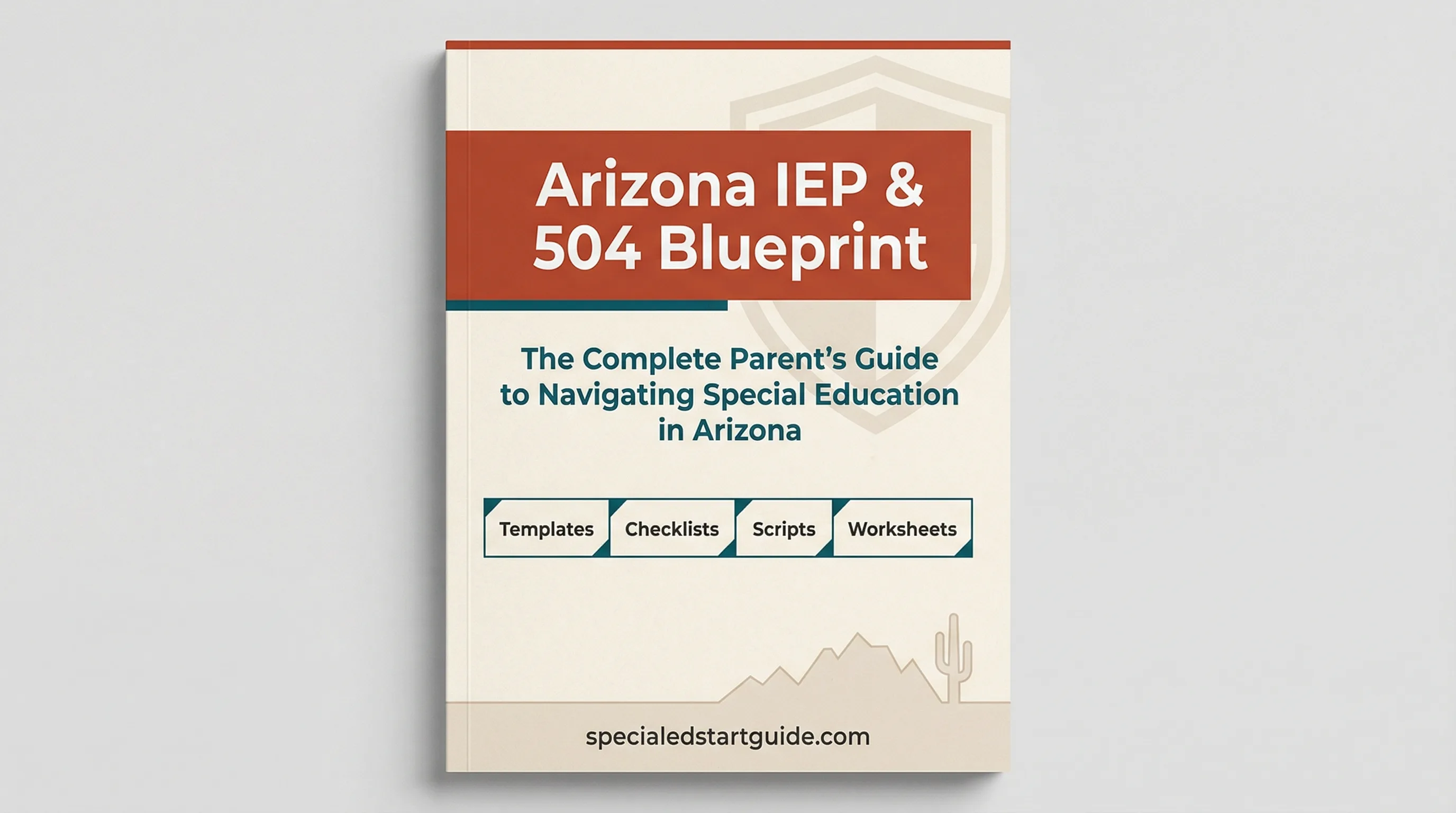
The Arizona IEP & 504 Blueprint is the Charter Accountability System — the tactical toolkit that bridges the gap between knowing your rights under Arizona law and actually enforcing them at the IEP table, with every template, tracking tool, and advocacy letter grounded in A.A.C. R7-2-401, A.R.S. Title 15, and IDEA.
What's Inside the Blueprint
The Charter School Compliance Checklist
This is the tool that changes everything for Arizona families. A structured, one-page audit that maps every IDEA obligation charter schools most frequently attempt to bypass. Does the charter have a qualified special education teacher — not a general education teacher "handling accommodations"? Are they providing the exact frequency, duration, and modality of related services listed in the IEP? Did they conduct a Manifestation Determination Review before suspending your child? Are they offering the full continuum of alternative placements — or just inclusion-only? Under A.R.S. § 15-184, charter schools cannot deny enrollment based on disability. Under IDEA, they must provide FAPE identically to district schools. This checklist lets you verify compliance item by item — and gives you the citation to hand the administrator when they claim otherwise.
The ESA vs. FAPE Decision Matrix
Before you accept an Empowerment Scholarship Account, this worksheet forces the calculation most parents never make. List every service currently provided on your child's public IEP — 60 minutes of speech therapy per week, a paraprofessional, specialized transportation, occupational therapy, behavioral intervention. Calculate the private market cost of replacing each one. Compare that total against the specific ESA dollar amount your child would receive based on their disability category. The math often reveals that the ESA funding covers tuition but not the related services your child is legally entitled to under IDEA — services the private school has zero obligation to provide. This matrix prevents the irreversible mistake of accepting an ESA before understanding the full financial and legal trade-off.
The 60-Calendar-Day Timeline Tracker
The moment you consent to an evaluation, Arizona administrative code under A.A.C. R7-2-401(E)(3) gives the district 60 calendar days to complete it. Districts exploit these timelines by initiating evaluations in April knowing they'll blame summer staffing gaps, or by scheduling eligibility meetings at the last possible hour. The Blueprint maps every milestone with the specific regulation reference, gives you the follow-up language at each checkpoint, and provides the escalation template when deadlines pass without action.
The Copy-Paste Advocacy Letter Library
Every letter cites the exact Arizona regulation. Request a formal evaluation and start the district's 60-calendar-day clock under A.A.C. R7-2-401(E)(3). Demand an Independent Educational Evaluation at public expense using the specific legal phrase that triggers the district's obligation to either pay or file for due process. Request a Functional Behavioral Assessment. Document service non-delivery with your tracking data. Formally disagree with an IEP proposal and demand Prior Written Notice under A.A.C. R7-2-401. These aren't generic federal templates — they're Arizona enforcement tools that create a legally binding paper trail the moment you hit send.
IEP Meeting Scripts and Checklists
What to say when the team tells you your child doesn't qualify because their grades are passing. What to say when they push a 504 instead of an IEP — and why the unfunded mandate problem makes that dangerous in Arizona. What to say when the charter school claims they "don't offer" a particular service. What to say when someone suggests the ESA as an alternative to fixing service delivery problems. Each script cites the A.A.C. R7-2-401 regulation that proves them wrong — so you're not arguing opinions at the table, you're citing Arizona law. The pre-meeting checklist covers one-party consent recording rules under A.R.S. Title 13, required IEP team composition, and the specific documents to bring.
Bilingual Family Language Rights Guide
If your family's primary language is Spanish — or any language other than English — this supplement explains your right to a competent interpreter at every IEP meeting, your right to receive the Procedural Safeguards Notice and Prior Written Notice translated into your native language, and the step-by-step Proposition 203 waiver process under A.R.S. § 15-753 for English Language Learners who need bilingual special education services. It also covers how to ensure evaluations use culturally and linguistically appropriate instruments — critical for preventing misidentification of language acquisition as a learning disability.
Goal-Tracking Worksheets
IEP goals must be measurable — with baselines, targets, and mastery criteria that meet the Endrew F. standard. Arizona requires SMART goals with benchmarks under ADE guidelines. But many goals are written so vaguely that progress is impossible to track. The worksheets give you a structured format to log data between meetings, compare school-reported progress against your own observations, and arrive at the annual review with documentation that either confirms the program is working or proves it isn't.
The Dispute Resolution Escalation Ladder
When informal advocacy fails, Arizona offers formal options: State Complaints to ADE Exceptional Student Services (triggering a 60-day investigation), mediation through ADE, and due process hearings. The Blueprint explains when each option is appropriate, the timeline and costs involved, and how to build the paper trail that wins — including the fact that State Complaints are free, don't require an attorney, and frequently produce faster results than due process.
Who This Blueprint Is For
- Parents preparing for their first IEP meeting who don't want to walk in blind against a team that does this every day — and who need to understand the IEP document before it's discussed at the table
- Parents whose child attends an Arizona charter school and who suspect the school is not meeting its IDEA obligations — reducing services, avoiding evaluations, or pushing the family toward withdrawal
- Parents considering the Empowerment Scholarship Account who need to understand exactly what IDEA protections they would be waiving before accepting the funds
- Bilingual and Spanish-speaking families navigating the intersection of language rights and disability rights — including the Proposition 203 waiver process and the right to translated documents and qualified interpreters
- Parents in Phoenix, Tucson, Mesa, Chandler, Gilbert, or Scottsdale navigating districts where caseloads are crushing, evaluations are backlogged, and IEP teams pressure parents to sign at the table
- Military families PCSing to Luke Air Force Base, Davis-Monthan AFB, or Fort Huachuca who need to understand how Arizona handles IEP transfers from other states
- Parents in rural Arizona or tribal communities facing provider shortages, transportation barriers, and itinerant service gaps
- Parents whose child has ADHD, autism, dyslexia, or anxiety and was told they're "too smart for special education" or "grades are too high" — and who need to understand that academic performance is not the legal standard
- Parents whose child needs heat-related accommodations during Arizona's extreme summer months — seizure disorders, sensory processing challenges, respiratory conditions, or thermoregulation issues
Why Not Just Use the Free Resources?
Arizona has strong free special education resources. Raising Special Kids (RSK) is the federally funded Parent Training and Information center. The Arizona Center for Disability Law (ACDL) publishes legally sound self-advocacy guides. ADE provides procedural safeguards in multiple languages. Here's why parents still struggle after consulting all of them:
- RSK trades money for time. Accessing their deepest value requires navigating intake forms, waiting for callbacks from family support specialists, and attending scheduled webinars. When you have a surprise IEP meeting in three days — or you receive a confusing evaluation report on a Friday afternoon — you need tools you can download and use at midnight, not an 8-week mentoring course.
- ACDL publications are legally accurate and practically impenetrable. Written by attorneys, structured around statutory citations, and dense enough to intimidate a parent who just received a diagnosis and needs to understand basic meeting prep tonight. Their format is informational, not operational.
- ADE procedural safeguards are written at a graduate reading level. Research consistently shows that procedural safeguards notices nationwide are functionally inaccessible to the average parent. Parents routinely sign the receipt without reading or understanding them. The Blueprint translates these protections into plain English with actionable worksheets.
- National guides like Wrightslaw don't address Arizona's unique landscape. They won't explain the ESA vs. FAPE trade-off, the charter school compliance gap, the Proposition 203 bilingual waiver process, or Arizona's specific 60-calendar-day evaluation timeline. Federal law is the floor — Arizona-specific implementation is where parents get lost.
- Etsy and TPT planners organize paperwork — they don't enforce rights. A pastel IEP binder keeps documents in order. It won't explain why the charter school is legally wrong, how to calculate compensatory service debt, or how to cite A.A.C. R7-2-401 to demand Prior Written Notice for a refusal.
- Private advocates cost $100–$300 per hour. Attorneys run $300–$500. If you hand them a disorganized pile of papers, you'll spend hundreds just for the file review. The Blueprint teaches you how to build the binder, decode the IEP, track services, and draft the initial requests — either empowering you to advocate alone or saving hundreds in billable hours if you do hire someone.
The free resources explain what Arizona law says. The Blueprint gives you the tools to make the district follow it.
— Less Than One Hour of a Special Education Advocate
Private advocates in Arizona charge $100–$300 per hour when you can find one. Special education attorneys run $300–$500. A comprehensive advocacy package — record review, meeting prep, and IEP attendance — costs $500 to $2,500. The Blueprint teaches you how to build the binder, decode the IEP document, track missed services, audit charter compliance, evaluate the ESA trade-off, and draft the initial requests — either empowering you to advocate effectively without professional help, or saving hundreds in billable hours if you do hire someone.
Your download includes the complete Blueprint guide plus standalone printable PDFs — every template, worksheet, script, and reference card, ready to print and bring to your next IEP meeting.
- Complete Blueprint Guide — 18 chapters covering the Arizona special education landscape, IEP vs. 504, referral and evaluation timelines (60-calendar-day evaluation under A.A.C. R7-2-401(E)(3)), Arizona's eligibility categories, IEP meeting strategies, the IEP document walkthrough, goals and progress monitoring, Independent Educational Evaluations, related services and ESY, service delivery tracking, compensatory education recovery, school discipline protections, transition planning from early childhood through post-secondary, graduation pathways, transfer students and military families, Arizona-specific topics (charter school compliance, ESA decision framework, Proposition 203 bilingual guidance, extreme heat accommodations, BCBA licensure), dispute resolution, and Arizona advocacy resources
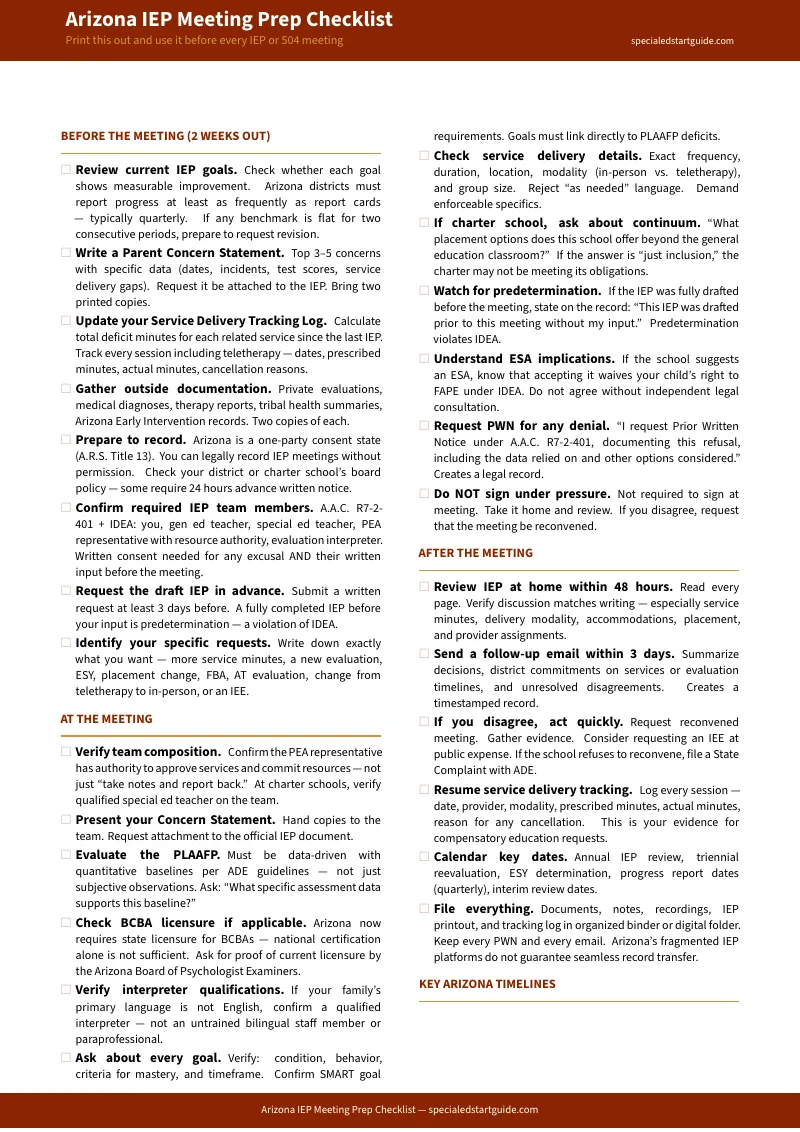
- IEP Meeting Prep Checklist — the before/during/after checklist with Arizona timelines and A.A.C. R7-2-401 citations for every step
- Charter School Compliance Checklist — audit every IDEA obligation your charter school must meet, with the A.R.S. and federal citations to enforce them
- ESA vs. FAPE Decision Matrix — calculate the true cost of accepting an Empowerment Scholarship Account before waiving your child's IDEA protections
- Advocacy Letter Templates — copy-paste letters citing exact A.A.C. R7-2-401 regulations for evaluation requests, IEEs, FBA demands, service non-delivery, compensatory education demands, and formal disagreements
- Service Delivery Tracking Log — printable matrix for logging every therapy session, calculating deficit minutes, and building your compensatory education case
- Goal-Tracking Worksheet — structured fillable worksheet for measurable progress monitoring between annual IEP reviews
- Arizona Timeline Cheat Sheet — every legal deadline on one page: 60-calendar-day evaluation, 30-day IEP development, annual reviews, triennial reevaluations
- IEP Meeting Scripts — word-for-word responses to common IEP team pushback tactics, each citing the specific Arizona regulation
- Dispute Resolution Roadmap — your formal options: ADE State Complaint, mediation, and due process — with Arizona-specific filing procedures
- 504 vs. IEP Decision Matrix — side-by-side comparison of protections with Arizona-specific qualification criteria and the critical unfunded mandate distinction
Instant PDF download. Print the templates tonight. Walk into tomorrow's IEP meeting with Arizona law on your side.
Money-back guarantee, no time limit. If the Blueprint doesn't change how you approach IEP meetings in Arizona, email us for a full refund. No questions asked.
Not ready for the full Blueprint? Download the free Arizona IEP Meeting Prep Checklist — a printable pre-meeting checklist with Arizona timelines, IEP team composition requirements, one-party consent recording rules under A.R.S. Title 13, charter school compliance red flags, ESA warning signs, and the specific questions that force the team to put refusals in writing. It's enough to walk into your next meeting prepared, and it's free.
Your child's education is a legal right — not a favor the charter school grants when it's convenient. The compliance checklist you print tonight is the first step toward making them prove it.