Don't Sign That IEP Until You've Read the SETS Printout.
You sat down at the IEP meeting in your child's school — across from the special education coordinator, the LEA representative, the general education teacher, and the school psychologist. They smiled. They used acronyms you'd never heard before — PLAAFP, LRE, SDI, ESY. They slid a stack of SETS-generated pages across the table and told you where to sign. You left with a document you didn't fully understand and a sinking feeling that everything had been decided before you walked in.
You were right. In Alabama, the Special Education Tracking System (SETS) produces the IEP documents that every public school district uses — and the printout is designed for compliance officers, not parents. Schools hold roughly 88,000 IEP meetings each year across 137 local education agencies, from the well-staffed districts of Madison City and Mountain Brook to Black Belt counties where a single special education teacher covers multiple campuses and the nearest occupational therapist is a ninety-minute drive. The law guarantees the same Free Appropriate Public Education in Lowndes County as in Shelby County. The reality does not match — and when the district arrives at the table with a pre-drafted IEP, the parent who doesn't understand the SETS paperwork, the 60-calendar-day evaluation timeline, or the difference between an IEP and a 504 Plan has no leverage to push back.
Special education attorneys in Alabama charge $250 to $450 per hour, with due process cases exceeding $30,000. The Alabama Disabilities Advocacy Program provides free legal help but serves the entire state with limited staff. The Alabama Parent Education Center runs excellent workshops — but they happen on their schedule, not yours, and they can't attend your child's meeting. If you earn too much for free legal aid but not enough for a retainer, you are on your own.
The Alabama IEP & 504 Blueprint is the SETS Navigation System — the tactical toolkit that bridges the gap between knowing your rights under Alabama law and actually exercising them at the IEP table, with every template, script, and checklist grounded in Alabama Administrative Code Chapter 290-8-9 and IDEA.
What's Inside the Blueprint
The SETS Form Walkthrough
Every Alabama public school generates IEPs through the state's Special Education Tracking System. The printout is 15+ pages of checkboxes, dropdown codes, and boilerplate legal language. The Blueprint walks you through every section — where the baseline data lives, where the measurable goals are documented, how the LRE justification is coded, and which page contains the service delivery details that determine whether your child gets 30 minutes of speech therapy twice a week or vague "services as appropriate." When you can read the SETS printout, you can challenge what's written in it.
The 60-Calendar-Day Timeline Tracker
The moment you consent to an evaluation, Alabama law gives the district 60 calendar days to complete it — and that clock runs continuously, including summer. Then 30 calendar days to determine eligibility. Then 30 calendar days to develop the IEP. Districts exploit these timelines by initiating evaluations in April knowing they'll blame summer delays, or by scheduling eligibility meetings at the last possible minute. The Blueprint maps every milestone, gives you the follow-up language at each checkpoint, and provides the escalation template when deadlines pass.
The CHOOSE Act Strategic Playbook
The 2024 CHOOSE Act reserves the first 500 Education Savings Accounts — worth up to $7,000 for private school tuition or $2,000 for homeschooling — specifically for students with special needs. But eligibility requires a copy of an active IEP, ISP, or 504 Plan. Parents are now highly motivated to secure these documents not just for public school services, but as a critical passport to private education funding through ClassWallet. The Blueprint explains how to use the public school IEP process to secure the documentation you need for the ESA application — and what happens to your IDEA rights if you leave the public system.
The Copy-Paste Advocacy Letter Library
Every letter cites the exact Alabama regulation. Request a formal evaluation and start the district's 60-calendar-day clock. Demand an Independent Educational Evaluation at public expense using the specific legal phrase that triggers the district's obligation to either pay or file for due process. Request a Functional Behavioral Assessment. Document service non-delivery. Formally disagree with an IEP proposal and request Prior Written Notice. These aren't generic federal templates — they're Alabama enforcement tools that create a legally binding paper trail the moment you hit send.
IEP Meeting Scripts and Checklists
What to say when the team tells you your child doesn't qualify because their grades are passing. What to say when they push a 504 instead of an IEP. What to say when the LEA representative claims they can't add service minutes "because of staffing." Each script cites the AAC 290-8-9 regulation that proves them wrong — so you're not arguing opinions at the table, you're citing Alabama law. The pre-meeting checklist covers one-party consent recording rules under Ala. Code §13A-11-30, required IEP team composition, and the specific documents to bring.
Goal-Tracking Worksheets
IEP goals are legally required to be measurable — with baselines, targets, and mastery criteria that meet the Endrew F. standard. But many goals in Alabama are written so vaguely that progress is impossible to track. The worksheets give you a structured format to log data between meetings, compare school-reported progress against your own observations, and arrive at the annual review with documentation that either confirms the program is working or proves it isn't.
The Dispute Resolution Escalation Ladder
When informal advocacy fails, Alabama offers formal options: State Complaints to ALSDE (triggering a 60-day investigation), mediation through ALSDE, and due process hearings. The Blueprint explains when each option is appropriate, the timeline and costs involved, and how to build the paper trail that wins — including the fact that State Complaints are free, don't require an attorney, and frequently produce faster results than due process.
Who This Blueprint Is For
- Parents preparing for their first IEP meeting who don't want to walk in blind against a team that does this every day — and who need to understand the SETS printout before it's discussed at the table
- Parents whose child has been pushed into a 504 Plan when they should be receiving Specially Designed Instruction under an IEP — especially after the Alabama Literacy Act expanded dyslexia identification
- Parents in Birmingham, Huntsville, Mobile, Montgomery, or Tuscaloosa navigating districts that pressure parents to sign at the table
- Parents in rural Alabama counties where staffing shortages mean IEP meetings don't happen on schedule, services aren't delivered, and the special education coordinator is also the principal's neighbor at church
- Parents whose child has ADHD, autism, dyslexia, or anxiety and was told they're "too smart for special education" or "grades are too high" — and who need to understand that academic performance is not the legal standard
- Military families PCSing to Fort Novosel, Redstone Arsenal, or Maxwell-Gunter AFB who need to understand how Alabama handles IEP transfers from other states
- Parents approaching an annual review or triennial reevaluation whose child's goals were vague, unmeasured, or routinely ignored
- Parents applying for the CHOOSE Act Education Savings Account who need a flawless IEP or 504 Plan to secure priority status for the first 500 ESA slots
Why Not Just Use the Free Resources?
Alabama has substantial free special education resources. The Alabama Disabilities Advocacy Program publishes "Special Education in Alabama: A Right Not A Favor." APEC runs federally funded parent training workshops. The ALSDE provides "Mastering the Maze" procedural guides. Here's why parents still struggle after consulting all of them:
- ADAP's manual is 100+ pages of legal text. It is legally exhaustive and accurate. It is also paralyzing to read the night before a meeting. It explains what the law is — it does not give you fill-in-the-blank email templates for enforcing it. Its format is informational, not operational.
- APEC offers excellent workshops — on their schedule, not yours. The training sessions happen monthly. Your IEP meeting is Tuesday. You need specific answers tonight, not a webinar registration link. Their Download Library contains useful handouts, but they're scattered across dozens of separate documents with no unified workflow.
- Mastering the Maze was written for educators and compliance officers, not parents. It literally trains teachers on how to fill out SETS forms. It uses acronyms like SPP, SPDG, SSR, and TA without defining them. It ensures the school passes its audit — it does not help you negotiate a better IEP for your child.
- Wrightslaw covers federal law — not Alabama's AAC 290-8-9. Wrightslaw is the gold standard for IDEA. It does not address the SETS system, Alabama's 13 eligibility categories, the CHOOSE Act, or the specific timelines in Alabama Administrative Code. If you use national terminology without understanding Alabama's implementation, the district knows.
- TPT and Etsy planners organize paperwork — they don't enforce rights. A pastel IEP binder helps you keep documents in order. It won't explain what the SETS printout means, why the district is pushing a 504, or how to cite AAC 290-8-9 to demand Prior Written Notice for a refusal.
- Private advocates cost $100–$275 per hour in Alabama. Attorneys run $250–$450. Bridge Educational Advocacy charges $1,110 for a comprehensive IEP review package. Most families can't afford that — and advocates prefer cases where a solid paper trail already exists. The Blueprint is how you build that trail.
The free resources explain what Alabama law says. The Blueprint gives you the tools to make the district follow it.
— Less Than One Hour of a Special Education Advocate
Private advocates in Alabama charge $100–$275 per hour. Educational attorneys run $250–$450. If you hand an advocate a disorganized pile of papers, you'll spend hundreds just for them to review the file and formulate a strategy. The Blueprint teaches you how to organize the binder, decode the SETS printout, and draft the initial requests — either empowering you to advocate effectively without an advocate, or saving hundreds in billable hours if you do hire one.
Your download includes the complete Blueprint guide plus standalone printable PDFs — every template, worksheet, script, and reference card, ready to print and bring to your next IEP meeting.
- Complete Blueprint Guide — 17 chapters covering the Alabama special education landscape, IEP vs. 504, referral and evaluation timelines (60-calendar-day evaluation + 30-day eligibility + 30-day IEP), IEP meeting strategies, the SETS document walkthrough, goals and progress monitoring, Independent Educational Evaluations, related services and ESY, the 504 Plan process, school discipline protections, transition planning from early childhood through post-secondary, diploma pathways, the CHOOSE Act and ESA applications, transfer students and military families, dispute resolution, and Alabama advocacy resources
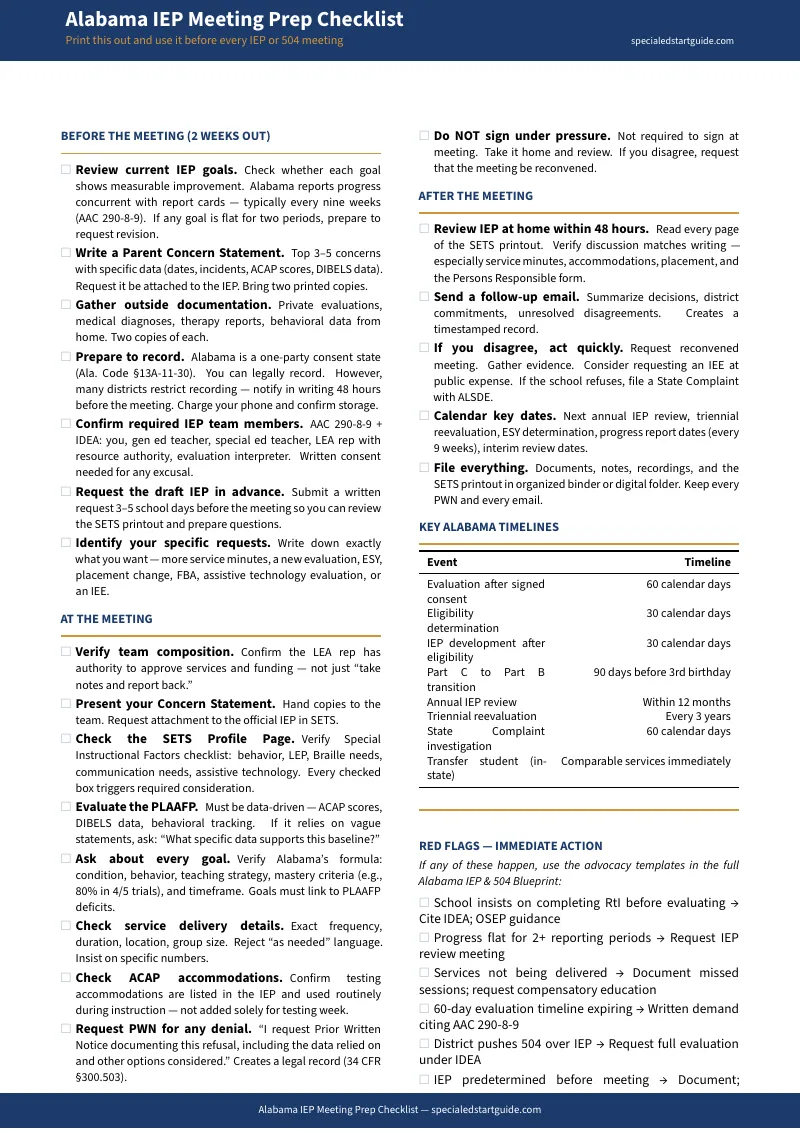
- IEP Meeting Prep Checklist — the before/during/after checklist with Alabama timelines and AAC 290-8-9 citations for every step
- Advocacy Letter Templates — copy-paste letters citing exact AAC 290-8-9 regulations for evaluation requests, IEEs, FBA demands, service non-delivery, and formal disagreements
- Goal-Tracking Worksheet — structured fillable worksheet for measurable progress monitoring between annual IEP reviews
- Alabama Timeline Cheat Sheet — every legal deadline on one page: 60-calendar-day evaluation, 30-day eligibility, 30-day IEP development, annual reviews, triennial reevaluations, and Part C transition
- IEP Meeting Scripts — word-for-word responses to common IEP team pushback tactics, each citing the specific Alabama regulation
- SETS Decoding Guide — plain-English translation of the SETS printout sections, profile page, special instructional factors, and how to connect the data to specific IEP goals and ACAP accommodations
- Dispute Resolution Roadmap — your formal options: ALSDE State Complaint, mediation, and due process — with Alabama-specific filing procedures
- 504 vs. IEP Decision Matrix — side-by-side comparison of protections with the Alabama-specific qualification criteria and enforcement mechanisms
Instant PDF download. Print the templates tonight. Walk into tomorrow's IEP meeting with the law on your side.
Money-back guarantee, no time limit. If the Blueprint doesn't change how you approach IEP meetings in Alabama, email us for a full refund. No questions asked.
Not ready for the full Blueprint? Download the free Alabama IEP Meeting Prep Checklist — a printable pre-meeting checklist with Alabama timelines, IEP team composition requirements, one-party consent recording rules under Ala. Code §13A-11-30, and red flags that require immediate action. It's enough to walk into your next meeting prepared, and it's free.
Your child's education is a legal right, not a favor. The district knows AAC 290-8-9. After tonight, so will you.