They Age Out at 21. The System Won't Tell You What Comes Next.
Your child has been in school for thirteen years. There is a SENCO, a teacher aide, an IEP meeting every term, and a daily routine that — even on the hard days — holds your family together. Then the calendar year they turn 21 arrives, and all of it stops. The school steps back. The Ministry of Education closes the file. And nobody calls to say what happens on Monday morning.
You Googled "transition planning NZ disability." You found the Ministry of Education's page about preparing students to leave school — written for schools, not parents. You found IHC's leaving school page — helpful, but it points you in five different directions without telling you which one to walk first. You found CCS Disability Action's transition service — excellent, but only available for twelve months and only in your child's final year. You checked Work and Income's website and discovered the Supported Living Payment exists, but the eligibility criteria are buried inside medical certificate forms you've never seen. You read about NASC assessments, Individualised Funding, Enabling Good Lives principles, the PPPR Act, and Welfare Guardianship — each on a different website, each written in a different dialect of bureaucratic language, none of them explaining how these pieces fit together or in what order you should tackle them.
Twelve browser tabs. Three government agencies. Zero clear answer to the question: what do I actually do first?
The New Zealand Post-School Transition Roadmap is a cross-agency planning system that maps the entire transition — from Year 10 to post-school adult life — across every ministry, funding stream, and legal mechanism your family will encounter. It translates the fragmented, agency-by-agency landscape of MoE, MSD, Whaikaha, NASC, Work and Income, StudyLink, and the Family Court into a single year-by-year timeline with specific actions, deadlines, and the exact documentation each agency requires. It is the document that should exist on a government website but doesn't — because no single agency owns the whole picture.
What's Inside the Guide
The Cross-Agency Timeline — Year 10 Through Post-School
Ministry of Education guidelines say transition planning should start at Year 9. MSD transition funding does not activate until the final year of school. That leaves a multi-year void where parents are told to plan but given no structure to plan with. This chapter fills the gap: concurrent actions for the school, the whānau, and government agencies at every stage from age 14 to 21 and beyond — who to contact, what to apply for, and when to start so you are not scrambling in Year 13 for things you should have initiated at Year 11.
Agency Architecture After the 2024/2025 Restructure
Whaikaha no longer distributes operational funding to individuals. MSD now runs Disability Support Services as a distinct business unit. If you are reading outdated guides that tell you to contact Whaikaha for Individualised Funding or Carer Support, you are calling the wrong agency. This chapter maps exactly which ministry does what post-restructure — MoE, MSD, Whaikaha, NASC, Te Whatu Ora, and ACC — so you stop submitting applications to the wrong portal and losing weeks.
NCEA Pathways and Special Assessment Conditions
The 2024 NCEA literacy and numeracy co-requisite changes the qualification landscape for disabled students. This chapter covers the SAC application timeline (submit by October of the year before exams — miss it and your child sits the exam without accommodations), the Supported Learning Standards alternative for students whose cognitive profile makes mainstream NCEA unattainable, and the Year 13+ curriculum pivot to functional life skills that ORS-verified students staying until 21 need but schools often fail to implement.
Tertiary Education — Disability Services at All Eight NZ Universities
At school, the SENCO coordinates support. At university, your child must self-advocate. This chapter details what each university offers — Auckland's Summer Start programme, Canterbury's CUP pathway, Otago's Disability Impact Statement, Wellington's inclusive learning software — plus registration timelines, documentation requirements, and the StudyLink Disability Allowance application that must be filed by mid-December or your child loses first-semester funding.
Employment Pathways — Supported Employment, Micro-Enterprise, and the ESiS Pilot
Workbridge, Deaf Aotearoa, Blind Foundation — specialist employment agencies that schools rarely mention until the final year. This chapter maps supported employment, the Minimum Wage Exemption framework (including the safeguards and the employee's right to decline), the Employment Service in Schools pilot, and the micro-enterprise pathway for young people whose support needs make traditional employment untenable but who can build a small business around their strengths.
The NASC Assessment — The Preparation That Determines Everything
The NASC assessment decides how much adult Disability Support Services funding your child receives. An underprepared assessment results in inadequate funding that takes months or years to correct. This chapter gives you the "Worst Day" diary method — the single most important preparation tool — the full documentation checklist, the goal alignment framework that ensures funding matches your child's life goals under EGL principles, and the appeal pathway when the allocation falls short.
The 2026 DSS Reforms — What Changes and What It Means for Your Child
The restrictive purchasing rules introduced in March 2024 are being removed in April 2026. A standardised national assessment tool replaces the regional inconsistencies that meant your postcode determined your funding level. But the new flexible budget is calibrated against historical spend from June 2023 to June 2025 — if your spending was suppressed during the restrictive period, your baseline may be artificially low. This chapter explains exactly what the reforms mean and what your family should do about it now.
Financial Entitlements — SLP, Disability Allowance, Individualised Funding, and Carer Support
The Supported Living Payment becomes available at age 16. The application requires a Work Capacity Medical Certificate — not a standard GP letter. This chapter walks you through the SLP application step by step, the Disability Allowance (a separate benefit your child can receive simultaneously), Individualised Funding and Enhanced Individualised Funding through NASC, Equipment and Modification Services, and Carer Support — the complete financial toolkit with eligibility criteria, application processes, and what to do when benefits are declined.
Legal Capacity at 18 — Guardianship, EPAs, and the PPPR Act
On your child's 18th birthday, you automatically lose legal guardianship. Without legal authority, you cannot consent to medical treatment, access their bank account, manage their finances, or speak on their behalf at NASC assessments. This chapter covers Enduring Powers of Attorney (the simplest option — but must be enacted while your child still has capacity to sign), PPPR Act applications through the Family Court (the necessary route when capacity is absent), Supported Decision-Making, and the timeline for each — because PPPR applications take months and waiting until after the 18th birthday creates a dangerous legal void.
Residential and Living Options
Living at home with Individualised Funding support, supported independent living, or residential care — the three post-school living pathways, what each costs, how NASC funding works for each, and how to start touring providers during the school years because waitlists for SIL and residential placement are long and getting longer.
Succession Planning — Special Needs Trusts and Letters of Direction
Assets left directly to a disabled adult can disqualify them from the Supported Living Payment and residential care subsidies. A Special Needs Trust manages inheritances as legally separate from personal assets. A Letter of Direction tells whoever takes over care exactly what your child's daily routine looks like — medications, triggers, de-escalation strategies, support contacts, financial arrangements. This chapter covers both, because the question that keeps parents awake deserves a concrete answer, not silence.
Cultural Responsiveness — Māori Rangatahi and Pasifika Young People
Whānau-centred transition planning for Māori rangatahi, culturally safe assessment environments, connections to Kaupapa Māori services, and Faiva Ora National Pasifika Disability Plan navigation for Pasifika disabled youth facing intersectional barriers.
Person-Centred Transition Plan Template
A fillable template covering six life domains — employment, living, community, health, finances, and legal capacity — designed to take into IEP and transition planning meetings. Driven by the young person's voice, updated at every meeting from Year 10 onward.
Who This Guide Is For
- Parents whose disabled child is between Year 10 and Year 13 and the school has not started any meaningful transition planning
- Parents whose child is on ORS and staying in school until 21, but the curriculum has not pivoted from academics to functional life skills
- Parents facing their child's first NASC assessment for adult Disability Support Services funding and unsure what to bring, how to prepare, or what to ask for
- Parents whose child turns 18 and suddenly realise they have no legal authority to consent to medical treatment or manage finances on their behalf
- Parents of autistic young people navigating the "missing middle" — too complex for mainstream tertiary study without support, not eligible for ORS, falling between every funding category
- Parents trying to understand the 2024/2025 agency restructure — whether to contact Whaikaha or MSD, what changed with Disability Support Services, and where to apply for what
- Parents whose child is approaching 16 and eligible for the Supported Living Payment but who don't know about the Work Capacity Medical Certificate requirement
- Māori and Pasifika whānau navigating a system that was not designed for collective decision-making or culturally safe assessment
- Rural families in Gisborne, Whakatāne, Kaikōura, or Gore — where the nearest day service provider is two hours away and the "options" discussed in Wellington-based guides don't exist locally
Why Not Just Use the Free Resources?
The information exists. It is scattered across the Ministry of Education, MSD, Whaikaha, Work and Income, StudyLink, IHC, CCS Disability Action, Parent to Parent, Disability Connect, and Community Law. Each website covers one slice of the puzzle. None of them assembles the full picture into a timeline you can actually follow.
- The Ministry of Education explains what schools should do. It does not tell you what to do when the school doesn't. MoE resources are system-facing documents for SENCOs and school leadership — they describe an idealised architecture that most schools fail to execute.
- IHC and CCS Disability Action provide excellent services — with strict limits. CCS transition support lasts twelve months and only starts in the final school year. IHC's leaving school page gives high-level guidance but no fillable templates or year-by-year planning tools. If you want to start at Year 10, these services cannot help you yet.
- Work and Income lists benefits. It does not walk you through the application. The SLP page tells you eligibility criteria. It does not explain that you need a Work Capacity Medical Certificate (not a standard GP letter), that your child must have a MyMSD account and a 9-digit client number, or that the medical appointment should be booked specifically to complete the certificate form.
- Disability Connect runs transition seminars. They cost $20-$50 per session, happen on specific dates, and are historically Auckland-centric. A two-hour seminar is not a comprehensive reference guide you can revisit over a four-year transition timeline.
- Etsy and international printables don't know what NASC stands for. A US-based transition binder references IDEA, Section 504, and FAPE — none of which exist in New Zealand. For $3 to $30, you get a visual timetable that tells you nothing about the Supported Living Payment, Individualised Funding, or the PPPR Act.
- A private career counsellor or transition consultant charges $95 to $150 per hour. A vocational assessment costs upwards of $1,000. This guide gives you the cross-agency planning framework for less than the cost of a single takeaway dinner.
Free resources describe the terrain. This guide gives you the map, the timeline, and the paperwork to traverse it — agency by agency, year by year, deadline by deadline.
— Less Than One Hour With a Transition Consultant
A private transition consultant in New Zealand charges $95 to $150 per hour. A vocational assessment runs $1,000 or more. A disability lawyer charges $300+ for an initial consultation. Missing a single NASC deadline or failing to apply for the Supported Living Payment at 16 can cost your family thousands in lost entitlements — not because your child was ineligible, but because nobody told you to apply.
Your download includes 4 PDFs, instant download:
- The New Zealand Post-School Transition Roadmap (13 chapters) — agency architecture after the 2024/2025 restructure, the year-by-year transition timeline from Year 10 to post-school, NCEA pathways and Special Assessment Conditions, tertiary education disability services at all eight NZ universities, employment pathways including supported employment and micro-enterprise, the complete NASC assessment preparation system with the "Worst Day" diary method, 2026 DSS reforms explained, financial entitlements including SLP application walkthrough and Individualised Funding, legal capacity at 18 covering EPAs and the PPPR Act, residential options, succession planning with Special Needs Trusts and Letters of Direction, culturally responsive approaches for Māori and Pasifika whānau, person-centred transition plan template, and a complete support organisation directory
- Person-Centred Transition Plan Template — fillable six-domain template covering employment, living, community, health, finances, and legal capacity. Print it and bring it to every IEP and transition planning meeting from Year 10 onward
- NASC Assessment Preparation Checklist — one-page printable covering medical reports, the "Worst Day" diary, school records, EGL-aligned goals, support hours calculation, and the appeal pathway. Everything you need before the most consequential meeting of the transition
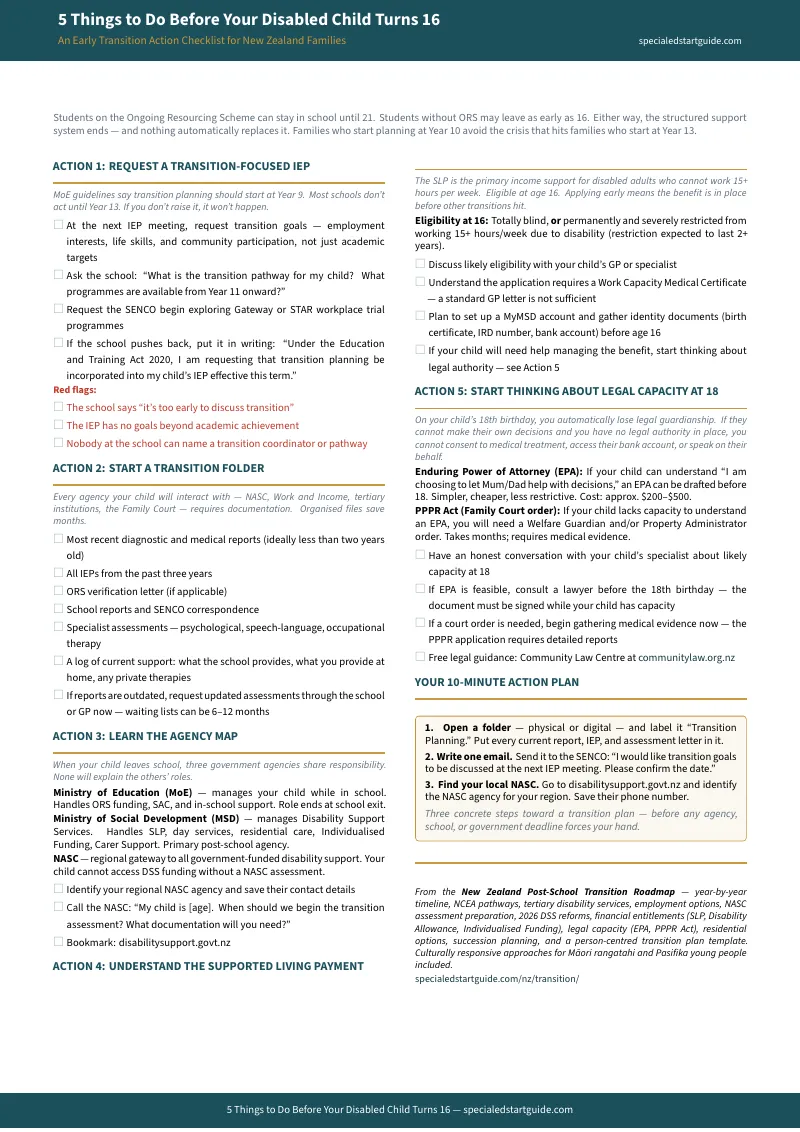
- 5 Things to Do Before Your Disabled Child Turns 16 (free) — a quick-start checklist covering the five highest-impact actions for early transition planning: requesting a transition-focused IEP, building your documentation folder, understanding the agency map, the Supported Living Payment basics, and legal capacity planning
Instant PDF download. Start with the Year 10 timeline tonight. Print the transition plan template and the NASC checklist — bring them to your next IEP meeting.
Money-back guarantee, no time limit. If this guide doesn't change how you plan your child's transition, email us for a full refund. No questions asked.
Not ready for the full guide? Download the free 5 Things to Do Before Your Disabled Child Turns 16 — a checklist covering the five foundational actions every NZ parent should take before transition planning gets urgent. Enough to start the conversation with the school and understand which agencies are coming next. Free.
The cliff edge is real. But families who start planning at Year 10 — not Year 13 — reach it with a roadmap, not a prayer.