The School Called Again. Your Child Was Sent Home Early — No Formal Stand-Down, No Paper Trail, No Accountability. This Playbook Gives You the Exact Scripts to End It.
You know what informal exclusion feels like even if you've never heard the term. It's the phone call at 11am asking you to "come collect him early — he's had a difficult morning." It's the suggestion that your daughter "might be better at home this afternoon." It's the camp permission slip that never arrived. It's the reduced timetable nobody asked you to agree to.
It's illegal. Under Section 34 of the Education and Training Act 2020, your child has exactly the same right to attend school full-time as every other enrolled student. A school cannot remove your child without following the formal stand-down process under Section 73 — which requires written notice, reason codes, and Ministry oversight. Everything else is unlawful. But schools do it constantly because most parents don't know how to force the paper trail that makes it stop.
You've tried the collaborative route. You've attended IEP meetings where the SENCO promised "more support" without specifics. You've spoken to the principal and been told "we're doing everything we can within our funding." You've contacted IHC and Autism NZ and received helpful brochures that explain your rights in general terms. But nobody has handed you the actual email to send tonight — the one with the statutory citation that forces the school to either formally stand down your child (triggering Ministry oversight) or keep them in class.
The New Zealand Special Education Advocacy Playbook is a tactical enforcement manual. Not philosophy. Not policy summaries. The exact scripts, legal templates, complaint letters, and escalation pathways that professional education advocates charge $150–$200 per hour to deploy — formatted so you can send them from your phone at 9pm on Sunday night before Monday's meeting.
What's Inside the Advocacy Playbook
The Informal Exclusion Protocol
The script that stops illegal send-homes within one email. When the school calls to "suggest" you collect your child early, you respond with a template that cites Section 73 and forces them to declare: is this a formal stand-down with written grounds, or are you struggling to provide the accommodations required under Section 34? Schools that have been doing this for months stop within one exchange — because the paper trail changes the risk calculus entirely.
11 Legal Letter Templates — Pre-Loaded With NZ Legislation
Cut-and-paste letters for every escalation scenario you will face. Request an IEP meeting. Demand a written explanation for reduced teacher aide hours. Halt an informal exclusion. Escalate unimplemented accommodations to the Board of Trustees. Lodge a formal complaint with the Ministry of Education. File a Privacy Act request for all records held about your child. Each template cites the specific sections of the Education and Training Act 2020, the Human Rights Act 1993, and the Privacy Act 2020 — because a letter with legislation gets answered. A letter without it gets filed.
The 6-Step Escalation Pathway
When the school says "we're already doing everything we can" and stops responding to emails, you need to know the exact next step — not next week, tonight. The pathway maps every rung: Principal → Board of Trustees → Ministry of Education Regional Office → Education Review Office → Human Rights Commission → the Ombudsman. Each step includes who to contact, what evidence to attach, expected response timeframes, and the trigger that tells you it's time to escalate further. Most parents never need to go past step two — because a school that recognises you know the pathway changes behaviour immediately.
Teacher Aide Hour Defence
"We don't have the funding" is not a lawful reason to cut your child's support. This section breaks down how the Special Education Grant works, how In-Class Support funding operates, what the school's actual obligations are under the Human Rights Act, and — critically — the email template that forces the Board to justify the cut in writing. A verbal "sorry, budgets are tight" is designed to end the conversation. A written request for justification under the Human Rights Act reopens it permanently.
ORS Funding Appeal System
ORS funding covers roughly 1.4% of New Zealand students. If your child's application was declined, you received a form letter and silence. This section maps the Section 47 appeal process step by step — from requesting the verification panel's reasons, to assembling a reconsideration portfolio, to understanding why the Deficit Paradox (schools present your child positively in daily practice, undermining the severity framing the panel needs) causes most declines. You'll know exactly what the verifiers look for and how to present evidence in their language.
IEP Meeting Advocacy Scripts
The school controls the meeting format, the room, the agenda, and the professional language. You arrive outnumbered and often talked over. This section provides verbatim scripts for the six most common power imbalances: when goals are presented as non-negotiable, when the school dismisses your concerns as "emotional," when accommodations are refused as "not feasible," when the SENCO claims no funding exists, when the school suggests your child would be "better suited elsewhere," and when action items from the last meeting have been quietly dropped. You'll know what to say before they finish the sentence.
The Documentation System
Advocacy without documentation is just conversation. This section provides the exact evidence file structure that professional advocates build: timestamped incident logs, email confirmation templates, meeting minute protocols, and the format that the Human Rights Commission and the Ombudsman actually accept as evidence. Every phone call, every "quick chat," every promise made in the corridor — you'll know how to convert it into binding, written record.
Formal Complaint Drafting
When internal escalation fails, you file externally. The playbook provides complete complaint templates for the Ministry of Education, the Human Rights Commission, and the Ombudsman — each formatted to the receiving body's specific requirements, with the evidence structure they expect and the legal grounds they can actually act on. Most parents don't file because the process feels opaque. These templates remove every barrier between your decision to complain and the complaint being lodged.
Culturally Responsive Advocacy for Māori and Pasifika Whānau
Advocacy framed only through Pākehā institutional norms ignores the obligations schools hold under Te Tiriti o Waitangi and Ka Hikitia – Ka Hāpaitia. This section covers how to integrate Te Whare Tapa Whā into accommodation requests, how to invoke Section 127 Board obligations to give effect to Te Tiriti, and how to ensure your child's IEP reflects cultural dimensions of wellbeing — not just academic metrics that serve the school's reporting requirements.
Who This Playbook Is For
- Parents whose child is being informally excluded — sent home early, put on a "reduced timetable," told to stay home when the aide is sick — and who need the legal citation to stop it happening again
- Parents whose teacher aide hours were cut without consultation and who were told "the budget doesn't allow it" — and who need to know why that answer doesn't meet the legal threshold
- Parents whose ORS application was declined and who received no meaningful explanation of what failed or how to challenge it
- Parents who attend IEP meetings feeling outnumbered, talked over, and pressured into agreeing to vague goals that commit the school to nothing
- Parents who've tried the collaborative approach for months and it isn't working — the school says the right things in meetings but nothing actually changes
- Parents who suspect the school is building a case to push their child out and who need to get ahead of it with documentation and legal knowledge
- Parents who've been told their child would be "better suited to a specialist school" and who recognise that as a push, not a suggestion
- Whānau members, grandparents, and support people who attend meetings on behalf of the parent and need the legal tools to advocate effectively
Why This Exists When IHC and Parent to Parent Are Free
They're extraordinary organisations doing essential work. Here's what they don't do — by design:
- IHC fights the system at a structural level — they don't write your email tonight. Their 2025 human rights settlement proved the system discriminates against disabled learners. That's landmark advocacy. But when you need to send a letter to the principal by 8am tomorrow because your child was sent home again, structural change doesn't help. The Playbook gives you the template — tonight, not in six months when an advocate is assigned.
- Parent to Parent assumes the school relationship is intact. Their IEP preparation booklet is outstanding when the SENCO is collaborative and the school is acting in good faith. When the relationship has broken down — when they're ignoring emails, cutting hours, or subtly pushing your child out — you need assertive enforcement language, not collaborative planning tools. This Playbook is built for the breakdown.
- Community Law provides the legal framework but not the fill-in-the-blank letters. They'll tell you Section 34 protects your child's attendance rights. They won't hand you the email that cites Section 34 in a way that forces the school to respond on record. The Playbook does — with 11 templates covering every common scenario.
- The Ministry of Education explains how the system should work — not what to do when it doesn't. MoE guidelines present IEPs as collaborative documents and schools as willing partners. When the school is the problem, Ministry resources are structurally incapable of helping you fight them. The Playbook takes the adversarial perspective that official resources cannot.
Free resources explain what the law says. This Playbook gives you the exact letters, scripts, and escalation pathways to enforce it today.
— Less Than 10 Minutes With a Private Education Advocate
Private education advocates in New Zealand charge $150–$200 per hour. A private educational psychologist assessment costs $1,400–$1,800. Some families spend over $10,000 a year from their own pockets just to keep teacher aide hours funded. The strategies in this Playbook are the same documentation systems, legal citations, and escalation pathways those professionals deploy — formatted so you can use them tonight without a billable clock running.
Your download includes the complete Advocacy Playbook guide plus 8 standalone printable tools:
- Complete Advocacy Playbook (guide.pdf) — 13 chapters covering the NZ legal framework, informal exclusion protocols, teacher aide funding defence, IEP meeting advocacy scripts, complaint drafting, ORS appeal strategy, documentation systems, the 6-step escalation pathway, NCEA Special Assessment Conditions, culturally responsive advocacy, and support organisations
- 11 Legal Letter Templates (letter-templates.pdf) — every template extracted as a standalone document with a quick-reference index, ready to copy and send tonight
- IEP Meeting Scripts (iep-meeting-scripts.pdf) — preparation checklist plus word-for-word responses for the 6 most common school pushbacks, designed to bring to the meeting
- Escalation Pathway (escalation-pathway.pdf) — the 6-step ladder from classroom teacher to the Human Rights Commission, with contacts, timelines, and triggers for each level
- Evidence Log (evidence-log.pdf) — fillable worksheet for tracking every interaction with the school
- Informal Exclusion Log (exclusion-log.pdf) — fillable tracker for documenting every instance your child is sent home without formal process
- IEP Action Tracker (iep-action-tracker.pdf) — fillable worksheet for monitoring whether school commitments from IEP meetings are actually implemented
- Support Organisations (support-organisations.pdf) — quick-reference card of NZ advocacy organisations, legal services, and government contacts
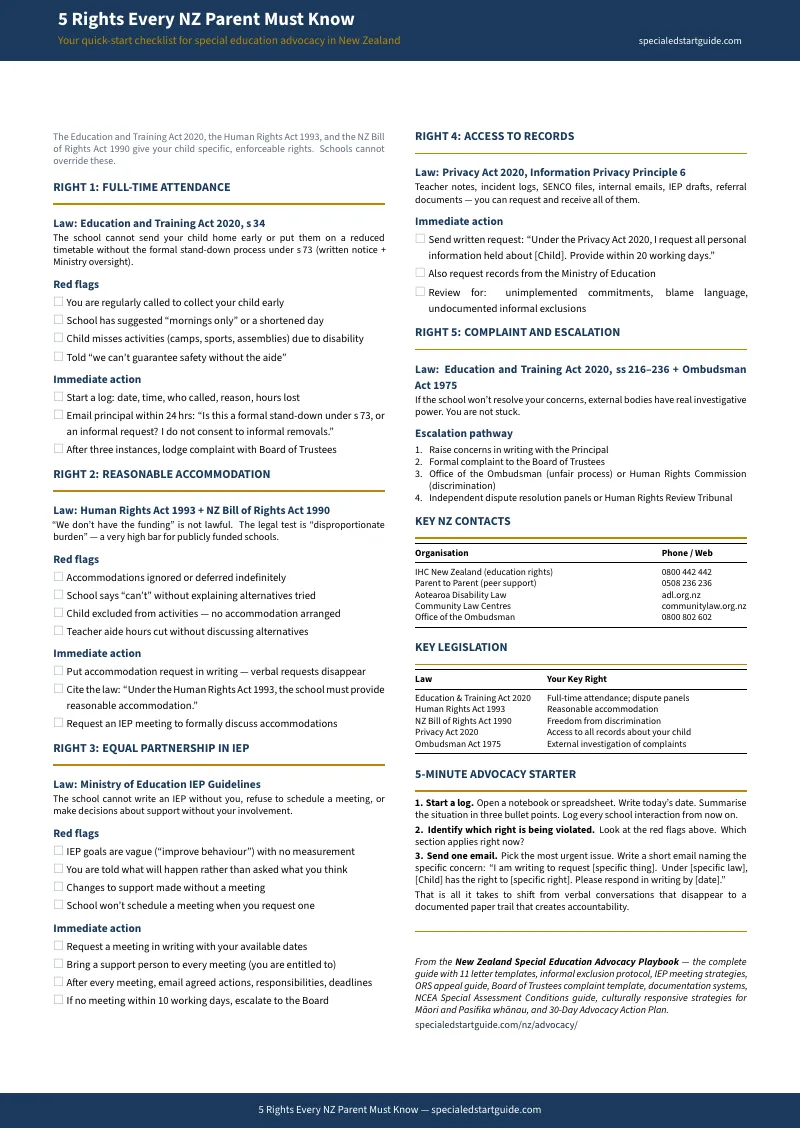
- 5 Rights Quick-Start Checklist (checklist.pdf) — the five fundamental rights every NZ parent must know, immediate-action steps for each violation, key legal citations, and the escalation ladder on one printable page
Instant PDF download. Print the checklist tonight. Send your first enforcement letter before the school opens tomorrow.
Money-back guarantee, no time limit. If the Playbook doesn't change how the school responds to you, email us for a full refund. No questions asked.
Not ready for the full Playbook? Download the free 5 Rights Every NZ Parent of a Disabled Child Must Know — a printable checklist covering full-time attendance, reasonable accommodation, IEP partnership, privacy rights, and the escalation pathway. It's enough to send your first informed email to the school, and it's free.
Your child has a legal right to be in that classroom — supported, accommodated, and educated. After tonight, you'll know exactly how to make the school comply.