The School Broke the Rules. Free Guides Tell You to "Keep a Notebook." This Playbook Gives You the Dispute Letters to Force Compliance Tonight.
You already tried being polite. You attended the ISSP meetings. You raised your concerns respectfully. You asked about the missing IRT hours, the Student Assistant who vanished mid-year, the accommodations written into the plan that never appeared in the classroom. The Teaching and Learning Team nodded. The principal said "we're doing our best with the resources we have." Nothing changed. Your child is still losing months of intervention while sitting on a 12-to-27-month waitlist for an assessment that the school refuses to act without — even though the RTL policy explicitly says they must.
You downloaded the Responsive Teaching and Learning Policy from the government website. You read dense bureaucratic language describing how inclusive education should work when administrators comply voluntarily. You found LDANL's assessment guide — excellent on procedure, silent on what to do when the system refuses to move. You Googled for help and found American IEP planners from Etsy referencing IDEA, 504 Plans, and due process hearings — none of which exist in Newfoundland and Labrador. You priced private assessments at $3,200–$3,900 and realized that the help your child needs is financially out of reach.
The Newfoundland & Labrador Special Ed Advocacy Playbook is the Crisis Enforcement System — the adversarial toolkit that free guides deliberately leave out. Five fill-in-the-blank dispute letter templates pre-loaded with Schools Act, RTL Policy, and NL Human Rights Act citations. Five step-by-step crisis protocols for the exact scenarios where Newfoundland and Labrador parents lose the most ground. The complete escalation ladder from classroom teacher to the Office of the Child and Youth Advocate. Every strategy grounded in provincial law — no American terminology, no collaborative platitudes, no 100-page preamble before you reach something actionable.
What's Inside the Playbook
The Legal Architecture Weaponized
The NL Human Rights Act, 2010 duty to accommodate, the Schools Act, 1997 Section 22 appeal right, the RTL Policy's mandate for needs-based intervention without a diagnosis, the ISSP framework's interagency obligations, and the Supreme Court of Canada's Moore v. British Columbia decision — translated from legislative language into the exact phrases that trigger administrative obligations when you put them in writing. This is not a policy explainer. It is a conversion guide that turns dense bureaucratic law into sentences a principal cannot legally ignore.
Five Fill-in-the-Blank Dispute Letter Templates
Pre-written adversarial letters for the five situations where NL parents need legal language fastest: requesting a psychoeducational assessment with a formal timeline demand, challenging the denial of IRT or Student Assistant hours, formally refusing an informal exclusion via shortened school day, demanding interim RTL-based accommodations while waiting years for a public assessment, and filing a Section 22 formal appeal under the Schools Act. Each template cites the specific section of the Schools Act, the RTL Policy, or the NL Human Rights Act that creates the enforceable obligation. Fill in the brackets with your child's name, the school, and the dates — then send. The school's obligation to respond on the record begins the moment your email arrives.
Five Crisis Advocacy Protocols
Step-by-step tactical playbooks for the moments where the collaborative relationship collapses: your child waiting 12-27 months for an assessment while receiving zero interim support, IRT hours cut or redirected to cover mainstream classroom shortages, Student Assistant time denied or diluted across multiple students, an ISSP meeting where decisions arrived pre-made and you were asked to rubber-stamp them, and a shortened school day with no written justification and no return-to-full-day plan. Each protocol begins with the immediate first step you take today — not a philosophical discussion about your rights.
The Complete Escalation Pathway
When a principal ignores your written concern, parents fail because they complain to the wrong person or use the wrong format. This playbook maps the rigid NL chain of command — from classroom teacher through IRT, Principal, Director of Schools, Section 22 Formal Appeal to the CEO/Director of Education (15-day filing deadline), the NL Human Rights Commission (12-month filing window), and the Office of the Child and Youth Advocate. Each level specifies the exact written language and documentation required to advance. The escalation pathway tells you who has actual authority, who is procedurally obligated to respond, and when you have exhausted internal remedies and earned the right to an external complaint.
The Assessment Waitlist Survival Protocol
No existing free resource adequately addresses what to do during the 12-to-27-month wait for a public psychoeducational assessment. The RTL policy explicitly mandates that intervention is based on observable educational need — not on a completed diagnosis. This playbook gives you the exact written language to force the Teaching and Learning Team to provide tiered support immediately, citing the RTL's Embedded Collaboration framework. Your child does not need to lose two years waiting for the system to validate what you already know.
ISSP Meeting Preparation
An ISSP meeting brings together representatives from Education, Health and Community Services, and potentially Children, Seniors and Social Development. Parents are routinely outnumbered and outflanked by professionals who control the agenda and arrive with pre-completed documents. The playbook provides a preparation matrix: what documents to bring, what questions to ask before signing consent, how to challenge proposed changes to programming pathways, and how to ensure that verbal commitments are documented in the official ISSP. The meeting prep section transforms you from a spectator into the most prepared person in the room.
Countering Common School Tactics
The exact response — with the provincial law citation that dismantles each refusal — when the school tells you "we don't have the budget for a Student Assistant," "we're waiting for the assessment before we can help," "your child is too dysregulated for the classroom," "inclusion means being in the regular classroom — that is the service," or "the educational psychologist only visits once a term." These are not philosophical arguments. They are copy-paste rebuttals with legal teeth.
Who This Playbook Is For
- Parents whose child has been on a 12-to-27-month public assessment waitlist and the school refuses to provide interim support — even though the RTL policy explicitly mandates needs-based intervention without a diagnosis
- Parents who discovered their child's IRT hours were cut mid-year because the teacher was pulled to cover mainstream classroom shortages — and need the letter template to demand written justification and reinstatement
- Parents who sat through an ISSP meeting where the document arrived pre-completed, the interagency team controlled the agenda, and they left feeling like spectators at a proceeding about their own child's future
- Parents in rural Newfoundland or Labrador — Corner Brook, Gander, Happy Valley-Goose Bay, Labrador City — where the educational psychologist visits quarterly and interim supports are nonexistent during multi-year assessment backlogs
- Parents whose child has been placed on a shortened school day with no written justification, no educational materials sent home, and no projected return-to-full-day date
- Parents whose child's Jordan's Principle funding has been cut or delayed — and need strategies to demand provincial replacement support while federal bureaucracy stalls
- Parents who already have the IEP & Support Plan Blueprint and need the next-level adversarial tools for when collaboration has failed
- Parents who contacted LDANL or the Autism Society NL and learned the waitlist for personalized advocacy support is months long — and the crisis is happening now
Why Not Just Use the Free Resources?
- The RTL Policy Manual and Service Delivery Model Forms describe how the system should work when administrators comply voluntarily. They are government documents written for education bureaucrats. They define terms — RTL, ISSP, IRT, SDM, Embedded Collaboration — in dense regulatory language and assume full institutional compliance. They provide zero guidance on what to do when the principal refuses to implement the ISSP goals, when IRT support vanishes, or when the school places your child on an indefinite shortened day with no justification.
- LDANL's assessment guide is excellent on procedure — silent on adversarial strategy. It explains how assessments work and what a comprehensive report should contain. This guidance assumes the system is acting in good faith. When your child has been waiting 18 months for an assessment and the school refuses interim intervention, you do not need another procedural explainer — you need the exact email template to send tonight citing the RTL policy's requirement for needs-based support.
- Etsy and Gumroad planners use American terminology that undermines your credibility. IEP, 504 Plan, FAPE, IDEA — none of these exist in Newfoundland and Labrador. Walking into a school in St. John's or Corner Brook demanding a "504 accommodation" signals immediately that you have not read the RTL policy. The Teaching and Learning Team knows. Your advocacy authority drops before you open your mouth.
- Private psychoeducational assessments cost $3,200–$3,900. Autism assessments run even higher. The public waitlist stretches up to 27 months. If you eventually hire a private advocate, your first several billable hours go toward administrative triage — organizing your emails and understanding your child's file. This playbook teaches you to build the documented case from day one — so if you do hire professional help, they execute instead of orientate.
The free resources explain what NL law says. This playbook gives you the fill-in-the-blank dispute letters to make the school follow it.
— Less Than a Single Hour With a Private Specialist
Private psychoeducational assessments in Newfoundland and Labrador cost $3,200–$3,900. Autism diagnostic assessments run even higher. For a family already losing income to shortened-day pickups and spending months navigating the public waitlist, hiring a private advocate is financially impossible. This playbook gives you the same legal frameworks, escalation pathways, and dispute letter templates that a private educational advocate would provide — adapted specifically to NL's unique RTL and ISSP system.
Your download includes 7 PDFs — an 11-chapter adversarial advocacy guide plus 5 standalone printable tools and a quick-start checklist:
- Advocacy Guide (guide.pdf) — the complete 11-chapter playbook covering the legal architecture, chain of command, programming pathways and the consent trap, getting assessments and surviving the waitlist, five crisis advocacy protocols, five dispute letter templates, the escalation pathway, countering common school tactics, the documentation system, Jordan's Principle and Indigenous advocacy, and the resource directory
- Dispute Letter Templates (letter-templates.pdf) — all five fill-in-the-blank letters as a standalone printable: assessment request, ISSP accommodation demand, exclusion challenge, student records request (ATIPPA), and Section 22 formal appeal
- Escalation Pathway (escalation-pathway.pdf) — the complete NL chain of command from classroom teacher to the Office of the Child and Youth Advocate as a printable reference card with deadlines and required written language
- Service Delivery Tracker (service-tracker.pdf) — fillable weekly log tracking promised ISSP/IEP services vs. actual delivery, plus communication and incident logs
- ISSP vs IEP Meeting Prep Matrix (meeting-prep-matrix.pdf) — one-page reference showing the critical differences between school-only and interagency meetings, who attends each, and the five questions to ask before signing consent
- Resource Directory (resource-directory.pdf) — printable contact sheet with LDANL, Autism Society NL, Inclusion Canada NL, the OCYA, the NL Human Rights Commission, private assessment clinics, and a "who to call when" quick reference
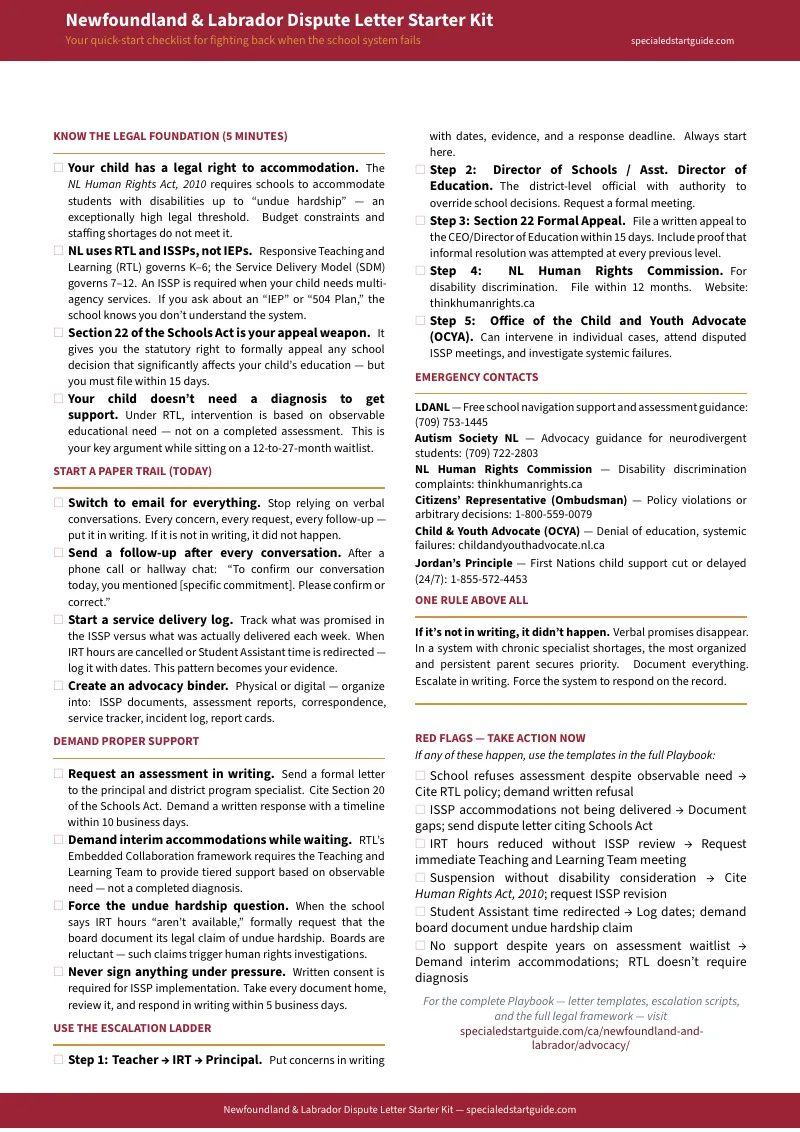
- Dispute Letter Starter Kit (checklist.pdf) — the quick-start action checklist with the legal foundation, paper trail essentials, and the first three escalation steps
Instant PDF download. Send your first dispute letter tonight. Force the school to respond on the record.
Money-back guarantee, no time limit. If the playbook doesn't change how you handle your child's advocacy, email us for a full refund. No questions asked.
Not ready for the full Playbook? Download the free Newfoundland & Labrador Dispute Letter Starter Kit — a sample dispute letter template and parent rights one-pager with the legal foundation, paper trail essentials, and the first three escalation steps. Enough to send your first formal written challenge today, and it is free.
Your child cannot wait for the system to fix itself. The school knows the law. After tonight, so will you.