The School Said "Wait." Your Child Can't Afford To.
You asked about getting your child assessed. The teacher agreed something was wrong. The principal nodded sympathetically. And then you were told the waitlist is six months. Or twelve months. Or — if you're in the Yukon — up to eight years.
Meanwhile, your child falls further behind every semester. The intervention window narrows. The school keeps saying "we're monitoring" while you watch the gap between your child and their peers grow wider every report card.
So you Googled it. You found American forums recommending you "demand an IEE" and "cite IDEA." You discovered Wrightslaw templates built on a federal law that does not exist in Canada. You called a private psychologist and learned that a psychoeducational assessment costs $2,000 to $3,750 — and that the school might reject the report anyway if it doesn't align with their internal criteria.
Canada has no federal special education law. No standardized assessment timelines. Thirteen provinces and territories, each with its own legislation, its own terminology, its own funding triggers, and its own mechanisms for deciding whether your child qualifies for support. An IEP in Ontario means something fundamentally different from an IPP in Alberta or a PLP in Newfoundland — and in British Columbia, the IEP is explicitly not a legally binding document.
The Canada Special Ed Assessment Decoder is the cross-provincial tactical playbook that bridges the gap between knowing your child needs an assessment and actually getting one — with province-specific procedures, ready-to-send letter templates, and the financial strategies that turn a $3,400 private assessment into a recoverable investment.
What's Inside the Assessment Decoder
Province-by-Province Assessment Procedures
The exact process for requesting and obtaining an assessment in all 13 jurisdictions. Ontario's IPRC pathway. Alberta's IPP coding system. BC's School-Based Team model. Quebec's dual-language bureaucracy. Saskatchewan's Student Support Services. The Territories' remote assessment challenges. Each section covers the identification body, the legislative framework, the timeline (official and actual), the funding triggers, and the appeal pathway specific to that province. You stop guessing which process applies to you and start following the correct one.
The Cross-Provincial Translation Matrix
The single reference tool that no other Canadian resource provides. When Ontario calls it an IPRC and Alberta calls it an IPP and Nova Scotia calls it a Program Planning Team — you need a translation guide, not thirteen separate booklets. The matrix maps terminology, identification philosophies, and legal weight of documents across every jurisdiction, so you can compare how your province handles assessments against how others do it. When your school says a specific accommodation is "impossible," knowing that the exact same accommodation is standard protocol in another province gives you the rhetorical leverage to push back.
The Private Assessment Survival Guide
When the public waitlist stretches past what your child can afford to lose, going private is the only option. But spending $2,000 to $3,750 on a private psychoeducational assessment without a corresponding school strategy is a fast track to wasted money. This chapter covers how to find a qualified assessor registered with your provincial College of Psychologists, how to verify their report will meet your district's criteria before you pay, how to access university sliding-scale clinics at $600–$1,400, and — critically — how to force the school to accept and implement the private report's recommendations in your child's accommodation plan.
The Financial Mitigation Roadmap
The $29 you spend on this guide can save you thousands. Detailed instructions for claiming private assessment costs under the CRA's Medical Expense Tax Credit (METC) — which most parents don't know exists. Step-by-step guidance on qualifying for the Disability Tax Credit (DTC) via Form T2201, which is based on functional impact rather than diagnosis alone. How to maximize your extended health benefits through Sun Life, Manulife, or Canada Life, which can cover up to $3,000 annually for psychological services when billed correctly. For First Nations families, a dedicated section on Jordan's Principle — the federal funding mechanism that covers private assessments when provincial services fail.
Assessment Request Letter Templates
Three fill-in-the-blank templates you can send tonight. Template 1: the initial assessment request that documents your concerns in precise language and starts the procedural clock. Template 2: the follow-up letter when the school delays, referencing your original request date and asking for a written timeline. Template 3: the letter that compels the school to accept and incorporate your private assessment findings. Each template is written in the professional, legally-toned language that commands administrative attention — because "please assess my child" gets filed away, but a dated letter citing your provincial education act gets a response.
Understanding Your Child's Assessment Report
The psychologist hands you a 15-page report full of percentile scores, standard deviations, and clinical terminology. Without understanding what those numbers mean, you cannot advocate for the specific accommodations your child needs. This chapter decodes standardized scores, explains how learning disabilities are diagnosed through ability-achievement discrepancies, and — most importantly — teaches you how to evaluate the recommendations section. A report that says "provide extra help" is useless. A report that says "requires extended testing time of 50% for all timed assessments and direct instruction in chunking multi-step tasks" compels specific action. You'll know the difference.
Common Scenarios and Tactical Responses
The school suggests "monitoring and waiting" instead of assessing. Your twice-exceptional child scores too high on the IQ test for the school to take the learning disability seriously. The school outright refuses to assess. You spent $3,400 on a private assessment and the school ignores it. You're relocating from Ontario to British Columbia and your child's hard-won IPRC designation means nothing in the new province. Each scenario includes the specific language to use, the procedural steps to take, and the escalation pathway when the school won't budge.
Advocacy Strategies for the Assessment Phase
How to build an evidence file that makes your case undeniable. How to write the assessment request letter that gets results. How to navigate the school meeting without getting steamrolled by a team that does this every day. This isn't theory — it's the tactical playbook for the parent who is done being told to wait.
Who This Guide Is For
- Parents whose child has been placed on a 6-to-24-month public assessment waitlist and who cannot afford to lose another semester
- Parents who've been told their child "doesn't qualify" or "isn't severe enough" for an assessment — despite clear evidence of academic or behavioural struggles
- Parents considering a private psychoeducational assessment who need to ensure the school will actually accept and implement the results
- Families relocating between provinces who've discovered that their child's hard-won special education designation doesn't transfer across provincial borders
- Parents who've been using American resources (Wrightslaw, IDEA templates, 504 plans) and need to understand why that advice is actively harmful in a Canadian school meeting
- Parents in Quebec navigating the dual-language system who need English-language assessment strategies within the French-dominant bureaucracy
- Parents who want to recover the cost of a private assessment through tax credits and insurance benefits but don't know where to start
Why Not Just Use the Free Resources?
Canada has credible free resources. AIDE Canada publishes a cross-provincial education rights toolkit funded by the Public Health Agency. Every provincial ministry puts out parent guides. The Learning Disabilities Association of Canada offers diagnosis-specific information. Here's why parents still feel lost after reading all of them:
- Provincial guides explain how the system works when fully funded. They outline the IPRC process, the IPP coding system, the SBT referral pathway — as they should operate in a utopian scenario. They do not explain what to do when the principal tells you there is no budget for an assessment this year. They do not provide the letter template to legally document that refusal. They do not explain how to force the school to accept your private report.
- AIDE Canada is excellent but clinical. Their toolkit explains the constitutional framework of education in Canada and cites the Moore v. British Columbia precedent. But parents in crisis do not need a lesson on Section 93 of the Constitution Act — they need the exact email template to send to a reluctant superintendent tonight.
- Non-profit resources are siloed by province and diagnosis. Autism BC covers BC. Autism Ontario covers Ontario. The LDAC covers learning disabilities. If your child has ADHD and you're moving from Alberta to Nova Scotia, you need to synthesize four separate organizations' resources. This guide does that synthesis for you.
- American resources are actively dangerous. Wrightslaw templates cite IDEA — a US federal law with no Canadian equivalent. A parent who walks into a School-Based Team meeting demanding a "504 Plan" or citing "due process rights" under IDEA immediately destroys their credibility. The school team knows American law doesn't apply. Now they know the parent doesn't understand the system — and that parent has lost the negotiating table before the meeting even started.
Free resources explain the rules of the game. This guide gives you a strategy to win when the game is rigged against you.
— Less Than One Minute With an Educational Consultant
Private special education advocates in Canada charge $85 to $150 per hour. A single introductory consultation with an educational navigator costs $150 for a package that includes just two meetings. A private psychoeducational assessment runs $2,000 to $3,750. The financial mitigation chapter alone — covering the Medical Expense Tax Credit, the Disability Tax Credit, and extended health benefit optimization — can save your family thousands of dollars over the next decade.
Your download includes the complete Assessment Decoder guide plus 4 standalone printables:
- Complete Assessment Decoder Guide — 11 chapters covering assessment types, province-by-province procedures for all 13 jurisdictions, the cross-provincial translation matrix, private assessment strategy, report interpretation, common scenarios and tactical responses, advocacy strategies, financial mitigation through tax credits and insurance, and three ready-to-send letter templates
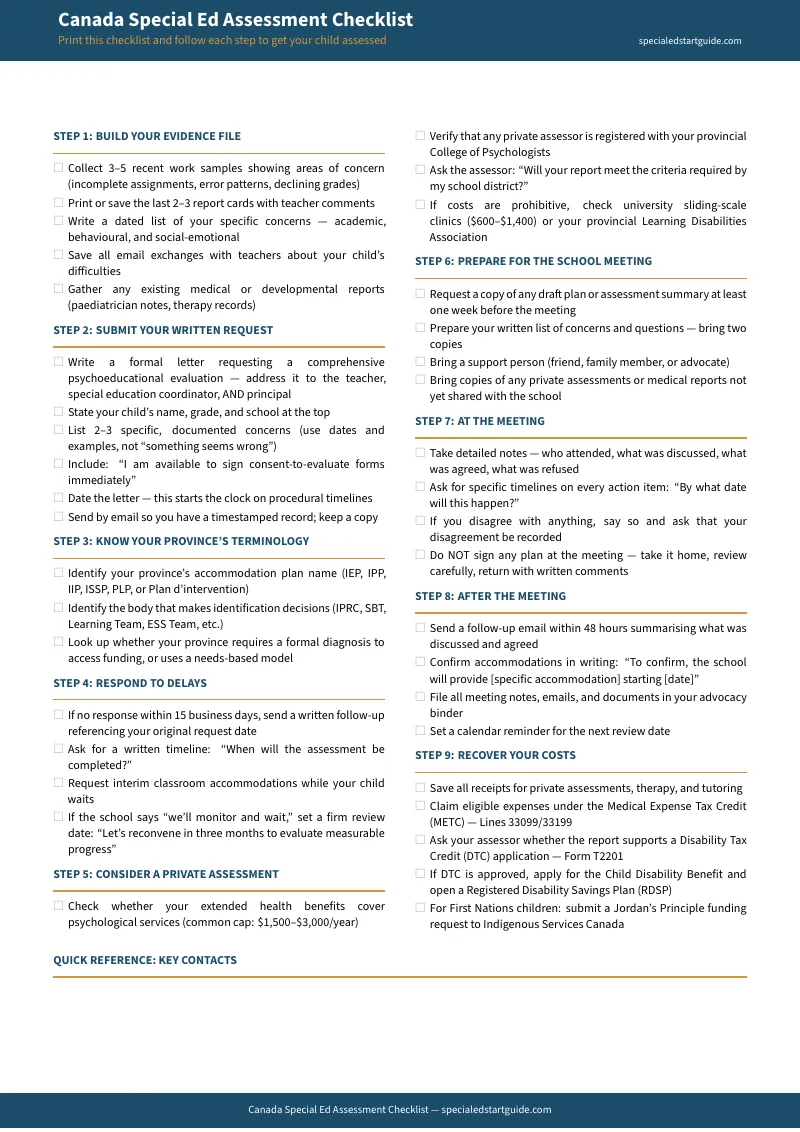
- Quick-Start Checklist — 9-step action plan: build your evidence file, submit your written request, know your province's terminology, respond to delays, evaluate private options, understand your report, navigate the school meeting, protect your financial position, and plan your next steps
- Assessment Request Letter Templates — Three standalone fill-in-the-blank templates ready to print and send tonight: initial assessment request, delay follow-up, and private report acceptance
- Cross-Provincial Translation Matrix — 2-page reference card mapping plan names, identification bodies, and assessment philosophies across all 13 jurisdictions — bring this to school meetings for instant cross-province comparison
- Financial Recovery Worksheet — Track your Medical Expense Tax Credit claims, Disability Tax Credit eligibility, extended health benefits coverage, and Jordan's Principle applications in one printable sheet
Instant PDF download. Send the assessment request letter tonight. Know exactly what to do when the school responds.
Money-back guarantee, no time limit. If the Assessment Decoder doesn't change how you navigate the assessment process in your province, email us for a full refund. No questions asked.
Not ready for the full guide? Download the free Canada Evaluation Request Letter Template — a ready-to-send letter template for requesting a special education evaluation that works in any Canadian province. It's the first step, and it's free.
Your child cannot wait for the waitlist. The system won't move until you make it. This guide shows you how.