The School Board Has Institutional Knowledge. You Need Constitutional Knowledge.
You walked into the IEP meeting and the plan was already written. Five professionals sat across from you. They explained what they had decided. They used terminology you did not recognize. They told you to sign at the bottom. You asked about more support hours and someone said "we don't have the budget." You asked about an Educational Assistant and someone said "staffing is a challenge right now." You asked why your child's goals are identical to last year's and someone said "we'll review that at the next meeting." You signed the document because you did not know what else to do.
Then you went home and searched for your child's special education rights. You found IDEA. You found FAPE. You found Section 504. You spent three hours reading about Individualized Education Programs under US federal law. None of it applies in Canada. There is no Canadian equivalent to IDEA. There is no federal department of education. There is no national definition of Free Appropriate Public Education. The principal was right when she told you that American law does not apply here — but she did not tell you what does.
Here is what she did not mention: the Canadian Charter of Rights and Freedoms guarantees your child's right to equal benefit of the law without discrimination based on disability. The Supreme Court of Canada ruled in Moore v. British Columbia that adequate special education is not a "dispensable luxury" but the essential "ramp" that provides access to education. Every provincial human rights code is quasi-constitutional — meaning it overrides your school board's education policies when they conflict. "We don't have the budget" is the exact argument that lost at the Supreme Court of Canada.
The Canada Special Ed Parent Rights Compass is the Constitutional Advocacy System — the guide that connects the Supreme Court's discrimination test, the Charter, and provincial human rights codes directly to your next school meeting, giving you the legal framework, jurisdiction-by-jurisdiction comparison tools, and fill-in-the-blank advocacy templates that transform a polite parental request into a formal demand your school board cannot ignore.
What's Inside the Compass
The 3-Step Moore Discrimination Test
The single most powerful legal tool available to Canadian parents, simplified into three yes-or-no questions. Step 1: Does your child have a disability, diagnosed or suspected? Step 2: Has the school denied, reduced, or failed to provide meaningful educational access? Step 3: Can the school prove genuine "undue hardship" — not budget tightness, not staffing shortages, but a burden so severe it would fundamentally alter the nature of the educational enterprise? If Steps 1 and 2 are yes and the school cannot satisfy Step 3, discrimination has occurred. This framework applies in every province and territory because it flows from the Charter and national human rights principles, not from any provincial statute. Learn it in five minutes. Use it at your next meeting.
The 13-Jurisdiction Comparison Matrix
Canada's extreme decentralization means an IEP in Ontario is an IPP in Alberta, a PPP in Saskatchewan, a PLP in New Brunswick, an ISSP in Newfoundland, and a Plan d'intervention in Quebec. The matrix maps plan terminology, governing legislation, identification processes, and dispute resolution pathways across all 13 provinces and territories. If you live in one province, it shows you exactly how your system works. If you move between provinces — or if you are a Canadian Armed Forces family facing another mandatory posting — it translates your child's supports instantly so you never start from scratch.
The Universal Advocacy Letter Templates
Fill-in-the-blank templates pre-loaded with human rights terminology that works in every province. Formal assessment requests that cite the duty to accommodate. Denial-of-services responses that invoke Moore v. BC and the three-factor undue hardship test. Soft exclusion documentation letters that frame "we sent your child home early because we don't have staff" as discriminatory denial of educational access. Plan review demands. Dispute escalation letters with human rights commission filing deadlines. You insert your child's name, the specific issue, and the accommodation you need — the legal language that commands a response is already built in.
The Constitutional Framework
Section 15 of the Charter, provincial human rights codes, the Accessible Canada Act, the CRPD, and the UNCRC — explained in plain language with the exact hierarchy that determines which law wins when school board policy conflicts with human rights law. The answer is always human rights law. Your school board's special education policies are derived from the provincial education act, but the duty to accommodate flows from quasi-constitutional human rights legislation that sits above education policy. A school board cannot use its own policies as a ceiling on what it must provide.
The Two Supreme Court Decisions
Eaton v. Brant County (1997) established that equality sometimes requires different treatment — inclusion is the starting point, not a guaranteed outcome. Moore v. British Columbia (2012) declared special education essential infrastructure and ruled that budget constraints cannot justify disproportionate cuts to special needs programs. These are not obscure precedents. They are the foundation of every argument you will ever make to a school board. The Guide breaks both down into the practical language you can use across the table from five school professionals who assume you do not know they exist.
The Cross-Provincial Mobility Playbook
Individualized plans do not transfer automatically between provinces. When you move, the receiving province applies its own criteria, terminology, and processes. The Guide includes the transition portfolio checklist, province-by-province re-entry steps, and specific guidance for Canadian Armed Forces families who face mandatory relocations every two to four years. It covers the Support Our Troops National Child and Youth Disability Reimbursement Program — up to $2,500 per fiscal year for dependent children with disabilities — making this a resource that may itself be reimbursable under existing CAF family support programs.
The Assessment Crisis Playbook
Across Canada, psycho-educational assessment waitlists stretch years into the future. In the Toronto District School Board, 57% of students receiving special education have no formal identification. The Guide covers your right to request an assessment at any time without a teacher referral, the school's obligation to provide interim accommodations while you wait, how to use a private assessment effectively when the public waitlist is measured in years, and the federal funding mechanisms — including the Canada Student Grant for Services and Equipment — that can offset the $2,000 to $4,000 cost of a private assessment.
The Dispute Escalation Ladder
Four tiers: internal school board appeals, provincial ombudsman, provincial human rights commission, and judicial review. Every province has a different pathway — Ontario's IPRC, SEAB, and Special Education Tribunal is the most formalized; British Columbia uses the BC Ombudsperson with jurisdiction over all 60 school districts; Alberta allows ministerial review under Section 40 of the Education Act. The Guide maps the escalation route for your specific province, including filing deadlines (typically one year for human rights tribunal complaints) and the strategic reality that filing a complaint — or credibly threatening to — often produces immediate results.
Who This Compass Is For
- Parents whose school board told them "we don't have the budget" for an Educational Assistant, reduced support hours, or reassigned the EA to another classroom — and who do not know that budget constraints and staffing shortages do not meet the legal threshold for undue hardship under human rights law
- Parents whose child is being sent home early or asked not to come to school because "we don't have the staff today" — soft exclusions that are a discriminatory denial of educational access, not an accommodation
- Parents who have spent hours researching special education rights online and found nothing but US law — IDEA, FAPE, Section 504 — that is legally irrelevant in Canada
- Parents sitting across from five school professionals at a plan meeting where the document arrived pre-written — who do not know whether to sign it, whether the goals are measurable, whether the service hours are enforceable, or whether the accommodations match their child's actual needs
- Parents whose child has "passing grades" and was told they do not qualify for support — even though educational performance under human rights law includes social, emotional, behavioural, and executive functioning, not just GPA
- Canadian Armed Forces families facing another mandatory posting who know from experience that their child's IPP in Alberta will not automatically become an IEP in Ontario — and who do not have the energy to learn an entirely new provincial system from scratch again
- Families who moved from Ontario to British Columbia, from New Brunswick to Alberta, or between any two provinces and discovered that their child's plan does not transfer, the terminology has changed, and the identification process is completely different
- Indigenous parents navigating both provincial special education and Jordan's Principle, with no single resource that explains how they interact
- Parents who tried the AIDE Canada toolkit and found a policy whitepaper, not a field guide — or who found the Inclusion BC handbook and live in Nova Scotia
Why Not Just Use the Free Resources?
Canada has excellent free advocacy resources. AIDE Canada publishes a comprehensive K-12 Toolkit. Inclusion BC offers a Parent's Handbook on Inclusive Education. Every provincial ministry provides parent guides. Here is why parents still lose disputes after consulting all of them:
- AIDE Canada's K-12 Toolkit reads like a policy whitepaper. It is genuinely comprehensive — on pedagogy, theory, and government subsidies. It does not include a single fill-in-the-blank advocacy letter template. It does not teach you how to counter a school board's "we don't have the budget" excuse using the Moore discrimination test. It explains what the policy says. It does not give you the exact email to send to your principal tomorrow morning.
- Provincial guides stop at the provincial border. The Inclusion BC handbook is excellent — for residents of British Columbia. It references the BC School Act and BC-specific programs. It is useless for a parent in Nova Scotia, a military family transferring from Vancouver to Winnipeg, or anyone who needs to understand the constitutional framework that applies nationally. There is no Inclusion Canada resource that covers all 13 jurisdictions.
- Ministry guides are written by the government, to protect the government. They describe the bureaucratic process. They do not teach you how to fight back when that process fails your child. They will spend fifty pages explaining how an IEP works and never mention that your strongest protection comes from human rights law that overrides the education act. They inform parents of the process. They deliberately omit the legal leverage parents hold when the process breaks down.
- Private advocates cost $100 to $200 per hour. Specialized education lawyers charge $250 to $700. Most Canadian families cannot afford either. For the majority of disputes, the issue resolves at the school board level when the parent demonstrates knowledge of human rights law and the Moore discrimination test. This Compass gives you that knowledge for a fraction of the cost of a single consultation — and if you do ultimately need legal counsel, it saves significant billable hours by handing the lawyer an organized case instead of a folder of frustration.
The free resources explain what the law says. This Compass gives you the advocacy tools to make your school board comply.
— Less Than Fifteen Minutes of a Private Advocate
Private special education advocates in Canada charge $100 to $200 per hour. Specialized education lawyers bill $250 to $700. A single consultation to review your situation costs more than this entire Compass. The Compass gives you the constitutional frameworks, Supreme Court precedents, advocacy letter templates, and escalation strategies those professionals use — so you can either handle the dispute yourself or arrive at a paid consultation with an organized case that saves hundreds in billable hours.
Your download includes the complete 14-chapter Compass plus 7 standalone printable tools — every advocacy template, jurisdiction matrix, and escalation checklist, ready to print and use tonight.
- Complete Rights Compass Guide — 14 chapters covering the constitutional framework, the two Supreme Court landmark decisions (Eaton v. Brant County and Moore v. BC), the duty to accommodate and undue hardship, the 13-jurisdiction comparison matrix, assessment rights and the waitlist crisis, IEP red flags, dispute resolution and the escalation ladder, cross-provincial mobility, federal financial supports (DTC, RDSP, CDB), Indigenous education rights and Jordan's Principle, universal advocacy letter templates, and the documentation system
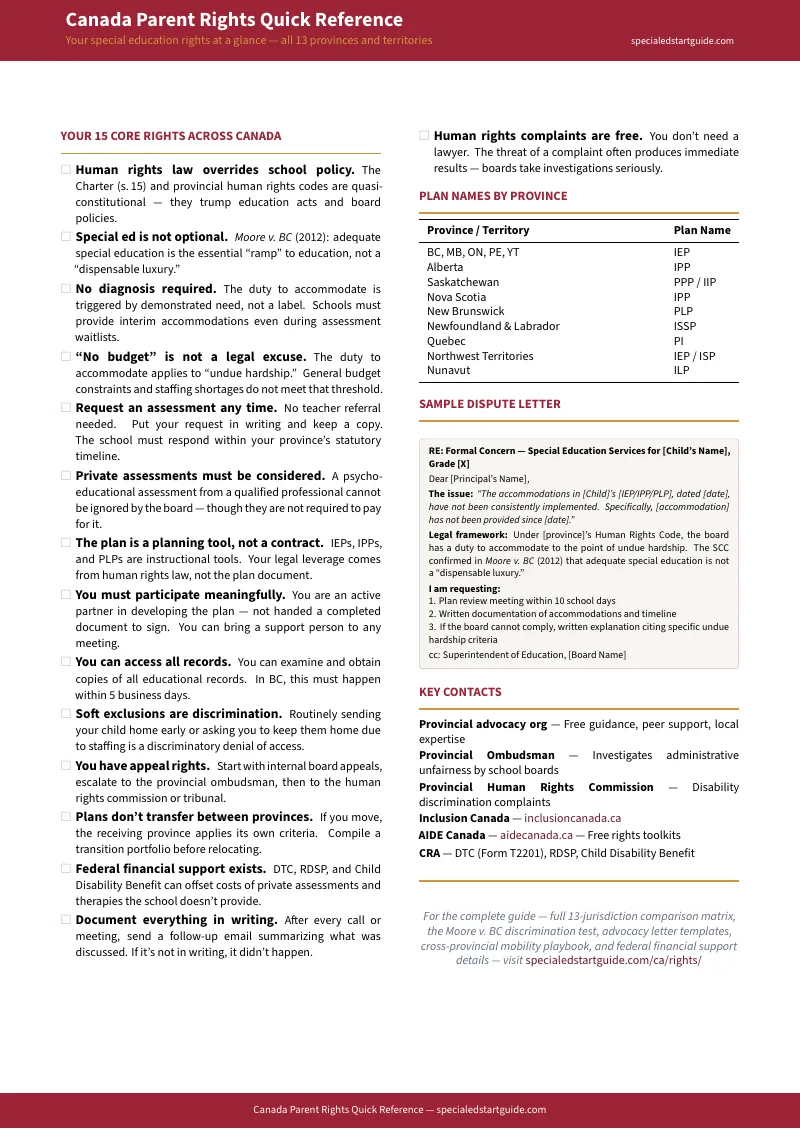
- Canada Parent Rights Quick Reference — the one-page printable checklist covering your core rights at a glance, the province-by-province plan terminology chart, a sample dispute letter with human rights language built in, and key contacts for advocacy organizations, ombudsman offices, and human rights commissions across all provinces
- 3-Step Moore Discrimination Test — the Supreme Court framework on a single printable card: three yes-or-no questions, the "What Is NOT Undue Hardship" list of common school excuses, and summaries of both landmark decisions
- 13-Jurisdiction Comparison Matrix — plan terminology, governing legislation, and key features for all 13 provinces and territories in one printable reference, plus the critical distinction between Canadian planning tools and American legal contracts
- Universal Advocacy Letter Templates — three fill-in-the-blank letters ready to print and customize: formal assessment request, denial-of-services response citing Moore v. BC, and soft exclusion documentation
- Dispute Escalation Ladder — the three-tier pathway from internal school board appeals through the provincial ombudsman to human rights commissions, with province-specific mechanisms and filing deadlines
- Cross-Provincial Transition Portfolio — the essential documents checklist, four-step advocacy strategy for the receiving school, and CAF military family guidance including the Support Our Troops reimbursement program
- Documentation System & Paper Trail Checklist — the follow-up email template, seven-section advocacy binder setup, communication log, and the strategy for requesting denials in writing
Instant PDF download. Print the advocacy letter that matches your situation tonight. Send it tomorrow morning.
Money-back guarantee, no time limit. If the Compass does not change how you advocate for your child's education, email us for a full refund. No questions asked.
Not ready for the full Compass? Download the free Canada Parent Rights Quick Reference — a printable one-page guide covering your core rights under the Charter and human rights law, the province-by-province plan terminology chart, a sample dispute letter, and key contacts. It is enough to walk into your next school meeting with more legal knowledge than most principals expect you to have, and it is free.
Your child's right to meaningful education is not a "dispensable luxury." The Supreme Court of Canada said so. This Compass makes sure your school board knows you know.