The School Calls It "Collaboration." You Call It Being Outnumbered. Here's How to Change That.
You sat through the IPP meeting — the principal, the classroom teacher, the learning support facilitator, and a district specialist you'd never met before. They talked about your child's "coding," referenced "Standards for Special Education" like you should know what that means, and told you the Educational Assistant hours were being reduced because the school needs to "reallocate resources." You asked why. They said it was a staffing decision. You asked what you could do. They said to "trust the Learning Team." You left with a document you barely understood and a feeling that the outcome was decided before you walked in.
You were right. And you are not alone. Over 20% of students in major Alberta urban jurisdictions like the Calgary Board of Education now hold a Special Education Code — and that rate has more than doubled relative to general enrollment growth over the past decade. The system is overwhelmed: class sizes of 35 to 40 students with 10 IPPs per teacher, Educational Assistant hours slashed mid-year without explanation, and psycho-educational assessment waitlists stretching 6 to 18 months through the public system. Parents who don't understand the coding categories, the funding formula, or the escalation pathways don't get heard. Parents who do, get results.
You live in a province where the closest thing to the American IEP system — the one every Google result describes — doesn't exist. Alberta uses the Individualized Program Plan (IPP), or in the Calgary Catholic School District, the Learner Support Plan (LSP). There are no due process hearings. There is no federal IDEA law. The entire system runs on provincial Standards, the Education Act, and a funding model that gives school boards discretion over how to spend block grants — which is exactly how schools justify telling you they "just don't have the resources." Bringing American IEP terminology into a meeting with an Alberta principal destroys your credibility in the first sentence.
The Alberta IEP & Support Plan Blueprint is the Provincial Advocacy System — the enforcement toolkit that translates Alberta's Education Act, Standards for Special Education, Special Education Coding Criteria, and human rights framework into the exact meeting scripts, advocacy templates, and escalation strategies you need to secure your child's support. Every recommendation cites the applicable Alberta regulation or legal principle.
What's Inside the Blueprint
The Alberta Legal Framework Decoded
The Standards for Special Education carry the force of Ministerial Order — meaning they have the weight of law, not just policy. The Blueprint translates every critical standard, the relevant sections of the Education Act, and the Supreme Court of Canada's Moore v. British Columbia decision into plain-language parental rights. When a school tells you they "don't have the budget" for your child's accommodation, the duty to accommodate under the Alberta Human Rights Act and the Canadian Charter creates an exceptionally high legal threshold called "undue hardship" — and this guide teaches you exactly how to invoke it without needing a lawyer in the room.
The Special Education Coding Criteria Explained
Alberta funds special education through the Specialized Learning Supports (SLS) Grant, distributed based on the Adjusted Enrolment Method. But your child's access to specific services depends on their coding — Code 41 for Severe Cognitive Disabilities, Code 44 for Severe Physical or Medical Disabilities, Code 54 for Learning Disabilities, Code 80 for Gifted and Talented, and a dozen more. Each code unlocks different levels of support. Schools sometimes undercode, fail to reassess, or claim your child "doesn't meet criteria" without explaining why. The Blueprint breaks down every coding category in plain language — what qualifies, what assessment triggers it, and the exact language to use when you believe your child has been coded incorrectly.
Copy-Paste Advocacy Templates
Every template cites the exact Alberta regulation. Request a psycho-educational assessment and document the date you asked — because schools have no mandated evaluation timeline in Alberta, and without a written record, months vanish without action. Demand a formal IPP revision when accommodations aren't being implemented. Escalate an EA hours reduction with a letter that references the Standards for Special Education and the school's duty to provide "access to appropriate programming." File a formal complaint with the school board superintendent. These aren't generic form letters — they're Alberta enforcement tools that create a documented paper trail the moment you hit send.
Calgary, Edmonton & Rural Alberta Navigation
The Calgary Board of Education (CBE) faces intense criticism for rigid full-inclusion models that strip specialized resources. The Calgary Catholic School District (CCSD) uses Learner Support Plans instead of IPPs — a semantic difference that catches parents off guard. Edmonton Public Schools (EPSB) has created over 100 specialized "Interactions" classes but faces a surge of 17,000 FTE students competing for limited seats. Rural and northern districts rely on Cross-Disability Support Services (CDSS) and traveling specialists who rotate through communities on schedules nobody shares with families. The Blueprint gives you district-specific strategies for each environment — because advocating in Calgary Catholic requires different language than advocating in a rural division two hours north of Edmonton.
IPP Meeting Scripts and Checklists
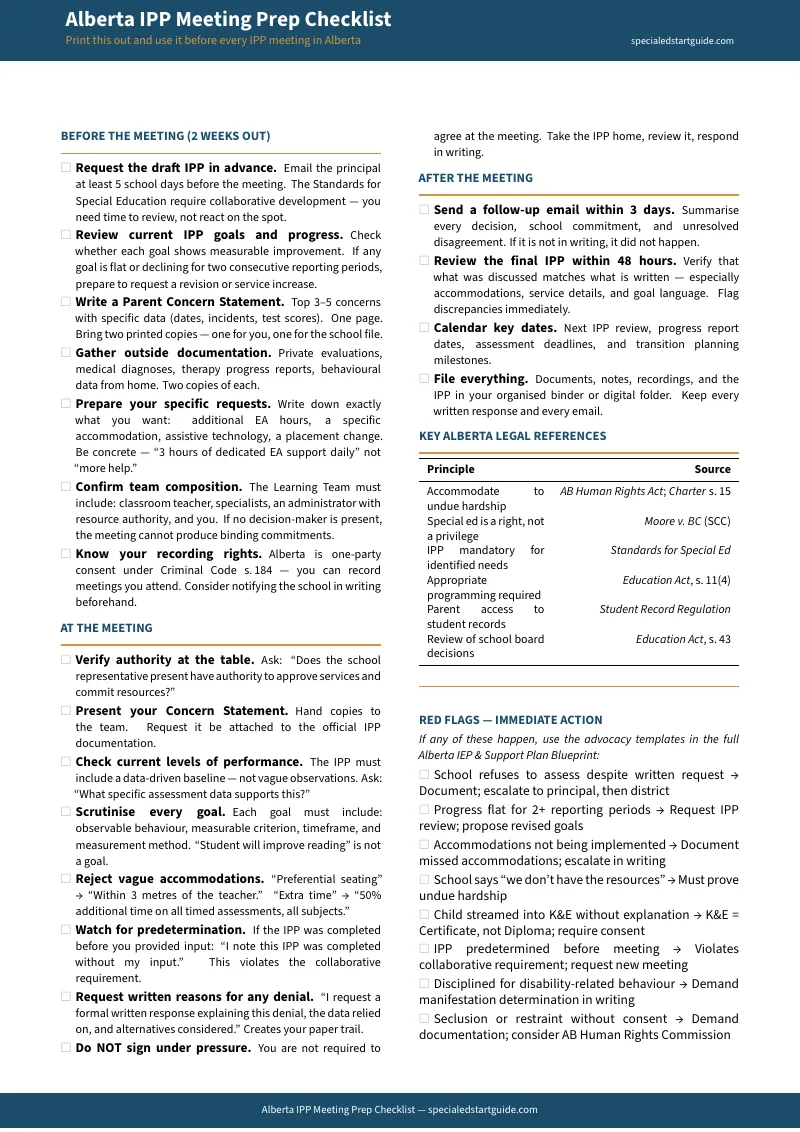
What to say when the team tells you "inclusion means the regular classroom" and refuses a specialized placement. What to say when they reduce EA hours mid-year and claim it's a "staffing decision." What to say when the principal tells you the Learning Team has decided your child doesn't need a formal assessment. Each script cites the Alberta regulation or legal principle that proves them wrong — so you're not arguing emotions at the IPP table, you're citing law. The pre-meeting checklist covers Alberta's one-party consent recording rights under Section 184 of the Criminal Code and the specific documents you need to bring.
Program Unit Funding (PUF) and Early Intervention
For children ages 2.5 to Kindergarten, Program Unit Funding provides early intervention support — but PUF has been cut repeatedly, and parents report confusion about eligibility, assessment requirements, and what happens when PUF ends and your child enters the K-12 system. The Blueprint explains how PUF works, what the current eligibility criteria are, and how to ensure your child's transition from PUF into a school-based IPP doesn't result in a gap in services.
The Dispute Resolution Escalation Ladder
When informal advocacy fails, Alberta offers escalation options — but they are not clearly documented for parents anywhere. The Blueprint maps the complete chain of command: classroom teacher to principal to district Inclusive Learning Team to school board superintendent to Alberta Education's Special Cases Committee. It explains when to file a complaint with the Alberta Human Rights Commission, what the provincial ombudsman can and cannot do, and how to build the paper trail that wins — because in Alberta, the paper trail IS the enforcement mechanism.
Transition Planning — Elementary Through Post-Secondary
Alberta requires transition planning for students moving between school levels and toward post-secondary or employment. But "requires" and "delivers" are different things. The Blueprint covers the specific transition planning obligations, what the Transition to Adulthood Toolkit from Alberta Education actually says versus what schools do, and how to ensure your child's transition plan includes concrete, measurable goals rather than the vague aspirational language that schools default to.
Who This Blueprint Is For
- Parents preparing for their first IPP meeting who don't want to walk in blind against a Learning Team that does this every day — and who need to understand Alberta's coding criteria before they're discussed at the table
- Parents whose child has been told they "don't qualify" for an Educational Assistant, a formal assessment, or a specialized placement — and who need the regulatory language to challenge that decision
- Parents in Calgary navigating the CBE's full-inclusion model where specialized supports have been centralized away from neighbourhood schools, or the CCSD's Learner Support Plan process
- Parents in Edmonton dealing with EPSB Interactions class waitlists, or fighting to get their child into a specialized program that technically exists but has no seats
- Parents in rural, remote, or northern Alberta where the educational psychologist visits quarterly, the speech-language pathologist covers four school divisions, and "specialized support" means a CDSS worker you've never met
- Parents whose child has ADHD, autism, a learning disability, or anxiety and was told they're "not severe enough" for coding — and who need to understand the mild/moderate versus severe distinction and what it means for funding
- Parents whose child's IPP says one thing but the classroom reality looks nothing like it — accommodations on paper, not in practice
- Parents who bought an "IEP Planner" from Etsy built for the American system and discovered that IEP, 504 Plan, FAPE, and IDEA don't apply in Alberta
- Parents who called Inclusion Alberta but were told there's a waitlist, or who need independent strategy beyond the full-inclusion philosophy
Why Not Just Use the Free Resources?
Alberta has genuine free special education resources. Alberta Education publishes The Learning Team Handbook. Inclusion Alberta offers workshops and direct advocacy. The Learning Disabilities Association of Alberta and Autism Society Alberta provide community support. Here's why parents still struggle after consulting all of them:
- Alberta Education's Learning Team Handbook is 121 pages of institutional protection. It comprehensively defines the coding categories and the theoretical model of collaborative teamwork. It does not tell you what to do when the "collaborative team" says your child's EA hours are being cut and the person making that decision isn't in the room. The tone frames all interactions as collegial partnerships — which is actively unhelpful when the partnership has broken down and you need tactical escalation language.
- Inclusion Alberta recently lost $500,000 in provincial funding. Their advocacy capacity has been reduced, and they hold a strict ideological position advocating only for full mainstream inclusion. If your child needs a specialized classroom — like EPSB's Interactions program or a congregated setting — you need independent strategy that Inclusion Alberta cannot provide.
- LDAA and Autism Society Alberta focus on medical definitions and community support. They are excellent at explaining disabilities and connecting families to peer groups. They do not provide step-by-step templates for writing an escalation email to a principal or decoding the funding formula behind your child's coding category.
- AIDE Canada covers national legal frameworks — not Alberta's operational mechanics. Their Moore v. BC analysis is valuable, but they cannot tell you the difference between how EPSB and CBE handle IPP disputes, or how the Adjusted Enrolment Method affects your child's classroom.
- Etsy and TPT planners organize paperwork — they don't enforce rights. A pastel IEP binder keeps documents in order. It won't decode Alberta's coding criteria, explain why the school is pushing full inclusion over specialized placement, or teach you to demand a formal IPP revision citing the Standards for Special Education.
- Private advocates charge $150–$240 per hour. Private psycho-educational assessments cost $2,000–$4,000 with recommended rates of $220 per hour. Most Alberta families can't absorb that. The Blueprint gives you the same procedural frameworks and advocacy templates that professional consultants use — and if you do hire one, a documented paper trail saves hundreds in billable hours they'd otherwise spend figuring out your situation.
The free resources explain what Alberta law says. The Blueprint gives you the tools to make the school follow it.
— Less Than One Hour of an Educational Consultant
Educational consultants in Alberta charge $150 to $240 per hour. Private psycho-educational assessments run $2,000 to $4,000 — and the public waitlist can stretch 18 months. If you hand a consultant a disorganized pile of IPP documents and school emails, your first several billable hours go toward them understanding your situation. The Blueprint teaches you how to organize the paper trail, decode the coding criteria, and draft the initial advocacy letters — either empowering you to win at the IPP table without a consultant, or saving hundreds in billable hours if you do hire one.
Your download includes a comprehensive 14-chapter Blueprint guide plus standalone printable tools — advocacy letter templates, IPP meeting scripts, a coding criteria decoder, a dispute resolution roadmap, an IPP goal tracking worksheet, and an IPP Meeting Prep Checklist. Every template is formatted so you can type directly into it or copy the text into an email, each citing the exact Alberta regulation that triggers a legal obligation.
Instant PDF download. Print the templates tonight. Walk into tomorrow's IPP meeting with Alberta law on your side.
Money-back guarantee, no time limit. If the Blueprint doesn't change how you approach IPP meetings in Alberta, email us for a full refund. No questions asked.
Not ready for the full Blueprint? Download the free Alberta IPP Meeting Prep Checklist — a printable pre-meeting checklist with Alberta timelines, Education Act citations, one-party consent recording rules, and red flags that require immediate action. It's enough to walk into your next meeting prepared, and it's free.
Your child's education is a legal right under the Alberta Human Rights Act and the Canadian Charter. The school knows the Standards. After tonight, so will you.