You Handed the School Your Child's IEP. The Homeroom Teacher Smiled, Filed It Away in Mandarin, and Nothing Happened.
You arrived in Taipei, Hsinchu, or Taichung with an IEP that took years to build — evaluations, meetings, hard-won accommodations back home. You gave it to the school, expecting someone to recognize what it meant. Instead, you got a polite smile and a room full of Mandarin. The homeroom teacher filed your English document somewhere. No one explained what comes next. No one mentioned the IEPC. And no one told you that Taiwan's Special Education Act was comprehensively amended in June 2023, giving you new rights that the school itself may not have fully internalized yet.
Meanwhile, you Googled "special education Taiwan expat" and found a Reddit thread from 2019, a government website entirely in Mandarin, and a bilingual psychologist in Taipei quoting NT$3,300 per 50-minute session just to explain what "鑑輔會" means and why it matters more than anything on your child's report card.
The Taiwan Special Education Blueprint is the Mandarin Barrier Navigation System — the plain-English operational playbook that translates the 2023 Special Education Act (including the June 21 amendments that expanded parental rights), the IEPC gatekeeping process, the 13 disability and 6 gifted categories, cultural advocacy strategies for Taiwan's Confucian face culture, and the bilingual terminology you need into the specific, sequential action plan that puts you on equal footing at every school meeting. Without paying a bilingual consultant NT$3,300 per hour to explain what the coordinator just said.
What's Inside the Blueprint
The 2023 Special Education Act — Decoded from Legislative Chinese into Parental Leverage
Taiwan comprehensively amended the Special Education Act on June 21, 2023. Article 7 now gives you the explicit right to invite outside professionals to identification and placement meetings — and legally requires the school to give you written reasons if they reject your recommendations. Article 18 mandates parent participation in IEP development. Article 28 extends the same rights to gifted guidance plans. But schools were not issued a memo saying "tell the foreign parents about their new rights." When the homeroom teacher tells you "we will observe a bit longer," this chapter tells you exactly which article obligates them to act, which municipal committee you escalate to, and how to frame the request so the administration sees cooperation as the path of least resistance rather than confrontation.
The IEPC (鑑輔會) Gatekeeping Process — The Committee That Actually Controls Your Child's Placement
In the US and UK, your school holds the power over evaluations and placements. In Taiwan, identification and placement authority belongs to the IEPC — the Identification, Placement, and Guidance Committee — a municipal-level body that operates independently of any individual school. Your school submits paperwork. The IEPC decides. This chapter walks you through who sits on the committee, how "pluralistic evaluation" works in practice, what happens when the IEPC rejects your recommendations, and the exact documentation sequence that gives your case the best chance of surviving the committee process.
The 13 Disability Categories and 6 Gifted Categories — Mapped Against Western Equivalents
Taiwan's categories do not map cleanly onto US IDEA categories. ADHD is often serviced under "Health Impairment" rather than its own category. Cerebral palsy is a distinct category rather than being folded into orthopedic or multiple disabilities. Developmental Delay exists as a separate temporary category for children under 6. This chapter provides a side-by-side comparison table so you understand exactly where your child fits in Taiwan's system — and where the gaps between Western and Taiwanese classification will catch you off guard at the IEPC meeting.
Giftedness Is Special Education — And Almost No Expat Parent Knows This
Under Article 4 of the Special Education Act, gifted and talented students are legally classified as special education students. There is no separate "GT program" outside the special education framework. Taiwan defines six categories: Intelligence, Academic Aptitude (over 52% of identified gifted students), Arts, Creativity, Leadership, and Other Areas. Accessing enrichment, acceleration, or an Individual Guidance Plan (IGP) requires formal IEPC identification — the same committee that handles disability evaluations. For English-speaking children, the problem is acute: Taiwan's standardized intelligence tests are normed for Mandarin speakers. Verbal reasoning sections systematically underestimate your child. This chapter covers the full gifted pathway and how to supplement with English-language assessments to give the IEPC the complete picture.
Twice-Exceptional (2e) Children — When the School Sees Only Half Your Child
If your child is both gifted and has a disability, they qualify for both an IEP and an Individual Guidance Plan (IGP). In practice, 2e identification is rare. Schools either see the giftedness and dismiss the disability ("they're too smart to need support") or see the disability and miss the giftedness ("they're struggling, so enrichment isn't appropriate"). This chapter explains the dual identification pathway and the advocacy strategies that prevent your child from falling through the gap between the two systems.
Cultural Advocacy — Powerful Results Without Triggering a Defensive Shutdown
Western special education advocacy says "assert your rights." Taiwan's educational culture says "maintain harmony." Deploying American-style demands in a Taiwanese IEP meeting does not just fail — it triggers the homeroom teacher to lose face, causes the school administration to close ranks, and leaves your child worse off than before you opened your mouth. This chapter teaches culturally calibrated advocacy: how face (面子) dynamics shape every meeting, why the Confucian hierarchy means teachers hold social authority parents are expected to respect, how to frame accommodation requests as reducing the teacher's burden rather than adding to it, the difference between genuine agreement and polite deflection, and when the principal's "we will consider this carefully" actually means your request has been declined.
The Language Barrier Strategy — Because No One Is Coming to Translate for You
Taiwan has no legal mandate requiring schools to provide English interpretation for IEP meetings. The entire operational infrastructure — the National Special Education Information Network, IEP forms, evaluation reports, legal notices of placement — runs in Mandarin. This chapter covers how to secure bilingual advocacy support, the risks of relying on your Taiwanese spouse as sole interpreter (they may soften your advocacy to preserve cultural relationships), why you should never depend on school staff to informally translate during the meeting, and how to use the bilingual templates in this guide to create a timestamped paper trail even when you cannot read every document the school produces.
International Schools — What They Can and Cannot Do
International schools in Taiwan are governed by the Private School Law, not the Special Education Act. They are not legally compelled to provide a Free Appropriate Public Education or to execute an IEP if your child's needs exceed their capacity. TAS tuition exceeds NT$800,000 annually. TES charges NT$506,800 to NT$765,000. Many mixed-nationality households are disqualified entirely by the foreign passport requirement. This chapter covers what each major school actually provides for learning support, the common rejection scenarios, and why understanding the public system is essential contingency planning even for families currently enrolled in private education.
The Complete English-Mandarin-Pinyin Legal Terminology Glossary
Not translations — operational definitions. Every official term you will encounter at school meetings, IEPC evaluations, and government offices: English meaning, Traditional Chinese characters, pinyin pronunciation, and a plain-language explanation of what the term means for your advocacy. Because knowing that 鑑輔會 means "Identification, Placement, and Guidance Committee" is useless if you do not know it is the body that controls whether your child receives services — not the school, not the homeroom teacher, not the principal.
Three Bilingual Letter Templates
Formal evaluation request, IEP meeting request, and placement objection. Each template is written in parallel English and Traditional Chinese, cites the relevant Special Education Act articles (including the 2023 amendments), and is designed to be sent via email for a timestamped record. Adapt the bracketed sections and send. No fluent Mandarin required.
Who This Blueprint Is For
- Tech workers and corporate families in Taipei and Hsinchu Science Park whose relocation packages cover housing but not the cultural minefield of advocating for a neurodivergent child in a Mandarin-language system built on Confucian compliance
- English teachers (EPIK equivalent, buxiban, public school FET) earning local salaries who work inside Taiwan's education system daily but cannot navigate it for their own children — and for whom international school tuition is entirely out of reach
- Diplomats and AIT-affiliated families on 2-3 year rotational assignments who cannot afford to lose a single semester to cultural confusion while their child sits unsupported in a classroom of 30+ students
- Foreign spouses of Taiwanese nationals who need independent English-language understanding of the system to participate as an equal partner in their child's education rather than relying on translated summaries filtered through cultural assumptions about disability and face
- Parents whose international school (TAS, TES, KAS) has told them it cannot accommodate their child's level of need — and who are suddenly facing the Taiwanese public system for the first time with no English-language roadmap
- Families who arrived with a foreign IEP, EHCP, or support plan and discovered it has no legal standing in Taiwan — the IEPC wants its own evaluation, and no one has explained the process in English
Why Not Just Use the Free Resources?
The Ministry of Education published an English translation of the 2023 Special Education Act. It contains the law in legislative language. No practical guidance on how to initiate an evaluation, what to say in an IEP meeting, or how the IEPC bureaucracy functions in reality. The National Special Education Information Network, where IEP forms are processed, is almost entirely in Mandarin. The Community Services Center in Taipei offers professional bilingual counseling — at NT$3,800 per 50-minute session, on their schedule, by appointment. No asynchronous procedural manual. No bilingual templates. No cultural advocacy coaching.
- Government resources describe the system in legislative Chinese. They do not explain how to activate it as an English-speaking outsider, how cultural norms shape what actually happens in meetings, or what advocacy strategies produce results rather than polite dismissal.
- Expat forums provide emotional tax, not structured guidance. Reddit threads from before June 2023 cite a version of the law that has been comprehensively amended. Forumosa advice oscillates between "just send them to TAS" (ignoring the NT$800,000+ tuition and the foreign passport requirement) and "Taiwan's schools will grind your child into an obedient robot" (wrong — the legal protections are real). Jaded expats mock parents for not speaking Mandarin. You leave the forums feeling worse than when you arrived.
- Bilingual professionals charge NT$3,300-3,800 per session. For families who need complex clinical intervention, that investment makes sense. For the 95% of expat families who need to understand the system, the terminology, and the cultural dynamics — paying NT$3,800 to have someone explain what the IEPC is and how to request an evaluation is an expensive way to get information this guide provides in five minutes.
Free resources describe the system. Professionals navigate it for you at premium rates. This Blueprint teaches you to navigate it yourself.
— Less Than One Session at a Bilingual Psychologist
A single session with a bilingual psychologist in Taipei costs NT$3,300-3,800. A private psychoeducational evaluation runs hundreds of thousands of NT$. International school tuition at TAS exceeds NT$800,000 per year — and still cannot guarantee your child a place if their needs exceed the school's learning support capacity. Missing the IEPC evaluation window delays your child's formal identification by months. Not knowing that giftedness runs through the special education framework means your gifted child sits unchallenged in a standard classroom while the state-funded enrichment pathway goes unused.
Your download includes 11 printable PDFs — a comprehensive guide plus 10 standalone reference tools:
- Complete Blueprint Guide (guide.pdf) — 16 chapters covering the 2023 Special Education Act framework and June 21 amendments, the IEPC identification and placement process, all 13 disability and 6 gifted categories mapped against Western equivalents, cultural advocacy tactics for Taiwan's Confucian face culture, the language barrier strategy, international school analysis (TAS, TES, KAS), four placement tiers and accommodations, gifted identification and twice-exceptional (2e) pathways, early intervention for children under 6, university transition and GSAT/AST testing accommodations, dispute resolution from school level to Control Yuan, a complete English-Mandarin-Pinyin legal terminology glossary, and three bilingual letter templates (evaluation request, IEP meeting request, placement objection)
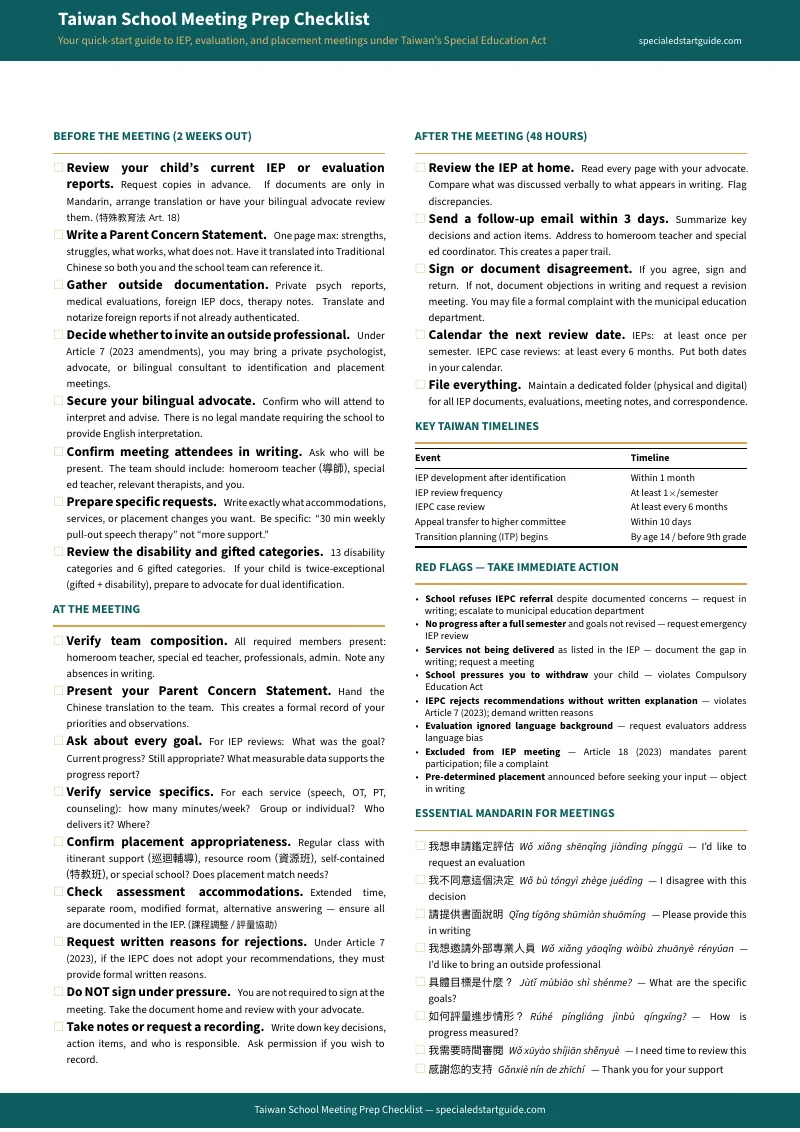
- Taiwan School Meeting Prep Checklist (checklist.pdf) — printable quick-reference covering documents to bring, questions to ask, Mandarin phrases for meetings, accommodation requests to consider, red flags requiring immediate action, and key legal timelines
- Bilingual Glossary (bilingual-glossary.pdf) — every official special education term with English, Traditional Chinese, and pinyin — print and bring to every school meeting
- Bilingual Letter Templates (letter-templates.pdf) — three ready-to-send letters in parallel English and Traditional Chinese: evaluation request, IEP meeting request, and placement objection with legal citations
- IEPC Process Flowchart (iepc-process-flowchart.pdf) — visual step-by-step pathway from initial concern through SST, IEPC evaluation, identification, placement, and IEP development
- Cultural Advocacy Quick Reference (cultural-advocacy-quick-reference.pdf) — DO and DON'T tactics for advocating within Taiwan's Confucian face culture, decoding polite responses, and escalating without triggering a defensive shutdown
- Category Comparison Card (category-comparison-card.pdf) — Taiwan's 13 disability and 6 gifted categories mapped side-by-side against US IDEA equivalents with key differences highlighted
- Placement Tiers Reference (placement-tiers-reference.pdf) — the four placement options from mainstream with itinerant services to special education school, plus accommodations vs. modifications
- Key Contacts and Resources (key-contacts-and-resources.pdf) — fridge-sheet directory of municipal resource centers by city, English-speaking psychologists, government resources, and advocacy organizations
- Dispute Resolution Pathway (dispute-resolution-pathway.pdf) — four-level escalation ladder from school-level resolution to Control Yuan, with action triggers and timelines
- Foreign IEP Transfer Checklist (foreign-iep-transfer-checklist.pdf) — step-by-step checklist for families arriving in Taiwan with an existing IEP, plus key legal timelines
Instant PDF download. Print the checklist and glossary tonight — bring them to your next school meeting alongside the letter templates and cultural advocacy reference.
Money-back guarantee, no time limit. If the Blueprint doesn't change how you navigate your child's education in Taiwan, email us for a full refund. No questions asked.
Not ready for the full Blueprint? Download the free Taiwan School Meeting Prep Checklist — a structured quick-reference covering IEP process basics, Special Education Act rights under the 2023 amendments, evaluation process and IEPC navigation, meeting preparation and cultural framing, and key English-Mandarin SEN terminology. It is enough to walk into your next meeting prepared, and it is free. The full Blueprint adds 16 chapters of deep system navigation plus 10 standalone printable tools — the bilingual glossary, letter templates, IEPC flowchart, cultural advocacy card, category comparison, placement tiers reference, key contacts directory, dispute resolution pathway, and foreign IEP transfer checklist.
Your child's foreign IEP doesn't work here. Taiwan's system has its own pathway — and the legal protections under the 2023 Act are real. After tonight, you'll know exactly how to activate them.