The School Says Your Child Will "Catch Up." The Elevhälsa Meeting Is in Swedish. The Waiting List for BUP Is Two Years. Your IEP Means Nothing Here.
You moved to Sweden for the career, the quality of life, the schools that consistently rank among the best in Europe. Then your child started struggling. The teacher smiled and told you not to worry — "children develop at different speeds." The specialpedagog mentioned something about extra anpassningar. When you asked for a formal assessment, the school said your child needs a BUP referral first — and the waiting list stretches twelve to eighteen months in Stockholm, longer in smaller municipalities. When you mentioned the IEP from your home country, nobody knew what to do with it. It carries no legal weight in Sweden.
You searched "special education Sweden English." You found Skolverket pages written for municipal administrators, not parents. You found Reddit threads on r/TillSverige where expat parents describe schools that "basically kicked the can down the road until the child was somebody else's problem." You found the Rätt på Riktigt website, which has genuinely useful English-language summaries — until you click "In-depth" and discover the actual legal templates are entirely in Swedish. You found a UK-based SEN consultant who charges £110 per hour for remote calls. You found a relocation agency that bundles "school orientation" into a 25,000 SEK family package that does not include the words "special education" anywhere in the service description.
You found nothing that tells you the one thing that changes everything: the difference between extra anpassningar and särskilt stöd. Your child is receiving extra anpassningar right now — informal classroom adjustments that the teacher can revoke at any time, that require no administrative decision, and that you cannot appeal. If you push the school across the legal threshold into särskilt stöd, the principal must create a formal åtgärdsprogram — Sweden's legal equivalent of an IEP — that triggers specific funding, names responsible staff, sets deadlines, and gives you the right to appeal to the national Board of Appeal if the school fails to deliver. That distinction is the single most consequential piece of information an expat parent can possess in the Swedish education system. And no free English-language resource explains how to use it.
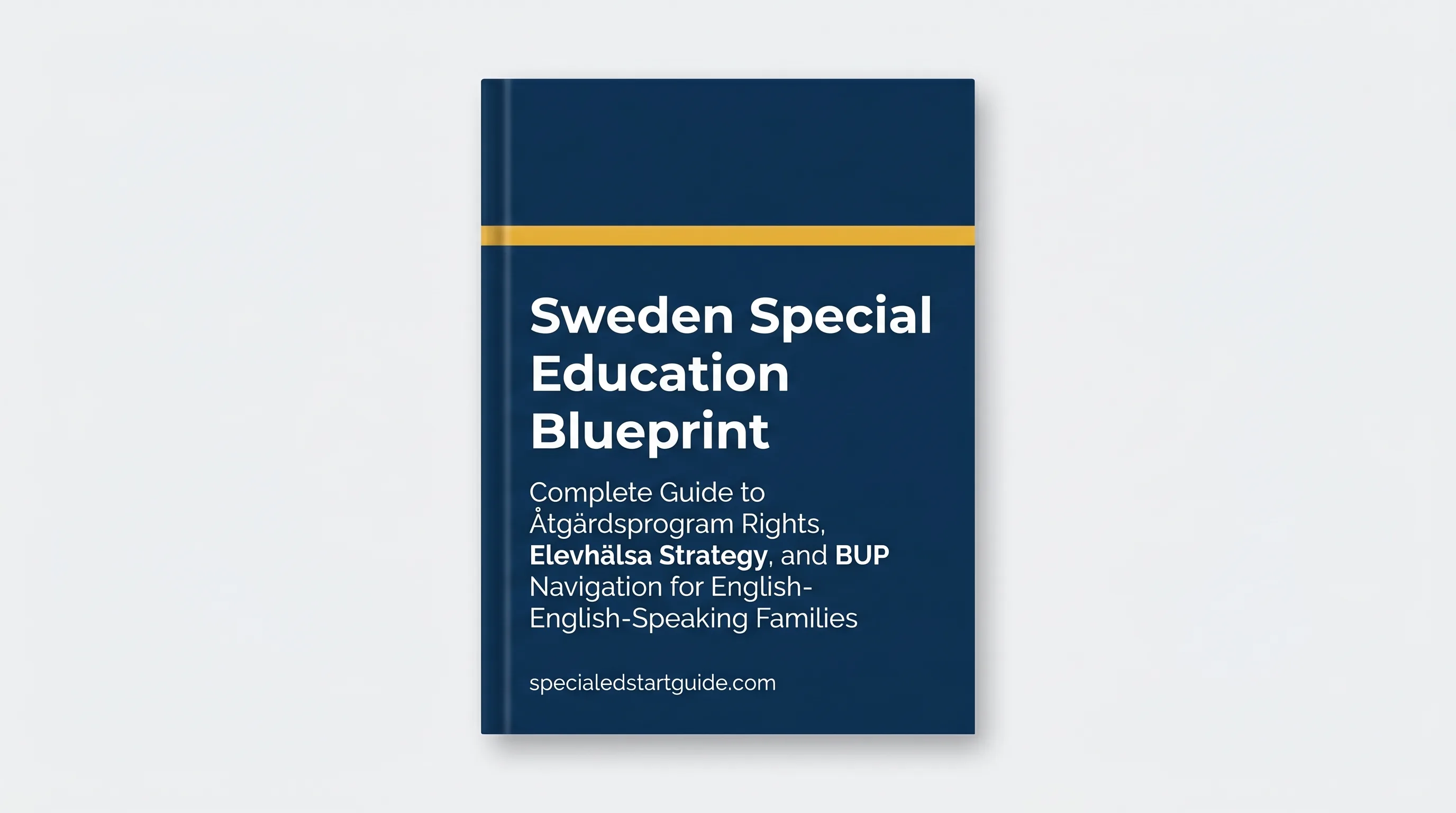
The Sweden Special Education Blueprint is the Åtgärdsprogram Advocacy System that translates Swedish special education law, Elevhälsa meeting strategy, BUP assessment navigation, and Skolinspektionen escalation into the plain-English legal framework, meeting preparation tools, and escalation templates that give you equal footing at the school table — for less than the cost of a weekday lunch in Stockholm.
What's Inside the Blueprint
The Legal Foundation — What the School Cannot Refuse
Chapter 3 of the Skollagen (Education Act 2010:800) obligates every school to investigate and provide support when a student risks not meeting the kunskapskraven (knowledge requirements). This obligation is unconditional — it does not depend on a medical diagnosis from BUP, it does not require the parent to prove the child has a disability, and it cannot be deferred while the healthcare system catches up. This chapter maps the complete legal architecture: the Education Act, the Discrimination Act (Diskrimineringslagen), and the UN Convention on the Rights of the Child (binding Swedish law since 2020). It includes the critical comparison table showing exactly how extra anpassningar and särskilt stöd differ in decision-making authority, documentation requirements, appeal rights, and municipal funding triggers.
How the Swedish System Is Structured — Why Your Neighbour's Experience Is Irrelevant
Sweden's 290 municipalities each control their own school budgets independently. A well-funded Stockholm suburb may employ a dedicated specialpedagog in every school. A rural kommun may share one across three schools. This chapter explains why your experience depends on which municipality you live in, decodes the difference between municipal schools (kommunala skolor) and independent schools (friskolor), and addresses the expat misconception that friskolor automatically provide better special education support.
The Elevhälsa — Your Most Important Meeting, Decoded
The Elevhälsa (Student Health Team) is the multidisciplinary panel — nurse, psychologist, social worker, specialpedagog — that evaluates whether your child needs formal support. Expat parents walk into these meetings unprepared, outnumbered, and unable to follow the Swedish discussion. This chapter provides the complete engagement strategy: how to request the meeting agenda in advance, how to open with a prepared Parent Statement, how to respond when the school says "we need to wait for BUP," and how to ensure every commitment has a named owner and a deadline recorded in official meeting notes.
The Åtgärdsprogram — Reading, Challenging, and Improving Your Child's Action Plan
The åtgärdsprogram is the document that determines your child's educational support. It must specify the student's needs, the measures to be implemented, who is responsible, the timeframe, and how progress will be evaluated. If it is vague, incomplete, or ignored, you have the legal right to challenge it. This chapter teaches you how to audit an existing åtgärdsprogram against Skolverket's quality criteria, how to identify measures that lack measurable outcomes, and how to formally request revisions.
The BUP Bottleneck — Securing School Support Without Waiting for Diagnosis
BUP (Child and Adolescent Psychiatry) is the gateway to formal neurodevelopmental diagnosis in Sweden. Waiting lists for ADHD and autism assessments stretch one to three years in major cities. Expat parents assume their child cannot receive educational support until the diagnosis arrives. They are wrong. Swedish law requires schools to provide support based on educational need, not diagnostic status. This chapter covers the BUP referral process (En väg in), self-referral options, private assessment alternatives, the healthcare guarantee (vårdgarantin), and the specific language to use when the school tries to defer pedagogical support pending a medical assessment.
The Appeals and Escalation System — From Classroom to National Inspectorate
If the school refuses formal support or produces an inadequate åtgärdsprogram, you have four escalation pathways: the Board of Appeal for Education (Skolväsendets Överklagandenämnd) for åtgärdsprogram decisions, the Schools Inspectorate (Skolinspektionen) for Education Act breaches, the Child and Student Ombudsman (BEO) for bullying and degrading treatment, and the Equality Ombudsman (DO) for disability discrimination. This chapter provides the complete chain of escalation — from teacher to principal to municipality (huvudman) to national body — with the specific documentation requirements that determine whether your complaint triggers an investigation or gets dismissed.
Gymnasium Transition — Preventing the Tracking Trap
Formal grading begins in Year 6. Admission to the eighteen national gymnasium programmes requires passing grades in Swedish, English, and Mathematics. An F in any core subject locks your child out of university-preparatory tracks and routes them into Introductory Programmes (Introduktionsprogram). For parents of neurodivergent children in Years 7-9, this timeline is not theoretical — it is an approaching cliff. This chapter covers gymnasium programme requirements, the adapted gymnasium (anpassad gymnasieskola), how to secure grading accommodations, and the Introductory Programme pathways that keep higher education accessible.
Escalation Letter Templates — Ready to Customise and Send
Five letter templates covering the critical communication points: requesting a pedagogical investigation (pedagogisk utredning), challenging an insufficient åtgärdsprogram, escalating to the huvudman when the principal is unresponsive, filing a formal complaint with Skolinspektionen, and appealing to the Board of Appeal. Each template includes the Education Act section references so the recipient knows you understand the legal framework.
The Swedish-English Special Education Glossary — Every Term, Legally Mapped
This is not a dictionary. It is a conceptual translation matrix that explains why your American "IEP" maps to åtgärdsprogram, why "accommodation" does not mean extra anpassningar in any legally useful sense, and why using the word huvudman in your correspondence triggers a different administrative response than saying "the school." Every term includes the Swedish original, its English equivalent, and a plain-language explanation of its legal and procedural weight.
Who This Blueprint Is For
- Corporate relocations and tech workers in Stockholm, Gothenburg, or Malmö who discovered that Swedish HR handled the personnummer, the apartment, and the SFI referral — but went silent the moment you mentioned your child's learning difficulties
- Trailing spouses and accompanying partners who bear the full weight of navigating the school system in a language they do not speak, in a culture that views aggressive advocacy as a breach of social norms
- Partners of Swedish nationals whose Swedish spouse trusts the system implicitly and dismisses concerns with "the school knows what they're doing" — while you watch your child fall further behind
- EU freedom-of-movement families who assumed Scandinavian schools would proactively address special needs, and discovered that Sweden's egalitarian philosophy means the system waits for you to fight before it acts
- Parents stuck on BUP waiting lists — twelve months, eighteen months, two years — who need the school to provide educational support now, not after the diagnosis arrives
- Parents of children in Years 7-9 facing gymnasium tracking decisions where an F grade in a core subject closes doors that cannot easily be reopened
- Families arriving with a US IEP, UK EHCP, or Australian ILP that the Swedish school politely accepted, filed in a drawer, and never referenced again
Why Not Just Use the Free Resources?
Sweden's government agencies publish information about special education rights. Free advocacy organisations exist. Expat forums discuss these issues daily. Here is why expatriate parents still arrive at Elevhälsa meetings unable to advocate effectively:
- Skolverket explains the law for administrators, not parents. The National Agency for Education publishes English translations of the Education Act and curricula. The language is policy-grade: "support should be given if students need it." It does not tell you how to prove your child needs support when the school insists the current adjustments are working. It provides no checklists, no templates, no tactical guidance on forcing a pedagogical investigation.
- Skolinspektionen's complaint process rejects undocumented claims. The Schools Inspectorate accepts formal complaints — and explicitly warns that they "do not investigate all the information submitted." Without a structured evidence file documenting the school's specific failures over time, citing the relevant Education Act sections, your complaint is dismissed as hearsay. No free resource provides the evidentiary framework required to file a complaint that actually triggers an investigation.
- Rätt på Riktigt's best content is locked behind Swedish. The Malmö Anti-Discrimination Bureau operates the most useful free resource for understanding extra anpassningar versus särskilt stöd. Their English summary is clear. Their "In-depth" section — the one with the actual legal templates and appeal procedures — is entirely restricted to Swedish.
- BUP and 1177.se do not address the school's obligation to act without a diagnosis. The healthcare portal accurately describes how to seek a psychiatric referral. It does not mention that the school's duty to provide educational support exists independently of any medical assessment. Parents sit on BUP waiting lists for years without knowing the school is legally obligated to act now.
- Expat forums give you emotion, not escalation strategy. Reddit and Facebook groups validate your frustration. They confirm that the system is difficult. They do not provide a systematic advocacy framework that works within Swedish cultural norms — where an aggressive American-style demand can make administrators withdraw rather than act.
- Private consultants price out the people who need help most. UK-based SEN advocates charge £110 per hour. Swedish educational consultants start at 1,500 SEK per session. Corporate relocation packages cost 25,000-50,000 SEK and do not include the words "special education." These services exist for C-suite executives, not for the accompanying partner managing the school crisis on a single-income household.
The government publishes the law in Swedish. Free advocates operate in Swedish. Expat forums crowdsource Swedish acronyms. The Blueprint gives you the strategic playbook in the one language you actually speak.
— Less Than a Weekday Lunch in Stockholm
A single session with a private educational consultant costs 1,500 SEK. A corporate relocation package starts at 25,000 SEK for families — and doesn't cover special education. A UK-based SEN advocate charges £110 per hour just for a phone call. Even requesting an interpreter for one school meeting costs more than this guide. If you eventually need professional support for a specific dispute, the systemic knowledge you build with this Blueprint saves hours of paid consultation — because you arrive understanding the framework, speaking the correct Swedish legal terminology, and asking targeted questions instead of paying someone to explain basics.
Your download includes 6 PDFs:
- Complete Blueprint Guide (guide.pdf) — 14 chapters covering the legal foundation (Skollagen Chapter 3, Diskrimineringslagen, UN Convention), the extra anpassningar vs. särskilt stöd threshold, municipal structure and school choice (kommunala skolor vs. friskolor), the Elevhälsa engagement strategy, åtgärdsprogram development and challenge process, BUP assessment navigation and private alternatives, the four-pathway appeals system (Överklagandenämnden, Skolinspektionen, BEO, DO), gymnasium transition planning and Introductory Programmes, the adapted school system (anpassad grundskola and resursskolor), multilingual assessment and mother tongue rights, and a structured record-keeping system
- Escalation Letter Templates (letter-templates.pdf) — five ready-to-customise letters: requesting a pedagogisk utredning, challenging an inadequate åtgärdsprogram, escalating to the huvudman, filing a formal complaint with Skolinspektionen, and appealing to the Board of Appeal (Överklagandenämnden). Each template cites the relevant Education Act sections.
- Swedish-English Glossary (swedish-english-glossary.pdf) — quick-reference card mapping every critical Swedish term to its English equivalent and legal weight. Grouped by category: core legal terms, people and roles, medical and clinical terms, administration and oversight, plus an Anglo-American concept translation table.
- Escalation Pathway (escalation-pathway.pdf) — visual two-page reference showing the five-level complaints ladder from classroom teacher to national oversight bodies, with deadlines, what to include at each level, and a pathway-selection table matching issue types to the correct escalation route.
- Evidence Tracker (evidence-tracker.pdf) — four-page printable worksheet with a communication log, åtgärdsprogram goal progress tracker, support implementation tracker, and evidence file checklist. The documentation system that makes your case if you escalate to Skolinspektionen.
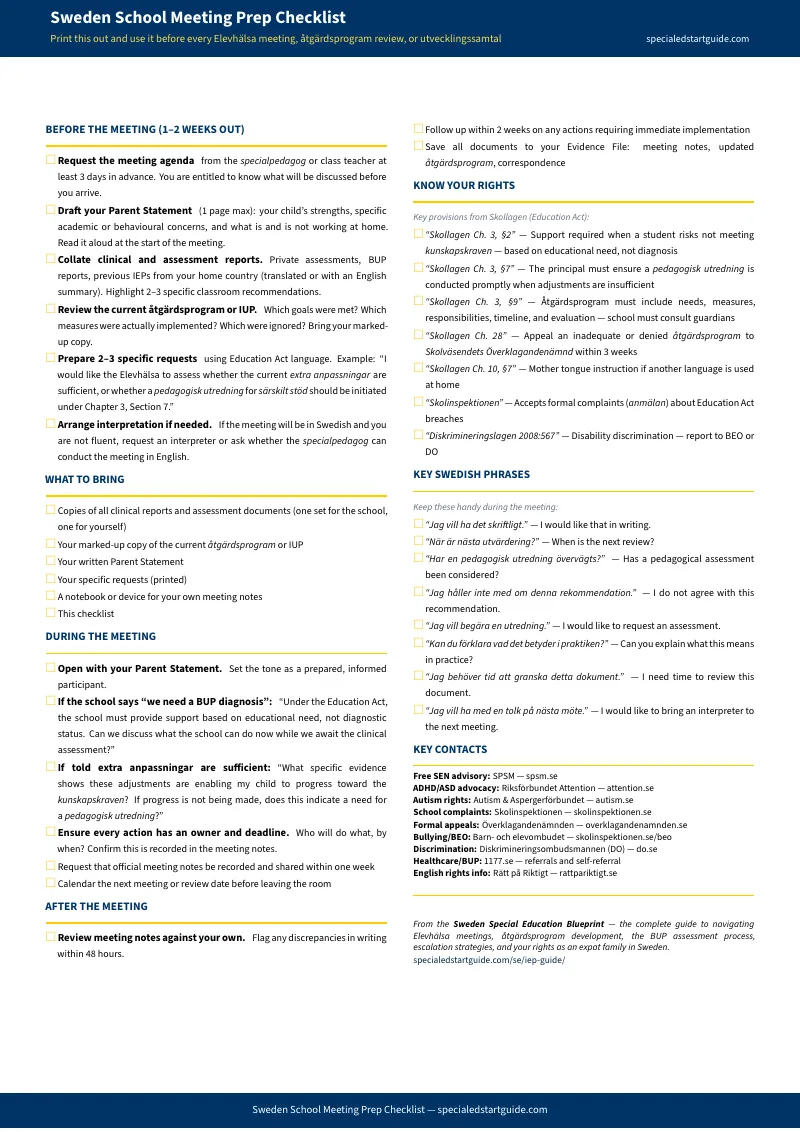
- Sweden School Meeting Prep Checklist (checklist.pdf) — printable quick-reference covering pre-meeting preparation, what to bring, in-meeting questions and responses (including scripted replies for "wait for BUP" and "extra anpassningar are enough"), post-meeting follow-up actions, a one-page rights summary with Education Act citations, and key contact organisations
Instant PDF download. Print the checklist and glossary tonight and bring them to your next Elevhälsa meeting.
Money-back guarantee, no time limit. If the Blueprint doesn't change how you navigate your child's education in Sweden, email us for a full refund. No questions asked.
Not ready for the full Blueprint? Download the free Sweden School Meeting Prep Checklist — a structured quick-reference covering åtgärdsprogram basics, Elevhälsa meeting preparation, essential questions with scripted responses, Swedish-English terminology, and key contacts. It is enough to walk into your next meeting prepared, and it is free.
Your child has legal protections in Sweden. The school knows exactly what they are — in Swedish. After tonight, so will you.