
Your Child's IEP Has Zero Legal Standing in Japan. The School Just Told You — in Japanese.
You relocated to Tokyo, Osaka, or Yokohama for the career, the adventure, the once-in-a-lifetime family experience. You brought your child's US IEP or UK EHCP, assuming any school system would recognise a professionally documented support plan. Then the homeroom teacher smiled politely, studied the document, and said something your interpreter translated as: "This has no legal value here. We will need to go through the Japanese process."
You Googled "special education Japan expat." You found a Reddit thread where someone claimed Japan's special ed is "basically in the 1950s" (wrong — the 2007 reforms created a comprehensive four-tier system), an academic paper written for university researchers, and three contradictory forum posts about something called shūgaku sōdan that nobody explained. You discovered that "IEP" has no direct equivalent, that schools use something called a kobetsu no kyōiku shien keikaku, and that there's a critical consultation process in September that apparently determines your child's entire educational path — but no English-language resource explains what any of this means in practice. Meanwhile, the school is defaulting your child to a regular class with no support because without completing the Japanese assessment process, that is their administrative status.
The Japan Special Education Blueprint is the Shūgaku Sōdan Navigation System that translates Japan's assessment pipeline, placement continuum, resource room eligibility, individualized support plan process, cultural advocacy strategies, and dispute resolution pathways from institutional Japanese into the plain-English roadmap, bilingual terminology guide, and meeting prep toolkit that give you equal standing at the school table — without paying ¥15,000–25,000 per hour for a bilingual educational consultant to explain what the coordinator just said.
What's Inside the Blueprint
The Legal Framework — What Japanese Law Actually Guarantees Your Child
The School Education Act (Gakkō Kyōiku Hō), the 2007 tokubetsu shien kyōiku reforms, the 2024 amendment to the Act for Eliminating Discrimination against Persons with Disabilities — translated from dense legislative Japanese into plain-language leverage. When the board of education tells you "this placement is final," this chapter tells you exactly which statutory provision requires them to consider parental wishes. When you arrive expecting your foreign IEP to transfer, this chapter explains precisely why it carries zero legal weight — and what Japan's system provides instead.
The Four-Tier Placement Continuum — From Mainstream to Specialized School
Regular class (no dedicated support) → Tsūkyū resource room (1–8 hours per week pull-out instruction) → Tokubetsu shien gakkyū (self-contained special needs class, max 8 students) → Tokubetsu shien gakkō (separate special needs school). This chapter explains eligibility criteria for each tier, how children move between them, what triggers a placement change, and the critical distinction between developmental disability support (available in resource rooms since 2006) and the "life skills" model that shocks Western parents encountering self-contained classes for the first time.
The Shūgaku Sōdan — The Consultation That Determines Everything
This municipal consultation process begins in June, tests through November, and issues placement decisions by December for the following April. If you arrive mid-year, you may face a "timing trap" where no formal assessment channel exists until the next cycle. This chapter explains exactly when to contact the board of education (kyōiku iinkai), what the shūgaku sōdan involves, how the assessment committee (shūgaku shien iinkai) makes placement recommendations, what your rights are if you disagree with the decision, and how to handle the critical September notification letter.
The Two Individualized Plans — And Why Neither Is Your IEP
The Individualized Education Support Plan (kobetsu no kyōiku shien keikaku) covers long-term goals and inter-agency coordination. The Individualized Instruction Plan (kobetsu no shidō keikaku) covers classroom-level academic strategies. Neither is legally binding. Neither requires your signature. Neither mandates specific services. This chapter explains how to make these non-binding plans actually deliver meaningful accommodations — by understanding what Japanese educators respond to and how to write specific, measurable requests that fit within the collaborative cultural framework.
Cultural Advocacy — Securing Accommodations Without Breaking the Wa
Western advocacy says "demand your rights." Japanese school culture says "preserve group harmony." Deploying American-style confrontation in a Japanese school meeting doesn't just fail — it triggers institutional resistance that makes future cooperation nearly impossible. This chapter teaches the culturally fluent advocacy approach: framing accommodation requests as reducing the teacher's burden, using nemawashi (consensus-building before the meeting), understanding tatemae vs. honne signals, and knowing when "we will carefully consider it" means your request has been denied. Because in Japan, the most effective advocate isn't the loudest — it's the one the school wants to help.
ADHD Medication — The Legal Minefield Every Expat Family Must Navigate
Adderall is a criminal offense to import into Japan under the Stimulants Control Act. Ritalin (methylphenidate) is heavily restricted. Concerta requires patient registration with the government. Vyvanse was only approved in 2019. This chapter covers exactly which medications are legal, the registration process for controlled substances, bridge medication strategies (Strattera, Intuniv), what to arrange before departure, and how medication access limitations affect your child's school accommodation needs.
The Military Family EFMP Chapter
If you're stationed at Yokosuka, Kadena, Misawa, or Camp Zama, the Exceptional Family Member Program controls whether your family can accompany you. When DoDEA schools lack capacity, you need documented evidence that off-base Japanese public schools can accommodate your child. This chapter explains how to gather that evidence, what Japanese municipal services map onto DOD requirements, and how to frame an EFMP appeal using specific local school capabilities.
The Complete Japanese-English-Kanji SEN Terminology Guide
Not just translated — functionally explained. The glossary doesn't just tell you that tokubetsu shien gakkyū means "special support class." It tells you this is a self-contained class of maximum 8 students, that your child may spend most or all of their day there, that the curriculum may emphasize life skills over academics, and that placement in one doesn't prevent partial integration into regular classes. Over 60 terms, each with operational meaning and practical implications for your advocacy.
Who This Blueprint Is For
- Corporate transferees in Tokyo, Osaka, Yokohama, and Nagoya whose relocation packages cover housing and visas but not the shūgaku sōdan assessment pipeline required for special education placement
- Military families at Yokosuka, Kadena, Misawa, Camp Zama, and Sasebo who need documented evidence of off-base Japanese school capabilities for EFMP appeals — or who are managing their child's education off-base because DoDEA schools lack capacity
- English teachers (JET, Interac, eikaiwa) who witness the system daily as ALTs but cannot navigate it for their own children due to the specialised bureaucratic vocabulary required for advocacy
- International marriage families where the foreign parent needs independent English-language understanding of the system to co-advocate effectively rather than relying entirely on their Japanese spouse's translated summaries
- Diplomatic and intergovernmental families on 2–4 year rotational assignments who cannot afford to lose an entire academic year to the "timing trap" while learning the system organically
- Parents whose child was rejected by an international school — or conditionally accepted at ¥150,000+/month for a private shadow teacher — and who are suddenly confronting the Japanese public system with no preparation
- Parents whose child is experiencing futōkō (school refusal) connected to unaccommodated neurodivergence and who need to understand alternative educational pathways before the situation becomes chronic
Why Not Just Use the Free Resources?
MEXT publishes an English-language overview of its education system. The National Rehabilitation Center has a multilingual developmental milestone brochure. CLAIR produces living guides for foreign residents. Here's why expat parents still arrive at school meetings unable to advocate effectively:
- MEXT resources are for international observers, not parents. They correctly describe the 2007 reforms and the four-tier placement structure. They do not tell you how to request a shūgaku sōdan consultation, what rights you have if you disagree with a placement decision, or how to ensure the school's individualized plan includes measurable accommodations rather than vague aspirational statements. Policy architecture is not an advocacy playbook.
- CLAIR's multilingual guides mention SEN in a single sentence. After dozens of pages covering disaster preparedness, garbage separation rules, and the 6-3-3-4 education structure, special education gets: "For children with disabilities there are also schools that provide special needs education." No mention of developmental disorders, no discussion of parental rights, no guidance on the assessment pipeline. If your child has ADHD, CLAIR effectively says the system exists. The Blueprint explains how to access it.
- The Rehabilitation Center's brochure explains how to obey the system, not how to advocate within it. It's an excellent developmental milestone checklist and a correct description of the shūgaku sōdan timeline. It does not address cultural friction, does not explain how to bridge the gap between a Western IEP and Japanese non-binding plans, and offers no dispute resolution pathways when the school simply refuses your request. Compliance guides are not advocacy tools.
- Expat forums are emotionally supportive but overwhelmingly pessimistic and frequently wrong. Reddit threads and Facebook groups tell parents Japan is "decades behind" on special ed (the 2007 reforms and 2024 anti-discrimination amendments say otherwise), advise leaving the country, or offer anecdotal accounts from 2015 that predate major legislative changes. Your child's educational placement is not the place for crowdsourced despair.
MEXT describes the architecture. CLAIR acknowledges it exists. The Blueprint gives you the operational playbook for navigating it.
— Less Than One Hour with a Bilingual Educational Consultant
A single session with a bilingual educational psychologist in Tokyo or Osaka costs ¥12,100–25,000 per hour. Tokyo Mental Health charges ¥17,000–19,000 per hour for self-funded consultations. An English-speaking shadow teacher at an international school runs ¥150,000+ per month. Missing the September shūgaku sōdan notification window means your child waits an entire academic year without formal support. Even if you ultimately need a specialist for a complex dispute, the systemic preparation you build with this Blueprint saves hours of paid consultations — because you arrive understanding the framework, speaking the correct terminology, and asking specific questions instead of paying someone to explain the basics.
Your download includes the complete guide, 5 standalone printable reference cards, and a quick-start checklist — 7 PDF files:
- Complete Blueprint Guide (guide.pdf) — 13 chapters covering the legal framework, four-tier placement continuum, shūgaku sōdan assessment pipeline, individualized plans, cultural advocacy strategies, ADHD medication legality, EFMP military chapter, futōkō pathways, disability certificates, dispute resolution, after-school day services, and the full Japanese-English-Kanji SEN glossary
- Japanese-English-Kanji SEN Glossary (japanese-english-glossary.pdf) — 60+ terms with romaji, kanji, and operational meaning for your advocacy. Print this and bring it to every school meeting, board appointment, and ward office visit
- School Meeting Preparation Worksheet (meeting-prep.pdf) — pre-meeting checklist, parent statement writing prompts, cultural signals decoder (what "we will carefully consider it" actually means), key Japanese phrases, and post-meeting follow-up steps
- Escalation Pathway (escalation-pathway.pdf) — the 6-step dispute resolution reference card with contact points, likelihood of reversal at each level, your strongest leverage points, and what not to do
- English-Speaking Medical Contacts (medical-contacts.pdf) — clinics and networks by region (Tokyo, Osaka, Nagoya, Fukuoka, Kobe) with a private vs. public assessment comparison and assessment strategy
- ADHD Medication Reference (adhd-medication-reference.pdf) — legal status of every common ADHD medication in Japan, the government registration system, and a pre-departure checklist to share with your home physician
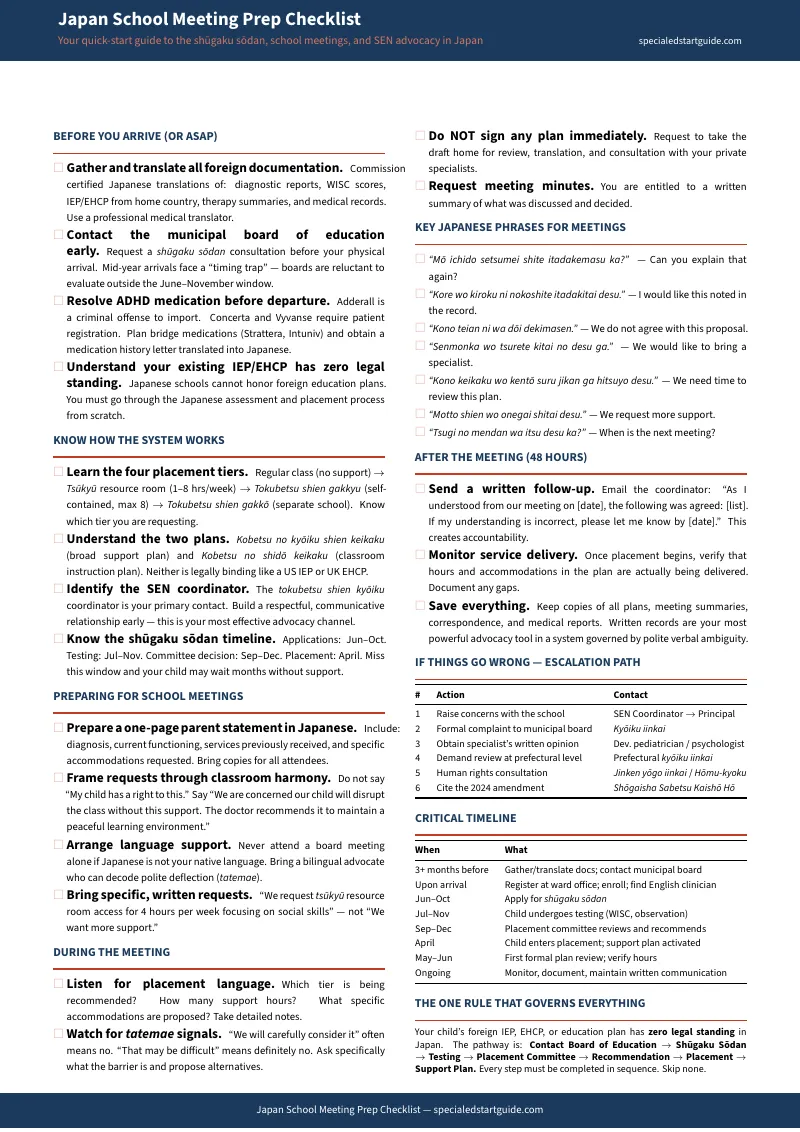
- Japan School Meeting Prep Checklist (checklist.pdf) — printable quick-reference covering the shūgaku sōdan timeline, four placement tiers, meeting preparation framework, cultural communication strategies, key Japanese phrases, and critical action items from pre-arrival through placement confirmation
Instant PDF download. Print the glossary and meeting prep worksheet tonight and bring them to your next school meeting.
Money-back guarantee, no time limit. If the Blueprint doesn't change how you navigate your child's education in Japan, email us for a full refund. No questions asked.
Not ready for the full Blueprint? Download the free Japan School Meeting Prep Checklist — a structured quick-reference covering the shūgaku sōdan process, four placement tiers, cultural communication norms, key Japanese-English SEN terminology, and meeting preparation essentials. It's enough to walk into your next school meeting prepared, and it's free.
Your child's foreign IEP doesn't work here. The Japanese system has a clear pathway. The legal protections are real. After tonight, you'll know exactly how to activate them.