The Committee Convened in Hebrew. They Assigned a Functioning Level. You Have 21 Days to Appeal — and You Don't Know What Any of It Means.
You made Aliyah for the right reasons — family, identity, the dream of raising your children in the Jewish homeland. You enrolled your child in the local school because that's what new Olim do. The Ulpan gave you enough Hebrew to buy groceries and read the bus schedule. Then a notice arrived from the municipal education department. It mentioned a Va'adat Ifyun V'Zakaut. It referenced a psycho-didactic evaluation. It listed a date, a time, and a building you've never visited. It was written entirely in Hebrew. Google Translate rendered Va'adat Shibbutz as "placement committee." It rendered Sal Shirutim Ishi as "personal services basket." It rendered Kita Mikademet as "promoted class." None of those translations told you that the committee is about to determine your child's disability category, assign a functioning level between 1 and 4 that controls how many therapy hours they receive, and issue a placement recommendation that could route them into a segregated special education school — permanently.
You called Nefesh B'Nefesh. They were helpful. They confirmed the committee exists and suggested you contact your municipality. You called the municipality. They spoke Hebrew. You joined three Facebook groups. One parent in Beit Shemesh said the committee is "no big deal." Another in Jerusalem said she hired an advocate for 500 NIS per hour and still lost the appeal. A parent in Ra'anana posted a timeline that contradicted everything the municipality told you. You spent four hours reading threads and ended up more confused than when you started.
The problem is not that Israel lacks special education protections. The Special Education Law 1988, Amendment 7 (2002), Amendment 11 (2018), and the Equal Rights for Persons with Disabilities Law 1998 collectively provide robust legal rights. The problem is that the entire system — every committee hearing, every evaluation, every official circular, every appeals process — operates in Hebrew, follows a collaborative-categorical model that directly contradicts the adversarial IEP framework you know from the US or UK, and assumes you already understand rules that nobody has ever explained to you in English. Your child's American IEP or British EHCP carries zero legal weight in Israel. You are starting from scratch.
The Israel Special Education Blueprint is the Aliyah Special Education Navigation System that translates Israel's eligibility committees, placement procedures, funding mechanics, and advocacy rights from institutional Hebrew into the plain-English roadmap, bilingual terminology guide, and meeting prep toolkit that give you equal standing at the committee table — without paying an educational consultant 500 NIS per hour to explain what the chairperson just said.
What's Inside the Blueprint
The Legal Foundation — What Israeli Law Actually Guarantees You
The Special Education Law 1988, Amendment 7 (the inclusion article), Amendment 11 (parental choice of placement), the Equal Rights for Persons with Disabilities Law 1998, and the landmark Yated v. Ministry of Education High Court ruling — translated from legislative Hebrew into plain-language leverage. When the committee tells you "we recommend a special education school," this chapter tells you exactly which statute guarantees your right to choose mainstream inclusion instead. When you arrive from the US expecting your IEP to transfer, or from the UK expecting your EHCP to carry legal weight, this chapter explains precisely why neither applies — and what Israel's system replaces them with.
The Evaluation Pipeline — From Suspicion Through Formal Assessment
How to request an evaluation. The difference between a school-initiated assessment and a parent-initiated private Ivchun. What happens when the public Sherut Psychologi Chinuchi (Educational Psychology Service) has a six-month waitlist and your committee deadline is March 31. When to pay 1,500–4,000 NIS for a private psycho-didactic evaluation and what to demand from the evaluator. How to get foreign evaluations translated, and why a notarised translation matters more than the evaluation itself.
The Va'adat Ifyun V'Zakaut — The Committee That Determines Everything
The Eligibility and Characterization Committee is where your child's disability category, functioning level (1–4), and Personal Services Basket allocation are decided. This chapter explains who sits on the committee, how to present your parent statement, how the functioning level directly controls weekly therapy hours, what to do when you disagree with the assigned level, and why walking in without a bilingual advocate is the most expensive mistake Anglo parents make in Israel.
Placement Options — Mainstream Inclusion, Self-Contained Class, or Special Education School
Israel offers three tracks: full mainstream inclusion with Shaot Shiluv (integration hours), a Kita Mikademet (self-contained special education class within a regular school), or a standalone special education school. Amendment 11 guarantees your right to choose — but the system structurally defaults to the option with the least administrative resistance. This chapter explains the real trade-offs: mainstream classrooms of 30–35 students with limited aide support versus guaranteed small classes of 7–8 in segregated settings. You need to understand this trade-off before the committee asks for your preference.
MATYA and the Personal Services Basket — How Funding Actually Works
If your child is placed in mainstream inclusion, services are delivered through the local MATYA (Support and Resource Center). The Personal Services Basket (Sal Shirutim Ishi) funds weekly therapy hours — OT, speech therapy, behavioural support — calibrated to your child's functioning level. This chapter explains how the basket is calculated, why Level 4 families receive dramatically more hours than Level 1, how to verify that approved hours are actually being delivered, and what to do when MATYA says "we don't have a therapist available" three weeks into September.
The TLA — Israel's Version of the IEP
The Tochnit Limudim Atzmit (Individual Learning Plan) is the closest Israeli equivalent to an American IEP. It is not a legally binding contract. This chapter explains what the TLA should contain, how to participate in its development, how to push for measurable goals instead of vague platitudes, and how to use documented failures to implement the TLA as evidence in an appeal.
The Bagrut — Protecting Your Child's Academic Trajectory
The Bagrut matriculation exams determine university eligibility. Students with recognised disabilities qualify for accommodations — extra time, assistive technology, modified formats — that can make the difference between a Bagrut certificate and no academic credential. This chapter covers the accommodation application process, documentation requirements, and why applying early (well before 10th grade) protects options your child doesn't know they need yet.
The Appeals Process — When the Committee Gets It Wrong
If you disagree with the committee's eligibility determination, functioning level, or basket allocation, you have 21 days from the date you receive the written decision to file a formal appeal with the Va'adat Hasaga (Appeals Tribunal). This deadline is absolute — miss it and the decision becomes binding for the entire academic year. This chapter walks through the appeal letter structure, common grounds for objection, what happens at the appeals hearing, and when to escalate to the District Court.
The Aliyah Protocol — Transitioning a Foreign IEP into the Israeli System
A dedicated chapter for families making Aliyah with a child who already receives special education services abroad. Your US IEP, UK EHCP, Australian equivalent, or Canadian IEP has zero legal standing in Israel. This chapter explains exactly how to package your child's existing documentation — evaluations, therapy reports, school records — so the Israeli system recognises their needs immediately, preventing a devastating lost academic year. Covers the Nefesh B'Nefesh disability pre-recognition process, the Bituach Leumi Disabled Child Allowance, and the critical December–March timeline for committee eligibility.
The Cultural Shift — Adversarial to Collaborative
Anglo parents arrive expecting an American-style adversarial process where threatening a lawsuit forces district compliance. Israel operates on a collaborative-categorical model where aggressive confrontation backfires. This chapter explains how to advocate firmly within the system's cultural norms — not the norms you carried from the US or UK. The golden rule: don't fight the system, learn to work the system.
The Complete Hebrew-English Terminology Guide
Not just translated — functionally explained. The glossary doesn't just tell you that Va'adat Shibbutz means "placement committee." It tells you that the Va'adat Shibbutz is the formal committee that assigns your child to a specific school after eligibility is established, that you attend by right, and that challenging its decision requires a separate appeal mechanism from challenging the eligibility determination. Over 60 terms, each with its operational meaning, legal weight, and practical implications.
Who This Blueprint Is For
- Olim Chadashim (new immigrants) who arrived from the US, UK, Canada, South Africa, Australia, or New Zealand and discovered that their child's existing IEP, EHCP, or equivalent carries no legal weight in Israel
- Long-term Anglo expats in Jerusalem, Ra'anana, Modiin, Beit Shemesh, Netanya, and surrounding communities whose child has been referred for a Va'adat Ifyun V'Zakaut — and who received Hebrew-language documentation they cannot fully parse
- Parents whose school is recommending a special education school or self-contained Kita Mikademet and who need to understand their legal right to choose mainstream inclusion under Amendment 11
- Parents caught between the 500 NIS/hour private advocate and the contradictory Facebook group advice — who need structured, legally grounded information at a fraction of either cost
- Parents making Aliyah in the next 12 months with a child who currently receives special education services and who need the December–March pre-arrival timeline to avoid losing an entire academic year
- Anglo-Israeli parents who speak conversational Hebrew but lack the specialised psycho-educational and legal vocabulary required to advocate effectively at a committee hearing
- Parents who need to apply for a Disabled Child Allowance from Bituach Leumi, arrange therapeutic services through the Kupat Cholim, or navigate the MATYA system — and have found zero English-language guidance on any of it
Why Not Just Use the Free Resources?
Nefesh B'Nefesh provides pre-Aliyah guidance and macro-level system overviews. Bizchut campaigns for disability rights at the Supreme Court level. The Ministry of Education publishes brochures acknowledging the system exists. Here's why Anglo parents still arrive at committee meetings unable to advocate effectively:
- Nefesh B'Nefesh is your compass — not your machete. NBN provides exceptional high-level immigration support and recently launched a groundbreaking disability pre-recognition initiative with the Ministry of Welfare. But they manage thousands of Olim annually and cannot walk an individual family through the specific mechanics of challenging a functioning level determination or drafting an appeal letter for a specific municipal committee. NBN points you in the right direction. When you're sitting in a Hebrew-language committee hearing at 9 AM with three professionals across the table, you need the step-by-step tactical instructions an overarching immigration agency cannot provide.
- Facebook groups are emotional support, not legal guidance. Anglo parent groups in Israel are fast, responsive, and emotionally supportive. They are also anecdotal, contradictory, and frequently wrong. A parent in Beit Shemesh giving advice based on their 2021 experience may be citing procedures that no longer apply. A parent in Jerusalem describing their committee outcome offers no insight into how a different municipality operates. As one parent noted: "I had to make a conscious choice to not read the group because I couldn't stand their misinformation." Your child's educational placement is not the place for crowdsourced guesswork.
- Ministry publications describe the system from the system's perspective. The Ministry of Education's English-language materials acknowledge that special education exists and present the Placement Committee as a supportive process. They do not provide step-by-step instructions for what to do when the committee assigns a functioning level you believe is too low. They do not explain the 21-day appeal deadline. They do not provide a bilingual terminology guide. State publications describe the bureaucracy. The Blueprint gives you the operational playbook.
- Private advocates are excellent — but 500 NIS per hour is a first step, not a starting point. English-speaking educational consultants in Israel charge 150–500+ NIS per hour. Many families hire them prematurely, spending thousands of shekels just to learn the basic terminology, timelines, and procedural mechanics of the system. The Blueprint commoditises that foundational knowledge. If you ultimately need an advocate for a complex dispute, you arrive informed — saving thousands in billable hours instead of paying premium rates to learn what Va'adat Ifyun V'Zakaut means.
The government publishes the regulations. NGOs campaign for policy reform. The Blueprint gives you the operational playbook.
— Less Than One Session with a 500 NIS/Hour Advocate
A single consultation with an English-speaking educational advocate in Israel costs 150–500 NIS. A special education attorney requires a retainer of 5,000 NIS or more to open a file. Private therapies — occupational therapy, speech therapy, behavioural support — run 1,000–3,000 NIS per month when the public system cannot deliver. And the cost of missing the March 31 committee deadline is an entire lost academic year of unfunded services. Even if you eventually need a professional advocate for a specific dispute, the systemic preparation you build with this Blueprint saves thousands — because you arrive understanding the framework, speaking the right terminology, and asking specific questions instead of paying someone to explain the basics.
Your download includes the complete guide and printable quick-reference tools:
- Complete Blueprint Guide (guide.pdf) — 17 chapters covering the legal framework (Special Education Law 1988, Amendments 7 and 11, Equal Rights Law 1998), evaluation pipeline, Eligibility and Characterization Committee navigation, placement options and mainstream inclusion advocacy, MATYA and Personal Services Basket funding mechanics, TLA development, Bagrut accommodations, transport entitlements, the 21-day appeals process, cultural advocacy strategy, the Aliyah transition protocol with December–March timeline, post-secondary pathways, key organisations and contacts, complete Hebrew-English glossary of 60+ terms, and annual calendar
- Hebrew-English Glossary Quick Reference (hebrew-english-glossary.pdf) — standalone printable glossary of 30 essential terms organised by category (committee, placement, people, immigration) with Hebrew script, transliteration, and operational meaning — bring this to every committee meeting
- Annual Calendar — Critical Deadlines (annual-calendar.pdf) — month-by-month fridge sheet mapping the March 31 committee deadline, evaluation windows, appeals periods, and the Aliyah arrival timeline
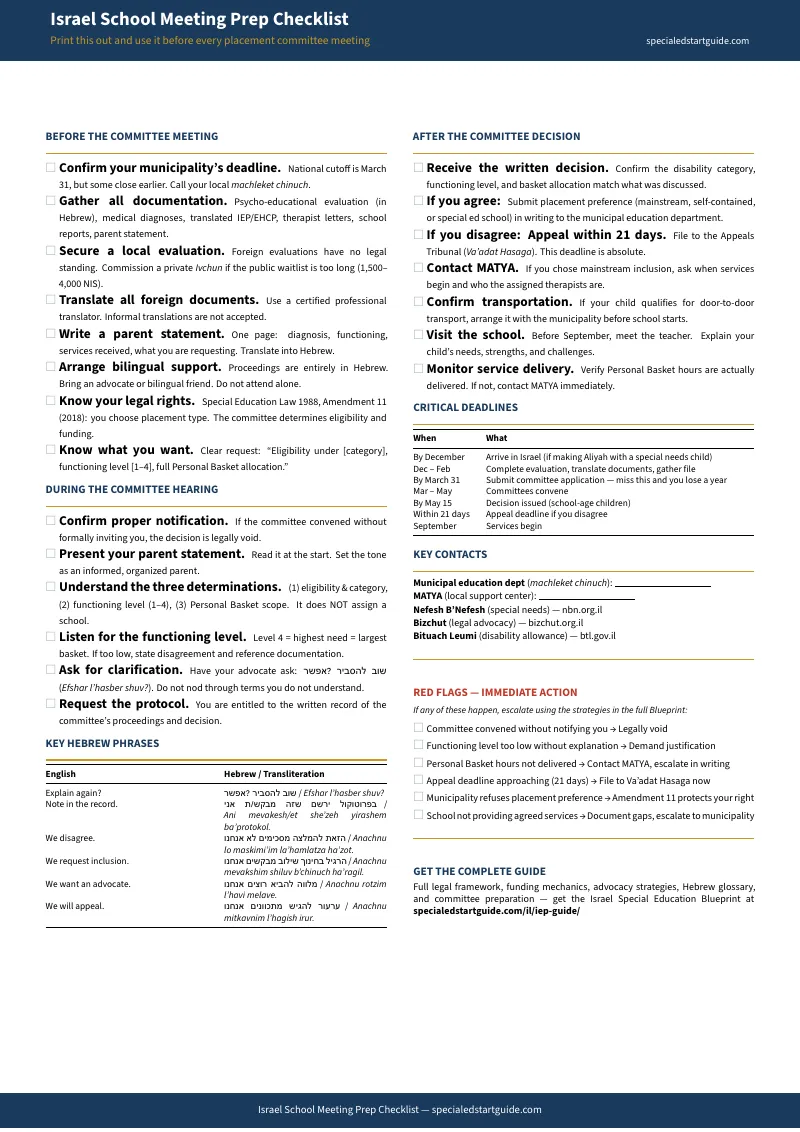
- Israel School Meeting Prep Checklist (checklist.pdf) — printable quick-reference covering before-meeting preparation, during-meeting advocacy tactics with Hebrew phrases, critical legal citations, post-meeting documentation protocol, deadlines calendar, and key contacts
Instant PDF download. Print the checklist tonight and bring it to your next committee meeting.
Money-back guarantee, no time limit. If the Blueprint doesn't change how you navigate your child's education in Israel, email us for a full refund. No questions asked.
Not ready for the full Blueprint? Download the free Israel School Meeting Prep Checklist — a structured quick-reference covering committee procedures, evaluation rights, essential Hebrew phrases for meetings, critical deadlines, and key contacts. It's enough to walk into your next committee hearing prepared, and it's free.
Your child has a right to inclusive education in Israel. The Special Education Law establishes it. Amendment 11 protects your choice. The committee knows the system. After tonight, so will you.