The School Handed You an EDB Pamphlet About the 3-Tier Model. Nobody Told You What to Do Next.
Your child has been identified with SEN. The SENCO explained the Whole-School Approach in five minutes. The school says it's providing "Tier-2 support" — but when you ask what that means in practice, the answer is "small group remedial sessions" with no frequency, no measurable goals, and no written plan. You've scrolled Baby Kingdom forums at 2 AM. You've been told the public Child Assessment Centre wait is over 90 weeks. And you still don't know whether your child should be at Tier 2 or Tier 3, what the difference actually changes, or whether the school is spending the Learning Support Grant on your child's needs or absorbing it into general operations.
Here's the core problem: in the United States, an IEP is a legal right enforced in federal court. In the UK, an EHCP carries statutory force. In Hong Kong, an IEP is a professional practice recommendation — the Education Bureau explicitly states there is "no need for schools to develop an IEP for every student with SEN." That single fact changes everything about how advocacy works here. The free EDB operational guides explain the system to school administrators. They do not tell parents how to push back when the system stalls.
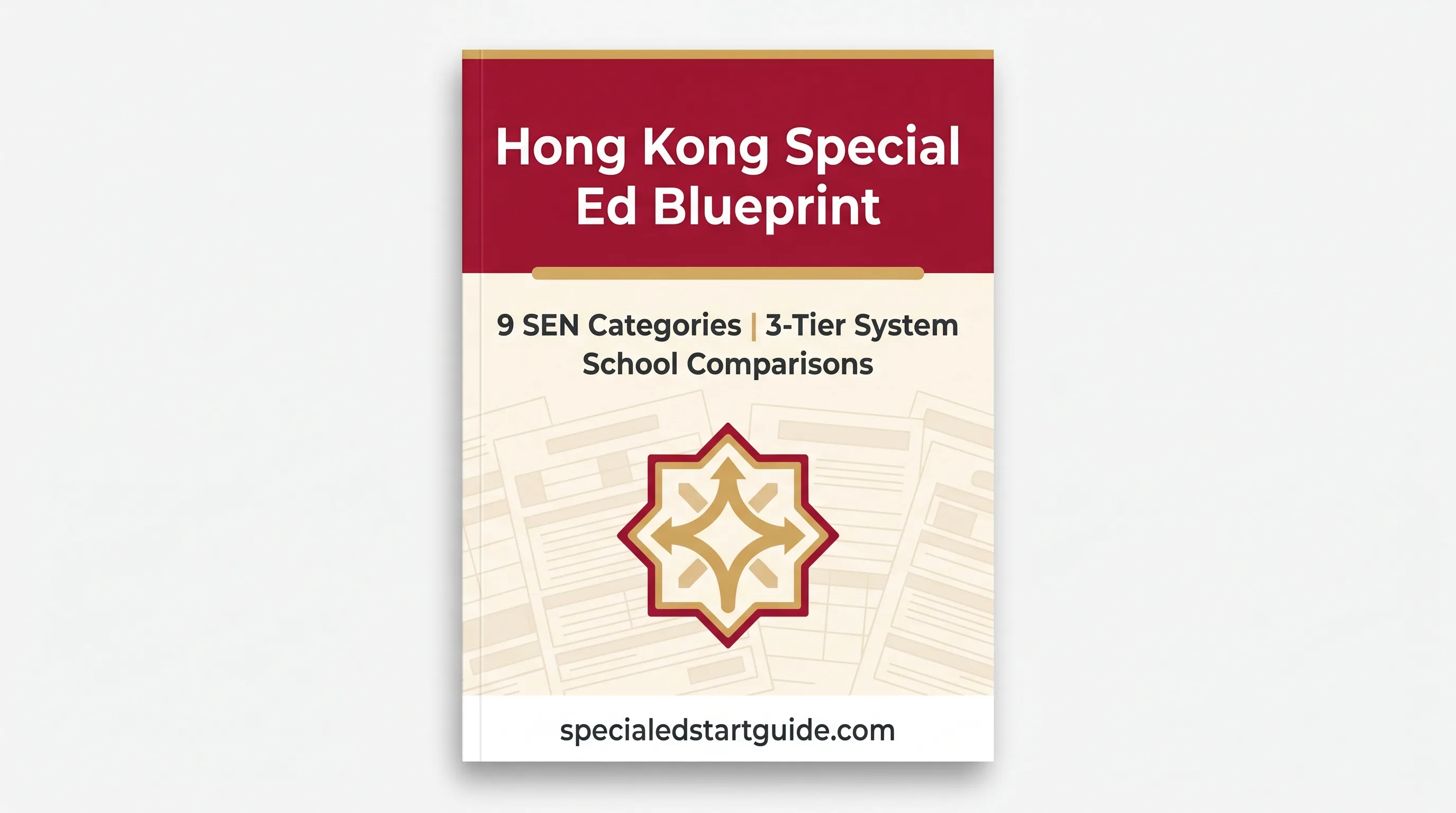
The Hong Kong Special Education Blueprint is the parent-side navigation system that translates the EDB's policy framework into a practical advocacy toolkit — covering all 9 SEN categories, the 3-Tier support model, school type comparisons, assessment pathways, IEP strategies, and the escalation steps that the government's own guides will never mention.
What's Inside the Blueprint
The 3-Tier System Translated for Parents
The EDB describes the 3-Tier Intervention Model in dense educational jargon written for principals maintaining compliance metrics. What parents need to know is different: What does Tier-2 support actually look like in a classroom of 35 students? How severe do difficulties need to be to trigger a Tier-3 designation — the only level where the EDB expects a formal IEP? What documentation should you be collecting at Tier 2 to build the case for escalation? The Blueprint answers these questions with specifics, not policy language.
The School Type Decision Framework
Mainstream aided schools provide guaranteed EDB funding but inflict intense academic pressure. DSS schools offer more curriculum flexibility but vary wildly in SEN commitment. International schools charge premium tuition and are legally unregulated on inclusion — some provide excellent support, others demand parents privately fund a full-time Educational Assistant on top of HK$145,000+ tuition. ESF schools have their own application process and waitlists. Special schools serve severe and multiple disabilities. The Blueprint compares every school type side by side on SEN support, funding, flexibility, cost, and legal obligations — so you make the placement decision with data, not marketing brochures.
The Assessment Pathway Map
The public Child Assessment Centre wait exceeds 90 weeks. What do you do during that time? The Blueprint maps the full assessment landscape: public CAC timelines, private psycho-educational assessment options (and their costs — HK$10,000 to HK$17,500 for full testing batteries), how to use private assessment results to push the school to act before the public process completes, pre-school rehabilitation services, and the dual-language assessment challenge for bilingual children whose cognitive profile differs between English and Chinese.
The IEP Advocacy Framework
Because an IEP is not a statutory right in Hong Kong, securing and monitoring one requires a different approach than in Western systems. The Blueprint covers how to request a documented plan when the school claims your child "doesn't meet Tier 3," how to ensure goals are specific and measurable rather than vague aspirations, how to track whether interventions are actually being delivered, and what to do when the annual review reveals that nothing has changed. Research shows 87.7% of surveyed Hong Kong parents find SEN support inadequate — having a plan on paper is the starting line, not the finish line.
SENCO and Student Support Team Navigation
The SENCO controls your child's support coordination. The Student Support Team meets to review cases. Understanding how these roles work — what each person is actually responsible for, what resources they have, and what constraints they operate under — determines whether you leave meetings with concrete commitments or vague promises. The Blueprint includes the specific questions that reveal whether a school's inclusion commitment is genuine or performative.
The Expat Translation Matrix
If you're arriving in Hong Kong with a US IEP or UK EHCP, those documents carry zero legal weight in Hong Kong's private or public education systems. International schools are private entities not bound by foreign disability law. The Blueprint maps US and UK SEN terminology to the Hong Kong reality — so you stop searching for "504 plan equivalent Hong Kong" and start navigating the system that actually exists.
Legal Protections and Escalation Pathways
The Disability Discrimination Ordinance (DDO) covers educational discrimination. The Equal Opportunities Commission accepts formal complaints. The Blueprint explains when and how to invoke these protections — including the escalation sequence from informal advocacy through formal channels — so you understand the full range of options before you need them.
Transition Planning
Kindergarten to primary. Primary to secondary. Secondary to HKDSE special examination arrangements. Each transition carries specific deadlines, documentation requirements, and decisions that must be made months in advance. The Blueprint maps every transition with timelines and the specific actions required at each stage — including the new Designated Support Teams for post-school planning.
Who This Blueprint Is For
- Parents whose child was flagged at the Maternal and Child Health Centre or by a kindergarten teacher — and who've just learned the assessment wait exceeds 90 weeks with no guidance on what to do in the meantime
- Parents who received a diagnosis and were handed EDB pamphlets about the Whole-School Approach, but nobody explained what specific support their child will receive tomorrow morning
- Parents whose child is at Tier 2 and the school says an IEP "isn't necessary" — but who have no way to verify whether Tier-2 support is being delivered, measured, or reviewed
- Expat parents arriving with a US IEP or UK EHCP who've just discovered that Hong Kong international schools have no statutory obligation to honour it
- Parents told by an international school that their child needs a full-time 1:1 Educational Assistant — privately funded, on top of tuition
- Parents weighing mainstream versus DSS versus international versus special school, unable to find a source that compares them objectively on SEN support
- Parents who've been in the system for years, hear the school say their child is "making progress," but see nothing measurable changing
Why Not Just Use the Free Resources?
Hong Kong has genuine SEN resources. The EDB publishes detailed operational guides. The Heep Hong Society provides excellent therapeutic materials. The SENSE website offers an overview of integrated education. Here's why parents still feel lost after consulting all of them:
- The EDB writes for school administrators, not parents. The Operation Guide on the Whole School Approach to Integrated Education is a compliance manual explaining how funding flows and how SENCOs should be deployed. It does not tell you how to escalate when the school denies a Tier-3 designation. It does not explain how to distinguish between a school that genuinely supports inclusion and one that absorbs the Learning Support Grant without delivering meaningful intervention. This Blueprint translates the system's rules into fill-in tools a parent can use at a meeting.
- NGO resources focus on therapy, not system navigation. The Heep Hong Society and SAHK produce outstanding clinical materials on behaviour management, early intervention, and parenting support. What they don't provide is strategic guidance on school selection, bureaucratic advocacy, or how to build the paper trail that holds a school accountable. The clinical support and the navigational strategy are complementary — but they're not the same thing.
- Baby Kingdom forums are survival advice wrapped in anxiety. Forum threads contain valuable anecdotal intelligence about specific schools and teachers. They also contain outdated policy information, contradictory advice, worst-case-scenario venting, and years of unorganised posts that take hundreds of hours to parse into a coherent strategy. A parent at 2 AM needs a structured decision framework, not another thread that ends with "every child is different, good luck."
The free resources explain how the system is supposed to work. This Blueprint gives you the tools to make it work for your child.
— Less Than 10 Minutes With a Private Educational Consultant
Private educational consultants in Hong Kong charge HK$900 for a 30-minute session. Educational psychologists charge HK$1,200 for 40 minutes. Senior therapists run HK$4,600 per hour. Much of that time — often the entire first session — is spent explaining the basic mechanics of the SEN system to parents who don't yet know the right questions to ask. This Blueprint gives you that orientation knowledge upfront, so your time with professionals is spent on your child's specific strategy, not on learning what the 3-Tier model is.
Your download includes the complete Blueprint guide plus 9 standalone printable tools — reference cards, worksheets, and scripts you can bring to meetings and keep in your SEN file:
- Complete Blueprint Guide — 11 chapters covering the 9 SEN categories, 3-Tier support model, assessment pathways, school type comparisons, IEP advocacy, SENCO navigation, legal protections, expat transition guidance, and transition mapping
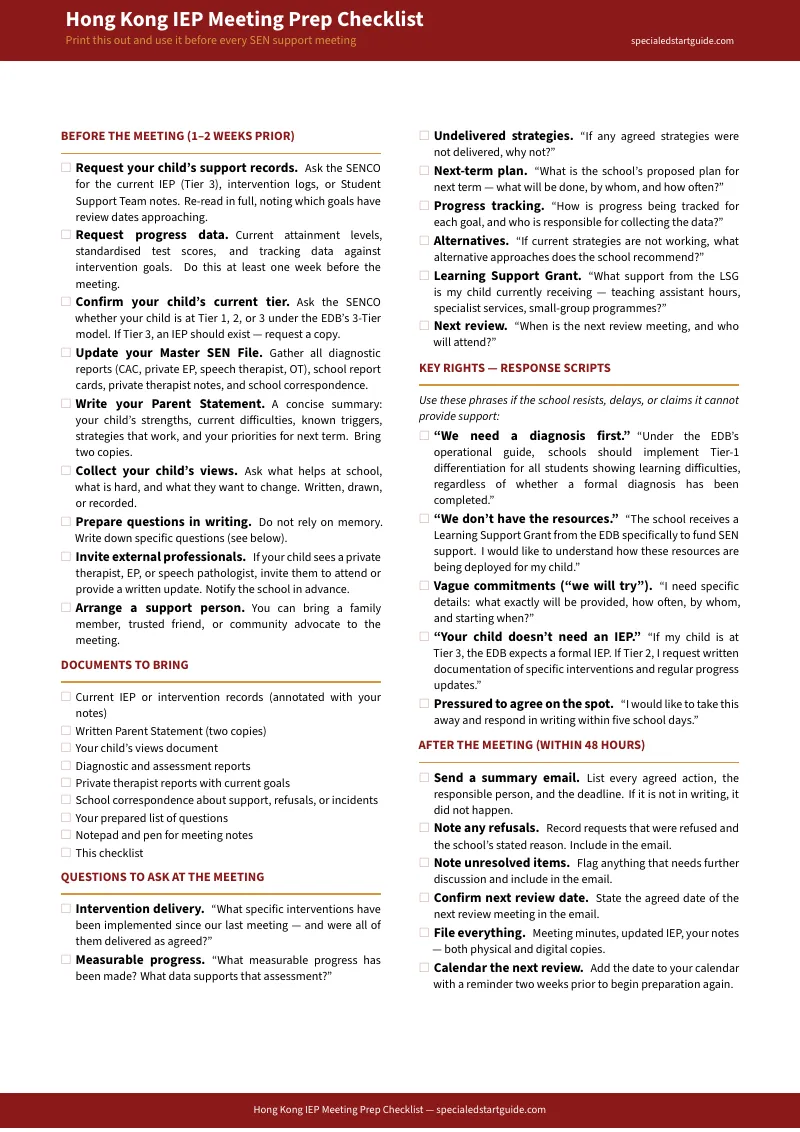
- IEP Meeting Prep Checklist — pre-meeting preparation, documents to bring, questions to ask, and red flags for school support quality
- SEN Categories Reference Card — all 9 EDB categories with key characteristics and parent implications
- Assessment Pathway Map — public vs private pathways, costs, timelines, and what to do during the wait
- School Type Comparison Chart — aided, DSS, international, ESF, and special schools compared on SEN support, funding, and risks
- Scenario Response Scripts — word-for-word responses for the 5 most common pushback situations from schools
- Master SEN File Template — fillable organiser for your advocacy paper trail with follow-up email template
- Escalation Pathway Reference — the 5-step sequence from SENCO through the Equal Opportunities Commission
- Transition Timeline — kindergarten to primary, primary to secondary, and HKDSE exam accommodations with deadlines
- Resources Directory — every government service, NGO, legal resource, and private assessment provider on one page
Instant PDF download. Print the checklist tonight. Walk into tomorrow's meeting with a strategy.
Money-back guarantee, no time limit. If the Blueprint doesn't change how you navigate the SEN system, email us for a full refund. No questions asked.
Not ready for the full Blueprint? Download the free Hong Kong IEP Meeting Prep Checklist — a structured checklist covering EDB SEN support tiers, SENCO collaboration, and IEP/ISP meeting preparation. It's enough to walk into your next meeting prepared, and it's free.
Every meeting where you don't understand the system is a meeting where the school controls the outcome. After tonight, you'll control it.