
The School Sent Home a Pedagoginen Selvitys. It's in Finnish. Your Child's Placement Meeting Is Next Week.
You moved to Finland for the job — Nokia, Supercell, Rovio, a university posting, your Finnish partner's career. You enrolled your child in the local comprehensive school because Finland has the world's best education system and international school fees in Helsinki start at €15,000 per year before learning support surcharges. The school seemed fine. Then something shifted. The erityisopettaja mentioned your child in passing. The opiskeluhuolto sent a meeting invitation. They used a phrase you'd never encountered: tuen toteuttamissuunnitelma. They mentioned rajoitettu oppimäärä. They said your child's support would be discussed. They did not explain what any of this meant in practice.
You went home and opened Google Translate. You typed tuen toteuttamissuunnitelma. It gave you "support implementation plan." You typed rajoitettu oppimäärä. It gave you "limited syllabus." You typed hallintopäätös. It gave you "administrative decision." None of these translations told you that a limited syllabus legally lowers your child's learning targets and can block their access to academic upper secondary school (lukio). None of them told you that Finland's entire support framework was overhauled in August 2025, rendering every Reddit thread and expat forum post you can find dangerously obsolete. None of them told you that the 14-day deadline to appeal an administrative decision is absolute. And none of them told you that your expensive private ADHD diagnosis from Mehiläinen does not automatically trigger school support — because Finland's system is needs-based, not diagnosis-driven.
You searched for "special education Finland English." You found the OPH.fi website confirming the support system exists. You found Reddit threads from American parents whose IDEA-based advice does not apply. You found an expat Facebook group where someone in Espoo recommended a strategy that depends on pre-2025 legislation. You found a private educational psychologist in Helsinki charging €200 per hour with a six-week waitlist. You found nothing that explained how Finland's reformed system actually works, step by step, in English, for a parent who needs to prepare for a school meeting next week.
The problem is not that Finland's special education system is broken. It has genuine structural protections — including the right to free interpreters, the right to be heard before any formal decision, and a funded special education teacher in every school. The problem is that the entire system was redesigned in 2025, operates in compound Finnish administrative terminology, relies on cultural consensus rather than legal adversarialism, and is fundamentally incompatible with the diagnosis-driven model that every Anglo-American expat expects.
The Finland Special Education Blueprint is the Three-Tier Decoder System that translates Finland's reformed support framework, advocacy strategy, and appeals process from institutional Finnish into the plain-English roadmap, meeting preparation tools, and bilingual question templates that give you equal footing at the school table — without paying a private consultant €200 per hour to explain what rajoitettu oppimäärä actually means for your child's academic future.
What's Inside the Blueprint
The Legal Foundation — What the Perusopetuslaki Actually Guarantees You
The Basic Education Act, the municipal decentralization model, and the 309 autonomous kunta systems — translated from legislative Finnish into plain-language leverage. When the school tells you "the municipality recommends pupil-specific support," this chapter tells you exactly which sections of the Perusopetuslaki define your right to challenge the decision. When you arrive from the US expecting your IEP to transfer, or from the UK expecting your EHCP to carry legal weight, this chapter explains precisely why neither applies in Finland — and what replaces them.
The August 2025 Reform — What Changed and Why Every Forum Post Is Now Wrong
Finland's celebrated three-tier system (yleinen tuki, tehostettu tuki, erityinen tuki) has been officially replaced by a two-construct model: group-specific support and pupil-specific support. The HOJKS is gone. The pedagoginen selvitys is gone. Every expat forum thread written before August 2025 references a framework that no longer exists in law. This chapter explains what the old system did, what replaced it, how schools are implementing the transition, and how to advocate effectively in the post-reform landscape.
The Key People — Who Does What and Who Has Authority
How the erityisopettaja works in practice. What the opiskeluhuolto (student welfare team) evaluates. How the rehtori (principal) influences recommendations. The critical difference between pienryhmä (small group), erityisluokka (special class), and erityiskoulu (special school) placements. And the Valteri Centre — Finland's national network of six state-owned special schools that provides expert consultation when your municipality lacks resources.
The Cultural Paradigm Shift — Why Your Foreign IEP Does Not Work Here
In the US, a medical diagnosis forces the school to produce an IEP. In Finland, a diagnosis is context, not a mandate. Finnish teachers assess pedagogical need through classroom observation, not medical paperwork. This chapter explains why aggressive adversarial tactics trigger institutional resistance, teaches you to frame requests in pedagogical language the system respects, and shows you how to use your private medical evidence strategically within the needs-based framework — rather than dropping a diagnosis on the principal's desk and expecting automatic resources.
School Meetings — The Advocacy Moment That Determines Everything
Finnish school culture operates on consensus, not confrontation. This chapter provides the exact preparation strategy that works: what documents to translate and bring, which Finnish phrases to use, how to exercise your legal right to an interpreter, and the six critical questions to ask at every stage — plus the "limited syllabus" response protocol for when the school proposes rajoitettu oppimäärä. Includes how to use Wilma (Finland's school communication platform) as an unalterable digital paper trail.
The Clinical Diagnostic Track — Getting Assessed in English
When your child needs a formal diagnosis — ADHD, autism spectrum, dyslexia — the public pathway through HUS, TAYS, or TYKS has wait times of three to nine months. This chapter explains how to use private English-speaking neuropsychologists at Mehiläinen, ProNeuron, Ombrelo, or Medishare as a workaround, why Finnish standardized tests may produce falsely depressed scores for English-speaking children, and how possessing a private diagnosis unlocks both school-level advocacy leverage and Kela financial benefits.
Kela Benefits — Unlocking Up to €500/Month Tax-Free
Your child's school support level directly impacts your eligibility for Kela's Disability Allowance for Children (Alle 16-vuotiaan vammaistuki). Three tiers: €110/month (basic), €258/month (middle), €500/month (highest) — all tax-free. But Kela requires a C-lausunto (Medical Statement C) documenting the care burden, and the application is dramatically stronger when the school has formal pupil-specific support in place. This chapter connects the school bureaucracy to the national benefits system — showing you exactly how to align documentation across both.
Your Legal Rights and the Appeals Process
When the municipality issues a formal hallintopäätös (administrative decision) you disagree with, you have exactly 14 days to file an oikaisuvaatimus (request for rectification). Miss the deadline and the decision becomes final. This chapter provides the escalation pathway from municipal appeal to Administrative Court, plus how to file a kantelu (complaint) with AVI when the school fails to implement agreed support, and how to contact the Yhdenvertaisuusvaltuutettu (Non-Discrimination Ombudsman) if discrimination is a factor.
The Complete Finnish-English Glossary
Not just translated — functionally explained. The glossary doesn't just tell you that opiskeluhuolto means "student welfare." It tells you that the opiskeluhuolto is the multi-professional team (psychologist, social worker, nurse) that assesses your child's needs, makes support recommendations, and serves as the gateway to formal pupil-specific support. Every term includes its operational meaning, its institutional weight, and what it means for your child in practice.
Who This Blueprint Is For
- Tech and gaming industry professionals at Nokia, Supercell, Rovio, Wolt, and Reaktor whose child has been flagged for additional support — and who received Finnish-language documentation they cannot fully understand
- EU researchers, postdoctoral fellows, and university faculty in Helsinki, Espoo, Tampere, Turku, Oulu, and Jyväskylä who need rigorously cited, actionable guidance rather than anecdotal forum advice
- Trailing spouses managing the family's educational integration while the primary earner works — and who bear the full weight of navigating municipal bureaucracy in a language they are still learning
- Partners of Finnish nationals who have a built-in cultural translator at home but need independent understanding of the system — because relying entirely on a Finnish spouse who trusts the state creates conflict when the state falls short
- Parents who arrived from the US, UK, Australia, or Canada expecting their existing IEP or EHCP to transfer — and discovered that Finland's needs-based system operates on entirely different pedagogical principles
- Parents whose child is in valmistava opetus (preparatory education) and who need to ensure the school distinguishes a language acquisition challenge from a genuine learning disability before formal assessments begin
- Parents whose child is gifted and bored — finding the pace frustratingly slow, acting out at home — and who need to understand why Finland does not operate grade acceleration programs and what differentiation options exist within the system
Why Not Just Use the Free Resources?
The Finnish government publishes special education policy. The erityisopettaja is free. The appeals process charges no filing fee. Here's why expatriate parents still arrive at meetings unable to advocate effectively:
- Government resources state the law — they don't teach you how to use it. OPH.fi provides high-level English descriptions of Finland's support system. It does not provide English guidance on the reformed documentation framework, the practical implications of a limited syllabus, or how to navigate the 14-day appeal deadline. The deep regulatory framework is published exclusively in Finnish legal language. The law exists. The operational instructions for using it do not — at least not in English.
- InfoFinland.fi is a citizen portal, not an advocacy tool. InfoFinland mentions that disabled children have the right to attend their local school. It provides zero guidance on the August 2025 reform, the reformed documentation requirements, or your rights when the school proposes a limited syllabus.
- The erityisopettaja works for the school. Special education teachers are your most important ally, but they also work within municipal budget constraints. They cannot advocate against their own employer's resource limitations on your behalf. When the school says "group-specific support is sufficient," you need independent knowledge to evaluate whether that claim is backed by law or budget pressure.
- Expat forums mix advice from different municipalities — and different eras. Reddit and Facebook threads regularly apply Helsinki-specific advice to families in Oulu, Turku, or smaller municipalities where different resources apply. Worse, the most commonly referenced advice about tehostettu tuki and erityinen tuki is based on the three-tier system that was replaced in August 2025. Outdated advice is more dangerous than no advice at all.
- Your foreign IEP/EHCP carries zero legal weight. A parent who arrives expecting their US IEP to automatically trigger Finnish support will waste months in frustration. The system operates on different principles entirely — and understanding those principles before your first school meeting is what separates effective advocacy from expensive misunderstanding.
The government publishes the legislation. The school provides the teacher. The Blueprint gives you the operational playbook for making both work in your child's favour.
— Less Than Fifteen Minutes With a €200/Hour Educational Psychologist
A single session with a private English-speaking educational psychologist in Helsinki costs upwards of €200 per hour. A full neuropsychological battery at Mehiläinen or ProNeuron runs €890–€2,410. Even if you eventually need a private assessment for clinical purposes, the systemic preparation you build with this Blueprint saves hundreds of euros — because you arrive understanding the reformed framework, speaking the correct Finnish terminology, and asking specific questions instead of paying someone to explain what tuen toteuttamissuunnitelma means.
Your download includes 5 PDFs:
- Complete Blueprint Guide (guide.pdf) — 12 chapters covering the legal foundation (Perusopetuslaki and municipal autonomy), the August 2025 reform (legacy three-tier system vs. the new group/pupil-specific framework), the key people and their authority, the cultural paradigm shift (diagnosis-driven vs. needs-based), school meeting strategy and the limited syllabus trap, the clinical diagnostic track (public vs. private in English), common expat scenarios (arriving with a foreign IEP, language vs. learning disability, gifted children), Wilma communication strategy, legal rights and the 14-day appeal deadline, Kela disability allowance connection, upper secondary transitions, and a complete Finnish-English special education glossary
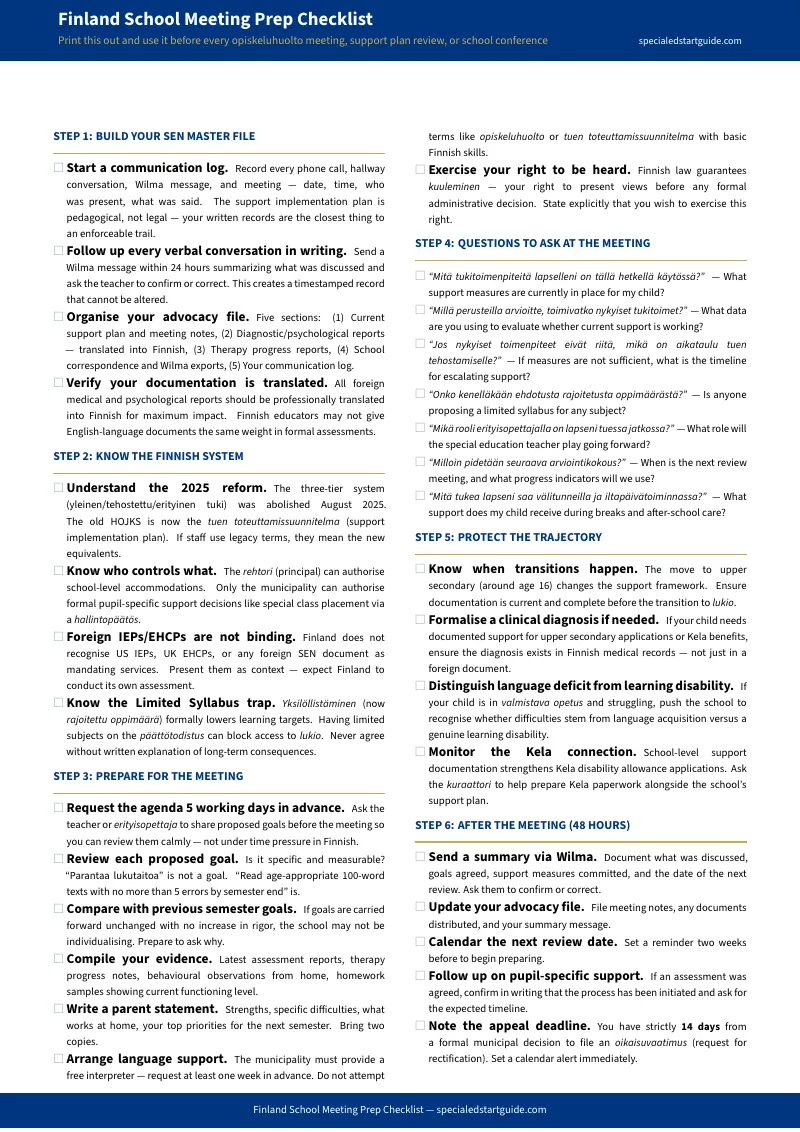
- Finland School Meeting Prep Checklist (checklist.pdf) — printable quick-reference covering essential Finnish terms, meeting preparation, the six critical questions to ask (with limited syllabus protocol), post-meeting documentation, appeal deadlines, Kela benefits quick check, and red flags for escalation
- Finnish-English Special Education Glossary (finnish-english-glossary.pdf) — printable 2-page desk reference with all 37 Finnish terms you will encounter in school documents, Wilma messages, and meetings — each with its English translation and operational meaning
- Kela Benefits Quick Reference (kela-benefits-reference.pdf) — 1-page fridge sheet covering the three benefit tiers (€110–€500/month), application requirements (Form EV 256e + C-lausunto), the school-Kela documentation connection, and additional rehabilitation benefits
- Appeals Timeline & Escalation Reference (appeals-timeline.pdf) — 1-page emergency reference with the 14-day oikaisuvaatimus deadline, the full 3-step appeals pathway, AVI complaint process, and discrimination complaint contacts
Instant PDF download. Print the checklist tonight and bring it to your next school meeting.
Money-back guarantee, no time limit. If the Blueprint doesn't change how you navigate your child's education in Finland, email us for a full refund. No questions asked.
Not ready for the full Blueprint? Download the free Finland School Meeting Prep Checklist — a structured quick-reference covering essential Finnish terms, meeting preparation, critical questions, appeal deadlines, and Kela benefits. It's enough to walk into your next meeting prepared, and it's free.
Your child has a right to special education support in Finland. The municipality knows the system. After tonight, so will you.