The School Just Told You Your Child Needs a Sonderpädagogischer Förderbedarf Assessment. The Letter Is in German. You Have Five Days to Appeal.
You moved to Vienna for the posting — IAEA, OSCE, a corporate rotation, your Austrian partner's career. You enrolled your child in the local Volksschule because that's what the relocation agent recommended. The school seemed fine. Then a meeting happened. The Klassenlehrerin sat down with the school psychologist and used a phrase you'd never heard before: Sonderpädagogischer Förderbedarf. They want to assess your child. They produced a consent form — in German. They mentioned something about a Bescheid from the Bildungsdirektion and a possible placement in a Sonderschule. They said you have options. They did not explain what those options are.
You went home and opened Google Translate. You typed in Sonderpädagogischer Förderbedarf. It gave you "special educational needs." You typed in Sonderschule. It gave you "special school." You typed in Nachteilsausgleich. It gave you "compensation for disadvantages." None of these translations told you that the SPF designation can lock your child into an alternative curriculum. None of them told you that Austria tracks children at age 10 into academic or vocational pathways — and that an SPF on the Sonderschule curriculum effectively bars access to the Gymnasium track. None of them told you that Austrian law explicitly grants you the right to refuse a Sonderschule placement and choose mainstream integration. And none of them told you that the appeal deadline on the Bildungsdirektion's official decree is five working days.
You searched for "special education Austria English." You found a four-paragraph summary on a government website that acknowledged the system exists. You found Reddit threads from parents in Germany whose advice does not apply. You found an American education consultant who charges $100 just to review a single report — and has never heard of a Widerspruch. You found a relocation agent who handles apartment leases but goes silent when you mention SPF. You found nothing that explained how the Austrian system actually works, step by step, in English, for a parent who needs to make decisions this week.
The problem is not that Austria's special education system is broken. It has genuine legal protections — including a legally guaranteed right to choose integration over segregation. The problem is that the entire system is documented in dense administrative German, designed for native speakers who grew up inside the bureaucracy, and operates on assumptions about parental knowledge that no expatriate family could reasonably meet.
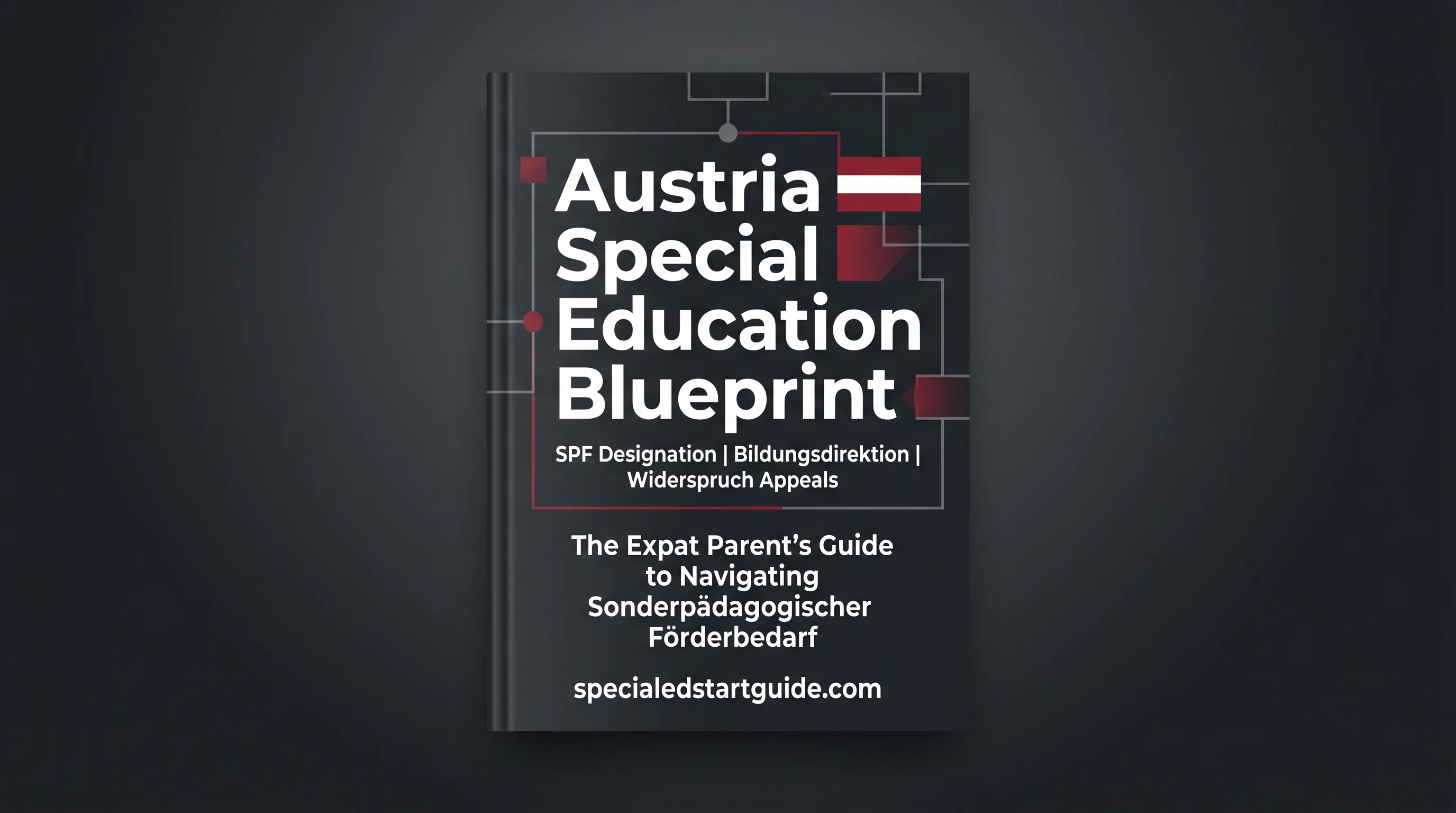
The Austria Special Education Blueprint is the Bureaucratic Defence System that translates Austria's SPF designation process, Bildungsdirektion procedures, and parental advocacy rights from institutional German into the plain-English roadmap, meeting preparation tools, and bilingual templates that give you equal footing at the school table — without paying a consultant €80 to €150 per hour to explain what the teacher just said.
What's Inside the Blueprint
The Legal Foundation — What Austrian Law Actually Guarantees You
The Schulpflichtgesetz, the SchUG, the UN Convention on the Rights of Persons with Disabilities, and the 2025 IMAS Austrian public opinion data on inclusive education — translated from legislative German into plain-language leverage. When the school tells you "the Bildungsdirektion recommends Sonderschule," this chapter tells you exactly which statute guarantees your right to refuse and choose mainstream integration instead. When you arrive from the US expecting your IEP to transfer, or from the UK expecting your EHCP to carry legal weight, this chapter explains precisely why neither applies in Austria — and what replaces them.
The SPF Designation Process — From Referral to Bescheid
How the SPF process works in practice. Who can initiate it (parents, teachers, or the school principal). What the Bildungsdirektion evaluates. What the school psychology assessment involves. What the Gutachten (expert opinion) contains. How to prepare your child for the evaluation — especially when every standardised tool is calibrated for German-speaking children. The critical March 1st deadline for next-year resources. And the single most important fact most expat families never learn: that the Bildungsdirektion's decree is an administrative act, and you can formally appeal it.
The Assessment Trap — When Language Deficit Gets Labelled as Cognitive Disability
Austria's MIKA-D language competence test is administered to every non-German-speaking child upon school entry. The results determine whether your child enters the standard curriculum, attends pull-out DaZ classes, or gets placed in a separate intensive language class. The research is clear: insufficient German proficiency is routinely and incorrectly conflated with permanent learning disability, leading to unwarranted SPF designations. This chapter explains how to distinguish a language acquisition issue from a genuine learning difficulty, how to insist the school recognises the difference, and how to prevent a temporary language barrier from becoming a permanent administrative label.
Integration vs. Sonderschule — Your Legal Right to Choose
Austria operates ten distinct types of segregated Sonderschulen alongside mainstream integration. Section 8a of the Schulpflichtgesetz gives you the legal right to choose integration — but schools routinely present Sonderschule as the only option. This chapter explains the ten Sonderschule types, what integration actually looks like in practice (including the documented reality that some "integration" classes leave children physically present but functionally segregated), what resources your child is entitled to in each setting, and how to assert your legal right when the school pushes back.
Nachteilsausgleich — The Hidden Accommodation Most Expats Never Hear About
If your child can meet curriculum goals with accommodations — extra time, oral instead of written exams, assistive technology — Nachteilsausgleich provides support without changing the curriculum standard or affecting academic tracking. This is the single most powerful tool for protecting your child's academic trajectory. This chapter explains when it applies, how to request it, and why you should push for Nachteilsausgleich before the school proposes an SPF designation — because an SPF on the Sonderschule curriculum alters the Zeugnis, changes grading, and can permanently narrow your child's options at age 10.
The Age-10 Tracking Crisis — What No One Tells You Until It's Too Late
Austria tracks students at age 10 into AHS/Gymnasium (academic track) or Mittelschule (general track). This is one of the earliest tracking systems in Europe. A child with an SPF on the Lehrplan der Sonderschule is effectively barred from the academic track. This chapter explains how tracking works, what factors influence the decision, how an SPF interacts with tracking, and how to position your child correctly — including the critical distinction between a DaZ language issue and a genuine learning disability that requires curriculum modification.
The Widerspruch — How to Appeal When the Bildungsdirektion Gets It Wrong
The default appeal deadline is five working days from delivery of the Bescheid. Miss it and the decision becomes legally binding. This chapter provides the exact procedure for filing a Widerspruch, the required documentation, and the bilingual appeal template. It explains what happens after you appeal, how the Bildungsdirektion reviews the objection, and what escalation pathways exist — including the Behindertenanwaltschaft (Disability Ombudsman) and the Volksanwaltschaft (Ombudsman Board).
Regional Variations — Why Vienna Rules Don't Apply in Salzburg
Each of Austria's nine Bundesländer operates its own Bildungsdirektion with distinct administrative practices, staffing ratios, and informal cultures. This chapter covers the state-by-state variations that affect expatriate families, with particular detail on Vienna (where 70% of Austria's expat families live), Salzburg, Graz, and Innsbruck.
The Complete German-English Glossary — Every Term You'll Encounter, Explained
Not just translated — functionally explained. The glossary doesn't just tell you that Bescheid means "decree." It tells you that the Bescheid is the legally binding administrative decision from the Bildungsdirektion, that it comes with a Rechtsmittelbelehrung (legal remedy instruction) specifying your appeal deadline, and that missing that deadline has permanent consequences. Every term includes its operational meaning, its legal weight, and what it means for your child in practice.
Who This Blueprint Is For
- UN, IAEA, OSCE, and international organisation families in Vienna whose child has been flagged for an SPF assessment — and who received German-language documentation they cannot fully understand
- Corporate assignees and trailing spouses who discovered that the relocation agent's expertise ends exactly where special education begins
- Parents whose school just recommended a Sonderschule placement and who need to understand their legal right to refuse it and choose mainstream integration instead
- Parents who arrived from the US, UK, Australia, or Canada expecting their existing IEP, EHCP, or equivalent to transfer — and discovered that Austria's system operates on entirely different legal and pedagogical principles
- Parents whose child struggles in school primarily because they are still acquiring German — and who need to ensure the school distinguishes a MIKA-D language issue from a cognitive disability before the SPF designation becomes permanent
- Parents approaching the age-10 tracking decision who need to understand how an SPF designation interacts with the AHS/Gymnasium admission process
- EU migrants and partners of Austrian nationals who cannot afford €15,000 to €28,000 per year for an international school and must navigate the public system effectively
Why Not Just Use the Free Resources?
The Austrian federal government publishes special education policy documents. The Bildungsdirektion has information pages. School psychology services are free. Here's why expatriate parents still arrive at meetings unable to advocate effectively:
- Government resources state the law — they don't teach you how to use it. The Ministry of Education clearly documents that parents have the legal right to choose integration over Sonderschule. It does not provide step-by-step instructions for what to do when a school director outright refuses integration, how to file a formal Widerspruch, or what to include in an appeal. The law exists. The operational instructions for using it do not — at least not in English.
- School psychologists work for the Bildungsdirektion. The school psychology service is free, voluntary, and confidential. It is also staffed by employees of the same authority that makes the SPF designation. Relying on a state-employed psychologist to advocate aggressively against the state's own educational decision is not a viable strategy. Furthermore, assessments, reports, and all formal documentation are conducted entirely in German.
- NGO advocacy resources are published in German. Organisations like Lebenshilfe, Integration Österreich, and Autistenhilfe produce excellent advocacy materials — written for native German speakers and aimed at systemic policy reform, not at individual expatriate parents who need to prepare for a meeting next Tuesday.
- Expat forums mix advice from different countries. Reddit threads and Vienna Family Network posts regularly conflate Austrian, German, and Swiss advice. Germany's special education system uses different terminology, different legal frameworks, and different tracking ages. Applying German advice in Austria is not just unhelpful — it can lead to missed deadlines and wrong assumptions about your legal rights.
- International education consultants don't know Austrian law. US-based special education advocates operate under IDEA and are experts in 504 plans. They have never navigated a Bildungsdirektion hearing, decoded a Gutachten, or filed a Widerspruch. At €80 to €150 per hour, you're paying for expertise in the wrong jurisdiction.
The government publishes the regulations. NGOs campaign for policy reform. The Blueprint gives you the operational playbook.
— Less Than One Hour of a €80/Hour Consultant
A single session with an educational consultant in Vienna costs €80 to €150. An American special education advocate charges $100 just to review one report — and can't advise on Austrian law. International school tuition — the escape route many families consider — starts at €15,000 annually, and if your child's needs exceed the school's internal support threshold, the school can reverse the admission and eject the student back into the public system. Even if you eventually need a consultant for a specific dispute, the systemic preparation you build with this Blueprint saves hundreds — because you arrive understanding the framework, speaking the right terminology, and asking specific questions instead of paying someone to explain basics.
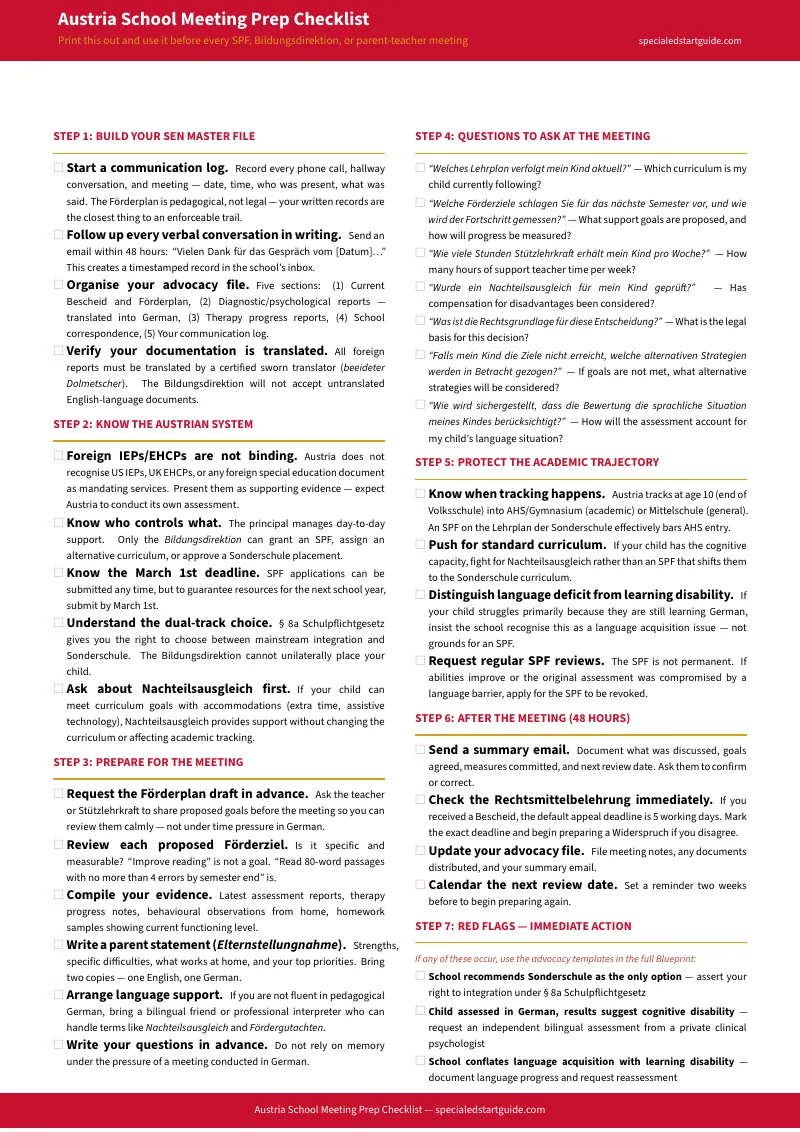
Your download includes 5 PDFs — the complete guide, a printable meeting prep checklist, and three standalone printable tools:
- Complete Blueprint Guide (guide.pdf) — 15 chapters covering the legal foundation, SPF designation process, integration vs. Sonderschule, assessment traps and language bias, Nachteilsausgleich, age-10 tracking, healthcare and diagnostics, regional Bildungsdirektion variations, Widerspruch appeals, school types (public, private, and international), meeting culture, support networks, German-English glossary, documentation system, and 90-day arrival action plan
- Austria School Meeting Prep Checklist (checklist.pdf) — printable 6-step quick-reference covering SEN Master File setup, system orientation, meeting preparation, key questions in German with English translations, tracking protection, post-meeting documentation, key timelines, red flags requiring immediate action, and a contact directory
- German-English Glossary Quick Reference (german-english-glossary.pdf) — all 39 Austrian special education terms across five categories, with plain-English explanations of what each term means in practice — print it and bring it to every meeting
- Bilingual Advocacy Letter Templates (advocacy-templates.pdf) — fill-in-the-blank SPF assessment request letter, Widerspruch appeal letter, and post-meeting follow-up email in German with facing English translations — ready to adapt and submit
- 90-Day Arrival Action Plan (90-day-action-plan.pdf) — week-by-week checklist covering school registration, documentation, network building, SPF initiation, and follow-through for newly arrived families
Instant PDF download. Print the checklist tonight and bring it to your next school meeting.
Money-back guarantee, no time limit. If the Blueprint doesn't change how you navigate your child's education in Austria, email us for a full refund. No questions asked.
Not ready for the full Blueprint? Download the free Austria School Meeting Prep Checklist — a structured quick-reference covering the SPF process, meeting preparation, essential questions in German, tracking protection, and post-meeting documentation. It's enough to walk into your next meeting prepared, and it's free.
Your child has a right to special education support in Austria. The school knows the system. After tonight, so will you.