Your Child's School Bus Stops Coming in June. Nobody Has Told You What Happens in September.
For years, the system held. An IEP reviewed every term. A SENCO who understood the diagnosis. Therapists coordinated through the school. Shadow teachers who knew your child's triggers, routines, and the exact moments when a day could unravel. Then your child entered Grade 11, and somewhere between the EmSAT accommodation deadline and the admissions form for a university you've never visited, someone used the phrase you'd been dreading: "We need to talk about what happens after Grade 12."
What happens after Grade 12 in the UAE is a cliff edge. The structured, federally mandated support of the school system — KHDA inclusion teams, ADEK documented learning plans, the "School for All" guidelines — stops. Not gradually. Not with a handover. It stops the day the student finishes their last exam or turns 18, whichever comes first. The school bus stops coming. The SENCO is no longer on call. The classroom that held everything together for a decade quietly closes its door.
And the adult services landscape your child enters is fragmented, opaque, and built primarily for UAE nationals. If you are an expatriate family — and most private school families in the UAE are — nobody has mapped the post-18 ecosystem for you. Nobody has explained that under Federal Decree-Law No. 41 of 2024, your legal authority to make medical, financial, and residential decisions for your adult child evaporates automatically at age 18 unless you proactively establish guardianship through DIFC Wills, Abu Dhabi courts, or Dubai Courts. Nobody has told you that the vocational centres with the shortest waiting lists require applications 12 to 18 months in advance. Nobody has told you that the Zayed Higher Organization's ATMAH project prioritises Emirati nationals — or that Al Noor's Work Placement program has a multi-year pipeline you need to enter in Grade 10, not Grade 12.
The UAE Post-School Transition Roadmap is the Cliff Edge Planning System — the year-by-year action plan that replaces hundreds of hours of scattered research across KHDA publications, ADEK policies, MOCD directories, and Reddit threads with a single chronological roadmap from Grade 9 to age 21.
What's Inside the Roadmap
The Transition Landscape Decoded
The UAE's inclusive education infrastructure has grown at extraordinary speed — enrollment of students with extra educational needs surged 116% between 2023 and 2024, and the Zayed Authority for People of Determination now serves more than 28,000 beneficiaries. But the post-secondary infrastructure has not scaled to match. This chapter maps the regulatory patchwork — KHDA (Dubai), ADEK (Abu Dhabi), and MOE (Northern Emirates) — so you understand exactly what your school is required to do for transition planning, what it is not required to do, and where the responsibility shifts entirely to you.
The Individual Transition Plan — Your Child's Forward-Looking Roadmap
An IEP manages what your child needs right now. An Individual Transition Plan asks where your child is going after school and what must happen between now and then. This chapter explains when to demand an ITP meeting (Grade 9, not Grade 12), what the three core domains are — postsecondary education, employment, and independent living — and what your school is legally obligated to include. It provides the Grade 9 to Grade 12 timeline your SENCO should be following but probably isn't, plus UAE-specific ITP templates using KHDA and National Unified Classification terminology — not irrelevant American IDEA formats.
Post-Secondary Pathway Comparison Matrices
University. Vocational training. Supported employment. Community programs. Four distinct post-school pathways, each with different eligibility rules, timelines, and costs — and most families don't discover the details until it's too late to apply. This chapter provides side-by-side comparison matrices covering Zayed University, UAE University, American University of Sharjah, NYU Abu Dhabi, and Middlesex University Dubai for the higher education track. Al Noor's multi-year Work Placement pipeline, Manzil Centre in Sharjah, the ZHO ATMAH Project, ASDAN and MyMaximus vocational diplomas for the training track. MOCD's employment platform, sheltered workshops, and supported employment initiatives for the work track. Each matrix details eligibility by emirate, nationality (expatriate versus Emirati), estimated costs, and application timelines.
The Post-18 Legal and Guardianship Roadmap
At exactly 18 years old, UAE law fundamentally changes your legal relationship with your child. Under Federal Decree-Law No. 41 of 2024, automatic parental custody ends at the age of majority. For parents of adults who lack capacity to manage their own affairs, this is not a distant legal abstraction — it means bank accounts may freeze, medical consent becomes complicated, and visa processes stall. This chapter translates the 2024 guardianship reforms into plain-language steps for expatriates: how to establish continuing guardianship through DIFC Wills Registry, Abu Dhabi Judicial Department, or Dubai Courts before the 18th birthday. No US or UK competitor addresses this — because no US or UK competitor has reason to understand UAE personal status law.
Visa, Residency, and Sponsorship for People of Determination
Expatriate families face an additional layer of complexity that Emirati families do not: residency depends on employment visas, and a child with special needs who turns 18 creates a sponsorship question that most families have never considered. Cabinet Resolution No. 65 of 2022 provides a sponsorship exemption for children with special needs — but applying for it requires specific medical documentation from approved facilities. This chapter walks you through the ICP application, the documentation requirements, and the contingency plan if your employment situation changes while your adult child is still dependent.
Disability Benefits Cards and Government Support
The MOCD People of Determination Card (federal), the Sanad Card (Dubai/CDA), the ZHO Card (Abu Dhabi), and the Fazaa Hemam Card (MOI) — four overlapping systems, four different eligibility processes, four different sets of benefits. Each card requires a recent medical report (under one year old) from an approved facility. This chapter details which cards to apply for, in what order, what documentation each requires, and what benefits each unlocks — clearly distinguishing between what nationals receive and what expatriates receive, because most government websites conflate the two.
Financial Planning and Exit Strategy
Adult care is expensive everywhere. In the UAE, where there is no universal state-funded disability support for non-citizens, it is existentially expensive. This chapter covers Special Needs Trust structures, life insurance planning with the trust as beneficiary, estate planning across both UAE and home country jurisdictions, and the repatriation planning framework for families considering a return to their home country — how to ensure the transition milestones achieved in the UAE translate into the receiving country's disability support system.
The Transition Portfolio
Universities, vocational programs, and employers need documentation. Schools produce some of it. Parents must assemble the rest. This chapter lists every document your child needs — updated psycho-educational assessments (less than 2-3 years old), the final IEP and ITP, the Summary of Performance, therapy reports, functional capacity evaluations, a resume with work samples, and recommendation letters — and tells you when to request each one so nothing expires before the applications are submitted.
Who This Roadmap Is For
- Expatriate parents of teenagers (ages 14-18) enrolled in UAE private schools who have been told "we need to discuss post-school options" but received no actionable plan — just a vague conversation and a list of centres nobody at the school has visited
- Parents whose child is on an alternative curriculum pathway (ASDAN, Global Citizen Diploma, bespoke vocational track) and who have discovered that the school's transition planning ends at the school gates
- Parents who searched "transition planning special needs UAE" and found nothing but American IDEA templates, US-specific IEP transition checklists, and resources that reference laws and funding streams with zero applicability in the UAE
- Parents approaching the guardianship cliff — their child turns 18 in the next 12 to 24 months and they have not yet begun the DIFC Wills, ADJD, or Dubai Courts process to maintain legal authority over medical, financial, and residential decisions
- Parents trying to compare post-school options across emirates — Al Noor in Dubai versus ZHO ATMAH in Abu Dhabi versus Manzil in Sharjah — and finding that each centre's website promotes only its own programs with no objective cross-comparison
- Emirati families navigating the intersection of federal support (MOCD welfare, ZHO programs) and private school transition planning — who need to understand eligibility criteria and application timelines for vocational placement and adult service registration
- Expatriate families considering repatriation who need to ensure that UAE-based assessments, IEPs, and transition documents translate into the disability support systems of the UK, US, Canada, or Australia
- Parents whose child is employment-bound rather than university-bound and who need structured internship, job shadowing, and supported employment pathways — not another conversation about university admissions
Why Not Just Use the Free Resources?
The UAE government, NGOs, and schools all publish free transition-related content. Here is why families still arrive at the cliff edge unprepared:
- KHDA and ADEK publish inclusion policies, not transition plans. Their documents mandate that schools facilitate transitions — but they are written for school compliance officers, not for parents. They tell principals what they must do. They do not tell you what to do when the principal hasn't done it. ADEK's published transition documentation is heavily skewed toward Early Education to Primary transitions, offering virtually no prescriptive guidance for the Grade 12 exit.
- MOCD and ZHO websites are service directories, not strategic planners. They tell you what programs exist. They do not explain how to qualify, when to apply, or how to compare options across emirates. The ATMAH vocational project sounds transformative — until you learn it is localised to Abu Dhabi and frequently prioritises Emirati citizens with specific cognitive disabilities. Expatriate parents waste months pursuing pathways they were never eligible for.
- NGO websites promote their own programs exclusively. Al Noor details its Work Placement pipeline. Manzil describes its vocational pathways. Neither provides an objective comparison of all options. And because these centres rely on charitable fundraising, their capacity fluctuates — leaving parents uncertain about guaranteed long-term placement.
- School transition plans end at the school gates. School personnel plan for your child's success inside the institution. They will not arrange post-18 legal guardianship. They will not conduct financial scoping for adult care liabilities. They will not objectively evaluate vocational centres outside their immediate referral network.
- Facebook groups and Reddit threads are emotionally supportive but legally dangerous. A parent's advice about guardianship from 2022 is now dangerously obsolete — Federal Decree-Law No. 41 of 2024 fundamentally changed the legal landscape. A forum recommendation about a vocational centre may reflect a program that has since closed, moved, or changed its eligibility criteria. For the price of a single coffee, you get legally grounded, step-by-step clarity instead of crowdsourced guesswork.
Government sites list what exists. NGOs promote their own programs. Schools plan to the school gates. This Roadmap plans for the rest of your child's life.
— Less Than a Single Therapy Session
A private consultation with a Dubai transition specialist or educational psychologist costs AED 500 to AED 1,000 per hour. A comprehensive psycho-educational assessment — the kind universities and vocational programs require — runs AED 2,000 to AED 5,000. KHDA-approved special education professional development courses cost over AED 4,600. The families who arrive at the Grade 12 cliff without a plan spend thousands in last-minute consulting fees, expedited assessments, and emergency legal filings. This Roadmap gives you the same chronological framework, pathway matrices, and legal checklists — instantly available, for a fraction of one session.
Your download includes the complete 11-chapter guide with 3 appendices, a printable year-by-year checklist, and 5 standalone printable tools — 7 PDFs total:
- Complete Transition Roadmap Guide (guide.pdf) — 11 chapters covering the transition landscape, ITP planning, post-secondary pathway comparison matrices (university, vocational, employment, community programs), the post-18 guardianship roadmap under Federal Decree-Law No. 41 of 2024, visa and residency for People of Determination, disability benefits cards across four systems, financial planning and exit strategy, the transition portfolio, support networks, scenario-specific action plans, and a monitoring routine — plus 3 appendices with contacts, acronyms, and legal references
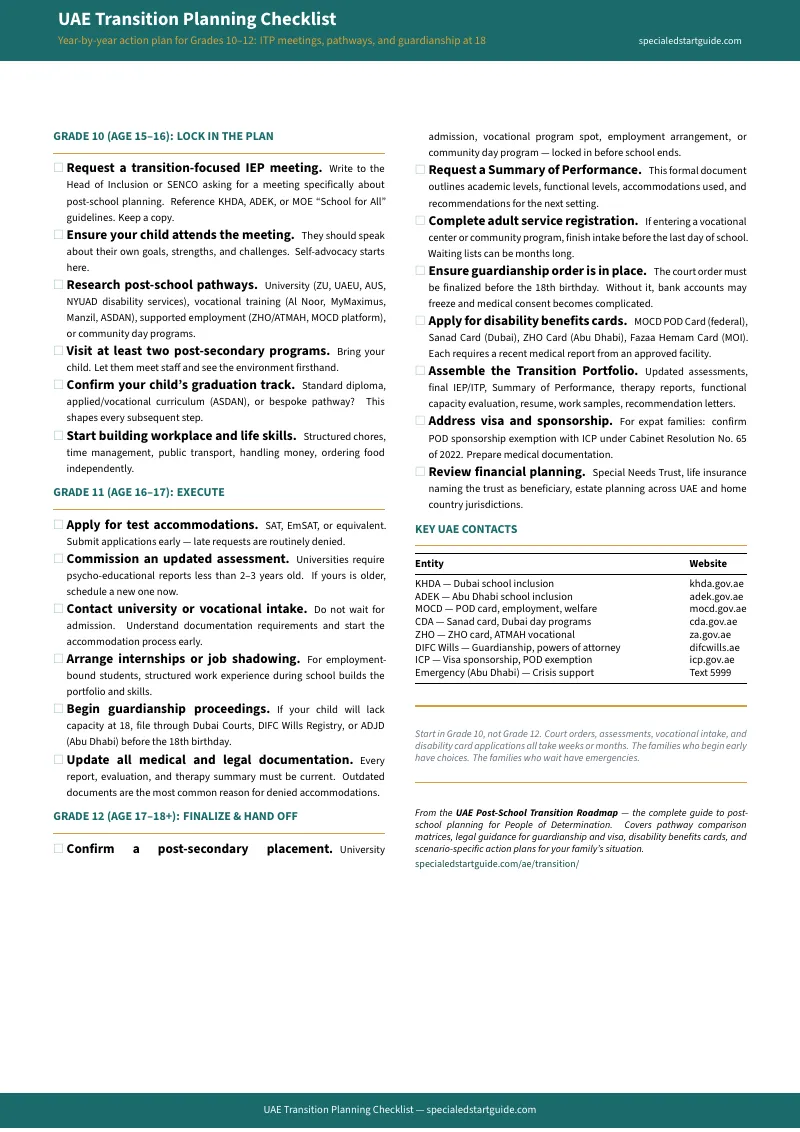
- Year-by-Year Transition Checklist (checklist.pdf) — printable action plan for Grades 10 through 12 with 20 time-sequenced items covering ITP meetings, pathway research, assessment updates, guardianship proceedings, disability card applications, portfolio assembly, visa sponsorship, and financial planning — with key UAE contacts table
- Pathway Comparison Matrix (pathway-matrix.pdf) — single-page landscape reference comparing all 5 post-school pathways (university, ASDAN/vocational school, training centre, supported employment, community day programme) by eligibility, cost, institutions, and emirate availability
- UAE Transition Key Contacts Card (contacts-card.pdf) — one-page reference with every entity you need: school regulators, government services, legal and guardianship bodies, and vocational programme contacts — pin it to your fridge or keep it in your advocacy folder
- ITP Meeting Request Letter (itp-request-letter.pdf) — fill-in letter template to request a transition-focused IEP meeting from your school's Head of Inclusion or SENCO, with checkboxes for KHDA, ADEK, or MOE regulatory frameworks
- Disability Benefits Card Tracker (disability-cards-tracker.pdf) — printable tracker for the 4 UAE disability card systems (MOCD, Sanad, ZHO, Fazaa Hemam) showing required documents, key benefits, and fillable application status columns
- Transition Portfolio Checklist (transition-portfolio-checklist.pdf) — one-page checklist covering all 8 document categories your child needs for university, vocational, or employment intake — medical, educational, functional, work experience, legal, visa, and repatriation readiness
Instant PDF download. Print the checklist tonight and tape it to your wall. Start checking off items tomorrow.
Money-back guarantee, no time limit. If the Roadmap doesn't change how you plan your child's transition in the UAE, email us for a full refund. No questions asked.
Not ready for the full Roadmap? Download the free UAE Transition Planning Checklist — a year-by-year action plan covering Grades 10 through 12 with the critical milestones for ITP meetings, pathway research, guardianship proceedings, and disability card applications. It is enough to understand what needs to happen and when, and it is free.
The school bus stops coming in June. The families who planned early have choices. The families who waited have emergencies. Start planning tonight.