
The District Says No Specialist Exists in Your County. Here's How to Make Them Find One.
You walked into that IEP meeting prepared — or you thought you did. You read the Procedural Safeguards. You brought your child's medical diagnosis. You wrote down your concerns. Then the special education director, the school psychologist, and the classroom teacher pointed to evaluation criteria you couldn't decode, referenced "Chapter 7" like you should know what it means, and told you your child doesn't demonstrate sufficient "adverse educational effect" — even though they struggle every single day.
You left the meeting with a document you didn't fully understand and a feeling that everything had been decided before you sat down. You were right. In Wyoming, the evaluation team must find both a disability under one of 13 eligibility categories AND an adverse educational effect requiring specially designed instruction — and districts routinely use that second prong to deny services for children with clear clinical diagnoses. Nobody at the table explained that your child's private evaluation confirming ADHD, Autism, or a Specific Learning Disability doesn't automatically trigger an IEP. Nobody told you that Wyoming implements IDEA through its own Chapter 7 Rules — a regulatory framework written for compliance officers and district administrators, not parents trying to understand what any of it means for their child.
You live in a state with 48 school districts spread across 97,000 square miles — the least densely populated in the nation. Your child's speech therapist rotates through three counties on a BOCES schedule nobody shares with you. The nearest private evaluator is hours away in Colorado or Montana. Special education attorneys charge $300 to $500 per hour with the closest one operating out of Fort Collins. Private advocates charge $100 to $300 per hour and there are almost none in Wyoming. This is not a collaborative system.
The Wyoming IEP & 504 Blueprint is the Chapter 7 Advocacy System — the enforcement toolkit that bridges the gap between knowing your rights under Wyoming law and actually exercising them at the IEP table, with every template, script, and checklist grounded in Chapter 7 Rules, IDEA, and Section 504.
What's Inside the Blueprint
The Chapter 7 Rules Decoder
Chapter 7 — Services for Children with Disabilities — governs everything: evaluations, eligibility, procedural safeguards, placement, and dispute resolution for all 48 Wyoming school districts. The Blueprint translates every critical section from dense regulatory language into plain-English parental rights, shows you exactly what the evaluation must assess under each of the 13 eligibility categories, and teaches you how to prove "adverse educational effect" when the district says a medical diagnosis isn't enough. This is the decoder that turns Chapter 7 from a wall of bureaucratic text into a tool you control.
BOCES Navigation and Rural Service Delivery
Northwest BOCES, Central Wyoming BOCES, and other regional cooperatives are how most rural districts access specialists — itinerant speech therapists, occupational therapists, behavioral interventionists, and adaptive PE instructors who serve multiple counties on rotation. The Blueprint explains how BOCES works, what services your district can legally access, how to demand contracted specialists when none exist locally, and the specific language that forces the district to find the budget for itinerant therapists or out-of-district placements. Geographic isolation does not legally absolve a district of its federal obligation to provide FAPE.
Copy-Paste Advocacy Templates
Every letter cites the exact Wyoming regulation. Request an evaluation and start the district's 60-calendar-day timeline — a clock that never pauses for breaks, holidays, or summer. Demand Prior Written Notice using the specific language that forces the district to document their refusal in writing. Request an Independent Educational Evaluation at public expense using the phrase that triggers the district's obligation to either fund it or file for due process. Document BOCES service delivery failures. File a WDE State Complaint. These aren't generic federal templates — they're Wyoming enforcement tools that create a legally binding paper trail the moment you hit send.
Teletherapy Rights and Remote Service Quality
When your rural district offers virtual speech therapy through a cost-cutting Zoom session, is that legally compliant? Wyoming has specific rules regarding parental consent for teletherapy, what equivalent virtual service delivery looks like versus an inadequate workaround, and when you can demand in-person services. The Blueprint gives you the documentation that holds the district accountable for remote service quality — because teletherapy is supposed to be a solution, not a budget shortcut.
Wyoming's 60-Calendar-Day Timeline Enforced
Unlike states that measure in school days — pausing the clock for breaks — Wyoming counts calendar days. The 60-day clock starts when the district receives your signed consent, not when you make the referral. After eligibility, the district has 30 more calendar days to develop the IEP. The Blueprint maps every milestone, gives you the specific follow-up language at each checkpoint, and provides the escalation template when the district misses a deadline or presents consent forms in late April hoping summer will stall the process.
The 100% Reimbursement Funding Leverage
Wyoming's post-Campbell County funding model reimburses school districts for 100% of their actual, approved special education costs. This eliminates the "we can't afford it" excuse. But recent HB 0110 silo funding constraints have created budget uncertainty that may affect staffing. The Blueprint gives you the specific language that forces the district to admit that budget is not a legally permissible reason to deny FAPE — and explains why the 100% reimbursement model means your district has no financial excuse for denying services.
Small-Town De-Escalation Strategies
In Wyoming's small towns, challenging the IEP team means challenging your neighbor, your fellow church member, and the parent who coaches your child's sports team. The Blueprint teaches de-escalation through compliance — framing every request as "helping the school meet its state compliance mandates" rather than making personal demands. You learn to use the bureaucracy's own language to enforce Chapter 7 without inciting a personal feud in a community where social survival depends on relationships.
IEP Meeting Scripts and Checklists
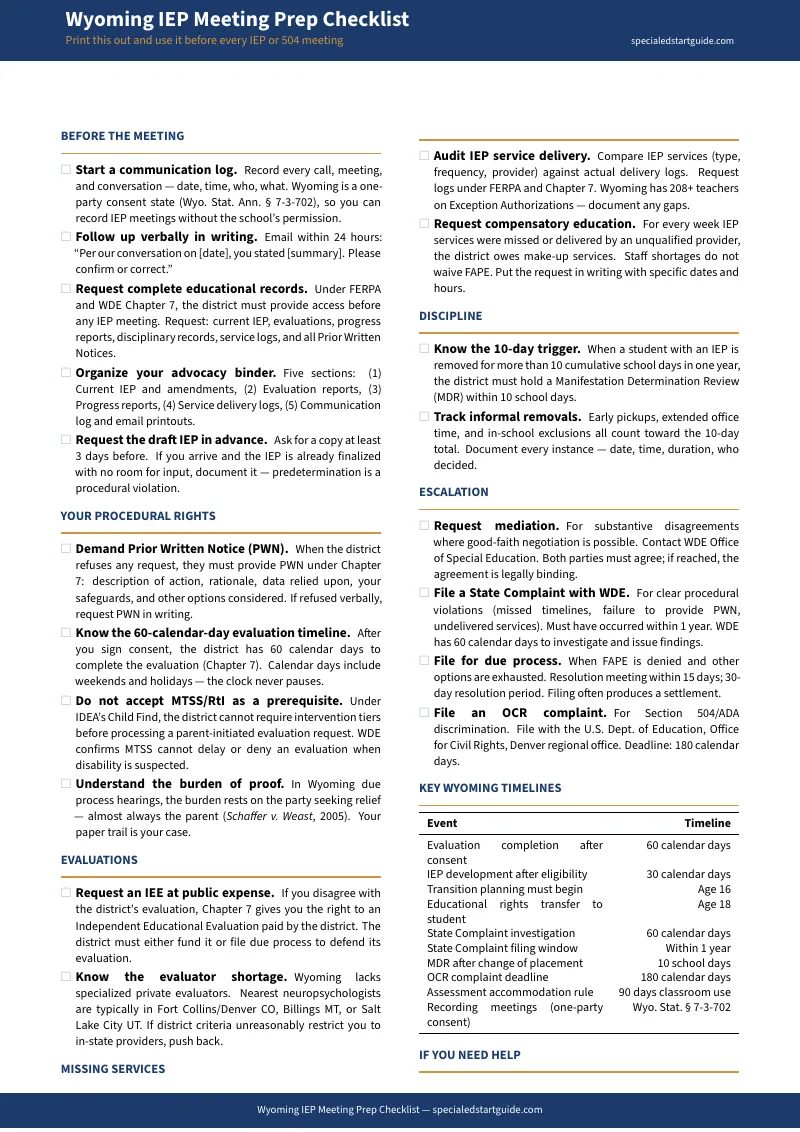
What to say when the team tells you your child doesn't qualify because grades are passing. What to say when they push a 504 instead of an IEP. What to say when the BOCES scheduler claims the specialist isn't available until next semester. Each script cites the Chapter 7 rule or IDEA regulation that proves them wrong — so you're not arguing opinions at the IEP table, you're citing law. The pre-meeting checklist covers Wyoming's one-party consent recording rights under Wyo. Stat. Ann. § 7-3-702 and the specific documents to bring.
Military Family PCS Transfer Procedures
PCSing to F.E. Warren Air Force Base? Wyoming's advance enrollment protocols and 30-day evaluation timeline for transfer students are unfamiliar territory for every incoming military family. The Blueprint covers EFMP coordination, School Liaison Officer resources, and the exact steps to force the receiving district to honor your out-of-state IEP from day one — because your child shouldn't lose services while the district figures out Wyoming's system.
The Dispute Resolution Escalation Ladder
When informal advocacy fails, Wyoming offers formal options: facilitated IEP meetings, formal mediation through WDE, State Complaints to the Office of Special Education, and due process hearings. The Blueprint explains when each option gives you maximum leverage, the timeline and costs involved, and how to build the paper trail that wins — including the fact that WDE State Complaints are free, don't require an attorney, and frequently produce faster results than due process.
Who This Blueprint Is For
- Parents preparing for their first IEP meeting who don't want to walk in blind against a team that does this every day — and who need to understand the Chapter 7 eligibility criteria before they're discussed at the table
- Parents whose child has been pushed into a 504 Plan when they should be receiving specially designed instruction under an IEP — and who were told it's "illegal" to have both
- Parents in Cheyenne navigating Laramie County School District 1 where bureaucratic bottlenecks and standardized policies delay evaluations
- Parents in Casper encountering a district with enough institutional resources to deploy polished resistance to service requests
- Parents in Rock Springs where the WDE recently conducted special monitoring after parents publicly demanded accountability for supervision failures
- Parents in rural Wyoming where the special education director is also the school psychologist, services come through BOCES cooperatives on rotation, and the nearest qualified private evaluator is hours away in Colorado or Montana
- Parents whose child has ADHD, Autism, dyslexia, or anxiety and was told they're "too high-functioning" or "not showing adverse educational effect" — and who need to understand the Chapter 7 criteria that actually apply
- Military families PCSing to F.E. Warren Air Force Base who need their child's out-of-state IEP honored immediately in a system they've never navigated
- Parents in one-room schoolhouse districts where a single educator handles multiple grade levels and your child's accommodations are getting informal, undocumented, and unreliable
- Parents whose child's IEP mandates related services but sessions are being missed because the BOCES rotation hasn't been scheduled — and nobody is offering compensatory services
Why Not Just Use the Free Resources?
Wyoming has genuine free special education resources. WPIC provides workshops and IEP meeting accompaniment. Chapter 7 Rules are online. Protection & Advocacy handles civil rights violations. WIND runs the assistive technology lending library. Here's why parents still struggle after consulting all of them:
- WPIC serves the entire state and operates under a collaborative mandate. Their workshops and meeting accompaniment are genuinely valuable for foundational understanding. But WPIC is institutionally constrained — they cannot offer aggressively adversarial advice or teach you how to trap an administrator in a compliance violation. Their guidance is general enough to maintain those collaborative district relationships. When the IEP meeting is in 48 hours and you need tactical language, not a scheduled workshop — that's the gap this fills.
- Chapter 7 Rules are dense regulatory text written for administrators. They'll tell you the district must provide Prior Written Notice before changing placement. They won't tell you how to write an email that compels an evasive principal to actually issue that notice within an enforceable timeframe. The law is there; the strategy is not.
- Protection & Advocacy focuses on severe civil rights violations. A standard IEP dispute over whether your child gets 60 or 120 minutes of speech therapy per week is unlikely to meet their threshold for direct legal intervention.
- Wrightslaw covers federal law — not Wyoming's Chapter 7. Wrightslaw is the gold standard for IDEA. It does not address Chapter 7 eligibility criteria, BOCES cooperative navigation, Wyoming's 60-calendar-day evaluation timeline, teletherapy rights, or how to file a WDE State Complaint. Use national terminology in a Wyoming school and the district knows immediately you're working from a template that wasn't built for their system.
- Etsy and TPT planners organize paperwork — they don't enforce rights. A pastel IEP binder keeps documents in order. It won't decode Chapter 7, explain why the district is pushing a 504 Plan, or teach you to demand Prior Written Notice.
- Private advocates cost $100–$300 per hour. Attorneys run $300–$500. The nearest ones are in Colorado. Most Wyoming families can't afford $1,500 for a single IEP dispute — and advocates prefer cases where a solid paper trail already exists. The Blueprint is how you build that trail.
The free resources explain what Wyoming law says. The Blueprint gives you the tools to make the district follow it.
— Less Than One Hour of a Special Education Advocate
Special education advocates charge $100–$300 per hour. Attorneys run $300–$500, and in Wyoming, the nearest ones are in Colorado. If you hand an advocate a disorganized pile of papers, you'll spend your first several billable hours paying them to understand your situation. The Blueprint teaches you how to organize the binder, decode the Chapter 7 eligibility criteria, and draft the initial requests — either empowering you to win at the IEP table without an advocate, or saving hundreds in billable hours if you do hire one.
Your download includes a comprehensive 21-chapter Blueprint guide plus 8 standalone printable tools — advocacy letter templates, IEP meeting scripts, a timeline cheat sheet, a 504 vs. IEP decision matrix, a dispute resolution roadmap, an IEP goal tracking worksheet, a Chapter 7 eligibility decoder, and an IEP Meeting Prep Checklist. Every template is formatted so you can type directly into it or copy the text into an email, each citing the exact Chapter 7 or IDEA citation that triggers a legal obligation.
Instant PDF download. Print the templates tonight. Walk into tomorrow's IEP meeting with Chapter 7 on your side.
Money-back guarantee, no time limit. If the Blueprint doesn't change how you approach IEP meetings in Wyoming, email us for a full refund. No questions asked.
Not ready for the full Blueprint? Download the free Wyoming IEP Meeting Prep Checklist — a printable pre-meeting checklist with Wyoming timelines, Chapter 7 citations, one-party consent recording rules, and red flags that require immediate action. It's enough to walk into your next meeting prepared, and it's free.
Your child's education is a legal right, not a favor. The district knows Chapter 7. After tonight, so will you.