The IEP Was Already Drafted Before You Walked In. Here's How to Change That.
You walked into that IEP meeting prepared — or you thought you did. You read the Procedural Safeguards. You brought your child's private evaluation. You wrote down your concerns. Then six district professionals used acronyms you'd never heard, pointed to PI 11 eligibility criteria you couldn't decode, and slid a pre-drafted IEP across the table. They told you everything was "in compliance."
You left the meeting with a document you didn't fully understand and a feeling that everything had been decided before you sat down. You were right. In Wisconsin, the evaluation team must find both a disability under PI 11.36 AND an "educational impact" requiring specially designed instruction — and districts routinely use that second prong to deny services for children with clear clinical diagnoses. Nobody at the table explained that your child's private neuropsychological evaluation confirming Autism, ADHD, or a Specific Learning Disability doesn't automatically trigger an IEP. Nobody told you that Wisconsin has its own model form system — Form I-4 for the IEP, Form ER-1 for evaluation reports, Form M-1 for Prior Written Notice — and that each form has specific requirements the district must follow.
The problem isn't that you're uninformed. The problem is that Wisconsin special education runs on a regulatory framework — Chapter 115 for the legal architecture, PI 11 for granular implementation — that was built to be navigated by administrators, not parents. Over 126,800 Wisconsin students have IEPs, and the system is structurally underfunded at a 35% reimbursement rate for public schools. Special education attorneys charge $300 to $500 per hour with retainers starting at $1,500 to $5,000. Private advocates charge $100 to $300 per hour. This is not a collaborative system.
The Wisconsin IEP & 504 Blueprint is the PI 11 Advocacy System — the enforcement toolkit that bridges the gap between knowing your rights under Wisconsin law and actually exercising them at the IEP table, with every template, script, and checklist grounded in Chapter 115, PI 11, and IDEA.
What's Inside the Blueprint
The PI 11 Eligibility Decoder
PI 11.36 defines Wisconsin's 13 disability categories, each with its own specific evaluation criteria and its own DPI model form — ER-1-AUT for Autism, ER-2-A for Specific Learning Disability, ER-1-EBD for Emotional Behavioral Disability, ER-1-OHI for Other Health Impairment. The Blueprint translates every category from administrative code into plain language, shows you exactly what each evaluation form requires, and teaches you how to prove "educational impact" when the district says a medical diagnosis isn't enough. This is the decoder that turns PI 11.36 from a wall of regulatory text into a tool you control.
DPI Model Form Walkthroughs
Form I-4 (IEP), Form ER-1 (Evaluation Report), Form ED-1 (Existing Data Review), Form P-1 (Placement), Form M-1 (Prior Written Notice), Form I-7 (Testing Accommodations) — the Blueprint walks you through every section of every form, explains what the district is required to document, and shows you what to challenge when the written form doesn't match what was discussed at the meeting. Wisconsin is the only state that uses this form numbering system. Generic IEP guides don't know these forms exist.
Copy-Paste Advocacy Templates
Every letter cites the exact Wisconsin regulation. Request an evaluation and start the district's 15-business-day review clock followed by 60 calendar days to complete the evaluation. Demand Prior Written Notice on Form M-1 using the specific language that forces the district to document their refusal in writing. Request an Independent Educational Evaluation at public expense using the phrase that triggers the district's obligation to either fund it or file for due process. Document service delivery failures. File a DPI State Complaint. These aren't generic federal templates — they're Wisconsin enforcement tools that create a legally binding paper trail the moment you hit send.
Act 20 Dyslexia Screening Bridge
Wisconsin's sweeping early reading legislation (Act 20) now mandates universal screening, and parents are receiving "at-risk" reading notifications without understanding their rights. When your child's screening data shows reading risk, can the school keep running interventions indefinitely? Or does it trigger a right to a full Specific Learning Disability evaluation under PI 11.36(6)? The Blueprint gives you the decision flowchart, the regulatory citations connecting Act 20 screening to SLD evaluation criteria, and the advocacy scripts to force a comprehensive evaluation when the school insists interventions alone are sufficient.
Wisconsin's Unique Timelines Enforced
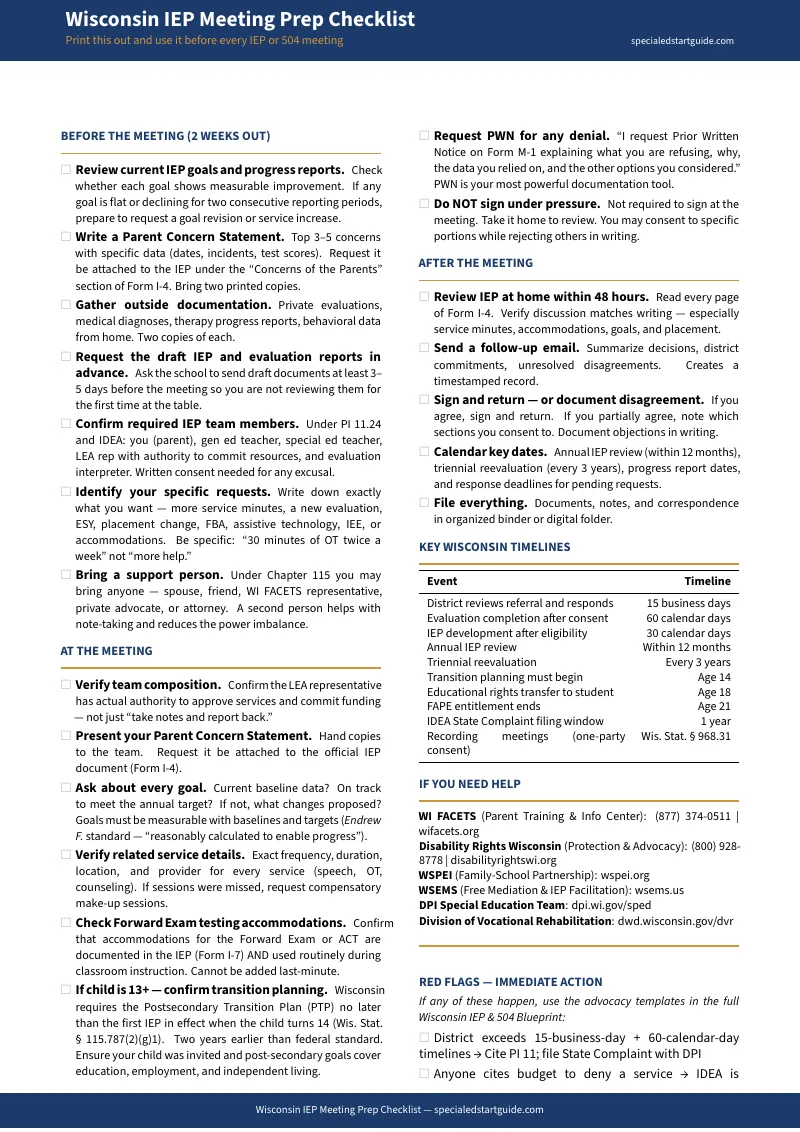
The 15-business-day referral review window. The 60-calendar-day evaluation completion deadline after signed consent. The 30-day IEP development requirement after eligibility determination. The Blueprint maps every milestone, gives you the specific follow-up language at each checkpoint, and provides the escalation template when the district misses a deadline. Generic guides say "60 days for evaluation" — that's only partially correct for Wisconsin. The 60-day clock starts when the district receives your signed consent, not when you make the referral. And before consent is even requested, there's a separate 15-business-day window. Those two distinct timelines trip up parents constantly.
Age 14 Transition Planning — Two Years Earlier Than Federal Law
Wisconsin requires the Postsecondary Transition Plan by age 14 under Wis. Stat. § 115.787(2)(g)1, while the federal standard is 16. Most districts don't mention this, and many parents learn about the requirement after the window has passed. The Blueprint covers DPI's web-based PTP application, connecting with the Division of Vocational Rehabilitation, IRIS and Family Care enrollment at age 17.5, and preventing the district from defaulting to a generic transition template.
IEP Meeting Scripts and Checklists
What to say when the team tells you your child doesn't qualify because grades are passing. What to say when they push a 504 instead of an IEP. What to say when the LEA representative claims they can't add service minutes "because of staffing." Each script cites the PI 11 or Chapter 115 regulation that proves them wrong — so you're not arguing opinions at the IEP table, you're citing law. The pre-meeting checklist covers Wisconsin's one-party consent recording rules under Wis. Stat. § 968.31, required IEP team composition under PI 11.24, and the specific documents to bring.
The Dispute Resolution Escalation Ladder
When informal advocacy fails, Wisconsin offers formal options: IEP Facilitation through WSEMS, formal mediation through WSEMS, DPI State Complaints (triggering a 60-day investigation), and due process hearings through the Division of Hearings and Appeals. The Blueprint explains when each option gives you maximum leverage, the timeline and costs involved, and how to build the paper trail that wins — including the fact that DPI State Complaints are free, don't require an attorney, and frequently produce faster results than due process.
Who This Blueprint Is For
- Parents preparing for their first IEP meeting who don't want to walk in blind against a team that does this every day — and who need to understand the PI 11 eligibility criteria before they're discussed at the table
- Parents whose child has been pushed into a 504 Plan or a non-binding Student Support Plan when they should be receiving specially designed instruction under an IEP
- Parents in Milwaukee navigating MPS where high staff turnover means case managers change yearly and seclusion/restraint incidents are disproportionately high for students with IEPs
- Parents in the WOW Counties (Waukesha, Ozaukee, Washington) encountering affluent districts that know the law well enough to use it defensively
- Parents in Madison where MMSD has reported being short 90 paraprofessionals, leaving high-needs students unsupported in general education classrooms
- Parents in rural Wisconsin where the special education coordinator is also the school psychologist and specialized services like speech therapy may not be locally available
- Parents whose child has ADHD, autism, dyslexia, or anxiety and was told they're "too high-functioning" or "not showing educational impact" — and who need to understand the PI 11.36 criteria that actually apply
- Parents whose child received an Act 20 "at-risk" reading notification and wants to know whether this triggers a right to a full SLD evaluation under PI 11.36(6)
- Parents whose child's IEP mandates speech therapy or OT but sessions are being missed and nobody is offering compensatory services
Why Not Just Use the Free Resources?
Wisconsin has substantial free special education resources. DPI publishes "Special Education in Plain Language." WI FACETS provides workshops, a helpline, and IEP Mini-Modules. WSPEI coordinates Family Engagement through 12 CESAs. Disability Rights Wisconsin handles systemic violations. Here's why parents still struggle after consulting all of them:
- WI FACETS serves the entire state and demand exceeds capacity. Their workshops and helpline are genuinely excellent for foundational understanding. But parents report wait times for individual assistance during crisis moments. Their delivery model relies on scheduled webinars and multi-part video modules — not the immediate tactical guidance you need when the IEP meeting is tomorrow. They also operate under a collaborative mandate and cannot provide aggressive advocacy scripts for when collaboration has already failed.
- DPI's "Special Education in Plain Language" is 70 pages of regulatory text. With a 10-page supplement just to update broken links from the previous version. It's structured as a compliance reference for administrators, not an operational playbook for a parent whose child was just denied eligibility. It explains what PI 11 says — it does not give you fill-in-the-blank templates for enforcing it.
- WSPEI coordinators promote collaboration — they can't teach you to fight. The 12 CESA-based Family Engagement Coordinators are funded to facilitate family-school partnerships. They explain your rights. They do not provide the enforcement language you need when the district has already refused your evaluation request.
- Disability Rights Wisconsin handles severe systemic violations, not routine IEP disputes. DRW is essential for litigation-level cases. They do not provide the day-to-day advocacy templates, meeting scripts, and form walkthroughs that most parents need before escalation becomes necessary.
- Wrightslaw covers federal law — not Wisconsin's PI 11. Wrightslaw is the gold standard for IDEA. It does not address PI 11.36 eligibility criteria, the DPI model form numbering system, the 15-business-day referral timeline, Act 20 screening data, or the WSEMS dispute resolution system. Use national terminology in a Wisconsin school and the district knows immediately you're working from a template that wasn't built for their system.
- Etsy and TPT planners organize paperwork — they don't enforce rights. A pastel IEP binder helps keep documents in order. It won't decode PI 11.36, explain why the district is pushing a Student Support Plan, or teach you to demand Prior Written Notice on Form M-1.
- Private advocates cost $100–$300 per hour. Attorneys run $300–$500. Most families can't afford $500 for a single IEP meeting — and advocates prefer cases where a solid paper trail already exists. The Blueprint is how you build that trail.
The free resources explain what Wisconsin law says. The Blueprint gives you the tools to make the district follow it.
— Less Than One Hour of a Special Education Advocate
Special education advocates in Wisconsin charge $100–$300 per hour. Private attorneys run $300–$500. If you hand an advocate a disorganized pile of papers, you'll spend your first several billable hours paying them to understand your situation. The Blueprint teaches you how to organize the binder, decode the PI 11.36 criteria, and draft the initial requests — either empowering you to win at the IEP table without an advocate, or saving hundreds in billable hours if you do hire one.
Your download includes 9 PDFs — the complete Blueprint guide plus 8 standalone printable tools, each ready to print and bring to your next IEP meeting.
- Complete Blueprint Guide (56 pages) — 14 chapters covering the Wisconsin special education landscape, IEP vs. 504 decision framework, PI 11.36 eligibility criteria decoded, DPI model form walkthroughs, Wisconsin's three-stage evaluation timeline, Act 20 and dyslexia screening, advocacy letter templates, IEE strategy, age-14 transition planning, Extended School Year eligibility, discipline protections, dispute resolution, documentation systems, and Wisconsin advocacy resources
- IEP Meeting Prep Checklist — the before/during/after checklist with Wisconsin timelines, PI 11 citations, one-party consent recording rules, and red flags requiring immediate action
- Advocacy Letter Templates — 6 copy-paste letters citing Chapter 115 and PI 11: evaluation request, Prior Written Notice demand (Form M-1), post-meeting follow-up, IEE request at public expense, service delivery failure documentation, and DPI State Complaint narrative
- IEP Meeting Scripts — 11 word-for-word responses to common district pushback ("grades are passing," "no educational impact," "more RTI first," "staffing limitations") plus before/during/after meeting checklists
- PI 11 Eligibility Decoder — all 13 disability categories with their PI 11.36 section numbers and ER form designations, plus diagnosis-to-eligibility bridging strategies for ADHD, Autism, Anxiety/Depression, and Dyslexia
- Timeline Cheat Sheet — every Wisconsin deadline on one fridge sheet: 15-business-day referral review, 60-calendar-day evaluation, 30-day IEP development, age-14 transition, age-17.5 IRIS/Family Care, plus all DPI form numbers
- 504 vs. IEP Comparison Matrix — side-by-side comparison across 8 dimensions with a 3-step decision flowchart and the Student Support Plan warning
- Dispute Resolution Roadmap — the 4-step escalation ladder from WSEMS IEP Facilitation through due process, with timeline, cost, and binding status for each option
- IEP Goal Tracking Worksheet — fillable tracker for measurable annual goals, service delivery logging, progress monitoring, and short-term objectives aligned to Form I-4
Instant PDF download. Print the templates tonight. Walk into tomorrow's IEP meeting with Chapter 115 and PI 11 on your side.
Money-back guarantee, no time limit. If the Blueprint doesn't change how you approach IEP meetings in Wisconsin, email us for a full refund. No questions asked.
Not ready for the full Blueprint? Download the free Wisconsin IEP Meeting Prep Checklist — a printable pre-meeting checklist with Wisconsin timelines, PI 11 citations, required team composition, one-party consent recording rules, and red flags that require immediate action. It's enough to walk into your next meeting prepared, and it's free.
Your child's education is a legal right, not a favor. The district knows PI 11. After tonight, so will you.