They Have a Legal Team. You Have This Playbook.
Your child's Wisconsin school district has a special education director trained in PI 11 compliance, district legal counsel, and five people at every IEP meeting who already agreed on the outcome before you sat down. You have a folder of confusing paperwork, a FACETS voicemail you're still waiting to hear back from, and the sinking feeling that asking questions makes things quietly worse for your kid.
The Wisconsin IEP & 504 Advocacy Playbook is the first Wisconsin-specific dispute resolution toolkit built for parents who have already hit the wall — the district said no, services aren't being delivered, and you need to know exactly what to write, who to send it to, and which PI 11 and Chapter 115 citations trigger a legal obligation the district cannot ignore.
Why Wisconsin Parents Need State-Specific Tools
Generic advocacy guides say "check your state's timelines." Wrightslaw covers federal law but doesn't mention PI 11 or Chapter 115. Etsy templates use collaborative language designed for minor teacher communications — not for a district that has already refused your evaluation request or stopped delivering the therapy your child's IEP promises.
Wisconsin is different. Your state reimburses districts only 27% to 35% of special education costs under its categorical aid model — meaning your district absorbs the majority of funding from its general budget. When they tell you they "can't afford" a service, that financial pressure is real, but the law says FAPE must be provided regardless of budget constraints. Wisconsin uses a 60-day evaluation timeline triggered when you sign consent. You live in a one-party consent state under Wis. Stat. §968.31, which means you can record IEP meetings without asking permission. And you can file a DPI state complaint using Form PI-2117 that triggers a formal investigation — if you know the right Chapter 115 and PI 11 citations.
This playbook knows them all.
What's Inside
- Prior Written Notice demand letters — the single most powerful tool parents never use. When the district refuses anything verbally, these letters force them to explain every denial in writing under Wis. Stat. §115.792 using DPI Form M-1. Written reasoning can be challenged. Verbal "no" cannot.
- DPI state complaint templates with PI 11 and Chapter 115 citations pre-loaded — not a link to the PI-2117 form, but a tactical guide showing who to name, what to allege, what evidence to attach, and how to structure the narrative so DPI opens a formal investigation rather than filing your letter away.
- IEE demand letters for Wisconsin's specialist shortage — the exact language that forces the district to either fund your Independent Educational Evaluation or file for due process to defend their own. Includes guidance for requesting evaluators through CESAs or private providers when district staff are overwhelmed.
- The underfunding argument decoded — a ready-to-cite breakdown of Wisconsin's categorical aid model showing why "we can't afford it" is never a legal excuse for denying FAPE, even when the state reimburses only 35% of costs.
- Compensatory education templates for the staffing crisis — letters demanding recovery of every therapy minute lost because the OT position has been vacant since October, the SLP carries a caseload of 80, or the specially designed instruction minutes on your child's IEP simply aren't being delivered.
- Discipline protections and MDR preparation — the 10-day removal trigger, the two questions the MDR team must answer using DPI Form I-12, informal removal tracking, FBA requirements, Wis. Stat. §118.305 seclusion and restraint rules, and documentation that prevents disability-related pushout.
- Seclusion and restraint documentation system — incident tracking templates built on Wis. Stat. §118.305 (2019 Act 118), covering mandatory parent notification timelines, the second-incident IEP reconvening requirement, and the evidence format DPI complaint investigators need.
- One-party consent recording guidance — how to use Wisconsin's recording law under Wis. Stat. §968.31 strategically, when to announce a recording to change the meeting's tone, and how to preserve audio evidence for complaints.
- Regional advocacy strategies for MPS, MMSD, WOW counties, and rural Wisconsin — because fighting Milwaukee Public Schools' systemic noncompliance requires different tools than challenging a rural district where the principal is your neighbor.
- Due process hearing preparation — the burden of proof reality under Schaffer v. Weast, the resolution session rules most parents walk into blind, and how to organize a case when special education attorneys in Wisconsin are scarce and expensive.
Who This Is For
Parents who have already tried asking nicely. The district refused to evaluate. The IEP meeting was an ambush. Services aren't being delivered. Your child was disciplined for disability-related behavior. You disagreed with the evaluation and got stonewalled on an IEE. You called FACETS and their help desk — genuinely dedicated — is stretched thin serving the entire state. You called Disability Rights Wisconsin and your case didn't meet their priority criteria. You downloaded the DPI Procedural Safeguards and found regulatory language that explains your rights in theory but doesn't tell you what to put in the email you need to send tomorrow.
If you're in Milwaukee dealing with MPS's systemic compliance failures, Madison navigating MMSD's bureaucratic grievance layers, Waukesha County fighting budget-driven service fading, or a rural district where there's no advocate within 100 miles — you need the same legal tools. This playbook provides them.
Why Not Free Resources?
WI FACETS is excellent — this playbook doesn't replace them. But FACETS is a collaborative organization serving all of Wisconsin. During acute crises, wait times can be long. Their workshops teach rights comprehensively, but their federal funding mandate prevents them from providing adversarial demand letters with PI 11 citations pre-loaded. The DPI publishes Chapter 115 and PI 11 regulations, sample forms, and procedural safeguards — regulatory documents written for compliance officers, not for a parent who needs to send a dispute letter by morning. WSPEI provides relationship-building tools for parents and educators — invaluable when the district is cooperative, useless when they're stonewalling. Disability Rights Wisconsin provides direct legal advocacy, but only for cases meeting their targeted priority criteria.
This playbook translates the legal authority those organizations teach into operational tools you can use tonight.
What About an Attorney?
You may ultimately need one. Professional special education advocates in Wisconsin charge $150–$200 per hour, and attorneys charge $250–$700 per hour. A typical dispute requires 10–15 hours of professional time, running $1,500–$2,250 before you even reach due process. This playbook teaches you to build the documented paper trail from day one. The DPI state complaint process alone resolves many disputes without reaching due process. And if you do hire counsel later, they inherit a case-ready file instead of performing basic administrative triage at premium hourly rates.
The Guarantee
Money-back guarantee, no time limit. If the playbook doesn't change how you handle your child's special education disputes, you get a full refund. No questions.
— Less Than One Hour of the Advocate You Can't Get
Your child's district is counting on you not knowing what to write. The playbook fixes that — tonight.
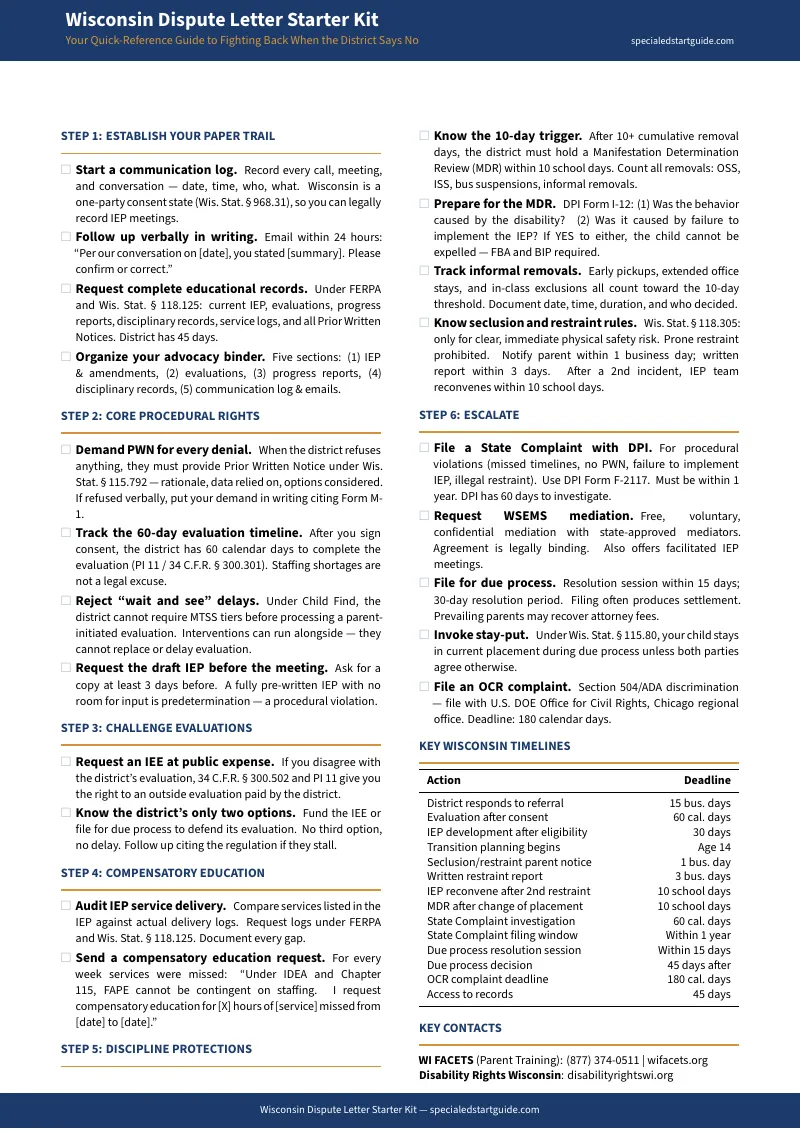
Download includes 7 PDFs: 13-chapter advocacy guide, 6 advocacy letter templates (evaluation request, PWN demand, compensatory education, IEE request, post-meeting follow-up, seclusion/restraint incident), DPI state complaint builder with modular violation paragraphs, timeline cheat sheet, seclusion & restraint incident tracker, dispute resolution roadmap, and the Dispute Letter Starter Kit.