Your Child's School Just Said No. Now What?
You requested an evaluation. The special education director said they'd "look into it." You asked for more speech therapy minutes. The IEP team said staffing doesn't allow it. You questioned why your child's aide was removed. The LEA representative told you the district "reevaluated the need." Every denial came verbally — nothing in writing, nothing you can challenge, nothing that creates accountability.
This is how Virginia's special education system is designed to work. Not for your child — for the district's budget. Parents who rely on verbal promises, cooperative relationships, and good faith lose. Parents who cite 8 VAC 20-81 in writing and demand Prior Written Notice for every refusal create a paper trail that divisions cannot ignore — because that paper trail is what VDOE compliance investigators, hearing officers, and federal OCR reviewers actually read.
Over a recent multi-year period, Virginia parents prevailed in only 1.5% of due process hearings statewide — 13 out of 847. In Northern Virginia, that rate dropped to 0.75%. Eighty-three percent of Virginia's hearing officers never ruled in a parent's favor over an 11-year span. By the time a dispute reaches a hearing, the outcome is nearly predetermined. The fight is won or lost months earlier — in the demand letters you send, the Prior Written Notice you force, and the procedural violations you document before the district's legal team ever gets involved.
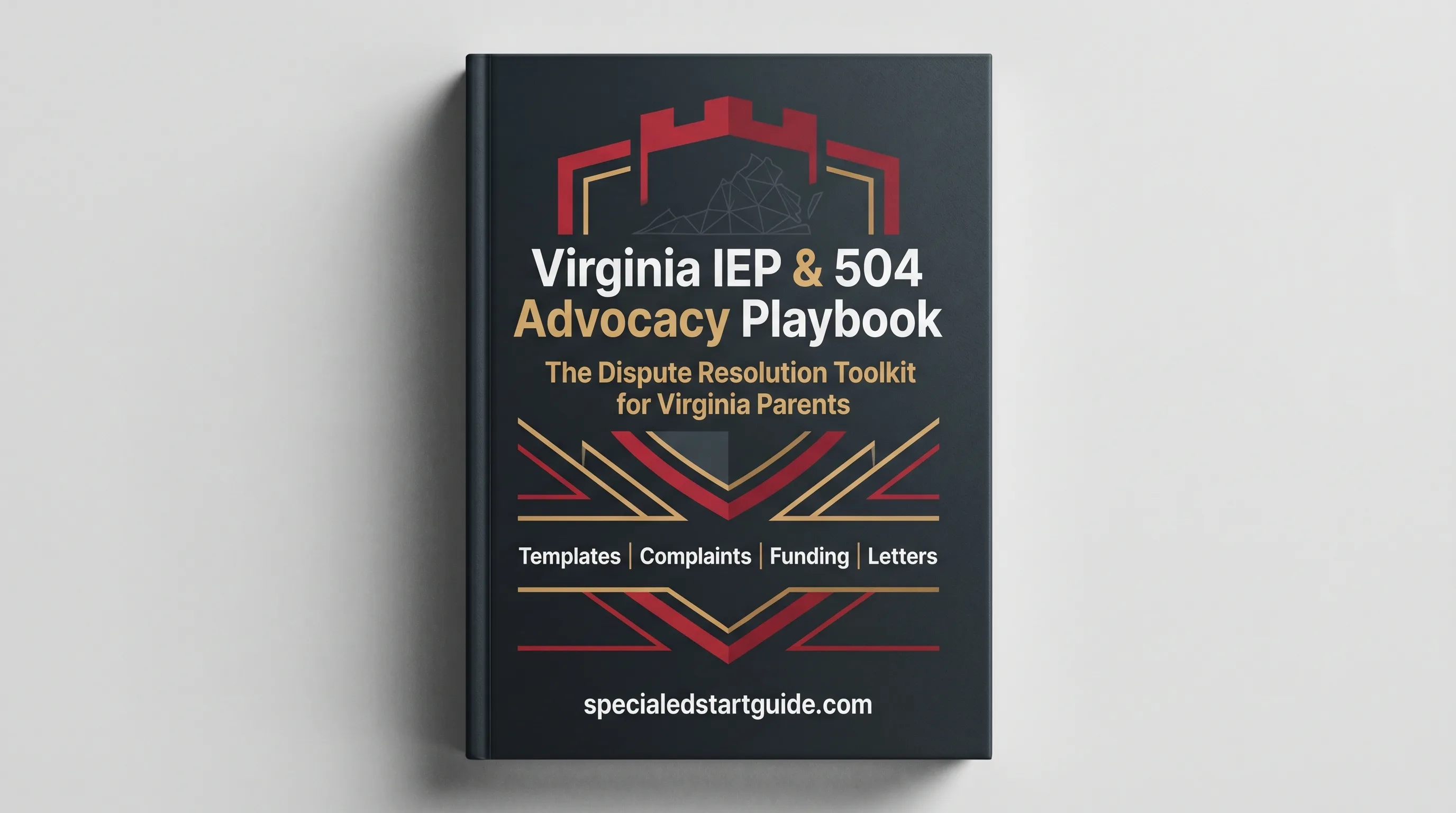
The Virginia IEP & 504 Advocacy Playbook is the Dispute Documentation System — the tactical toolkit that turns verbal denials into written records, missed deadlines into state complaints, and vague IEP promises into enforceable obligations, with every template anchored in 8 VAC 20-81 and Fourth Circuit case law.
What's Inside the Playbook
The Prior Written Notice Enforcement Kit
Prior Written Notice under 8 VAC 20-81-170 is the single most powerful procedural tool available to Virginia parents — and the one districts work hardest to avoid issuing. When a school verbally denies your request for an evaluation, a service, a placement change, or an IEE, the PWN demand letter forces them to put the refusal in writing: what was refused, why, what data they relied on, and what alternatives they considered. Districts hate PWN requests because they create the exact paper trail that wins state complaints. The Playbook gives you the copy-paste template that triggers this obligation — fill in the blanks, attach to an email, and the division's legal clock starts ticking.
The VDOE State Complaint Filing Guide
State Complaints to the VDOE Office of Dispute Resolution and Administrative Services are free, don't require an attorney, and frequently produce faster results than due process hearings. But most parents don't know how to file one effectively. The Playbook provides the complaint template with the exact format VDOE investigators expect — chronological timeline of events, specific 8 VAC 20-81 regulations violated, supporting documentation references, and proposed corrective actions including compensatory education hours. VDOE has 60 days to investigate and issue a Letter of Finding.
The Compensatory Education Calculator
When your child's IEP services weren't delivered — the speech therapist position was vacant for three months, the aide was pulled for testing season, the behavioral support hours were cut without an IEP meeting — you are entitled to compensatory education. Not "make-up" sessions at the district's convenience, but additional services designed to put your child back where they would have been if the IEP had been implemented. The Playbook shows you how to calculate hours owed, document the gap, and submit the formal request that districts cannot deflect with vague promises to "increase services next quarter."
The Children's Services Act (CSA) and FAPT Navigation Roadmap
Virginia has a unique state-level funding mechanism that most parents never learn about. When an IEP team determines that the public school cannot meet your child's needs and a private therapeutic day placement is required, the Children's Services Act pools state and local funds to pay for that placement. But accessing CSA funds requires navigating a local Family Assessment and Planning Team (FAPT) meeting and Community Policy and Management Team (CPMT) approval — an extra bureaucratic layer that schools use to delay or deny placements they've already agreed are necessary. The Playbook demystifies this process and gives you the documentation to push through the FAPT bottleneck.
The Military PCS Transfer Protocol
Virginia hosts one of the largest military populations in the country — Norfolk Naval Station, Quantico, Fort Belvoir, Joint Base Langley-Eustis, the Pentagon. When your family PCSes to Virginia with an active IEP, the receiving division must provide "comparable services" immediately under MIC3 and 8 VAC 20-81-120. "Comparable" does not mean "we'll evaluate your child first and then decide." The Playbook gives you the exact documentation to bring from your last duty station, the transfer demand letter that cites the specific Virginia regulation, and the escalation template when the receiving school stalls.
The Due Process Hearing Preparation Framework
If your dispute escalates beyond state complaints and mediation, due process is the final administrative remedy. The Playbook doesn't replace an attorney — but it gives you the preparation framework that attorneys charge thousands to build: organizing your evidence binder, identifying the specific FAPE denial, preparing your witness list, and understanding how Fourth Circuit precedent shapes hearing outcomes in Virginia. Whether you represent yourself or hire counsel, this framework ensures you walk in prepared.
Who This Playbook Is For
- Parents whose IEP requests have been denied verbally and who need to force the district to put refusals in writing — creating the paper trail that wins state complaints
- Parents whose child's IEP services are not being delivered due to staffing shortages, schedule changes, or administrative neglect — and who need to document the gap and demand compensatory education
- Parents in Fairfax, Prince William, Loudoun, Virginia Beach, or Richmond whose districts have legal teams that outmatch individual families — and who need the same procedural citations those attorneys use
- Parents in rural Southwest Virginia, Southside, or the Shenandoah Valley where there is no local special education attorney and the nearest advocate is 90 minutes away
- Military families who just PCSed to a Virginia installation and are watching the receiving school dismantle their child's IEP under the guise of "our own evaluation process"
- Parents navigating discipline disputes — suspensions, restraint, seclusion, manifestation determination reviews — who need to understand the 10-day rule and MDR process under Virginia law
- Parents whose child needs a private therapeutic day placement but whose district claims it "can't afford" the placement — and who don't know about CSA funding through FAPT
- Parents who have already used the Virginia IEP & 504 Blueprint and now need the advanced dispute resolution and advocacy tools
Why Free Resources Won't Get You Through a Dispute
Virginia has genuinely excellent free resources. PEATC's Complaint Toolkit and Dispute Resolution Guide are well-written. The VDOE Family Guide explains the law clearly. The dLCV publishes sharp legal fact sheets. Here's why parents still lose disputes after reading all of them:
- PEATC is an impartial educator, not your advocate. Their federal funding requires them to explain the system — not to teach you how to fight it. Their workshops happen on scheduled dates. Your IEP dispute is happening now. Their templates exist but remain somewhat generic to avoid crossing into legal counsel. When a Fairfax County administrator hands you a pre-written IEP and asks you to sign, PEATC's brochure on "collaborative IEP meetings" isn't going to help.
- VDOE is the agency your complaint goes to — not your ally. The VDOE Family Guide explains what the law requires. It does not tell you what to do when the district ignores the law. OSEP investigations have found that VDOE itself has failed to properly monitor local divisions or enforce corrective actions. The agency that accepts your state complaint is the same agency that parents' advocacy groups have accused of systemic under-enforcement.
- The dLCV takes systemic cases, not standard IEP disputes. The disAbility Law Center of Virginia is the state's Protection & Advocacy organization. They do critical work. But they prioritize cases with broad systemic impact — they simply cannot serve as individual counsel for the thousands of IEP disputes occurring across 131 divisions.
- Wrightslaw is federal law — not 8 VAC 20-81. Wrightslaw is the gold standard for understanding IDEA theory. It does not cover Virginia's 65-business-day timeline traps, CSA/FAPT private placement funding, VDOE-specific complaint procedures, or Fourth Circuit case law that shapes every hearing officer decision in the Commonwealth.
- Private advocates cost $100–$300 per hour. Attorneys run $344–$700. A due process case in Northern Virginia can exceed $30,000. Most families can't afford a retainer — and advocates prefer clients who already have a solid paper trail. The Playbook is how you build that trail.
The free resources explain what Virginia law says. The Playbook gives you the enforcement tools to make the district follow it — or document their refusal so VDOE has no choice but to act.
— Less Than 15 Minutes of a Special Education Attorney
Special education attorneys in Northern Virginia charge $344 to $700 per hour. Even a brief initial consultation can cost more than this entire Playbook. Private advocates charge $100 to $300 per hour — and the first thing they do is ask for your paper trail. If you don't have one, you're paying them to build what the Playbook teaches you to build yourself.
Your download includes the complete Advocacy Playbook guide plus 7 standalone printable PDFs — every dispute template, demand letter, complaint form, and reference card, ready to print and send tonight.
- Complete Advocacy Playbook Guide — 12 chapters covering procedural safeguards, Prior Written Notice enforcement, the 65-business-day defense, IEE demands, CSA/FAPT private placement funding, military PCS transfers under MIC3, manifestation determination reviews, compensatory education, state complaints, mediation, due process preparation, and Virginia advocacy resources
- Advocacy Letter Templates — 9 ready-to-send letters citing 8 VAC 20-81: evaluation requests, PWN demands, IEE requests, military transfer letters, CSA/FAPT referrals, VDOE state complaints, and meeting follow-ups
- IEP Meeting Scripts — word-for-word responses for when the division denies services, pushes a 504 instead of an IEP, presents a predetermined document, pressures you to sign, or claims resource limitations
- Dispute Resolution Roadmap — side-by-side comparison of State Complaints, mediation, and due process with Virginia-specific timelines, filing procedures, and realistic success rates
- Virginia Timeline Cheat Sheet — every legal deadline on one page: the 3-day referral response, 65-business-day evaluation clock, MDR triggers, dispute filing windows, and records request timelines
- Manifestation Determination Prep Sheet — evidence checklist and challenge strategy for MDR meetings, including the two questions the team must answer and your options if the finding goes against you
- Compensatory Services Worksheet — fillable tracker for documenting missed IEP services, calculating hours owed, and building the formal demand that forces the division to make your child whole
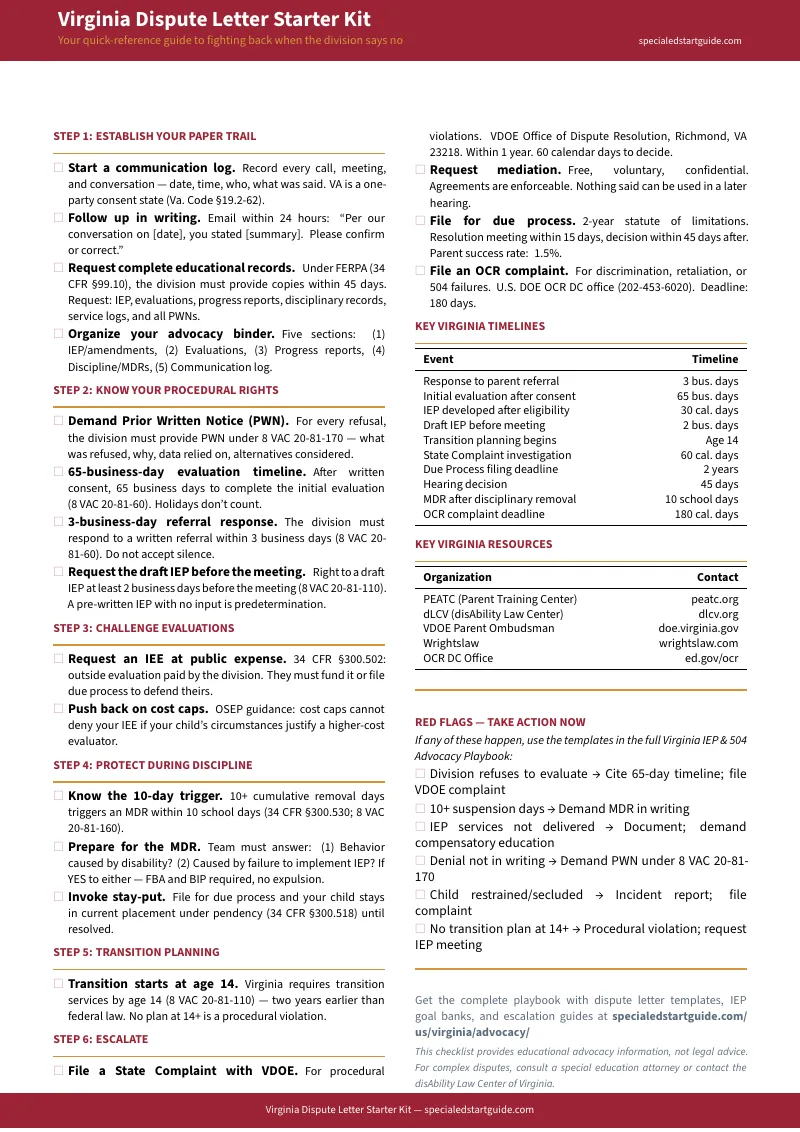
- Dispute Letter Starter Kit — step-by-step checklist for establishing your paper trail, knowing your procedural rights, challenging evaluations, protecting your child during discipline, and escalating disputes
Instant PDF download. Print the demand letter that matches your situation tonight. Send it tomorrow morning.
Money-back guarantee, no time limit. If the Playbook doesn't change how you handle IEP disputes in Virginia, email us for a full refund. No questions asked.
Not ready for the full Playbook? Download the free Virginia Dispute Letter Starter Kit — a printable checklist covering paper trail basics, core procedural rights under 8 VAC 20-81, and the essential steps for challenging denials. It's enough to start documenting tonight, and it's free.
The district has a legal team. After tonight, you'll have the same procedural citations they use — and the paper trail to prove they ignored them.