
Your Child's IEP Meeting Is Next Week. Do You Know What Act 173 Changed?
You sat across from the special education director, the general education teacher, and the LEA representative from your Supervisory Union. They talked about MTSS tiers, adverse effect thresholds, and "census-based funding." They mentioned the Educational Support Team had reviewed your child's case. They slid documents across the table and explained where to sign. You left the meeting not sure whether your child had just been offered real help or politely denied it.
You were right to wonder. In Vermont, approximately 19.6% of students — over 16,000 children — receive special education services under an IEP, one of the highest rates in the country. Yet the four-year graduation rate for students with IEPs recently dropped to 67%, nineteen points below students without disabilities. Vermont leads the nation in classroom inclusion metrics — over 82% of students with IEPs spend most of their day in general education — but inclusion without proper support is not inclusion. It is abandonment with better optics.
The structural challenge is Act 173. Passed in 2018, it shifted Vermont from a categorical reimbursement model — where districts were paid based on how many students had IEPs — to a census-based block grant, where districts receive a flat amount regardless of need. The intent was to expand Multi-Tiered Systems of Support. The effect, in district after district, has been administrators citing "budget constraints" to delay evaluations, reduce service minutes, and push families toward 504 Plans that carry weaker enforcement. Act 173 is a funding mechanism. It does not change your child's right to a Free Appropriate Public Education under federal law. But you will hear it invoked as if it does.
Special education advocates in Vermont charge $100 to $250 per hour. Attorneys cost significantly more — and due process cases can run into the tens of thousands. The Vermont Family Network offers excellent emotional support but has "extremely limited" capacity to attend meetings and cannot give legal advice. Vermont Legal Aid's Disability Law Project provides free representation — but only for the most severe cases. If your situation is too routine for Legal Aid but too complex for a fact sheet, you are on your own.
The Vermont IEP & 504 Blueprint is the Act 173 Defense System — the tactical toolkit that bridges the gap between knowing your rights under Vermont law and actually exercising them at the IEP table, with every template, script, and checklist grounded in Vermont Rules Series 2360 and IDEA.
What's Inside the Blueprint
The EST-to-IEP Escalation Guide
Vermont's Educational Support Team process is the pre-referral intervention system that every district runs before considering a formal special education evaluation. It is also the most common stalling point. Schools can cycle a child through EST tiers for months — sometimes years — while the parent assumes the child is receiving specialized help. The EST is general education intervention. It is not an IEP. It does not carry the same legal protections. The Blueprint explains exactly when the EST process crosses from legitimate intervention into illegal delay, gives you the federal citation (34 CFR 300.311(a)(8)) that prohibits using MTSS to deny a parent-initiated evaluation, and provides the copy-paste letter to force the district's hand.
The Act 173 Defense Playbook
When the IEP team says they "don't have the budget" for a 1-on-1 paraeducator, a private reading program, or additional speech therapy minutes, they are citing Act 173's census-based funding as if it overrides federal law. It does not. IDEA is an entitlement — your child's right to FAPE exists regardless of the district's internal accounting. The Blueprint gives you the exact meeting scripts and written responses to redirect Act 173 budget excuses, including the Prior Written Notice demand that forces the district to document their refusal in writing and explain the data they relied on.
Vermont's 15-Day and 60-Day Timeline Tracker
When you submit a written evaluation referral, the district has 15 calendar days to convene an Evaluation Planning Team meeting, request your consent, or provide Prior Written Notice of refusal. Once you sign consent, the 60-calendar-day clock starts — running continuously through weekends, holidays, and summer. Then the district must determine eligibility. Then develop the IEP. Districts exploit these timelines by initiating evaluations in April knowing they'll blame summer staffing gaps, or by scheduling the EPT meeting at the last possible minute. The Blueprint maps every milestone, gives you the follow-up language at each checkpoint, and provides the escalation template when deadlines pass.
The Copy-Paste Advocacy Letter Library
Every letter cites the exact Vermont rule or federal regulation. Request a formal evaluation and start the district's 15-day EPT clock. Demand an Independent Educational Evaluation at public expense. Request a Functional Behavioral Assessment. Document service non-delivery. Formally disagree with an IEP proposal and demand Prior Written Notice. These are not generic national templates — they reference Vermont Rules Series 2360, Vermont Statutes Title 16, and your Supervisory Union's specific obligations.
The Tuitioning Rights Decoder
Vermont's town tuitioning system — where districts without public schools pay for students to attend approved independent schools — creates confusion that no national guide addresses. Can your child's IEP follow them to an independent school? What happens if the school says they "can't serve" your child's needs? Under Act 73 and State Board Rule 2200, approved independent schools receiving public tuition funds must accept students with disabilities and cannot discriminate. The sending LEA remains legally responsible for FAPE. The Blueprint explains exactly how this works, what to do when an independent school resists, and how to ensure your child's services are not lost in the transfer.
IEP Meeting Scripts and Checklists
What to say when the team tells you your child doesn't qualify because their grades are passing. What to say when they push a 504 instead of an IEP. What to say when the SU representative claims they can't add service minutes because of staffing shortages across three towns. Each script cites the Vermont rule or federal regulation that proves them wrong — so you are not arguing opinions at the table, you are citing law. The pre-meeting checklist covers one-party consent recording rules in Vermont, required IEP team composition under Rules Series 2360, and the specific documents to bring.
Goal-Tracking Worksheets
IEP goals are legally required to be measurable — with baselines, targets, and mastery criteria that meet the Endrew F. standard. But many goals in Vermont are written so vaguely that progress is impossible to track. The worksheets give you a structured format to log data between meetings, compare school-reported progress against your own observations, and arrive at the annual review with documentation that either confirms the program is working or proves it isn't.
The Dispute Resolution Escalation Ladder
When informal advocacy fails, Vermont offers formal options: State Complaints to the Vermont Agency of Education (triggering a 60-day investigation), mediation through the AOE, and due process hearings. The Blueprint explains when each option is appropriate, the timeline and costs involved, and how to build the paper trail that wins — including the fact that State Complaints are free, don't require an attorney, and frequently produce faster results than due process.
Who This Blueprint Is For
- Parents preparing for their first IEP meeting who don't want to walk in blind against a team that does this every day — and who need to understand how Vermont's Supervisory Union structure affects who sits at the table and who controls the budget
- Parents whose child has been cycling through the EST process for months without progressing to a formal special education evaluation — and who need to know when the district is required to stop intervening and start evaluating
- Parents in Burlington, South Burlington, Rutland, Bennington, or Brattleboro navigating districts that pressure parents to sign at the table
- Parents in rural Vermont where the Supervisory Union shares one speech pathologist across three towns, services get missed because the provider drives a circuit, and the special education director is also the person who decides next year's budget
- Parents whose child has ADHD, autism, dyslexia, or anxiety and was told they're "doing fine in general ed" or "the EST is enough" — and who need to understand that academic performance alone is not the legal standard for eligibility
- Parents in tuitioning towns whose child attends an approved independent school and who need to know whether the IEP follows the child and what happens when the school says they "can't accommodate" certain services
- Parents approaching an annual review or triennial reevaluation whose child's goals were vague, unmeasured, or routinely ignored
- Parents worried that Act 173's census-based funding is giving their district an excuse to cut services — and who need the exact language to push back at the IEP table
Why Not Just Use the Free Resources?
Vermont has substantial free special education resources. The Vermont Agency of Education publishes procedural safeguards and technical guidance. The Vermont Family Network runs a free helpline and webinars. Vermont Legal Aid's Disability Law Project provides legal representation for eligible families. Here's why parents still struggle after consulting all of them:
- The AOE's procedural safeguards are written for compliance officers, not parents. They explain what the law requires in dense bureaucratic language designed to protect the state. They do not give you fill-in-the-blank email templates for enforcing it. Their format is informational, not operational.
- The Vermont Family Network is overwhelmed. They explicitly state they have "extremely limited" capacity to offer in-person meeting support, and they cannot provide legal advice. Your child's IEP meeting is next Tuesday. You need specific answers tonight, not a callback list.
- Vermont Legal Aid triages by severity. The Disability Law Project serves the entire state with limited staff. Routine IEP disputes — a service reduction, a vague goal, an EST that drags on too long — rarely qualify for representation. They reserve their resources for the most severe cases of discrimination or systemic failure.
- Wrightslaw covers federal law — not Vermont's Rules Series 2360. Wrightslaw is the gold standard for IDEA. It does not address the EST process, Act 173 funding mechanics, the tuitioning system, the Supervisory Union structure, or Vermont's adverse effect eligibility standard. If you use national terminology without understanding Vermont's implementation, the district knows.
- TPT and Etsy planners organize paperwork — they don't enforce rights. A pastel IEP binder helps you keep documents in order. It won't explain why the district is cycling your child through EST tiers, how to cite Rules Series 2360 to demand Prior Written Notice, or what to do when the tuitioning school says they can't serve your child's IEP.
- Private advocates cost $100–$250 per hour in Vermont. Most families can't afford that — and advocates prefer cases where a solid paper trail already exists. The Blueprint is how you build that trail.
The free resources explain what Vermont law says. The Blueprint gives you the tools to make the district follow it.
— Less Than One Hour of a Special Education Advocate
Private advocates in Vermont charge $100–$250 per hour. If you hand an advocate a disorganized pile of papers, you'll spend hundreds just for them to review the file and formulate a strategy. The Blueprint teaches you how to organize the binder, decode the IEP documents, and draft the initial requests — either empowering you to advocate effectively without an advocate, or saving hundreds in billable hours if you do hire one.
Your download includes the complete Blueprint guide plus standalone printable PDFs — every template, worksheet, script, and reference card, ready to print and bring to your next IEP meeting.
- Complete Blueprint Guide — 18 chapters covering the Vermont special education landscape, IEP vs. 504, the EST process, referral and evaluation timelines (15-day EPT + 60-day evaluation), Vermont's adverse effect eligibility standard, the IEP document walkthrough, IEP meeting strategies, the Act 173 defense playbook, 504 Plans in Vermont, Part C to Part B transition, Independent Educational Evaluations, related services and ESY, behavior and discipline protections, the tuitioning system and independent schools, transition planning, dispute resolution, small-district dynamics, and Vermont advocacy resources
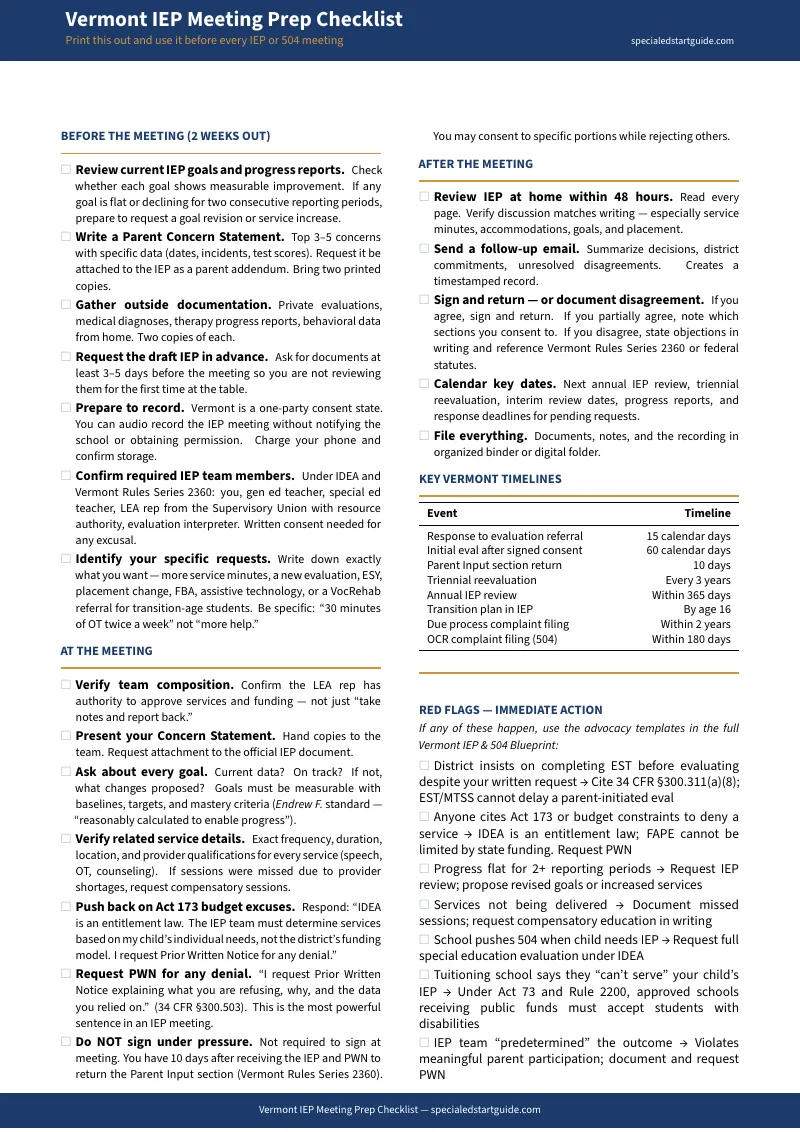
- IEP Meeting Prep Checklist — the before/during/after checklist with Vermont timelines and Rules Series 2360 citations for every step
- Advocacy Letter Templates — copy-paste letters citing exact Vermont Rules Series 2360 and federal regulations for evaluation requests, IEEs, FBA demands, service non-delivery, and formal disagreements
- Goal-Tracking Worksheet — structured fillable worksheet for measurable progress monitoring between annual IEP reviews
- Vermont Timeline Cheat Sheet — every legal deadline on one page: 15-day EPT response, 60-day evaluation, annual reviews, triennial reevaluations, and Part C transition
- IEP Meeting Scripts — word-for-word responses to common IEP team pushback tactics, each citing the specific Vermont rule or federal regulation
- EST Process Flowchart — visual guide showing the legal boundary between EST general education interventions and formal special education evaluation, with escalation triggers
- Dispute Resolution Roadmap — your formal options: AOE State Complaint, mediation, and due process — with Vermont-specific filing procedures
- 504 vs. IEP Decision Matrix — side-by-side comparison of protections with Vermont-specific qualification criteria and enforcement mechanisms
Instant PDF download. Print the templates tonight. Walk into tomorrow's IEP meeting with the law on your side.
Money-back guarantee, no time limit. If the Blueprint doesn't change how you approach IEP meetings in Vermont, email us for a full refund. No questions asked.
Not ready for the full Blueprint? Download the free Vermont IEP Meeting Prep Checklist — a printable pre-meeting checklist with Vermont timelines, IEP team composition requirements under Rules Series 2360, one-party consent recording confirmation, and red flags that require immediate action. It's enough to walk into your next meeting prepared, and it's free.
Your child's education is a legal right, not a favor. The district knows Rules Series 2360. After tonight, so will you.