Act 173 Changed the Money. Your Child's IEP Stayed the Same. The District's Behavior Did Not.
You already know something is wrong. The IEP says 30 minutes of speech therapy three times a week, but the speech-language pathologist left in November and nobody replaced her. The district evaluated your child in the minimum time possible and declared them ineligible — even though your child's reading scores have dropped for two consecutive years and the classroom teacher has been raising flags since second grade. You asked for an Independent Educational Evaluation and the special education director said the district's evaluation was "adequate." You pushed back at the IEP meeting and the team moved on to the next agenda item. Your child was suspended for behavior directly linked to the disability the district has not adequately addressed — and nobody mentioned a Manifestation Determination Review.
Vermont serves roughly 16,000 students in special education across its supervisory unions and school districts — 19.6% of total enrollment, one of the highest rates in the nation. Nearly 82% of those students spend 80% or more of their day in general education classrooms. Vermont calls this inclusion. But the four-year graduation rate for students with IEPs dropped to 67% in 2024, creating a 19-point gap with non-disabled peers. Your child is in the room. The question is whether they are actually receiving the specialized instruction the IEP requires.
Then Act 173 changed the funding. Vermont shifted from categorical reimbursement — where districts were paid per identified student — to census-based block grants, where every district receives the same flat amount regardless of need. The financial incentive now runs against your child. You have watched "specialized instruction" become "tiered supports." You have heard MTSS replace the paraprofessional who knew your child by name. You have sat across from a special education director who looked at the budget before looking at the data.
Special education attorneys in New England charge $250 to $500 per hour. Due process cases cost $15,000 to $30,000. A private neuropsychological evaluation in Vermont runs $2,800 to $4,500. You earn too much for Legal Aid and not enough for a retainer. And in a state of 643,000 people, the superintendent might be your neighbor.
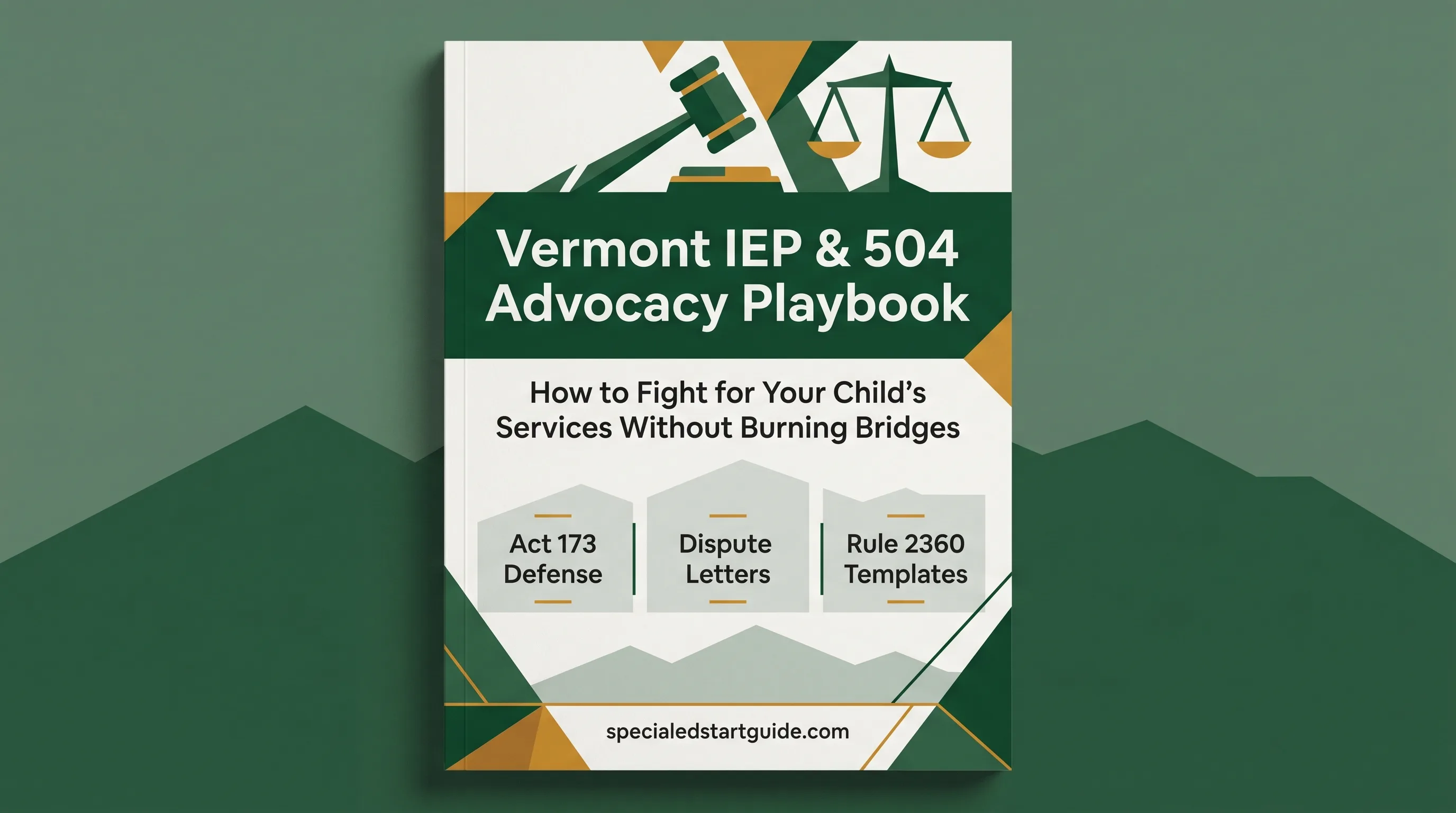
The Vermont IEP & 504 Advocacy Playbook is the Collaborative Firmness System — the tactical toolkit that turns overwhelmed parents into effective advocates by providing the exact dispute letters, Act 173 defense scripts, and escalation procedures grounded in Vermont Rules Series 2360, 16 V.S.A., and federal IDEA that force districts to respond on the record — without burning bridges in a state where everyone knows everyone.
What's Inside the Playbook
The Act 173 Defense Scripts
Act 173 changed how Vermont funds special education. It did not change federal IDEA law. Your child is still entitled to individualized services based on need, not budget. When the IEP team cites "new funding models" or "MTSS interventions" to justify reducing your child's services, these scripts give you the exact language to respond — the specific sentence that makes the district's budget argument legally irrelevant under 20 U.S.C. §1412. Because "we moved to census-based funding" is not a legal basis for denying a Free Appropriate Public Education.
The Fill-in-the-Blank Dispute Letter Library
Every letter cites the exact Vermont regulation. Demand an Independent Educational Evaluation at public expense — using the specific legal phrase under Rule 2362.2.8 and 34 C.F.R. §300.502 that triggers the district's obligation to either fund the IEE or file for due process to defend their evaluation. Request Prior Written Notice (Form 7a) for every denial — because the district is required under IDEA and Rules 2360 to explain in writing what they refused, why, what data they relied on, and what alternatives they considered. Challenge the EST process when it is used to delay your evaluation request — citing the federal protection that prohibits RTI or MTSS from blocking a parent-initiated referral. These are not generic federal templates — they cite the Vermont Rules Series 2360 sections that AOE investigators check during state complaint investigations.
The Small-Town Advocacy System
National advocacy guides — Wrightslaw, the Nolo IEP guide — are written for parents in large suburban districts where you will never see the special education director at the co-op. Their tone is adversarial by default. In Vermont, going to war with the school means going to war with your community. This playbook uses "collaborative firmness" — language that shifts accountability to state and federal compliance requirements rather than placing blame on individuals. You learn to say: "I know you are doing your best with limited staff, but under Rule 2360, we are required to implement these services." Your child's rights are protected. Your community relationships survive.
The 15-Day and 60-Day Timeline Enforcer
When you submit a written evaluation request, the district has 15 calendar days to convene an Evaluation Planning Team meeting or provide written reasons for denial. Once you sign consent, the district has 60 calendar days to complete the evaluation. These are Vermont-specific timelines that exceed federal minimums. The Playbook includes follow-up templates for Day 10, Day 30, and deadline day — escalation language that moves from collaborative reminder to formal AOE complaint when the district misses the legally binding deadline that staffing shortages do not excuse.
The Paper Trail System
In Vermont due process hearings, the burden of proof rests on the party seeking relief — almost always the parent. Without a documented paper trail, you lose. The Playbook includes communication logs, follow-up email templates for every verbal conversation, and a systematic documentation protocol. Every hallway conversation at the co-op gets a summary email. Every IEP meeting gets a written follow-up. Every denial triggers a Prior Written Notice demand. This is the foundation that wins cases — or prevents them from being necessary, because districts respond differently when they know the parent is documenting everything.
The Vermont AOE Complaint Filing Guide
An Administrative Complaint with the Vermont Agency of Education is free, does not require an attorney, and frequently produces faster results than due process. You mail it to: Secretary of Education, Vermont Agency of Education, 219 North Main Street, Suite 402, Barre, VT 05641. The AOE has 60 calendar days to investigate and issue a decision. The Playbook explains which Rule 2360 violations are best suited for state complaints versus mediation versus due process, how to frame the complaint narrative for maximum impact, what evidence to attach, and the common mistakes that result in dismissed complaints.
The Manifestation Determination Prep Kit
When a student with a disability is removed from placement for more than 10 cumulative school days in a year, the district must conduct a Manifestation Determination Review within 10 school days. The MDR team must answer two legal questions: Was the behavior caused by or substantially related to the disability? Was the behavior a direct result of the district's failure to implement the IEP? If yes to either, the behavior is a manifestation — and the child cannot be expelled. The Playbook walks you through preparing for the MDR, requesting a Functional Behavioral Assessment, demanding a Behavioral Intervention Plan, and invoking stay-put rights within 15 days of receiving Prior Written Notice of a proposed placement change.
The Due Process Hearing Roadmap
Due process is the highest administrative remedy before federal court. The statute of limitations is two years. The district must respond within 10 calendar days, hold a resolution meeting within 15 days, and the resolution period expires at 30 days. A hearing decision must be issued within 45 days after the resolution period. Your child stays in their current placement during the entire process — the stay-put provision. The Playbook covers resolution session strategy, evidence organization, what hearing officers look for, and how to build a case that survives the preponderance-of-evidence standard without spending $30,000 on an attorney.
Who This Playbook Is For
- Parents whose child was denied special education eligibility despite clear academic, behavioral, or functional struggles — and who need to challenge the evaluation or request an IEE at public expense
- Parents whose child's IEP services are not being delivered — the speech therapist has not been replaced, the paraprofessional was reassigned, the goals have not changed in two years — and who need to create the paper trail that forces accountability
- Parents watching Act 173 erode their child's services — "tiered supports" replacing specialized instruction, MTSS substituting for IEP-mandated services — and who need the legal language that makes budget arguments irrelevant
- Parents in small Vermont communities who need to advocate firmly without making enemies of the only special education director in their supervisory union
- Parents facing disciplinary action against their child — suspensions, alternative placements — who need to understand Manifestation Determination Reviews and protect their child's right to stay in placement
- Parents in rural supervisory unions where the district genuinely lacks staff — and who need to know how to demand compensatory education or alternative service delivery when staffing shortages are not a legal excuse
- Parents whose child has been stuck in the EST process for months while the school insists on "more interventions" before evaluating — and who need the federal citation that stops the delay
- Parents being steered toward a 504 Plan when their child qualifies for the stronger IEP protections — particularly under Act 173, where the financial incentive to push 504s has intensified
Why Not Just Use the Free Resources?
Vermont has serious free advocacy resources. The Vermont Family Network fields over 4,000 contacts a year. Vermont Legal Aid's Disability Law Project handles the most severe civil rights violations. The AOE publishes the Special Education Rules Series 2360. Here's why parents still lose disputes after consulting all of them:
- VFN provides guidance, not documents. They explain your rights. They cannot draft your emails, customize your dispute letters, or attend your meeting at 7:30 tomorrow morning. They have publicly acknowledged "extremely limited" capacity for in-person meeting support. When it is 10:00 PM the night before your IEP meeting and you need the exact words to challenge an Act 173 service reduction, their helpline is closed. VFN is the orientation. This playbook is the field manual.
- Legal Aid triages by severity. The Disability Law Project serves the entire state with limited staff and prioritizes the most severe civil rights violations — systemic discrimination, physical abuse, total exclusion. If your child's services are being quietly eroded rather than dramatically denied, you may wait months. You cannot afford to wait while the statute of limitations runs.
- Rules 2360 were written for administrators, not parents. The 42-page Special Education Procedures and Practices Manual will tell you the 60-day evaluation timeline exists. It will not tell you what to write in the follow-up email on Day 30 when the district has not scheduled the assessment. It will not tell you what to say when the IEP team denies your request and cites Act 173 budget constraints.
- Wrightslaw covers federal IDEA — not Vermont's Rules 2360. Wrightslaw is the gold standard for federal law. It does not address Vermont's 15-day referral rule, the EST process, Act 173's census-based funding, or how Vermont hearing officers interpret burden of proof. Its tone is adversarial by default — designed for large districts where you will never see the decision-makers at the farmers market.
- Private advocates cost $150–$250 per hour. Special education attorneys charge $250–$500. Most Vermont families cannot afford this — and advocates achieve better results when the parent arrives with an organized paper trail. This Playbook is how you build that trail.
The free resources explain what Vermont law says. This Playbook gives you the dispute tools to make the district comply.
— Less Than One Hour of a Special Education Advocate
Private advocates in Vermont charge $150–$250 per hour. Educational attorneys run $250–$500. A single consultation to review your situation costs more than this entire Playbook. The Playbook gives you the dispute letters, Act 173 defense scripts, and documentation system that advocates use — so you can either handle the dispute yourself or arrive at a paid consultation with an organized case file that saves hundreds in billable hours.
Your download includes 8 PDFs — the complete Advocacy Playbook guide plus 7 standalone tools ready to print and use tonight:
- Complete Advocacy Playbook Guide — 12 chapters covering your legal foundation and procedural safeguards under Rules 2360, building a bulletproof paper trail, Vermont's 15-day and 60-day evaluation rules, IEP meeting navigation, filing AOE administrative complaints, mediation and due process hearings, discipline protections and Manifestation Determinations, town tuitioning and independent schools, transition planning, federal OCR complaints, and Vermont support organizations
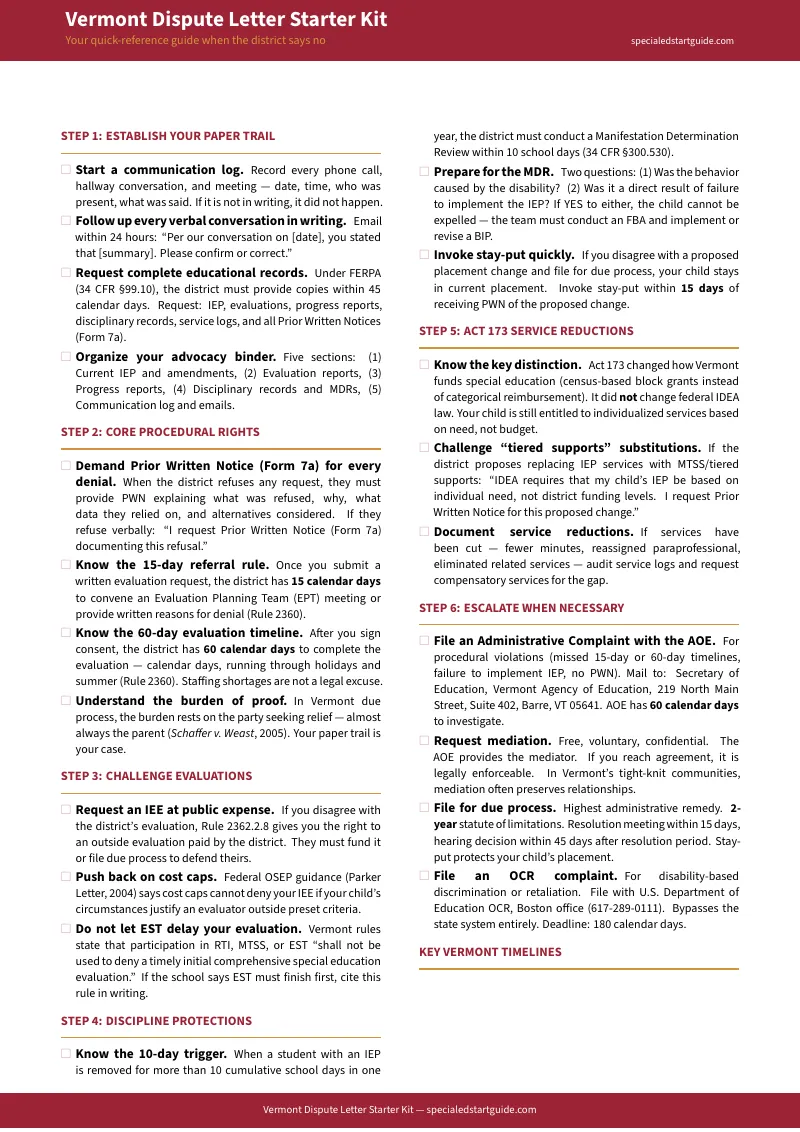
- Vermont Dispute Letter Starter Kit — the quick-reference checklist covering paper trail setup, core procedural rights, evaluation challenges, Act 173 service reduction pushback, discipline protections, and escalation procedures with key Vermont timelines
- Dispute Letter Templates — 6 fill-in-the-blank letters citing Vermont Rules 2360 for IEE demands, Prior Written Notice requests, evaluation requests, service non-delivery complaints, EST delay challenges, and follow-up emails
- Paper Trail Worksheet — fillable communication log for tracking every interaction with the district by date, person, method, and follow-up status
- MDR Preparation Checklist — the two legal questions, documents-to-bring checklist, FBA/BIP audit, and stay-put invocation language for Manifestation Determination Reviews
- AOE Complaint Template — fill-in-the-blank Vermont Agency of Education complaint with required elements, evidence checklist, and the 60-day investigation timeline
- Escalation Ladder Reference Card — visual pathway from documentation to PWN demand to AOE complaint to mediation to due process to federal OCR, with timelines and cost at each level
- Act 173 Defense Reference — what census-based funding changed, why budget arguments are legally irrelevant, and response scripts for common district excuses
Instant PDF download. Print the dispute letter that matches your situation tonight. Send it tomorrow morning.
Money-back guarantee, no time limit. If the Playbook doesn't change how you handle disputes with your Vermont school district, email us for a full refund. No questions asked.
Not ready for the full Playbook? Download the free Vermont Dispute Letter Starter Kit — a sample dispute letter template and parent rights one-pager for special education disagreements in Vermont. It covers paper trail setup, core procedural rights under Rules 2360, evaluation challenges, discipline protections, and escalation steps. It's enough to start building your case tonight, and it's free.
Your child's education is a legal right — and when the district violates it, Vermont law gives you the tools to fight back. This Playbook puts those tools in your hands.