Utah Ranks 51st in Per-Pupil Spending. Your Child's IEP Rights Are Still Enforceable.
You called the Utah Parent Center. They were warm, knowledgeable, and funded in part by the same school districts you need to negotiate with. You downloaded the USBE Procedural Safeguards notice — 30 pages of legalese that a regulatory attorney would need a second pass to digest. You even searched for a private advocate in Salt Lake City and found they charge $100 to $200 just to attend a single IEP meeting.
So you sat across from the special education teacher, the school psychologist, the LEA representative, and the general ed teacher — and they used acronyms you'd never heard before. PLAAFP. WPU. R277-750. LRE. They smiled. They said your child was "making adequate progress" and the current services were "appropriate given available resources." And you didn't know enough to tell them that FAPE is determined by your child's individual needs under federal law — not the district's budget.
You left with the same IEP you walked in with, no Prior Written Notice documenting their refusal, and no idea that you had the right to demand one.
The problem isn't effort. The problem is that Utah's special education system is built on a structural contradiction: the law promises Free Appropriate Public Education to every qualifying child, but the state spends less per student than any other in the nation — roughly $9,500 to $11,500 per pupil, depending on the formula. That gap between federal mandate and state funding doesn't just exist in the abstract. It shows up in your IEP meeting as "we don't have the resources," "we don't do that here," and "your child is doing fine in the general education setting." Forty-one school districts and 140+ charter schools, from Alpine's 90,000-student system to a rural charter in San Juan County with one special education teacher managing 30 IEPs across six grade levels — all operating under the same law with wildly different capacity.
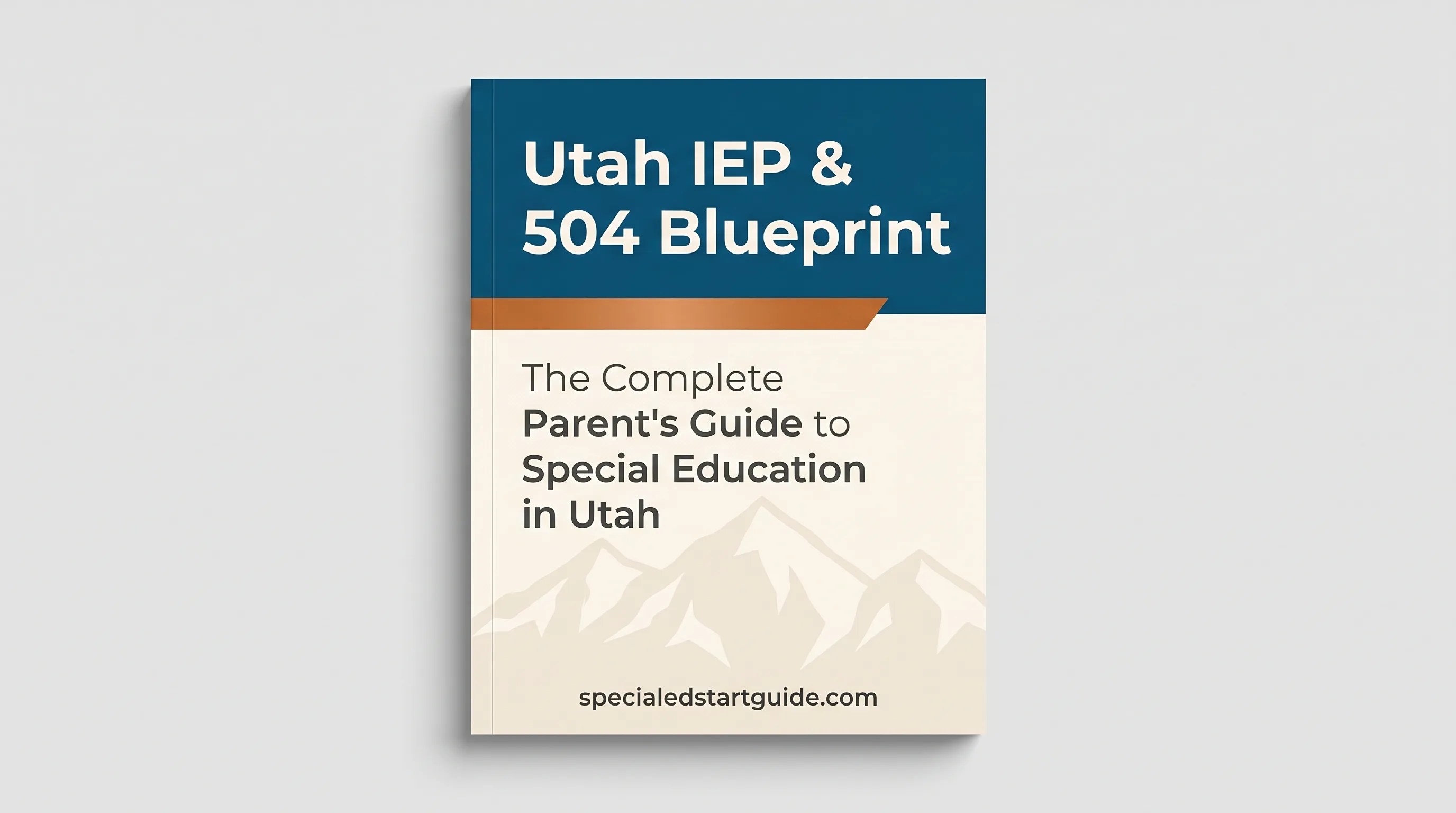
The Utah IEP & 504 Blueprint is the independent, Utah-specific enforcement playbook that bridges the gap between knowing your rights exist and actually making the district follow them — with every template, script, and checklist grounded in Utah Code §53E-7, Administrative Code R277-750, and federal IDEA regulations.
What's Inside the Blueprint
The "We Can't Afford That" Counter-Protocol
Utah ranks 51st in per-pupil spending. Schools fund special education through the Weighted Pupil Unit (WPU) multiplier, but the base funding is so low that districts routinely draw from general education funds to cover deficits. When your school tells you "we can't afford that," they're describing their budget — not the law. The Blueprint provides the exact statutory citations (Utah Code §53E-7-207, 34 CFR § 300.17) and pre-written response scripts that force the district to separate budget complaints from legal obligations. No free resource in Utah teaches you how to counter this — because the free resources are embedded in the same system that creates the constraint.
The Carson Smith Scholarship Decision Framework
Utah's Carson Smith Opportunity Scholarship offers tuition assistance for private school placement — but the eligibility rules create a decision trap that most parents don't see until it's too late. Your child must have a qualifying IEP or multidisciplinary evaluation within the last 36 months to be eligible. A 504 Plan alone does not qualify. And the moment your child enrolls in a private school, federal IDEA protections — FAPE, the right to a due process hearing, service delivery guarantees — vanish. The Blueprint maps this entire decision matrix with a flowchart so you can weigh the trade-offs before making an irreversible choice.
R277-750 Translated Into Plain English
The Utah Administrative Code R277-750 is the state-level rulebook governing special education — discipline procedures, manifestation determinations, evaluation timelines, placement decisions, and FAPE obligations. It is written in dense regulatory prose designed for compliance officers, not parents. The Blueprint translates every section you need into actionable language with real Utah examples, so you can cite the exact rule number at the IEP table without having spent a week decoding bureaucratic syntax.
The Copy-Paste Advocacy Letter Library
Every letter cites the exact Utah statute or USBE rule. Request an evaluation and start the district's 45-school-day clock. Demand Prior Written Notice when the team refuses anything — because without it, their refusal isn't documented and your paper trail has a hole. Request an Independent Educational Evaluation at public expense when you disagree with the district's assessment. Formally request service delivery logs to verify whether the therapy minutes written in the IEP are actually being delivered. These aren't generic national templates — they're Utah-specific enforcement tools that create a legally binding record the moment you hit send.
IEP Meeting Scripts and Checklists
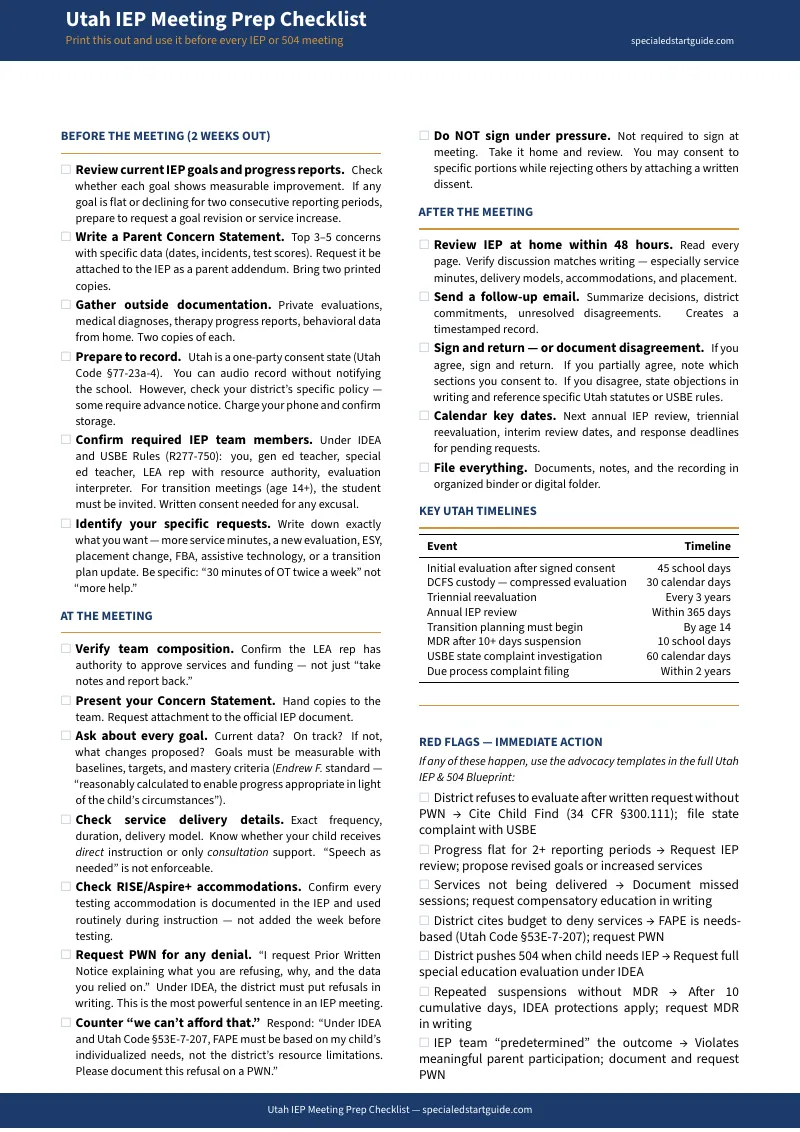
What to say when the team tells you your child is "making progress" but the data shows otherwise. What to say when they offer a 504 instead of an IEP. What to say when the LEA representative claims the district "doesn't have the resources." Each script cites the Utah statute or USBE rule that proves them wrong — so you're not arguing opinions, you're citing law. The pre-meeting checklist covers one-party recording consent (Utah Code §77-23a-4), team composition verification under R277-750, and the specific documents to bring.
The Part C to Part B Transition Survival Guide
When your child turns three, early intervention services through Baby Watch end and the school district takes over — often with dramatically reduced services or an outright denial of special education eligibility. The Blueprint maps Utah's exact transition timeline, explains why school-based eligibility criteria differ from medical diagnoses, and provides specific arguments for demonstrating that therapies your child received under Part C remain educationally necessary under IDEA.
The RISE and Utah Aspire+ Accommodation Guide
Utah's statewide RISE assessments (grades 3–8) and Utah Aspire+ (grade 9–10) carry accountability stakes. Accommodations must be documented in the IEP or 504 Plan AND used routinely during instruction — not added the week before testing. The Blueprint explains accommodation categories, how they interact with alternate assessments (UAA), and your right to ensure every accommodation is explicitly listed before testing season.
The Behavior Crisis Toolkit
When a child faces suspension for behavior caused by their disability, Utah law triggers specific protections. The Blueprint covers Functional Behavioral Assessment requirements, Behavior Intervention Plans, the Manifestation Determination Review process when suspensions exceed 10 cumulative days, and Utah's restraint and seclusion rules. It also addresses the district practice of sending children home without formal documentation to avoid triggering an MDR — and how to stop it.
Goal-Tracking Worksheets
IEP goals are legally required to be measurable — with baselines, targets, and mastery criteria meeting the Endrew F. standard. But many goals are written so vaguely that progress is impossible to track. The worksheets give you a structured format to log data between meetings, compare school-reported progress against your own observations, and arrive at the annual review with documentation that either confirms the program is working or proves it isn't.
The Dispute Resolution Roadmap
When advocacy fails, you have three formal options in Utah: filing a state complaint with USBE, requesting mediation, or filing for a due process hearing. In the 2021-2022 school year, only 23 students statewide filed a state complaint resulting in a compliance finding — in a state with 85,000+ IEP-eligible students. Parents aren't filing because they're satisfied. They're not filing because the process is inaccessible and intimidating. The Blueprint explains when each option is appropriate, the timeline and costs involved, and how the paper trail you've been building becomes the evidence that wins your case.
Who This Blueprint Is For
- Parents whose child just qualified for an IEP or 504 Plan and who are staring at a stack of procedural safeguards that read like a legal contract — and need every section explained in plain English before their first meeting
- Parents whose child is turning three and Baby Watch early intervention is ending — and who need to know exactly how to prevent therapy gaps when the school district takes over
- Parents in Alpine, Granite, Jordan, Davis, or any large Wasatch Front district where evaluations are backlogged and meetings keep getting rescheduled
- Parents in rural Utah — San Juan, Duchesne, Millard, Emery — where the nearest developmental pediatrician is a three-hour drive and the district claims they "don't have staff" for your child's services
- Parents weighing the Carson Smith Opportunity Scholarship and terrified of losing IDEA protections if they move their child to a private school
- Parents who've been told their child "doesn't qualify" despite holding a medical diagnosis — and who need the legal language to challenge that determination under R277-750
- Parents navigating the 504-to-IEP question — unsure whether their child's current plan is legally sufficient or whether they should push for a full special education evaluation
- Parents whose child was suspended and the school never mentioned a Manifestation Determination Review — but the behavior is clearly tied to the disability
- Military families at Hill AFB, Dugway Proving Ground, or Tooele Army Depot navigating Utah's system after a PCS move from another state
- Parents preparing for their annual IEP review who are tired of hearing "we don't have the resources" and want to walk in with the law — not just frustration
Why Not Just Use the Free Resources?
Utah has legitimate free special education resources. The Utah Parent Center runs workshops and provides consultants. The Disability Law Center publishes guides. USBE publishes the Special Education Rules. Here's why parents still struggle after consulting all of them:
- The Utah Parent Center is non-confrontational by design. The UPC provides extensive free education and can even send an advocate to sit in on IEP meetings. But as private advocates have noted, the UPC takes a deliberately non-confrontational approach with districts — districts that contribute to funding their services. Their materials are diplomatically excellent. They do not equip you for adversarial negotiations when a district flatly denies services due to budget constraints.
- The Disability Law Center is resource-constrained. The DLC provides free legal advocacy, but they prioritize systemic cases that affect many students. They cannot provide day-to-day meeting preparation templates. As they state: "Even though our focus is on cases that can help as many people as possible — because time and resources are limited — we at least offer information and/or referral options."
- USBE publications protect the system, not you. The official Special Education Rules (R277-750) and Procedural Safeguards notice are written in dense bureaucratic prose for compliance officers. They tell you the rules exist. They provide zero tactical instruction on how to enforce them when a school is non-compliant. A stressed parent at 10pm does not need to decipher a 100-page administrative code — they need the exact phrasing to put in an email tonight.
- Etsy and TPT planners organize paperwork — they don't enforce rights. A pastel IEP binder helps you sort documents. It won't tell you what R277-750 says about manifestation determinations, how to counter "we can't afford that" with the correct federal citation, or why the Carson Smith Scholarship requires an IEP and not a 504. Generic federal templates miss every Utah nuance that actually determines your outcome.
The free resources explain what the law says. The Blueprint gives you the tools to make the district follow it.
— Less Than 10 Minutes of a Private Advocate
Special education advocates in Utah charge $100 to $200 per meeting. Private evaluations cost $1,500 or more. Even if you eventually need professional help, the meticulous paper trail you build with this Blueprint saves thousands in billable hours — because you're handing your advocate an organized case, not a shoebox of unsigned IEP copies and half-remembered conversations.
Your download includes the complete Blueprint guide plus 8 standalone printable PDFs — every template, worksheet, script, and reference card, ready to print and bring to your next meeting.
- Complete Blueprint Guide (guide.pdf) — 17 chapters covering evaluations, IEP development, 504 plans, the Carson Smith scholarship decision framework, Utah's funding reality, R277-750 procedures, RISE accommodations, Part C to Part B transitions, related services, ESY, behavior crisis protocols, IEEs, transition planning from age 14, transfer student protections, discipline and restraint rules, dispute resolution, and a Utah resources directory
- IEP Meeting Prep Checklist (checklist.pdf) — the before/during/after checklist with Utah timelines, team composition requirements, and red flags that require immediate action
- Advocacy Letter Templates (advocacy-letters.pdf) — 8 copy-paste letters citing exact Utah Code sections and USBE rules for evaluations, Prior Written Notice demands, IEEs, service delivery log requests, FBA requests, addendum meetings, and USBE state complaints
- Goal-Tracking Worksheet (goal-tracking.pdf) — structured fillable worksheet for measurable progress monitoring and service delivery logging between annual reviews
- RISE Accommodation Checklist (rise-accommodation-checklist.pdf) — classroom accommodations table plus testing accommodation categories and a pre-meeting audit checklist
- Utah Timeline Cheat Sheet (timeline-cheat-sheet.pdf) — every legal deadline on one page: 45-school-day evaluation, annual reviews, triennial reevaluation, MDR timelines, Carson Smith recency rules, and due process filing windows
- IEP Meeting Scripts (meeting-scripts.pdf) — word-for-word responses to 7 common district pushback tactics, each citing the specific Utah statute or USBE rule
- Carson Smith Decision Flowchart (carson-smith-flowchart.pdf) — the eligibility requirements, IDEA trade-offs, and 36-month evaluation recency rule on one printable page
- Dispute Resolution Roadmap (dispute-roadmap.pdf) — your four formal options when advocacy fails: IEP facilitation, mediation, USBE state complaint, and due process hearing — with a side-by-side comparison table
Instant PDF download. Print the templates tonight. Walk into tomorrow's meeting with the law on your side.
Money-back guarantee, no time limit. If the Blueprint doesn't change how you approach IEP meetings in Utah, email us for a full refund. No questions asked.
Not ready for the full Blueprint? Download the free Utah IEP Meeting Prep Checklist — a printable pre-meeting checklist with Utah timelines, team composition requirements, and the red flags that require immediate action. It's enough to walk into your next meeting prepared, and it's free.
Your child's education is a legal right, not a budget line the district gets to cut. Utah ranks last in spending. You don't have to rank last in advocacy.