The District Said No. Now What?
You've been through the ARD meetings. You've written the emails. You've asked — politely, repeatedly — for the services your child is legally entitled to receive. And the district said no. Or worse, they said "we'll look into it," and then nothing happened. The speech therapy minutes vanished from the IEP. The Behavior Intervention Plan sits in a filing cabinet while your child gets suspended again. The evaluation you requested three months ago hasn't started. You called Partners Resource Network, but the callback came two weeks later. You looked at attorneys — $300 to $850 per hour, with $5,000 retainers just to get started.
Here's the reality the district is counting on: most Texas parents give up. They don't know that the TEA accepts free state complaints with a 60-day investigation timeline. They don't know that citing TAC §89.1050(h) in a 10-day recess letter forces the district to document its refusal in Prior Written Notice. They don't know that an Independent Educational Evaluation request at public expense shifts the cost burden to the district unless it files for due process. Districts win 72% of formal hearings — but most disputes never reach that stage. The parents who win are the ones who build an airtight paper trail and cite the specific Texas statute that makes noncompliance legally risky.
The Texas IEP & 504 Advocacy Playbook is the Dispute Enforcement System — the tactical escalation toolkit that picks up where the IEP Blueprint leaves off. Every template, script, and strategy is built specifically for the moment a Texas school district stops cooperating and starts stonewalling.
What's Inside the Advocacy Playbook
The TEA State Complaint Filing System
A TEA state complaint is free, doesn't require an attorney, and triggers a mandatory 60-day investigation by the Texas Education Agency. Districts hate them because they create a compliance record. Most parents don't file because the process looks intimidating. The Playbook walks you through every step: what qualifies as a valid complaint, how to structure the narrative, which TAC and TEC citations to include, what evidence to attach, and how to follow up when the investigator contacts you. This is the single most cost-effective enforcement mechanism available to Texas parents — and most don't even know it exists.
The Compensatory Services Calculator
When a district fails to deliver IEP services — missed therapy sessions, unfilled staff positions, services reduced without an ARD meeting — your child is owed compensatory education. The problem is that districts don't volunteer this. The Playbook provides the framework for calculating what's owed: how to document missed services, how to quantify the gap between what the IEP promised and what the district delivered, and how to present a compensatory services demand that the district's legal team takes seriously. This chapter also covers the 8.5% cap era — how to determine whether your child was illegally denied identification between 2004 and 2017, and how to pursue retroactive compensatory services.
The Dispute Resolution Escalation Ladder
Texas offers four formal dispute resolution pathways: TEA state complaints, IEP facilitation, mediation, and due process hearings through SOAH. Each has different timelines, costs, and strategic implications. The Playbook maps out when each option is appropriate, what evidence you need before filing, and how to build the paper trail that wins. It covers the critical distinction between filing a state complaint (free, 60 days, compliance-focused) and requesting due process (expensive, adversarial, outcome-focused) — and why starting with a state complaint often produces faster results.
The Advanced Advocacy Letter Library
Every letter cites the exact Texas regulation. Demand compensatory services for undelivered IEP minutes. File a formal disagreement with the ARD committee's proposal. Request an Independent Educational Evaluation at public expense when the district's FIIE was inadequate. Invoke the 10-day recess with specific follow-up actions. Escalate to the superintendent when the campus ignores your correspondence. Notify the district of your intent to file a TEA state complaint. These aren't polite requests — they're legal instruments that create binding timelines and paper trails.
Manifestation Determination Scripts
When a student with a disability faces suspension beyond 10 cumulative school days, the district must hold a Manifestation Determination Review to decide whether the behavior was caused by or substantially related to the disability. In Texas, special education students account for 91% of all physical restraints despite being less than 10% of the student population. The Playbook gives you the scripts and documentation strategies for the MDR meeting — how to challenge a district's finding that behavior was "not a manifestation," how to demand a Functional Behavioral Assessment, and how to invoke IDEA's stay-put protections while appeals are pending.
The IEP Facilitation and Mediation Playbook
Before due process, Texas offers IEP facilitation — a TEA-assigned neutral facilitator who runs the ARD meeting — and mediation through an independent mediator. Both are free. Both are underused because parents don't know how to prepare. The Playbook covers how to request a facilitated IEP meeting, what to submit in advance, how to present your case to the facilitator, and when mediation is the better strategic choice. It also covers the enforceability of mediation agreements — and what to do when the district violates one.
The Documentation War Chest
Every successful dispute — whether resolved at the campus level or through a formal TEA complaint — depends on documentation. The Playbook provides the systems: communication logging templates, service delivery trackers, incident report forms, and the records request protocol under TEC §25.002. It covers how to use Texas's one-party consent law to record ARD meetings, how to request Prior Written Notice for every district refusal, and how to organize your file so that an attorney or advocate can pick it up and immediately understand your case.
Who This Playbook Is For
- Parents whose child has an IEP or 504 plan that the district is failing to implement — missed therapy minutes, unfilled positions, services reduced without an ARD meeting
- Parents who have been through the ARD process and hit a wall — the district disagrees, delays, or deflects, and informal advocacy isn't working
- Parents considering filing a TEA state complaint but who don't know how to structure the case or what evidence to include
- Parents whose child was suspended or restrained and who need to challenge the Manifestation Determination Review or demand a Functional Behavioral Assessment
- Parents in Houston, Dallas, Austin, San Antonio, or Fort Worth ISDs where institutional resistance to special education compliance is well-documented
- Parents in rural Texas districts where there's no local advocate, no private evaluator within driving distance, and the district acts like it's above the law
- Parents who suspect their child was denied identification during the illegal 8.5% cap era (2004–2017) and want to pursue compensatory services
- Parents who already own the Texas IEP & 504 Blueprint and need the next level of enforcement — the dispute resolution tools that kick in when collaboration breaks down
Why Not Just Hire an Attorney?
You might need one eventually — and if you do, this Playbook makes them more effective and your bill smaller. But here's what most parents don't realize about the Texas special education dispute landscape:
- Districts prevail in 72% of formal due process hearings. The deck is stacked. Large ISDs like Houston, Arlington, and Leander hire specialized education law firms — Walsh Gallegos, Eichelbaum Wardell — using taxpayer dollars. An unrepresented parent entering due process is statistically likely to lose. The Playbook's strategy is to resolve disputes before they reach that stage.
- Most attorneys won't take your case without a paper trail. The first thing a special education attorney asks for is your documentation file. If you don't have organized records of every request, refusal, missed service, and district response, the attorney has nothing to work with — and you'll spend $500+ in billable hours just getting the file organized. The Playbook builds that file from day one.
- TEA state complaints are free and often faster. A state complaint triggers a 60-day investigation. The TEA reviews records, interviews staff, and issues findings with required corrective action. It costs nothing to file, doesn't require a lawyer, and frequently produces the same result as a due process hearing — without the $10,000 to $50,000 price tag.
- Special education advocates charge $100–$250 per hour in Texas metros. Attorneys charge $300–$850. A single strategy session costs $400+. The Playbook gives you the same dispute resolution templates and escalation strategies they use — for a fraction of one billable hour.
Free resources explain what your rights are. The Playbook gives you the enforcement tools to make the district respect them.
— Less Than 15 Minutes of an Education Attorney
Texas education attorneys bill at $300 to $850 per hour. An advocate consultation starts at $400. If your case goes to due process, costs routinely exceed $50,000. The Advocacy Playbook gives you the dispute resolution templates, TEA complaint filing system, and escalation strategies to fight back at the campus and district level — where 90% of disputes are actually resolved — before those costs ever become necessary.
Your download includes the complete Advocacy Playbook guide plus 7 standalone printable tools:
- Complete Advocacy Playbook Guide — 12 chapters covering the Texas advocacy landscape, your legal arsenal (TAC Chapter 89 and TEC Chapter 29 statutes), the evaluation battle and 45-school-day timeline enforcement, ARD committee navigation, discipline and manifestation determinations, the dyslexia battleground under HB 3928, autism supplement enforcement, dispute resolution (TEA state complaints, mediation, due process), 8.5% cap compensatory services, documentation systems, special situations (charter schools, military families, ESAs), and Texas advocacy resources
- Advocacy Letter Templates — 9 copy-paste letters for FIIE evaluation requests, IEE demands, PWN demands, formal disagreements, bullying impact requests, compensatory services demands, TEA state complaints, superintendent escalations, and verbal conversation confirmations — each citing exact Texas regulations
- ARD Meeting Scripts — word-for-word responses for when the district says "complete RTI first," "your child doesn't qualify," "we don't have staff," "sign today," or presents a pre-written IEP
- Texas Timeline Cheat Sheet — every legal deadline on one page: 15-day response, 45-day FIIE, 5-day report delivery, 10-day recess, 60-day TEA complaint, and more
- Dispute Resolution Roadmap — side-by-side comparison of IEP facilitation, TEA state complaints, mediation, and due process — when to use each, costs, timelines, and outcomes
- Manifestation Determination Prep Sheet — evidence checklist and challenge strategy for MDR meetings, including HB 6 cumulative ISS tracking
- Compensatory Services Worksheet — fillable tracker for documenting missed IEP services, calculating hours owed, and building your demand — includes 8.5% cap era assessment
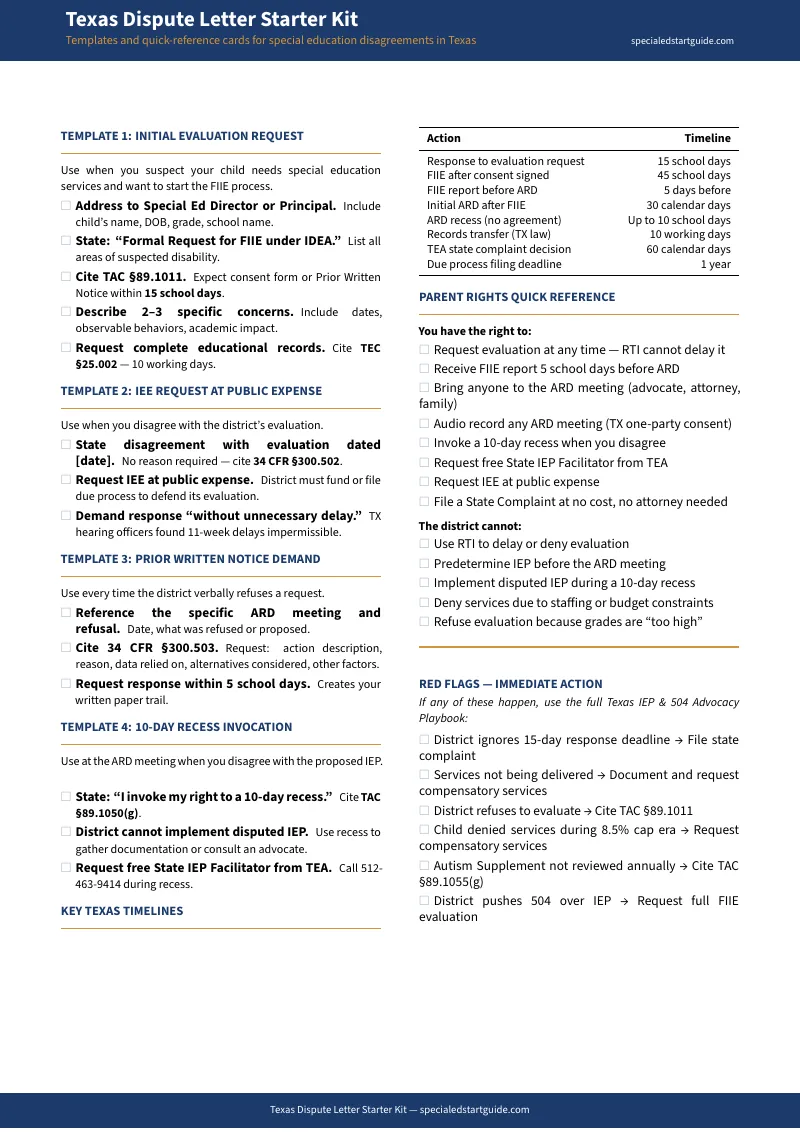
- Texas Dispute Letter Starter Kit — free quick-start templates and parent rights one-pager for your first enforcement letter
Instant PDF download. Print the templates tonight. Send the first letter tomorrow morning.
Money-back guarantee, no time limit. If the Playbook doesn't change how you handle disputes with your Texas school district, email us for a full refund. No questions asked.
Not ready for the full Playbook? Download the free Texas Dispute Letter Starter Kit — sample dispute letter templates and a parent rights one-pager for special education disagreements in Texas. It's enough to send your first enforcement letter, and it's free.
Your child's education is a legal right, not a resource allocation decision. The district has attorneys. After tonight, you have the statutes.