The District Said No. Now What?
You requested an evaluation three months ago. The school told you your child "has to go through RTI2 first" — even though you have a private diagnosis in hand and the Tennessee Department of Education explicitly warns that RTI2 cannot be used to delay or deny an evaluation. You asked for a Functional Behavioral Assessment after the third suspension. The principal said she would "look into it." That was six weeks ago. You walked into the IEP meeting with specific concerns, and the team arrived with a pre-written document and told you where to sign.
None of this is normal. All of it is illegal under Tennessee law.
Tennessee serves over 130,000 students with IEPs. The state's burden-of-proof structure places the weight on parents in due process hearings. The RTI2 framework — designed to catch struggling students early — has been associated with a 61 percent decrease in the odds of first-time SLD identification by third grade, disproportionately affecting Black and economically disadvantaged students. The TISA funding formula ties district revenue to IEP service levels, creating a structural incentive to resist adding services. When the district tells you no, it is making a financial decision dressed up as an educational one.
Special education attorneys in Tennessee charge $275 to $450 per hour with retainers starting at $5,000. Private advocates bill $100 to $250 per hour. A neuropsychological evaluation you could have gotten at public expense — if you had known how to legally request an Independent Educational Evaluation — runs $1,500 to $4,000 out of pocket. If you are a working family in Nashville, a single parent in Memphis, or a farm family in East Tennessee, you cannot afford that.
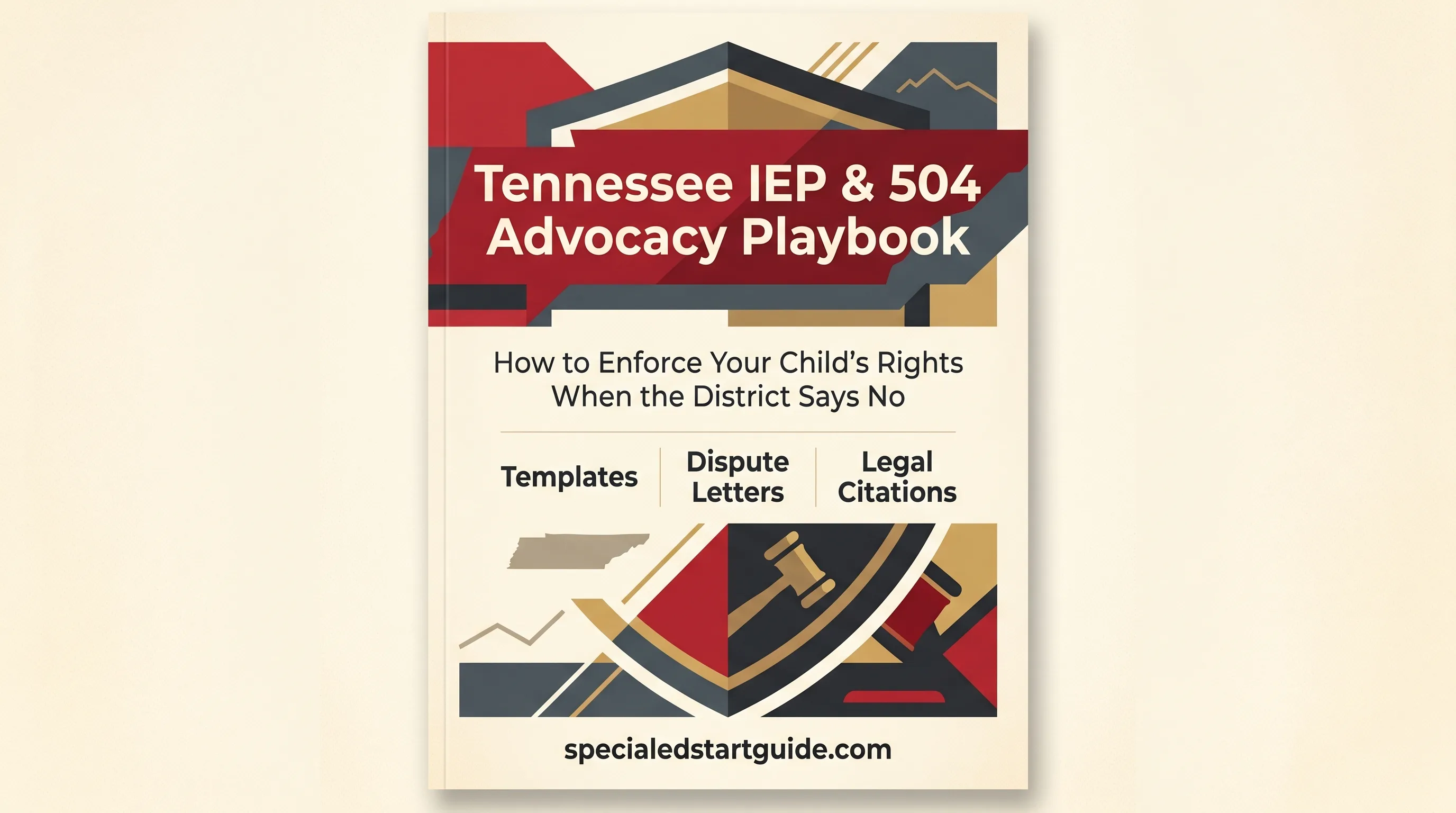
The Tennessee IEP & 504 Advocacy Playbook is the Tennessee Enforcement System — 10 copy-paste dispute letter templates, a complete escalation framework, and every strategy grounded in TCA §49-10, State Board Rule 0520-01-09, and IDEA. It is built for the moment when collaboration has failed and you need instruments, not information.
What's Inside the Playbook
10 Copy-Paste Dispute Letter Templates
Every template cites the exact Tennessee regulation that commands a response. Request an evaluation and start the district's 60-calendar-day clock — regardless of where your child sits in RTI2. Demand an Independent Educational Evaluation at public expense using the specific legal phrase from 34 C.F.R. Section 300.502 that forces the district to either pay or file for due process. Invoke the 14-day rule under SBE Rule 0520-01-09-.12(3) when the IEP team cannot reach agreement. File a predetermination objection when the team arrives with a pre-written IEP and refuses your input. Demand compensatory education for missed services. File a formal administrative complaint with TDOE. Challenge a Manifestation Determination. Request complete educational records under FERPA. These are not generic federal templates — they cite Tennessee administrative rules by section number.
The TDOE Complaint Translation Matrix
"They said he has to finish RTI2 first" becomes a violation of OSEP Memo 07-11 and SBE Rule 0520-01-09. "They reduced speech therapy without telling me" becomes a 34 C.F.R. Section 300.503 violation for failure to provide Prior Written Notice. "They had the IEP written before I arrived" becomes a predetermination violation under 34 C.F.R. Section 300.322. The matrix translates ten common parent frustrations into the exact legal violations you cite when filing a state complaint — so you stop describing problems and start documenting violations.
RTI2 Counter-Strategies
Tennessee mandated RTI2 statewide for identifying Specific Learning Disabilities. In practice, schools routinely tell parents their child "must complete" Tier III interventions before an evaluation can begin. This violates both federal guidance (OSEP Memo 07-11) and Tennessee's own RTI2 Framework Manual. The Playbook gives you the exact written response that bypasses the gatekeeping — citing the specific state and federal rules that require simultaneous processing of your evaluation request regardless of RTI2 tier placement.
Manifestation Determination Defense
When your child faces suspension exceeding 10 consecutive school days, the district must conduct a Manifestation Determination Review within 10 school days under SBE Rule 0520-01-09-.24. The Playbook walks you through every element the MDR team must address — whether the behavior was caused by the disability, whether it resulted from the district's failure to implement the IEP — and gives you the template to challenge the determination and demand a Functional Behavioral Assessment if one was never conducted.
The 14-Day Rule Enforcement Protocol
Tennessee's 14-day rule is one of the strongest parent protections in the country, and most parents have never heard of it. Under SBE Rule 0520-01-09-.12(3), when the IEP team cannot reach agreement, the school cannot implement its proposed changes for 14 calendar days. The Playbook tells you exactly what to write on the attendance sheet, what to say on the recording, and which template to send within 24 hours — creating a legally binding paper trail that triggers stay-put protections the moment you file for due process.
IEA Voucher Trap Analysis
Tennessee's Individualized Education Account voucher program offers $6,300 to $7,200 annually for private school tuition. The catch: parents who accept the IEA must waive all IDEA rights — no IEP, no FAPE, no due process, no manifestation determination. If you return your child to public school, evaluations start from scratch. The Playbook lays out exactly what you forfeit and why the short-term appeal of private school placement does not justify permanently surrendering your child's legal protections.
Evidence-Building System
Due process hearings in Tennessee are decided on evidence, not emotion. The Playbook gives you the paper trail system — the follow-up email rule, the service delivery tracking log, the goal progress documentation method, and the chronological timeline format that TDOE investigators and Administrative Law Judges rely on. When a principal tells you a requested service is unavailable due to budget cuts, that verbal statement means nothing in a formal proceeding. The follow-up email documenting that statement is evidence.
IEP Meeting Advocacy Strategies
What to say when the team pressures you to sign. What to write on the attendance sheet when you disagree. How to identify when the LEA representative at the table lacks authority to commit resources. Tennessee is a one-party consent state under T.C.A. Section 39-17-902 — you can record every meeting without permission, and the Playbook explains why overt recording changes district behavior immediately. When the meeting becomes hostile, the exit strategy creates a contemporaneous record of procedural violation that supports a formal complaint.
Three-Path Dispute Resolution Guide
TDOE administrative complaints for procedural violations — free, no attorney required, 60-day investigation. Mediation for substantive disagreements — voluntary, confidential, and the agreement is legally enforceable. Due process hearings before Administrative Law Judges for fundamental FAPE denials. The Playbook explains when each path gives you maximum leverage, the timeline and costs involved, and the critical fact that Tennessee places the burden of proof on the parent — making your documentation the difference between winning and losing.
Who This Playbook Is For
- Parents whose school district refused an evaluation, delayed it with RTI2, or conducted a narrow evaluation that missed key deficits — and who need the letter templates to force the issue under Tennessee law
- Parents whose child's IEP services are not being delivered — speech therapy cancelled for months, aide hours reduced without notice, goals unmeasured — and who need to document the failure and demand compensatory education
- Parents whose child is facing suspension, expulsion, or placement change for behavior related to the disability — and who need to challenge a Manifestation Determination or demand a Functional Behavioral Assessment
- Parents in Nashville, Memphis, Knoxville, Chattanooga, or Murfreesboro navigating large districts that pressure parents to sign pre-written IEPs at the table
- Parents in rural East or West Tennessee counties where staffing shortages mean the speech therapist left five months ago and nobody replaced her — and who need to hold the district accountable despite limited local resources
- Parents who have attended IEP meetings and left feeling steamrolled — who need the 14-day rule, the recording strategy, and the exit protocol that transforms a hostile meeting into documented evidence
- Parents considering the IEA voucher program who need to understand exactly what IDEA rights they are waiving before they sign
Why Not Just Use the Free Resources?
Tennessee has substantial free advocacy resources. They are valuable. They are also not built for the moment you are in.
- STEP provides training, not instruments. STEP (Support and Training for Exceptional Parents) is Tennessee's federally funded Parent Training and Information Center. They offer excellent workshops and navigation guides. As a state-partnered entity, their institutional tone encourages collaboration. When you need to file a formal complaint citing specific regulatory violations, STEP gives you information — you need fill-in-the-blank templates with the legal citations already embedded.
- Disability Rights Tennessee handles severe cases. DRT is the state's federally mandated Protection and Advocacy organization. They provide free legal advocacy for abuse, restraint and seclusion violations, and systemic FAPE denials. Their capacity for individual representation is severely limited. Their fact sheets are informative but lack the ready-to-send templates you need for tomorrow's deadline.
- TDOE procedural safeguards are written for lawyers. The mandatory Notice of Procedural Safeguards tells you that you have the right to Prior Written Notice. It does not give you the email template to demand it when the team refuses your request. It does not explain how the 14-day rule interacts with stay-put protections. It does not translate your daily frustrations into legally actionable complaint language.
- Wrightslaw covers federal law — not Tennessee's State Board Rule 0520-01-09. Wrightslaw is the gold standard for understanding IDEA. It does not address Tennessee's RTI2 framework, the 14-day cooling-off rule, the 16 disability categories, the IEA voucher trap, the TISA funding weights that drive district behavior, or the specific TDOE complaint filing procedures.
- National templates miss Tennessee-specific citations. A generic IEE request letter from Understood.org or PACER does not cite SBE Rule 0520-01-09 or reference Tennessee's 60-calendar-day evaluation timeline. When you send a letter that cites the wrong state's rules — or no state rules at all — the district knows you are working from a template, not from knowledge.
- Private advocates and attorneys cost thousands. Attorneys in Tennessee charge $275 to $450 per hour with $5,000+ retainers. Non-attorney advocates charge $100 to $250 per hour. The Playbook helps you self-advocate effectively at the local level — and if you do eventually need an attorney, the paper trail you build using these templates is exactly what they need to take your case seriously.
The free resources explain what Tennessee law says. The Playbook gives you the enforcement tools to make the district follow it.
— Less Than 10 Minutes of a Special Education Attorney
Special education attorneys in Tennessee charge $275 to $450 per hour. That is $45 to $75 for every 10 minutes they spend reviewing your file. The Playbook gives you 10 dispute letter templates, a complete evidence-building system, and the escalation framework that attorneys themselves use — so you can resolve disputes at the school level without a retainer, or arrive at an attorney's office with the organized case file that saves hundreds in billable hours.
Your download includes 8 PDFs — the complete guide plus 7 standalone printable tools:
- Complete Advocacy Playbook — 11 chapters covering Tennessee procedural safeguards, the evaluation process and RTI2 counter-strategies, IEP meeting navigation and the 14-day rule, 10 copy-paste advocacy letter templates citing TCA §49-10 and SBE Rule 0520-01-09, the three-path dispute resolution system, Tennessee-specific advocacy issues (IEA voucher trap, charter school LEA status, TISA funding leverage, staffing shortages, ESY, disproportionality), IEP meeting strategies, and the evidence-building system
- Advocacy Letter Templates — all 10 copy-paste dispute letter templates in a standalone printable format, each citing exact Tennessee regulations
- TDOE Complaint Translation Matrix — a one-page reference card translating 10 common parent frustrations into the exact legal violations and regulatory citations you need for a formal complaint
- Communication Log — a fillable two-page worksheet for tracking every interaction with the district plus a service delivery tracking table for documenting missed sessions
- MDR Preparation Checklist — a printable prep sheet for Manifestation Determination Reviews with the two questions the team must answer, documents to bring, and next steps
- TDOE Written State Complaint — a fillable complaint form with sections for violations, proposed resolution, and a supporting documents checklist — ready to print, complete, and mail
- Dispute Escalation Ladder — a two-page visual reference showing the five-step path from informal advocacy to federal OCR complaint, with Tennessee-specific timelines and contacts
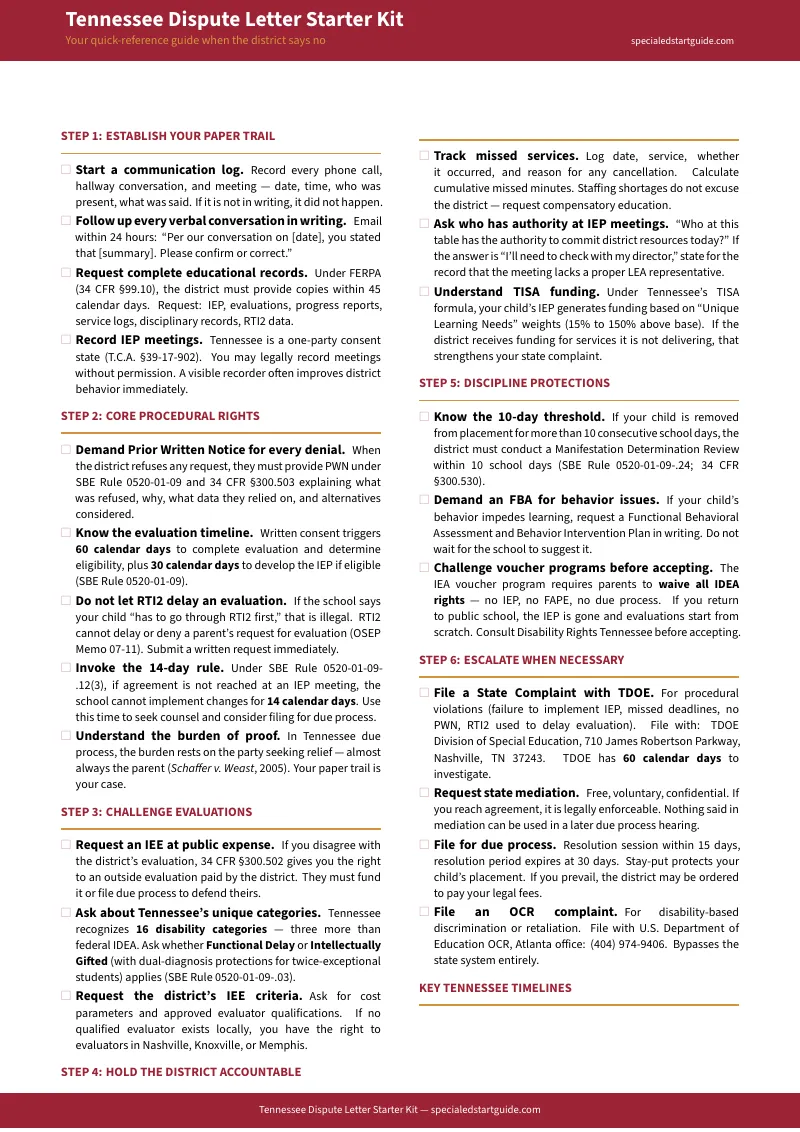
- Tennessee Dispute Letter Starter Kit — a 6-step quick-reference checklist with paper trail setup, core procedural rights, evaluation challenges, district accountability, discipline protections, and escalation procedures — with key Tennessee contacts and timelines
Instant PDF download. Print the templates tonight. Send the first letter tomorrow morning.
Money-back guarantee, no time limit. If the Playbook doesn't change how you handle IEP disputes in Tennessee, email us for a full refund. No questions asked.
Not ready for the full Playbook? Download the free Tennessee Dispute Letter Starter Kit — a printable quick-reference checklist covering paper trail setup, core procedural rights, evaluation challenges, discipline protections, and escalation procedures with key Tennessee contacts and legal timelines. It is enough to start building your case tonight, and it is free.
Your child's education is a legal right, not a district favor. The school knows State Board Rule 0520-01-09. After tonight, you will too.