Your Child's School Just Said No. Here's What You Say Next.
The district denied the evaluation. Or they ran an evaluation and found your child "not eligible." Or the IEP meeting ended with the same boilerplate goals from last year, no additional service minutes, and a verbal promise to "monitor progress" — which means nothing will change.
You've already tried the cooperative approach. You wrote the polite emails. You showed up to every meeting. You trusted the team. And the team decided that your child would get the minimum the district was willing to pay for — not what your child actually needs.
Now you need to know exactly what to say, who to say it to, and which South Carolina law to cite when you say it. That's what this playbook does.
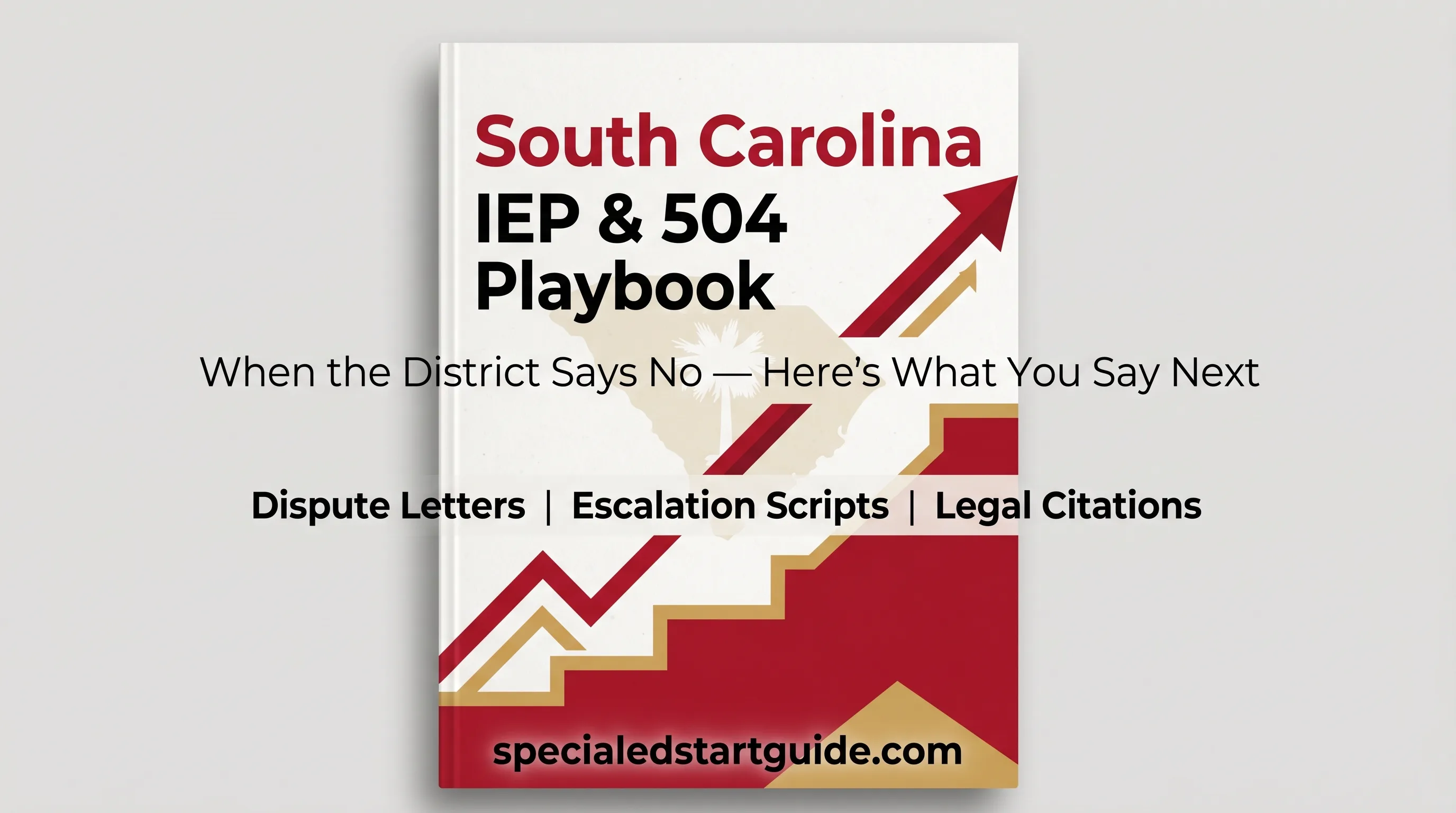
The South Carolina IEP & 504 Advocacy Playbook is the Escalation Toolkit for parents who have moved past asking nicely. Every template cites specific South Carolina regulations. Every script is built for the moment the district says no — and you need to make them reverse it.
What's Inside the Playbook
The Dispute Letter Library
Pre-written, copy-paste letters for the situations where parents lose the most ground. Request an evaluation and trigger the district's strict 60-day clock under SC Regulation 43-243. Demand an Independent Educational Evaluation at public expense — using the exact legal phrase that forces the district to either pay for an outside evaluator or file for due process to defend their own. Formally dispute a Manifestation Determination Review when the district claims your child's disability-driven behavior isn't related to the disability. Demand Prior Written Notice for every refusal, every denial, every reduction in services — creating the paper trail that makes the district legally accountable for its decisions.
The Escalation Ladder
When the IEP team says no, most parents don't know there are five more levels above them. The Playbook maps the complete escalation pathway in South Carolina: from the IEP team, to the special education director, to the SCDE Ombudsman (1-866-628-0910), to a formal SCDE State Complaint, to mediation, to South Carolina's two-tier due process hearing system. Each level includes the specific filing requirements, timelines, and the exact language to use so you don't waste a complaint on a procedural technicality.
Manifestation Determination Defense
When a student with an IEP accumulates more than 10 days of suspension, the district must hold a Manifestation Determination Review within 10 school days. The MDR team must answer two questions: Was the behavior caused by the disability? Was the behavior a direct result of the district failing to implement the IEP? If the answer to either is yes, your child must be returned to their placement. The Playbook gives you the preparation checklist, the specific evidence to gather, and the script for the MDR meeting — because most parents don't realize the district was supposed to be implementing a Behavior Intervention Plan that it quietly stopped following.
The Military Transfer Protocol
PCSing to Fort Jackson, Shaw AFB, Joint Base Charleston, or MCAS Beaufort? The receiving South Carolina district must provide comparable services based on your child's current out-of-state IEP under the Interstate Compact on Educational Opportunity for Military Children (MIC3). But 51% of military families with a child in special education report significant trouble transferring the IEP during a PCS move. The Playbook gives you the exact enrollment language to invoke MIC3 protections before the district has a chance to "reevaluate" your child's services downward — and the escalation path when they ignore it.
The Independent Educational Evaluation (IEE) Playbook
If you disagree with the district's evaluation, federal law gives you the right to an outside evaluation at the district's expense. The district must either fund it or file for due process to defend their work — they cannot simply refuse. But districts routinely stall, impose unauthorized cost caps, or claim you must explain your reasons first. The Playbook covers each of these tactics and gives you the specific response that shuts them down, citing OSEP guidance and 34 C.F.R. Section 300.502.
Compensatory Education Strategies
When the district fails to deliver the services written into the IEP — the SLP resigned and was never replaced, the aide rotates across three classrooms, the counseling sessions stopped in October — your child is owed compensatory education to make up for the lost instruction. The Playbook explains how to document service delivery failures, calculate what your child is owed, and file the demand that forces the district to provide makeup services or fund outside providers.
The Evidence System
South Carolina hearing officers decide cases based on documented evidence. Not feelings. Not verbal promises. Not what you remember being said at the meeting. The Playbook builds your documentation system from day one: communication logs, follow-up email templates, service delivery tracking, and the specific records request language under FERPA that forces the district to hand over everything in your child's file — including internal emails about your child that they'd rather you didn't see.
Who This Playbook Is For
- Parents whose district has denied an evaluation, reduced services, or refused to implement the IEP — and who need the specific SC regulation to cite in the dispute letter they're sending tonight
- Parents facing a Manifestation Determination hearing after their child was suspended — and who need to know exactly how to prove the behavior was caused by the disability or by the district's failure to implement the BIP
- Parents in rural South Carolina districts along the I-95 Corridor where staffing shortages mean IEP services exist on paper but are never actually delivered — and who need to demand compensatory education
- Military families transferring to a South Carolina base who need to enforce their child's existing IEP from day one — before the district can delay, reevaluate, or reduce services
- Parents who have tried Family Connection SC but can't wait 10 to 14 days for an intake call when the IEP meeting is this week
- Parents whose school handbook still directs them to PRO-Parents — an organization that is functionally defunct and whose website now redirects to an online gambling site
- Parents who can't afford a private advocate at $150 to $300 per hour or an attorney at $250 to $700 per hour — but who need the same enforcement tools the professionals use
- Parents who already own our companion South Carolina IEP & 504 Blueprint and are now in the dispute phase — this Playbook picks up where the Blueprint leaves off
Why Not Just Use the Free Resources?
South Carolina has legitimate free advocacy resources. Here's why they don't solve the problem you're facing right now:
- Family Connection SC requires a 10-to-14-day intake process. They are the state's federally funded Parent Training and Information Center, and their Education Partners program is excellent — but they train parents to collaborate with the school, not to force compliance. If the school is actively denying services, a collaborative approach isn't working. And their intake timeline doesn't help when your MDR hearing is Tuesday.
- Disability Rights SC handles the extreme cases. DRSC provides vital legal advocacy for systemic civil rights violations, abuse investigations, and OCR complaints. Their fact sheets are legally accurate but written by attorneys for people already deep in the legal process. They don't have the staff to help every parent disputing service minutes or challenging an evaluation.
- The SCDE's complaint forms are designed to document your rights, not to teach you how to use them. The Office of Special Education Services provides blank State Complaint forms and Procedural Safeguards notices online. The forms are stark and intimidating. The state tells you the form exists. It does not tell you how to fill it out effectively, what evidence to attach, or how to frame the complaint so it triggers a corrective action plan rather than a dismissal.
- PRO-Parents no longer exists. School districts across South Carolina still list PRO-Parents in their procedural safeguard handbooks. The organization is defunct. Their web domain redirects to an international gambling site. Parents following their school's official resource list hit a dead end.
- Wrightslaw covers federal law — not SC Reg 43-243. Wrightslaw is the gold standard for national IDEA knowledge. It does not cover the SCDE State Complaint process, South Carolina's two-tier due process system, the 60-day evaluation calendar-day rule, or the military compact enforcement strategies specific to SC installations.
- Private advocates cost $150–$300 per hour. Advocacy of the Carolinas charges $350 for a document review with no meeting attendance, or $800 for a single virtual IEP meeting package — plus a $60 consultation fee just to receive a proposal. This Playbook gives you the same enforcement templates for a fraction of one billable hour.
The free resources explain what the law says. This Playbook gives you the exact words to make the district follow it.
— Less Than 2 Minutes of a Private Advocate's Time
Special education advocates in South Carolina charge $150 to $300 per hour. A basic document review from Advocacy of the Carolinas costs $350. Even if you eventually need professional help, the meticulous paper trail you build with this Playbook saves hundreds in billable hours — because you're handing your advocate an organized case file, not a folder of unsigned IEP copies and half-remembered conversations.
Your download includes the complete Advocacy Playbook guide plus standalone printable PDFs — every dispute letter template, escalation checklist, and reference card, ready to print and use tonight.
- Complete Advocacy Playbook Guide — 12 chapters covering your legal foundation in SC, triggering evaluations and enforcing timelines, Independent Educational Evaluations at public expense, IEP meeting navigation and counter-scripts, discipline and Manifestation Determination defense, the full escalation ladder (Ombudsman → State Complaint → mediation → two-tier due process), legal representation and support resources, military family IEP transfers under MIC3, edge cases and special situations, building your evidence system, and copy-paste template letters for every major dispute scenario
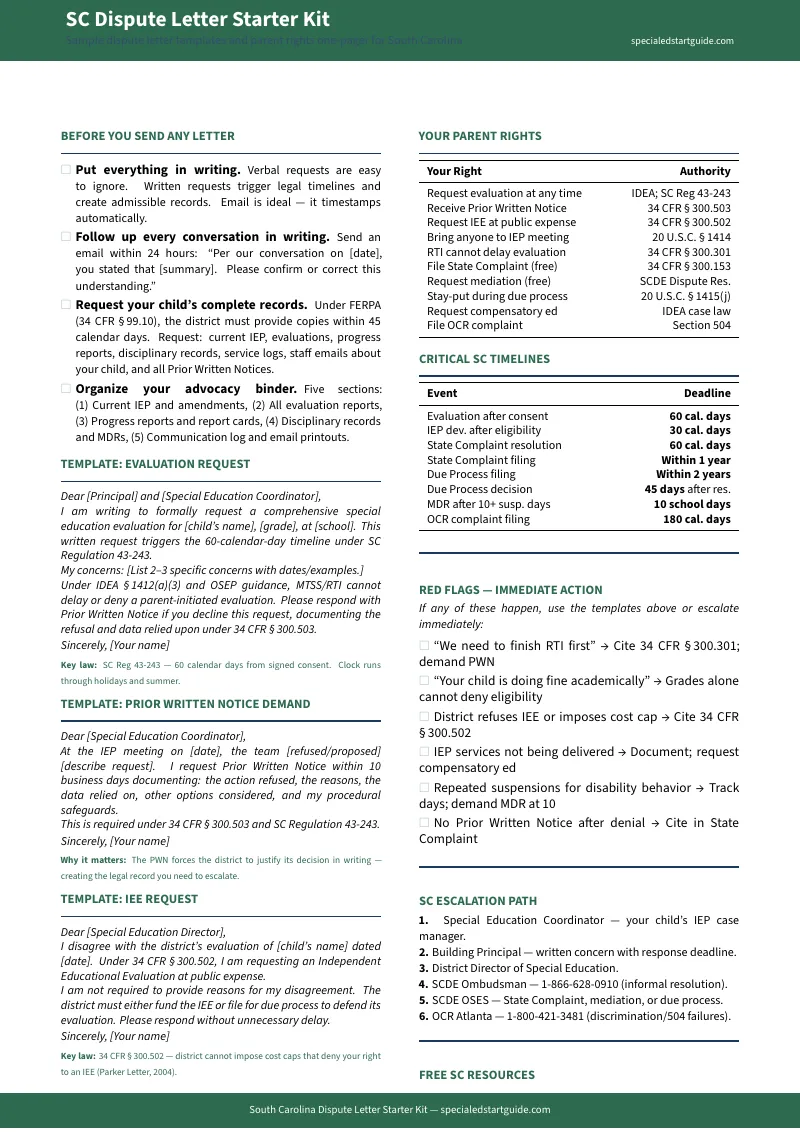
- Dispute Letter Starter Kit — the quick-reference checklist covering paper trail setup, core procedural rights with SC Reg 43-243 citations, IEE requests, discipline protections, escalation steps, and every key SC timeline
- Advocacy Letter Templates — fill-in-the-blank letters citing exact SC Reg 43-243 regulations for evaluation requests, IEE demands, Prior Written Notice requests, service non-delivery documentation, and FERPA records requests
- State Complaint Template — structured SCDE complaint filing template with required elements, evidence attachment guide, and mailing instructions
- Communication Log — printable documentation tracker for every call, meeting, and conversation — the systematic paper trail that wins cases
- MDR Preparation Checklist — step-by-step Manifestation Determination Review preparation including the two legal questions, documents to bring, key arguments, and FBA demand templates
- Dispute Escalation Ladder — visual roadmap from informal advocacy through SCDE Ombudsman, State Complaint, mediation, due process, and OCR complaint — with South Carolina-specific timelines at every stage
Instant PDF download. Print the dispute letter that matches your situation tonight. Send it before the district has another day to stall.
Money-back guarantee, no time limit. If the Playbook doesn't change how you handle disputes with your child's South Carolina school district, email us for a full refund. No questions asked.
Not ready for the full Playbook? Download the free South Carolina Dispute Letter Starter Kit — a printable checklist with the core procedural rights, evaluation timelines, discipline protections, and escalation steps every SC parent needs to know. It's enough to send your first enforcement letter tonight, and it's free.
The district has a team of administrators, a legal department, and a budget they'd rather not spend on your child. After tonight, you'll have the exact words to make them spend it anyway.