They Brought a Lawyer. You Brought a Highlighter. This Playbook Fixes That.
You already know your child deserves better. You've sat through the IEP meeting where six school professionals nodded along, cited acronyms you'd never heard, and slid a Notice of Recommended Educational Placement across the table. "Just check Approve and sign at the bottom." You didn't know that checking the wrong box — or missing the 10-day response window — could permanently strip your child's placement protections. You signed because they made it seem routine. It wasn't.
You've tried the free resources. You called the ConsultLine and left a voicemail — they called back three days later to read you the statute. You attended a PEAL Center webinar that assumed the school was acting in good faith. You downloaded the Education Law Center's fillable PDFs and stared at blank fields that told you to "be as specific as possible" without explaining what specific language actually triggers a legal obligation. You read Wrightslaw cover to cover and discovered it says nothing about Pennsylvania's NOREP, Chapter 14, or what to do when the Intermediate Unit and the school district blame each other for missed services.
The Pennsylvania IEP & 504 Advocacy Playbook is the Dispute Enforcement System — 18 fill-in-the-blank advocacy templates pre-loaded with 22 Pa. Code Chapter 14 citations, NOREP response protocols, ODR filing strategies, and the exact counter-arguments to every district excuse, from "we don't have the staff" to "your child doesn't qualify." This isn't a binder of blank pages. It's the tactical enforcement toolkit that turns vague parental rights into legally binding demands.
What's Inside the Playbook
The NOREP Dispute Protocol
The NOREP is the most dangerous document in Pennsylvania special education — and the one districts use to force changes you never agreed to. The Playbook walks you through every line, explains the exact consequences of each checkbox (Approve, Disapprove, Mediation, Due Process), maps the 10-calendar-day deadline that triggers implied consent if you miss it, and gives you the specific disapproval language that activates pendency rights — freezing your child's current placement while the dispute plays out. The follow-up letter template creates a paper trail the district cannot ignore.
18 Fill-in-the-Blank Advocacy Templates
Every template cites the exact Pennsylvania regulation that compels a response. Demand an initial evaluation and trigger the district's 10-day PTE deadline under 22 Pa. Code § 14.123(c). Request an Independent Educational Evaluation at public expense using the phrase that forces the district to either pay or file for due process. Challenge a NOREP you disagree with. Demand compensatory education for every missed service session. File a state complaint to the BSE Division of Compliance. Request mediation or due process through the ODR. Each letter creates a legally binding paper trail the moment you hit send — because "we discussed it at the meeting" doesn't hold up without documentation.
The "Staff Shortage" Rebuttal Script
Your district claims it can't fulfill the IEP because it can't hire a speech therapist, a paraprofessional, or a special education teacher. You've been told to accept reduced services as an unfortunate reality. Under IDEA and 22 Pa. Code Chapter 14, a district's inability to hire staff does not eliminate its legal obligation to deliver the services in your child's IEP. The Playbook provides the exact email language to reject this excuse, demand immediate compliance or compensatory education, and escalate to a formal state complaint when they don't respond.
The Dispute Resolution Escalation Ladder
When the district ignores your letters, Pennsylvania offers four formal paths through the Office for Dispute Resolution: IEP Facilitation, Mediation, State Complaint (60-day investigation by the BSE Division of Compliance), and Due Process Hearing. The Playbook maps each option — when it gives you maximum leverage, what it costs, the timeline, and the strategic difference between filing a single-issue due process request versus a comprehensive complaint. Pennsylvania allows you to contest one specific denial without putting the entire IEP at risk.
Compensatory Education Demands
When services are missed — speech sessions cancelled, aide hours not provided, evaluations delayed past the 60-day deadline — the district owes compensatory education. The Playbook shows you how to calculate what's owed, the documentation format that proves the deficit, and the demand letter that converts missed hours into a binding recovery plan. Districts routinely deny compensatory education claims from parents who can't specify what's owed in legally precise terms. This template removes that barrier.
The Intermediate Unit Accountability Framework
Pennsylvania's 29 IUs deliver specialized services — speech therapy, occupational therapy, behavioral support, preschool Early Intervention — to local school districts. When services fail, the district and the IU blame each other. The Playbook clarifies the legal chain: the district of residence is always liable for FAPE, even when the IU operates the program. For preschool children (ages 3–5), the IU itself functions as the LEA. The escalation templates address both scenarios.
Charter and Cyber Charter Enforcement
If your child attends a Pennsylvania charter or cyber charter school, that charter is the LEA under Chapter 711 — fully responsible for Child Find, evaluations, IEP development, and all related services. Cyber charters routinely fail to implement existing IEPs, especially for services requiring in-person delivery. The Playbook provides the compliance demand letter and the state complaint template specific to charter school violations.
Discipline Protection Protocols
When a child with a disability faces repeated suspensions, the 10-day cumulative removal rule triggers a Manifestation Determination Review (MDR). The school must determine whether the behavior was caused by or substantially related to the disability. If the answer is yes, the child returns to their placement — not the disciplinary alternative. The Playbook walks you through the MDR process, the Functional Behavioral Assessment demand, and the documentation that prevents your child from being disciplined for disability-related behavior.
Who This Playbook Is For
- Parents who've been handed a NOREP they disagree with and don't know how to respond without accidentally waiving their child's pendency rights
- Parents whose district has been cutting IEP services by claiming staff shortages — and who need the legal language to reject that excuse and demand compensatory education
- Parents navigating a dispute with the school and trying to decide between mediation, a state complaint, or due process through the ODR — and who can't afford an attorney to explain the difference
- Parents in Philadelphia, the collar counties, or Pittsburgh dealing with adversarial districts that spend hundreds of thousands on legal fees to fight parent claims
- Parents whose child receives services through an Intermediate Unit and can't determine who is responsible when those services aren't delivered
- Parents whose child attends a Pennsylvania cyber charter school and whose existing IEP is not being implemented
- Parents whose child has been suspended or faces disciplinary removal for behavior related to their disability — and who need to understand the Manifestation Determination process before the district acts
- Parents who've already purchased the Pennsylvania IEP & 504 Blueprint and are now facing an active dispute that requires escalation-level templates and strategy
Why Not Just Use the Free Resources?
- The PEAL Center trains you to collaborate — not to fight. PEAL is Pennsylvania's federally funded Parent Training and Information Center. They run excellent workshops on how the IEP process works. They are institutionally unable to provide aggressive enforcement strategies for when the school actively refuses to comply. They cannot give you the copy-paste language that corners a non-compliant IEP team — because their federal funding requires them to foster collaboration, not confrontation.
- The ELC-PA forms give you the shell — not the ammunition. The Education Law Center publishes legally accurate fillable PDFs for requesting evaluations, IEEs, and mediation. The forms tell you to "be as specific as possible" without providing the specific vocabulary, the legal citations, or the tactical framing that forces a district to act. A distressed parent writes an emotional paragraph. The district files it and does nothing. The Playbook gives you the exact words that trigger legal timelines.
- The ConsultLine is a callback service, not a crisis line. You leave a voicemail during business hours and wait. When they call back, they read you the statute — they cannot provide tactical advice on how to outmaneuver your specific district. At 10 PM the night before an ODR mediation, ConsultLine is functionally useless.
- Wrightslaw covers federal law — not Pennsylvania Chapter 14. Wrightslaw is the gold standard for IDEA. It does not explain the NOREP, the 60-day evaluation timeline (which excludes summers), the IU chain of command, or the ODR filing procedures. If you cite "Prior Written Notice" instead of "NOREP" in a Pennsylvania meeting, the district knows you're working from a national playbook.
- Private advocates cost $150–$300 per hour. Special education attorneys run $250–$700. Most families can't afford this — and advocates prefer cases where a solid paper trail already exists. This Playbook is how you build that trail before spending a dollar on legal fees.
The free resources explain what Pennsylvania law says. The Playbook gives you the templates to make the district follow it.
— Less Than 10 Minutes of a Special Education Attorney
Special education advocates in Pennsylvania charge $150–$300 per hour. Attorneys charge $250–$700. If you walk into a consultation with a disorganized timeline and no paper trail, you'll spend $600 before the attorney even understands your case. The Playbook gives you the organizational framework, the dispute templates, and the escalation strategy — either empowering you to resolve the dispute without legal representation, or saving you hundreds in billable hours when you do hire counsel.
Your download includes the complete Advocacy Playbook guide plus standalone printable PDFs — every template, reference card, and strategy document ready to use immediately.
- Complete Advocacy Playbook — 18 chapters covering Pennsylvania's advocacy landscape, Chapter 14 and Chapter 15 legal citations, evaluation timelines, the NOREP system, IEP meeting tactics, staff shortage rebuttals, dispute resolution through ODR, compensatory education demands, ESY services, discipline protections, transition planning, Approved Private Schools, charter and cyber charter accountability, documentation standards, special populations, 18 advocacy letter templates, Pennsylvania resources directory, and 2024–2026 regulatory updates
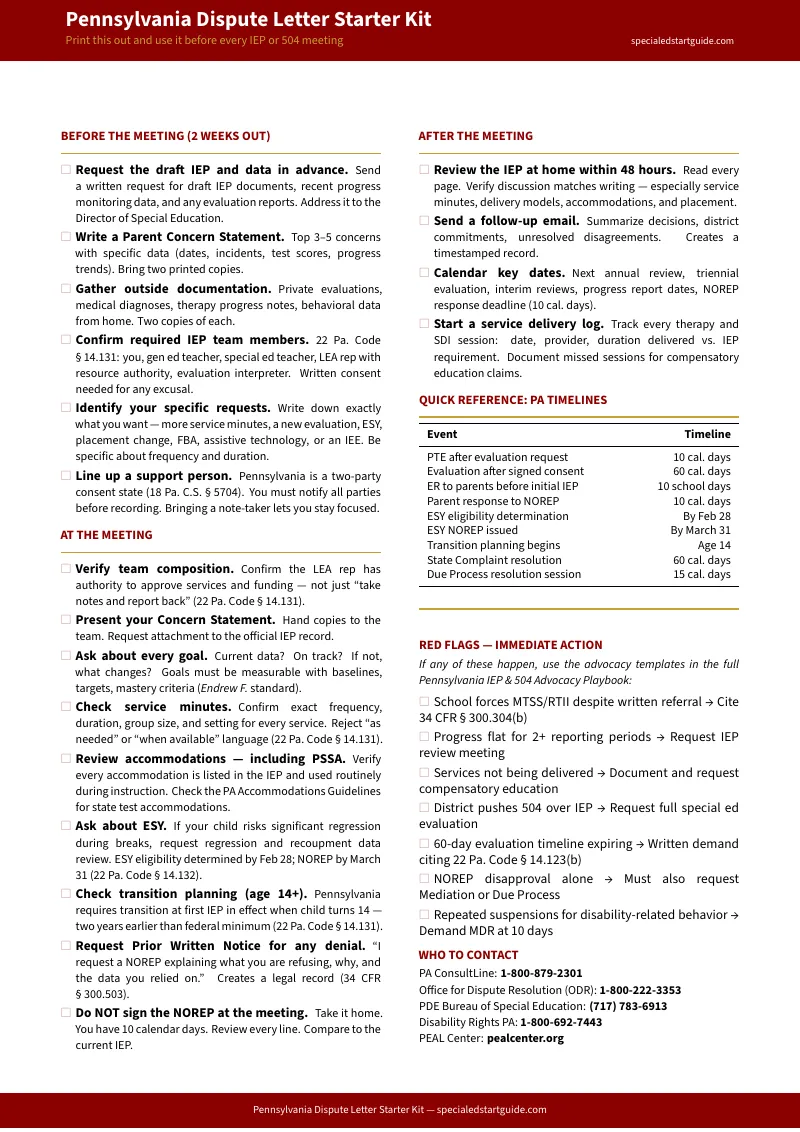
- Dispute Letter Starter Kit — 4 ready-to-send templates: initial evaluation request, NOREP demand, IEE request at public expense, and staff shortage / missed services demand with Pennsylvania-specific citations
- NOREP Response Quick-Reference Card — checkbox-by-checkbox breakdown of the NOREP with pendency trigger instructions and the 10-day deadline mapped
- Dispute Resolution Pathway Card — side-by-side comparison of IEP Facilitation, Mediation, State Complaint, and Due Process with timelines, costs, and strategic guidance
- Compensatory Education Calculator Card — how to calculate missed hours, document the deficit, and convert it into a binding recovery demand
Instant PDF download. Print the templates tonight. Send the first letter before the 10-day clock runs out.
Money-back guarantee, no time limit. If the Playbook doesn't change how you handle disputes with your Pennsylvania school district, email us for a full refund. No questions asked.
Not ready for the full Playbook? Download the free Pennsylvania Dispute Letter Starter Kit — four ready-to-send templates covering evaluation requests, NOREP demands, IEE requests, and staff shortage rebuttals, each with Pennsylvania-specific legal citations. It's enough to start building your paper trail tonight, and it's free.
The district has a legal team. After tonight, you'll have the law.