
The District Knows Oregon Administrative Rules. Now You Will Too.
You walked into that IEP meeting prepared — or you thought you did. You read the FACT Oregon toolkit. You printed the ODE procedural safeguards notice. You wrote down your concerns. And then the team smiled, spoke in acronyms — PLAAFP, LRE, OAR, PWN, FAPE — and told you your child "doesn't qualify" or that certain services "aren't available through the ESD right now."
You left the meeting with the same IEP your child walked in with. No additional minutes. No new assessments. No Prior Written Notice explaining why they refused your requests — because you didn't know to ask for one.
The problem isn't that you're uninformed. The problem is that Oregon's special education system is specifically designed to be navigated by professionals, not parents. Over 190 school districts with different budgets and staffing levels. Education Service Districts that provide specialized services across entire regions — until your child needs one and the ESD blames the local district and the local district blames the ESD. A 60-school-day evaluation timeline that districts blow past citing "staffing shortages" — as if a lack of resources is a legal defense for denying your child a Free Appropriate Public Education. And an abbreviated school day epidemic where districts send children home after a few hours because they lack the support staff to manage complex behavioral needs, while framing it as a "safety plan" rather than the FAPE violation it actually is.
The Oregon IEP & 504 Blueprint is the tactical enforcement toolkit that bridges the gap between knowing your rights and actually exercising them — with every template, script, and checklist grounded in OAR Chapter 581, Division 15.
What's Inside the Blueprint
The Copy-Paste Advocacy Letter Library
Every letter cites the exact Oregon Administrative Rule. Request an initial evaluation and start the district's 60-school-day clock under OAR 581-015-2110. Demand Prior Written Notice when the team refuses any request under 34 CFR §300.503. Formally refuse an abbreviated school day and cite Senate Bill 819's strict 10-day limit. Request an Independent Educational Evaluation at public expense when the district's assessment misses the diagnosis. These aren't generic samples — they're Oregon-specific enforcement tools that create a legally binding paper trail the moment you hit send.
The Abbreviated Day Combat Protocol
Oregon districts have historically sent children with complex behavioral needs home after a few hours — framing shortened schedules as "safety plans" or "gradual transitions." Under Senate Bill 819, abbreviated days beyond 10 school days require strict documented parental consent and measurable reintegration goals. The Blueprint gives you the step-by-step sequence for formally refusing a shortened schedule, demanding a Functional Behavioral Assessment, and forcing the provision of adequate behavioral supports within a full school day. Most parents don't know this right exists. Districts count on that.
The Oregon Diploma Pathway Matrix
The difference between a Standard Diploma (24 credits) and a Modified Diploma (12 credits) isn't just academic — it determines whether your child can apply to Oregon's four-year universities or enlist in the armed forces. IEP teams under pressure to improve graduation rates often present the Modified Diploma as the path of least resistance without explicitly warning you about the post-secondary consequences. The Blueprint maps every diploma option under OAR 581-022-2010, details what you're consenting to, and provides the scripts for refusing a Modified track when you believe your child can achieve the Standard Diploma with proper accommodations.
The ESD Navigation Guide
Oregon uses Education Service Districts — Northwest Regional, Multnomah, Lane, and others — to provide specialized services like autism classrooms, behavioral day treatment, and early intervention. When disputes arise, the local district blames the ESD for a lack of program slots, and the ESD claims the district hasn't completed the referral paperwork. The Blueprint cuts through this shell game with one fact: your local resident district is always legally responsible for your child's IEP, regardless of which entity delivers the services. It shows you how to hold the right people accountable.
IEP Meeting Scripts and Checklists
What to say when the team tells you your child is "making progress" but the data shows otherwise. What to say when they offer a 504 instead of an IEP. What to say when the administrator claims they don't have the staff. Each script cites the specific OAR or federal regulation that proves them wrong — so you're not arguing opinions, you're citing law. The pre-meeting checklist covers recording notices, team composition verification, Parent Concern Statements, and the specific documents to request 48 hours before the meeting.
Goal-Tracking Worksheets
IEP goals are legally required to be measurable — with baselines, targets, and mastery criteria that meet the Endrew F. standard. But many goals are written so vaguely that progress is impossible to track. The worksheets give you a structured format to log data between meetings, compare school-reported progress against your own observations, and arrive at the annual review with documentation that either confirms the program is working or proves it isn't.
School Discipline Protections
When cumulative suspensions reach 10 days, the district must conduct a Manifestation Determination Review to decide whether the behavior was caused by or substantially related to the disability. The Blueprint walks through Oregon's specific restraint and seclusion reporting requirements, explains the evidence you need to prevent your child from being pushed out of school for disability-related behavior, and provides the documentation templates for challenging a disciplinary removal.
The Dispute Resolution Roadmap
When informal advocacy fails, you have four escalation options in Oregon: filing a state complaint with the ODE, requesting a Facilitated IEP meeting (free, neutral facilitator), requesting mediation, or filing for due process. The Blueprint explains when each option gives you maximum leverage, the timeline and costs involved, and how the paper trail you've been building with the advocacy templates becomes the evidence that wins your case — or convinces the district to settle before you ever reach a hearing.
Who This Blueprint Is For
- Parents whose child is being sent home early on abbreviated days — and who need the legal tools to demand a full school day and a Functional Behavioral Assessment under Senate Bill 819
- Parents who've been told their child "doesn't qualify" for an IEP despite holding a medical diagnosis — and who need the legal language to challenge that determination under OAR 581-015
- Parents in Portland Public Schools, Beaverton, Salem-Keizer, Eugene 4J, or any Oregon district where IEP services are chronically underdelivered and meetings feel predetermined
- Parents caught in the ESD-versus-district finger-pointing and unsure who is legally responsible for their child's services
- Parents navigating the 504-to-IEP question — unsure whether their child's current plan is legally sufficient or whether they should push for a full evaluation
- Parents preparing for their first IEP meeting who don't want to walk in outnumbered against a team that does this every day
- Parents whose IEP team is recommending a Modified Diploma and who need to understand the long-term consequences before they sign
Why Not Just Use the Free Resources?
Oregon has excellent free special education resources. FACT Oregon provides peer support and toolkits. Disability Rights Oregon publishes the Short School Day Parent Tool Kit. The ODE issues procedural safeguards notices. Here's why parents still struggle after consulting all of them:
- FACT Oregon operates on a collaborative mandate and a 48-to-72-hour callback window. They do critical empowerment work. But when the district emails an inadequate IEP amendment on Friday afternoon and your response window is ticking, FACT Oregon cannot provide the instant, adversarial strategy you need. They will not draft combative demand letters against the very districts the state oversees. The Blueprint is available the moment the crisis hits.
- Disability Rights Oregon publishes legal briefs, not playbooks. Their Short School Day Parent Tool Kit is authoritative and heavily researched. It reads like it was written for attorneys — because it was. For a parent in crisis, the gap between understanding a right and exercising it is the gap between reading a statute and sending the email that cites it.
- Wrightslaw covers federal law — not Oregon Administrative Rules. Attempting to use Wrightslaw to solve a local dispute is akin to reading the entire tax code to file a personal return. The Blueprint strips away the national data that doesn't apply and focuses on how federal IDEA interacts with OAR Chapter 581, Division 15 — the specific rules your district is actually bound by.
- Etsy and TPT planners organize paperwork — they don't enforce rights. A pastel IEP binder helps you keep documents in order. It won't tell you what an ESD is, how Senate Bill 819 restricts abbreviated days, or how to cite OAR 581-015-2110 to force the 60-school-day evaluation timeline. Generic federal templates miss every Oregon nuance that actually determines your outcome.
The free resources explain what the law says. The Blueprint gives you the tools to make the district follow it.
— Less Than 3 Minutes of a Special Education Attorney
Special education attorneys in Oregon charge $250 to $700 per hour. A private educational advocate runs $100 to $300 per hour — and the industry is entirely unregulated, with no licensing, no certification, and no standardized training. Even if you eventually need professional help, the meticulous paper trail you build with this Blueprint saves thousands in billable hours — because you're handing your attorney an organized case, not a folder of unsigned IEP copies and half-remembered conversations.
Your download includes the complete Blueprint guide plus 8 standalone printable PDFs — every template, worksheet, script, and reference card, ready to print and bring to your next meeting.
- Complete Blueprint Guide — 16 chapters covering evaluation timelines, IEP development, 504 plans, the abbreviated day crisis, diploma pathways, ESD navigation, school discipline, IEEs, transition planning, ESY, assistive technology, dispute resolution, and district-specific strategies for Portland, Beaverton, Salem-Keizer, and Eugene
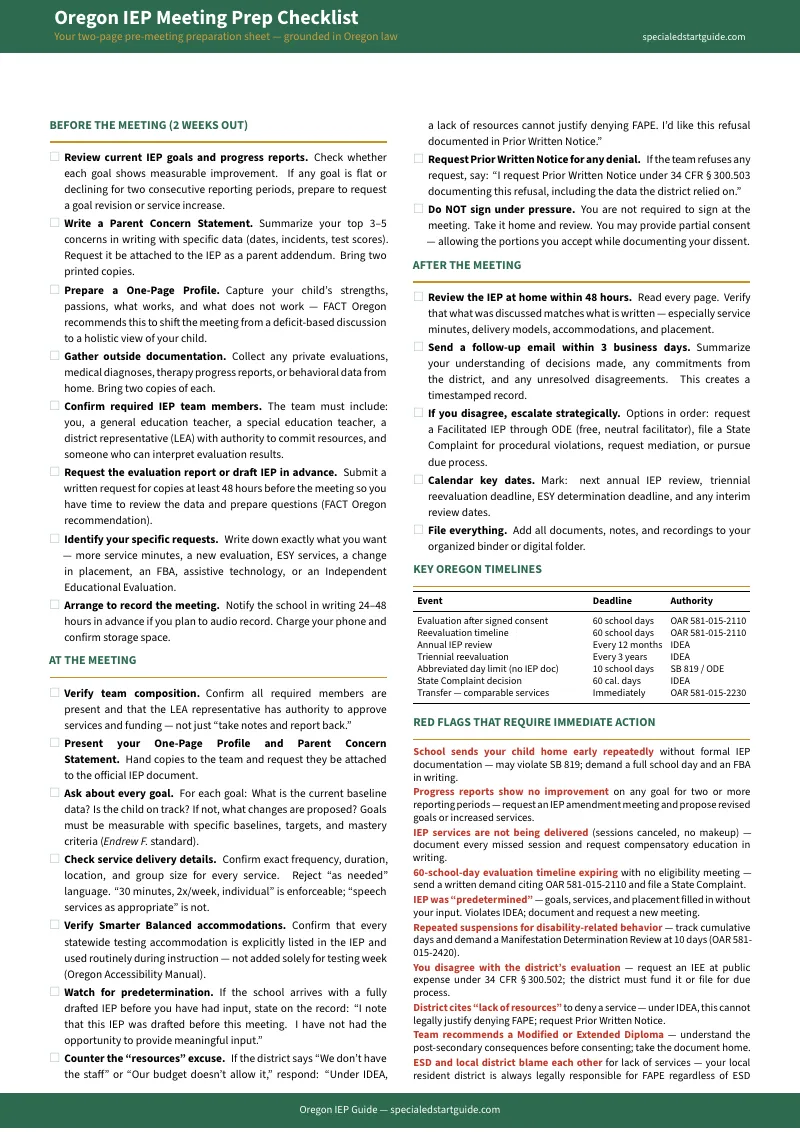
- IEP Meeting Prep Checklist — the before/during/after checklist with Oregon timelines, OAR 581-015 citations, and red flags requiring immediate action
- Advocacy Letter Templates — copy-paste letters citing exact OAR and federal sections for evaluations, IEEs, Prior Written Notice demands, abbreviated day refusals, service delivery failure documentation, and ODE state complaint narratives
- Goal-Tracking Worksheet — structured fillable worksheet for measurable progress monitoring between annual reviews
- Oregon Timeline Cheat Sheet — every legal deadline on one page: 60-school-day evaluation, annual reviews, triennial reevaluations, transfer rules, abbreviated day limits, and dispute resolution windows
- IEP Meeting Scripts — word-for-word responses to common district pushback tactics, each citing the specific OAR or federal regulation
- Abbreviated Day Refusal Template — the complete letter and documentation sequence for formally refusing a shortened school day under Senate Bill 819
- Diploma Pathway Reference Card — side-by-side comparison of Standard, Modified, Extended, and Alternative Certificate options with post-secondary consequences
- Dispute Resolution Roadmap — your four formal options when advocacy fails, with a comparison table
Instant PDF download. Print the templates tonight. Walk into tomorrow's meeting with the law on your side.
Money-back guarantee, no time limit. If the Blueprint doesn't change how you approach IEP meetings in Oregon, email us for a full refund. No questions asked.
Not ready for the full Blueprint? Download the free Oregon IEP Meeting Prep Checklist — a printable pre-meeting checklist with Oregon timelines, OAR 581-015 citations, team composition requirements, and red flags that require immediate action. It's enough to walk into your next meeting prepared, and it's free.
Your child's education is a legal right, not a favor. The district knows Oregon law. After tonight, so will you.