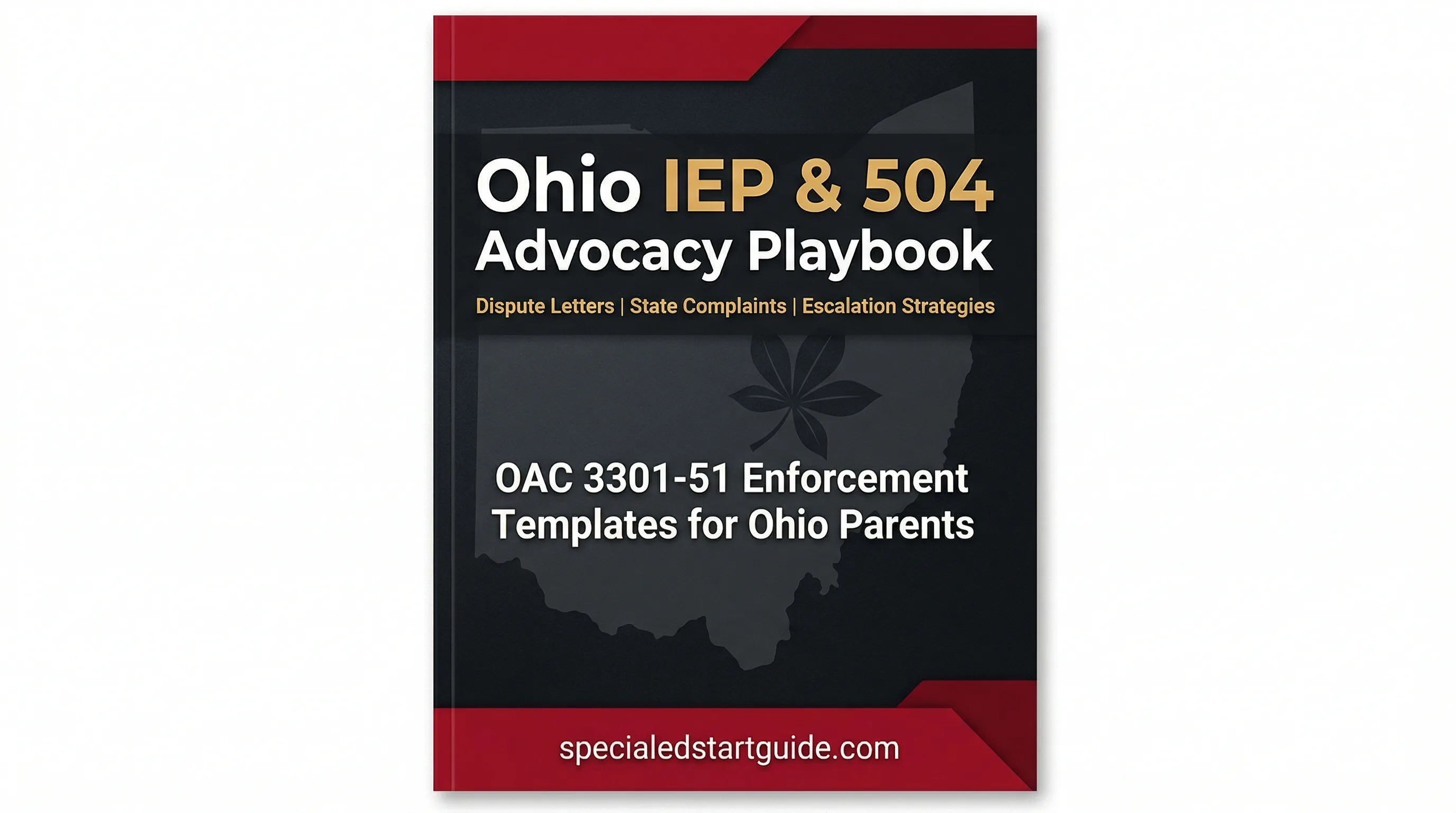
The District Said No. Ohio Law Says Otherwise.
You've already sat through the IEP meetings. You've already been told your child "doesn't qualify." You've already watched the team present a predetermined outcome with practiced smiles and clinical language designed to make you feel like you're overreacting. You've already filed the evaluation request that disappeared into a voicemail. You've already been told to "give MTSS more time" while your child falls further behind — in direct violation of OAC 3301-51-06.
Now you're past the point of polite collaboration. The school isn't listening because you're asking. They'll listen when you cite the law — the specific Ohio Administrative Code section, the specific form number, the specific calendar-day deadline they missed — and put it in writing.
The Ohio Advocacy Enforcement System is the dispute-ready toolkit that transforms your frustration into legally precise, documented pressure. Every template, every escalation path, every strategy is grounded in OAC 3301-51 and ORC Chapter 3323 — not generic federal advice that Ohio districts know how to sidestep.
What's Inside the Playbook
The Dispute Letter Arsenal
Pre-written advocacy letters with exact OAC 3301-51 citations already embedded. Demand Prior Written Notice on Form PR-01 when the district refuses services — forcing them to explain, in writing, why they said no and what data they used to justify it. Request an Independent Educational Evaluation at public expense using the specific legal phrase that triggers the district's obligation to either fund it or file for due process within Ohio's legal framework. Challenge an ETR that diluted or omitted clinical recommendations. Escalate missed service minutes with a formal implementation violation letter. Every letter is copy-and-paste ready — fill in names, dates, and specific facts, then send it tonight.
The ETR Challenge Strategy
Ohio's Evaluation Team Report (PR-06) is where eligibility decisions live or die — and it's written in clinical language designed for school psychologists, not for you. The Playbook teaches you how to cross-reference Part 1 (Individual Evaluator's Assessment) against Part 2 (Summary of Assessments) to catch when the team softens a speech-language pathologist's clinical finding, omits an occupational therapist's recommendation, or reclassifies a deficit as "not educationally relevant." When the ETR is wrong, you have the right to demand an Independent Educational Evaluation — and this toolkit gives you the exact template to do it.
The ODEW State Complaint Builder
Filing a state complaint with the Ohio Department of Education and Workforce (ODEW) Office for Exceptional Children triggers a mandatory 60-day investigation. It is the most powerful enforcement tool available to Ohio parents — and most parents don't know how to use it. The Playbook walks you through the narrative structure, the evidence requirements, the specific violations to allege, and the remedies to request. It includes a complaint template pre-loaded with OAC 3301-51 citations covering the most common violations: missed evaluation timelines, failure to implement IEP services, predetermined meetings, and refusal to provide Prior Written Notice.
The Dispute Escalation Ladder
Not every fight requires a due process hearing. The Playbook maps your formal options in order of severity: early resolution meetings, ODEW state complaints, state-sponsored mediation, facilitated IEP meetings, and due process hearings. Critically, in Ohio the burden of proof at a due process hearing falls on the filing party. That means the paper trail you build before you ever file determines whether you win. The Playbook explains which path gives you maximum leverage based on what the district did wrong — and when to stop escalating because you've already won.
The Implementation Monitoring System
An IEP that isn't implemented is an IEP that doesn't exist. The Playbook gives you a structured tracking system for documenting every missed therapy session, every SDI session that ran short, every related service that was "rescheduled" and never delivered. You'll log actual delivery against what the IEP requires, calculate the cumulative service gap, and build the compensatory education claim that gives you leverage at the next IEP meeting — or at a due process hearing if the district refuses to make it right.
The Manifestation Determination Defense
When a student with a disability faces suspension beyond 10 cumulative school days, the district must hold a Manifestation Determination Review (MDR) to decide whether the behavior was caused by or substantially related to the disability. Districts frequently rush these reviews, fail to consider the relationship between the behavior and the disability, or conduct them without the required team members. The Playbook covers what must happen at an MDR, the specific OAC citations that govern the process, how to challenge a finding that the behavior was not a manifestation, and your options when the district skips the process entirely.
The Scholarship Trap Navigator
Ohio's Jon Peterson Special Needs Scholarship provides up to approximately $30,000 per year — but requires an active, finalized IEP from your public district of residence. The Autism Scholarship provides up to $32,445 with an Autism Education Plan. Both require continued engagement with the public school system. And if you accept an EdChoice voucher instead, you lose FAPE protections entirely. The Playbook explains exactly which scholarship preserves your advocacy rights, which ones eliminate them, and how to force the district to finalize the IEP you need to access funding — even when they're dragging their feet because they'd rather you leave.
Who This Playbook Is For
- Parents who have already tried the collaborative approach and been ignored, delayed, or gaslit by the IEP team — and who need the legal citations to force the district to respond
- Parents whose child's IEP services are not being delivered as written — missed therapy sessions, canceled SDI, unfilled specialist positions — and who need to document the violations and demand compensatory education
- Parents whose evaluation request was denied, delayed, or funneled into MTSS — and who need the OAC 3301-51-06 template that triggers the district's legal obligation to evaluate
- Parents preparing to file their first ODEW state complaint and who need the narrative structure, evidence requirements, and legal citations that trigger the 60-day investigation
- Parents facing a Manifestation Determination Review after their child was suspended for behavior related to their disability — and who need to understand the process before they walk in
- Parents in Columbus, Cleveland, or Cincinnati navigating overwhelmed special education departments with documented compliance failures and systemic overcrowding
- Parents in rural or Appalachian Ohio where specialist shortages mean IEP services exist on paper but are rarely delivered at the required frequency
- Parents exploring the Jon Peterson or Autism Scholarship who need to understand the IEP requirements and FAPE trade-offs before making an irreversible decision
- Parents who have been advised to hire a special education attorney but cannot afford $150–$400 per hour — and who need to build the documented case that makes eventual representation more effective and less expensive
Why Not Just Use Free Resources or Hire an Attorney?
- OCECD teaches collaboration — not enforcement. Ohio's federally funded Parent Training and Information Center explains what the law says. It does not provide dispute letter templates, state complaint narratives, or escalation strategies for when the district actively ignores the law. Their institutional mandate requires fostering partnerships — which doesn't help when the partnership has broken down.
- Disability Rights Ohio is overwhelmed. DRO focuses on systemic class-action litigation and cannot take every individual case. Their intake hours are limited to weekdays 9am–noon and 1–4pm. If your IEP meeting is tomorrow morning, they are not your answer.
- Wrightslaw covers IDEA — not OAC 3301-51. Wrightslaw is the gold standard for federal special education law. It does not cover Ohio's PR-06 ETR form, the state's specific 30-day and 60-day evaluation timelines, the ODEW state complaint process, or how Ohio's scholarship programs interact with IEP rights. Federal advice leaves gaps at the Ohio IEP table.
- Attorneys cost $150–$400 per hour. Most families cannot afford this — particularly families already absorbing the income deficit that comes with raising a child with a disability. And attorneys prefer cases where a documented paper trail already exists. This Playbook builds that paper trail — making eventual representation more effective and saving hundreds in billable hours.
Free resources explain what the law says. This Playbook gives you the templates to make the district follow it.
— Less Than 10 Minutes of a Special Education Attorney
Special education attorneys in Ohio charge $150–$400 per hour. Private advocates run $75–$150. Even if you eventually need professional help, the meticulous paper trail you build with this Playbook saves hundreds in billable hours — because you're handing your attorney an organized case file, not a folder of unsigned IEP copies and half-remembered conversations.
Your download includes 8 printable PDFs — the complete Advocacy Playbook guide plus 7 standalone tools you can print and use tonight.
- Complete Advocacy Playbook Guide — 10 chapters covering the Ohio advocacy landscape, IEP vs. 504 framework, evaluation timelines and MTSS defense, ETR decoding strategy, IEP meeting negotiation, implementation monitoring, dispute resolution escalation, discipline and behavior protections, scholarship navigation, and Ohio advocacy resources
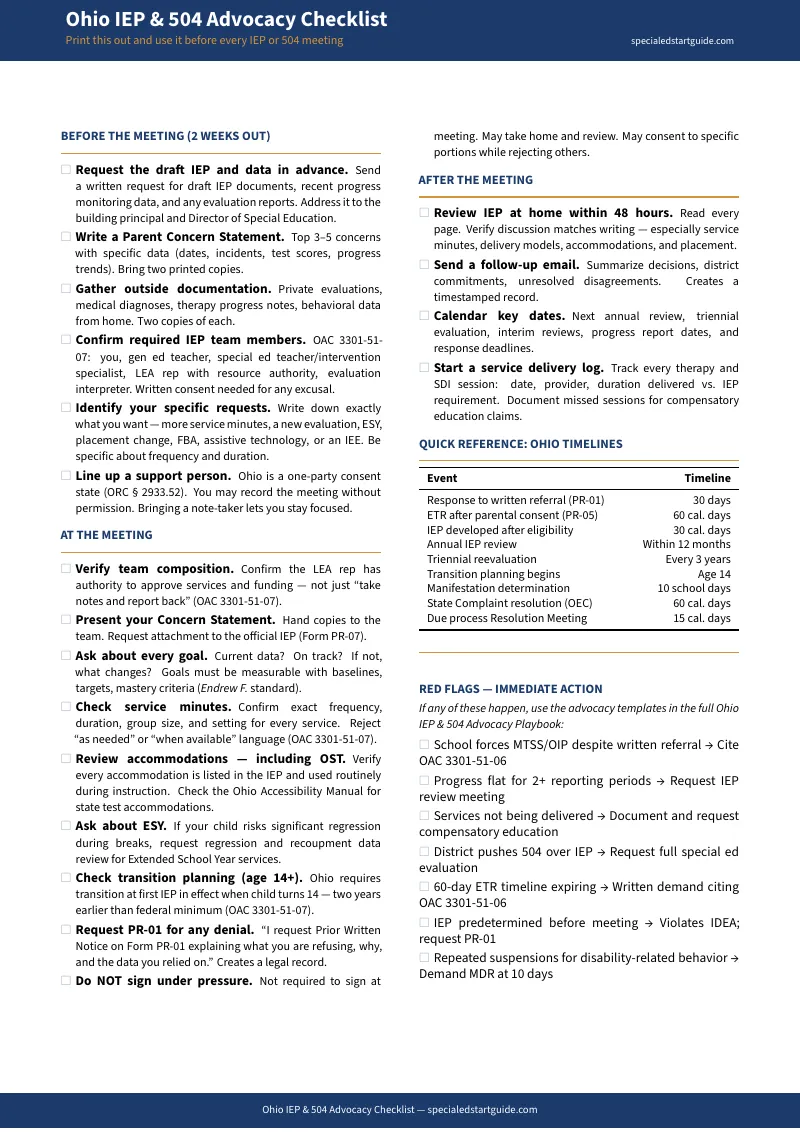
- IEP Meeting Prep Checklist — before/during/after protocol with Ohio timelines, OAC 3301-51 citations, team composition requirements, and one-party consent recording rights
- Advocacy Letter Templates — 7 ready-to-send letters with OAC citations for evaluation requests, IEE demands, MTSS bypass, implementation violations, ETR challenges, PR-01 demands, and state complaint cover letters
- Dispute Resolution Roadmap — 4-tier escalation flowchart from early resolution through due process, with timelines, costs, and burden-of-proof comparison
- Ohio Timeline Cheatsheet — every Ohio special education deadline on one printable card: evaluation, IEP, complaint, and due process filing windows
- Goal Tracking Worksheet — fillable service delivery log for documenting missed sessions and building compensatory education claims
- IEP Meeting Scripts — 10 word-for-word scripts citing Ohio law for requesting evaluations, demanding PR-01, challenging predetermined outcomes, and invoking recording rights
- Scholarship Decision Card — Jon Peterson vs. Autism Scholarship vs. EdChoice comparison with eligibility, funding caps, and FAPE trade-off decision tree
Instant PDF download. Print the dispute letters tonight. Send your first advocacy email before the week is over.
Money-back guarantee, no time limit. If the Playbook doesn't change how you approach IEP disputes in Ohio, email us for a full refund. No questions asked.
Not ready for the full Playbook? Download the free Ohio IEP Meeting Prep Checklist — the before/during/after protocol with Ohio timelines, OAC 3301-51 citations, and team composition requirements. It's enough to walk into your next IEP meeting prepared, and it's free.
The district knows OAC 3301-51. After tonight, you'll know how to enforce it.