The District Knows North Dakota Law. Now You Will Too.
You sat in that IEP meeting and did everything right. You brought your notes. You stayed calm. You asked good questions. And the team smiled, used acronyms you'd never heard, and explained that your child "doesn't meet criteria" — or that the service you requested "isn't something we can provide at this time."
You left the meeting with the same IEP your child walked in with. No new services. No additional minutes. No written explanation of why they refused your request — because you didn't know to demand one.
The problem isn't that you're uninformed. The problem is that North Dakota's special education system has features that generic national guides never mention. Twenty multidistrict special education units sharing itinerant specialists across vast rural distances. A 60-calendar-day evaluation timeline that does not stop for school breaks — and that districts routinely blow past when parents don't track it. Dyslexia screening mandates under NDCC 15.1-32-26 that many schools quietly ignore. And a state where the special education director might also be your neighbor, your church deacon, or your kid's baseball coach.
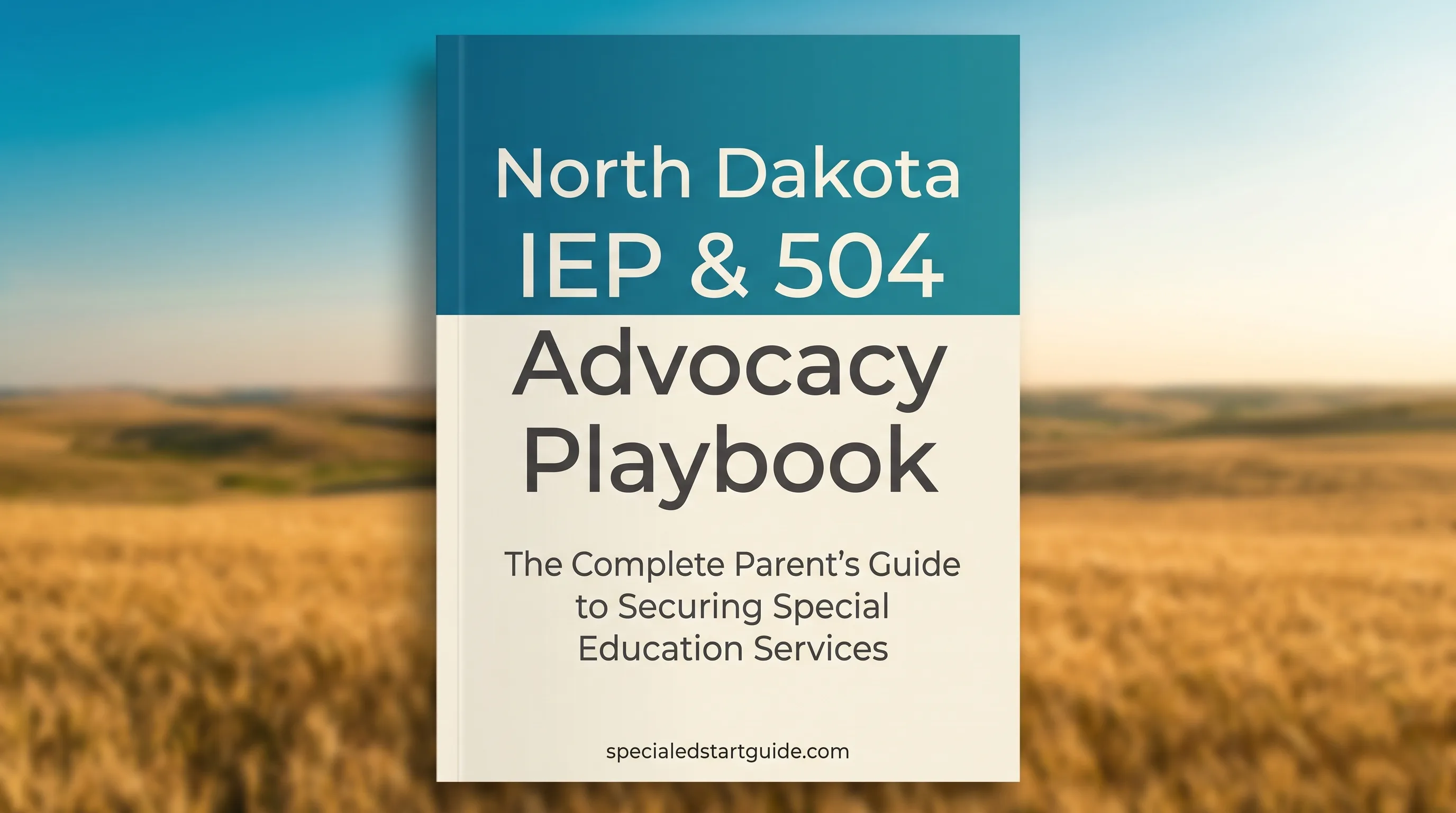
The North Dakota IEP & 504 Advocacy Playbook is a tactical enforcement toolkit — the Collaborative Leverage System — that gives you the exact words to say, the exact letters to send, and the exact North Dakota statutes to cite when the district says no. Not to start a fight. To depersonalize it. You're not arguing with your neighbor — you're citing the law.
What's Inside the Playbook
The Copy-Paste Advocacy Letter Library
Every letter cites the exact statute. Request an initial evaluation and start the district's 60-calendar-day clock. Demand an Independent Educational Evaluation at public expense under 34 CFR § 300.502. Request Prior Written Notice when the team refuses anything verbally. Challenge an MTSS delay by citing 34 CFR § 300.301(b) and NDDPI guidance. These aren't generic samples — they're North Dakota enforcement tools that create a legally binding paper trail the moment you hit send.
The Multidistrict Unit Decoder
North Dakota is one of the few states where special education is delivered through 20 regional multidistrict units pooling resources across rural districts. Most parents don't know their unit exists, who its director is, or that this person — not the building principal — often holds the authority to approve services and allocate funding. The Playbook explains how this structure works, how to confirm the LEA representative at your IEP meeting actually has decision-making authority, and what to do when the person the district sends says "I'll have to check with my director about that."
The 60-Calendar-Day Tracker
Once you sign consent for an initial evaluation, North Dakota requires the district to complete all assessments, compile the Integrated Written Assessment Report, and hold the eligibility meeting within 60 calendar days. Calendar days — not school days. The clock does not stop for winter break, spring break, or holidays. The Playbook gives you the exact follow-up language to send when day 55 arrives and you've heard nothing, plus the escalation path when the district misses the deadline entirely.
The Small Town Strategy Guide
No national guide addresses the reality of advocating in a community where the special education director goes to your church, your kids play on the same soccer team, and pushing back feels like declaring war on everyone you know. This dedicated chapter teaches you how to use legal standards to depersonalize the conflict — citing NDCC 15.1-32 instead of pointing fingers — so you can enforce your child's rights without burning every relationship in town.
The Dyslexia Screening Enforcer
Under NDCC 15.1-32-26, North Dakota mandates universal dyslexia screening for children seven and younger, covering phonemic awareness, decoding, and spelling. If your child is struggling to read and the school hasn't screened for dyslexia, this chapter gives you the exact statute to cite and the letter to send. It is a state mandate, not a suggestion.
IEP Meeting Scripts and Checklists
What to say when the team tells you "we don't have the staff for that." What to say when they offer a 504 instead of an IEP. What to say when they claim MTSS must come before an evaluation. Each script cites the federal or state provision that proves them wrong — so you're not arguing opinions, you're citing law. The pre-meeting checklist covers team composition verification, draft IEP review, recording notification, and the specific documents to bring.
The Dispute Resolution Roadmap
When informal advocacy fails, North Dakota offers four tiers: IEP facilitation (free, through NDDPI), mediation (free, voluntary, legally binding), state complaints (60-day resolution timeline), and due process hearings. The Playbook explains when each option is appropriate, the timelines and procedures, and how the paper trail you've built with the advocacy templates becomes the evidence that wins your case — or convinces the district to settle before you reach a hearing.
Who This Playbook Is For
- Parents whose child was denied an evaluation or told "let's try more interventions first" — and who need the legal language to override that delay
- Parents in rural districts or multidistrict units where the nearest speech therapist is shared across five schools and services keep getting cut
- Parents preparing for their first IEP meeting who don't want to walk in blind against a team that does this every day
- Parents who suspect the district isn't delivering the therapy minutes listed in the IEP but have no documentation to prove it
- Military families who PCS'd to Minot AFB or Grand Forks AFB and need to force the new district to honor an out-of-state IEP
- Parents navigating the overlap between reservation schools and North Dakota public school special education mandates
- Parents who've been offered a 504 Plan when their child actually needs an IEP — and who need to know the difference and how to push back
Why Not Just Use the Free Resources?
North Dakota has good free special education resources. Pathfinder Parent Center offers phone consultations and webinars. NDDPI publishes a 72-page Parent Guide to Special Education. The Protection & Advocacy Project provides legal help for qualifying families. Here's why parents still struggle after consulting all of them:
- Pathfinder is federally funded and must stay neutral. They explain your rights and offer excellent training — but they cannot draft adversarial demand letters for you or advise you on aggressive legal maneuvers. They explicitly state they are "not a legal firm." The Playbook provides the tactical templates that government-funded centers aren't permitted to supply.
- The NDDPI Parent Guide is 72 pages of bureaucratic legalese. It outlines the law but doesn't teach you how to negotiate. It lacks fill-in-the-blank templates and tactical advice for when the school refuses to comply. For a parent in crisis, the gap between knowing a right exists and actually exercising it is where most families lose.
- Protection & Advocacy has strict eligibility and limited capacity. Most families dealing with standard IEP disputes — arguing over speech therapy minutes or evaluation scope — won't qualify for direct legal representation. The Playbook equips you to handle the 80% of IEP conflicts that don't require an attorney.
- Etsy and TPT planners organize paperwork — they don't enforce rights. A pastel IEP binder keeps documents tidy. It won't tell you about multidistrict unit authority, the 60-calendar-day evaluation rule, or how to cite NDCC 15.1-32-26 to force a dyslexia screening. Generic federal templates miss every North Dakota nuance that determines your outcome.
Free resources explain what the law says. This Playbook gives you the tools to make the district follow it.
— Less Than 10 Minutes of an Advocate's Time
A private special education advocate in rural areas charges $100–$125 per hour. An attorney runs $300 or more. Even if you eventually need professional help, the meticulous paper trail you build with this Playbook saves thousands in billable hours — because you're handing your advocate an organized case file, not a stack of unsigned IEP copies and half-remembered conversations.
Your download includes 7 PDFs — the complete 12-chapter Playbook plus 6 standalone printable tools you can use immediately:
- Complete Advocacy Playbook (guide.pdf) — 12 chapters covering evaluations, IEP meetings, paper trails, dispute resolution, discipline protections, the small town strategy, homeschooling and private placement, key contacts, common scenarios, and your ongoing advocacy routine
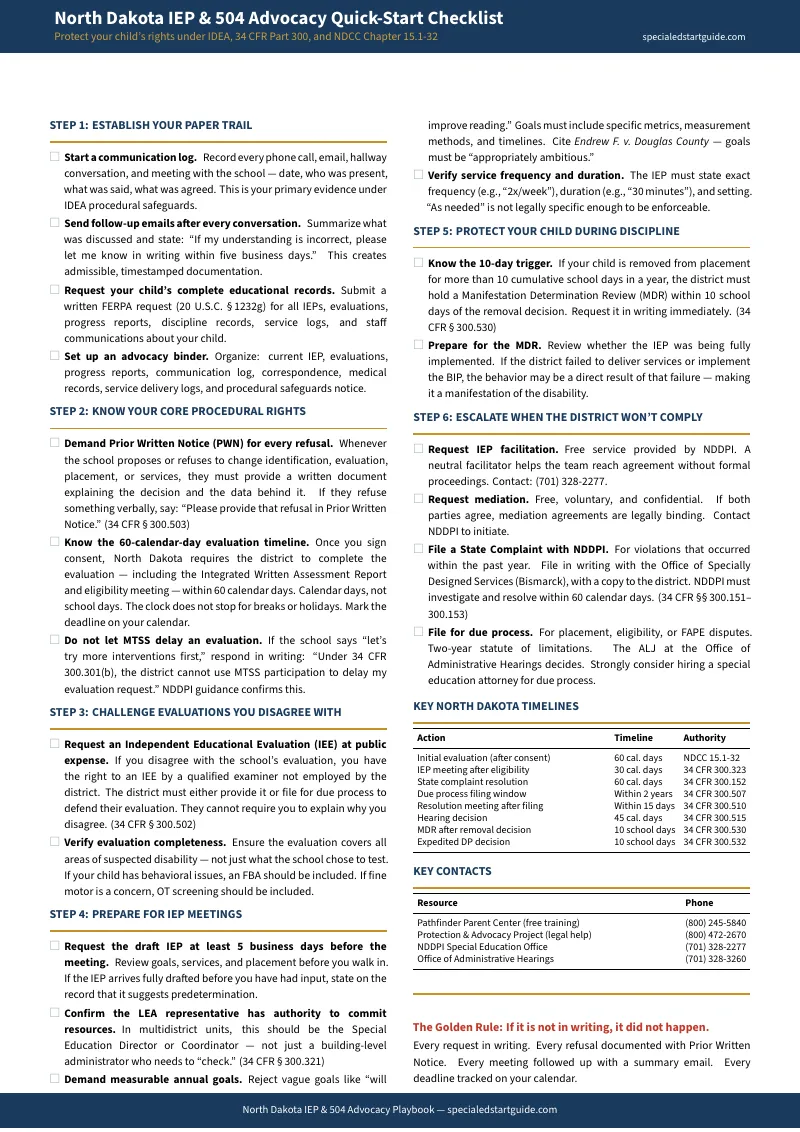
- Quick-Start Checklist (checklist.pdf) — the step-by-step action plan with North Dakota timelines, legal citations, and key contacts — print it and pin it to your fridge
- Advocacy Letter Templates (advocacy-letters.pdf) — 9 copy-paste letters citing NDCC 15.1-32 and federal law, from evaluation requests to state complaint filings
- IEP Meeting Scripts (iep-meeting-scripts.pdf) — pre-meeting checklist, 7 word-for-word responses to common district pushback, and a what-to-bring list
- Dispute Resolution Quick Reference (dispute-resolution-guide.pdf) — all 4 escalation tiers compared side-by-side with filing steps and key deadlines
- 60-Calendar-Day Evaluation Tracker (60-day-tracker.pdf) — fillable worksheet to track the evaluation timeline plus a ready-to-send follow-up letter
- Key Contacts Reference Card (contacts-reference-card.pdf) — Pathfinder, P&A, NDDPI, and more on a single fridge-door page
Instant PDF download. Print the templates tonight. Walk into tomorrow's meeting with the law on your side.
Money-back guarantee, no time limit. If the Playbook doesn't change how you approach IEP meetings in North Dakota, email us for a full refund. No questions asked.
Not ready for the full Playbook? Download the free North Dakota Dispute Letter Starter Kit — a sample dispute letter template and parent rights one-pager for special education disagreements in North Dakota. It's enough to send your first formal request tonight, and it's free.
Your child's education is a legal right, not a favor. The district knows North Dakota law. After tonight, so will you.