The District Knows NC 1500. Now You Will Too.
You walked into that IEP meeting prepared — or you thought you did. You read the Procedural Safeguards Notice at midnight. You printed your child's progress reports. You wrote down your concerns. And then the EC teacher, the school psychologist, and the LEA representative smiled, used phrases you'd never heard before, and told you your child needed "more time in MTSS" before they could even start evaluating.
You left the meeting with nothing. No evaluation referral. No Prior Written Notice explaining why they refused. No timeline. Just a vague promise to "keep monitoring" while your child falls further behind — because you didn't know that North Carolina law gives you the right to demand a formal evaluation regardless of what MTSS tier your child is in.
The problem isn't that you're uninformed. The problem is that North Carolina's special education system is specifically designed to be navigated by professionals, not parents. The state serves roughly 190,000 students with disabilities under IDEA — and for two consecutive years, the U.S. Department of Education labeled North Carolina a state that "needs assistance" in meeting federal special education requirements. Only 19% of students with disabilities scored proficient on standardized assessments. Transition planning compliance collapsed from 94.7% to just 44.6%. The dropout rate for disabled students climbed to 15.7%. Districts across the state — from Wake County and Charlotte-Mecklenburg to rural Robeson and Greene counties — are systematically using MTSS to delay evaluations, missing the 90-day timeline, and failing to deliver the services they promised in writing.
The North Carolina IEP & 504 Blueprint is the tactical enforcement toolkit that bridges the gap between knowing your rights and actually exercising them — with every template, script, and checklist grounded in the NC 1500 Policies Governing Services for Children with Disabilities.
What's Inside the Blueprint
The Copy-Paste Advocacy Letter Library
Every letter cites the exact NC 1500 policy section. Request a formal evaluation and start the district's strict 90-calendar-day clock — a clock that does not pause for summer breaks or holidays, no matter what the school tells you. Demand an Independent Educational Evaluation at public expense using the specific legal phrase that triggers the district's obligation to either pay or file for due process. Formally disagree with an IEP and demand Prior Written Notice for every refusal. These aren't generic federal templates — they're North Carolina enforcement tools that create a legally binding paper trail the moment you hit send.
The MTSS Delay Defense Playbook
The most pervasive illegal practice in North Carolina special education is administrators requiring students to exhaust every MTSS tier before agreeing to evaluate. Class-action lawsuits against Cumberland County and NCDPI investigations in Greene County have documented this pattern. Federal law is unambiguous: a school cannot use MTSS to delay a parent-initiated evaluation under IDEA's Child Find mandate. The Blueprint gives you the exact NC 1500 and federal citations to read aloud at the meeting — and the follow-up letter to send that same evening when the district ignores you anyway.
The 90-Day Timeline Tracker
The moment you submit a written evaluation referral, the district has exactly 90 calendar days to conduct all evaluations, determine eligibility, and implement the IEP — not 90 school days, not "when the psychologist has availability," and not paused for summer. If the district misses that deadline — a common occurrence documented in federal oversight reports — you have grounds for a State Complaint and potentially compensatory education. The Blueprint maps every milestone within the 90-day window, gives you the specific follow-up language at each checkpoint, and provides the escalation template when the deadline passes.
Wake County, CMS, and Rural District Navigation
Advocating in Wake County Public Schools or Charlotte-Mecklenburg is fundamentally different from advocating in Robeson County or Hickory. In the large urban districts, you're navigating overwhelmed administrative systems with high EC teacher turnover and systemic complaint backlogs — a 2023 investigation revealed Wake County students were being suspended instead of receiving Functional Behavioral Assessments. In rural districts, the challenges are isolation and severe staffing shortages — schools that don't convene IEP meetings for months, virtual instruction that leads to academic regression, and no local advocacy infrastructure. The Blueprint covers strategies for both environments.
The Military Transfer Protocol
Fort Liberty, Camp Lejeune, Seymour Johnson — North Carolina's massive military population faces unique bureaucratic hurdles when transferring existing out-of-state IEPs into the North Carolina system. Under N.C. Gen. Stat. § 115C-407.5 and the Interstate Compact on Educational Opportunity for Military Children (MIC3), the receiving district must initially provide comparable services based on the current IEP. The Blueprint provides the exact language to invoke these protections at enrollment — before the district has a chance to "reevaluate" your child's services downward.
IEP Meeting Scripts and Checklists
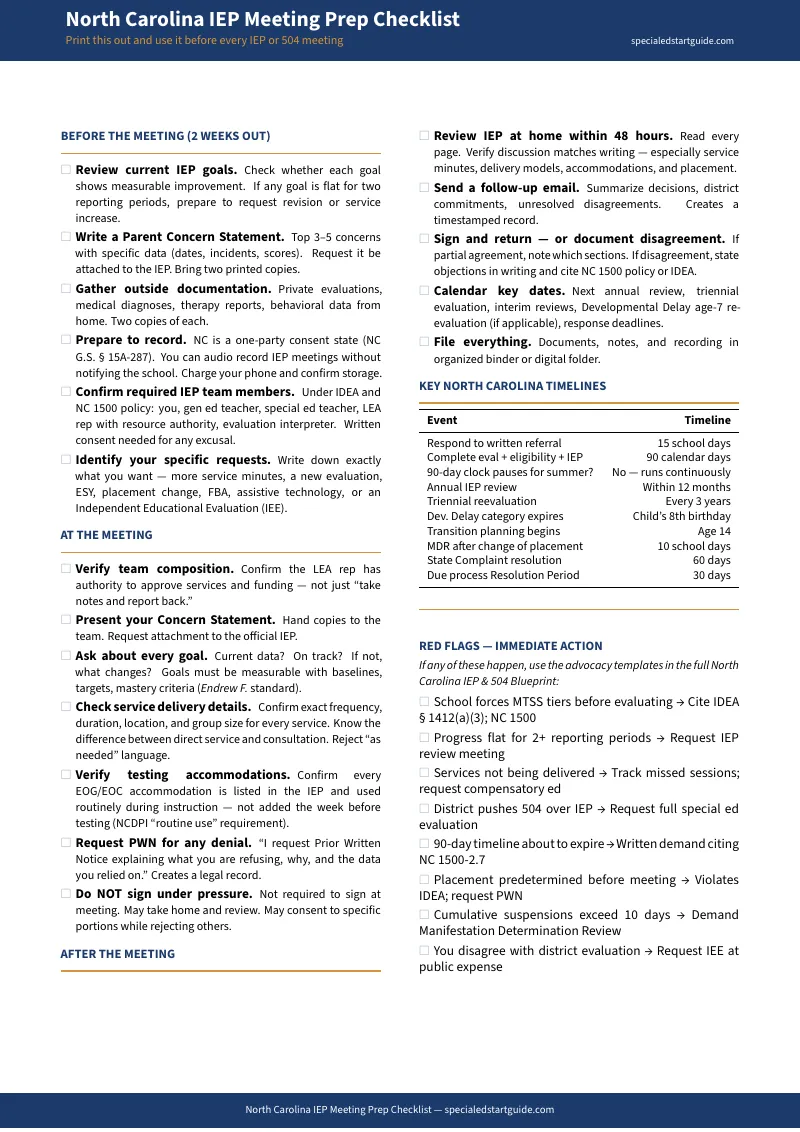
What to say when the team tells you your child needs "more time in MTSS" before they'll evaluate. What to say when they offer a 504 instead of an IEP. What to say when the LEA representative claims they can't add service minutes "because of staffing." Each script cites the NC 1500 section that proves them wrong — so you're not arguing opinions at the table, you're citing law. The pre-meeting checklist covers one-party consent recording rights under NC G.S. § 15A-287, team composition verification, and the specific documents to bring.
Goal-Tracking Worksheets
IEP goals are legally required to be measurable — with baselines, targets, and mastery criteria that meet the Endrew F. standard. But many goals are written so vaguely that progress is impossible to track. The worksheets give you a structured format to log data between meetings, compare school-reported progress against your own observations, and arrive at the annual review with documentation that either confirms the program is working or proves it isn't.
The Dispute Resolution Roadmap
When informal advocacy fails, you have formal options in North Carolina: filing a State Complaint with the NCDPI Exceptional Children Division, requesting mediation, requesting a facilitated IEP meeting, or filing for a due process hearing at the NC Office of Administrative Hearings (OAH). Critically, in North Carolina the burden of proof at OAH falls on the parent — you must prove the district failed to provide FAPE. This is the opposite of New York, where the burden falls on the district. The Blueprint explains when each option is appropriate, the timeline and costs involved, and how the paper trail you've been building becomes the evidence that carries your case.
Who This Blueprint Is For
- Parents preparing for their first IEP meeting who don't want to walk in blind against a team that does this every day — and who need to understand the 90-day evaluation timeline before consent forms are pushed across the table
- Parents whose child has been stuck in MTSS for months while the school insists on "more data" before evaluating — and who need the legal citations to force a referral
- Parents in Wake County or Charlotte-Mecklenburg navigating overwhelmed EC departments, high teacher turnover, and systemic complaint backlogs
- Parents in rural North Carolina districts where staffing shortages mean IEP meetings don't happen on schedule, services aren't delivered, and there's no local advocate to call
- Military families at Fort Liberty, Camp Lejeune, or Seymour Johnson who need to enforce their child's existing IEP during a North Carolina school transfer
- Parents navigating the 504-to-IEP question — unsure whether their child's current accommodations are legally sufficient or whether they should push for a full evaluation
- Parents whose child is approaching their 8th birthday with a Developmental Delay classification — and who need to proactively initiate reevaluation under a permanent category before services are lost
- Parents whose child is being repeatedly suspended for behavior related to their disability — and who need to understand the 10-day rule and Manifestation Determination procedures
Why Not Just Use the Free Resources?
North Carolina has solid free special education resources. ECAC provides training and toolkits. NCDPI distributes the Procedural Safeguards Handbook. Disability Rights NC publishes legal guides. Here's why parents still struggle after consulting all of them:
- ECAC is neutral by design — they can't teach you to fight. ECAC is North Carolina's federally mandated Parent Training and Information Center. They explain what the law is. They do not provide aggressive enforcement strategies for when the school actively ignores it. They cannot give you the exact copy-and-paste email scripts needed to corner a non-compliant IEP team — because their institutional funding requires them to foster collaboration, not confrontation.
- The Procedural Safeguards Handbook is written for lawyers. NCDPI's official document tells you the district has 90 calendar days to evaluate. It does not tell you what to say in the email to the EC Director on Day 85 when nothing has happened. It contains blank placeholders for contact information that your district may never fill in. It is designed to document that your rights were "disclosed," not to teach you how to use them.
- Wrightslaw covers federal law — not North Carolina's NC 1500 policies. Wrightslaw is the gold standard for IDEA. It does not address NC 1500 regulations, the specific 90-calendar-day timeline that runs through summer, ECATS documentation systems, or the OAH hearing procedures that are unique to North Carolina. Generic national advice leaves you vulnerable at a North Carolina IEP table.
- TPT and Etsy planners organize paperwork — they don't enforce rights. A pastel IEP binder helps you keep documents in order. It won't explain what MTSS means, why the district is delaying your evaluation, or how to cite NC 1500-2.7 to force the referral. Generic federal templates use terminology that North Carolina districts don't recognize — instantly marking you as unprepared.
- Private advocates cost $150–$300 per hour. Attorneys cost $200–$500. A standard special education case in NC runs $8,000–$10,000. Most families can't afford this. And attorneys prefer cases where a solid paper trail already exists — meaning you still need guidance on building the documentation that makes representation possible.
The free resources explain what the law says. The Blueprint gives you the tools to make the district follow it.
— Less Than 2 Minutes of a Special Education Attorney
Special education attorneys in North Carolina charge $200–$500 per hour. A private advocate runs $150–$300 per meeting. Even if you eventually need professional help, the meticulous paper trail you build with this Blueprint saves thousands in billable hours — because you're handing your attorney an organized case, not a folder of unsigned IEP copies and half-remembered conversations.
Your download includes the complete Blueprint guide plus standalone printable PDFs — every template, worksheet, script, and reference card, ready to print and bring to your next meeting.
- Complete Blueprint Guide — 13 chapters covering the NC special education landscape, IEP vs. 504, referral and evaluation timelines, IEP meeting strategies, placement and LRE, Independent Educational Evaluations, ESY and service specifics, dispute resolution, school discipline protections, military transfers and special populations, high school transition and diploma pathways, paper trail documentation, and NC advocacy resources
- IEP Meeting Prep Checklist — the before/during/after checklist with North Carolina timelines and NC 1500 citations for every step
- Advocacy Letter Templates — copy-paste letters citing exact NC 1500 sections for evaluation requests, IEEs, Prior Written Notice demands, MTSS bypass, formal disagreements, and addendum meeting requests
- Goal-Tracking Worksheet — structured fillable worksheet for measurable progress monitoring between annual reviews
- North Carolina Timeline Cheat Sheet — every legal deadline on one page: 90-day evaluation clock, 15-day referral response, annual reviews, triennial reviews, Developmental Delay expiration, and transition dates
- IEP Meeting Scripts — word-for-word responses to common IEP team pushback tactics, each citing the specific NC 1500 section
- MTSS Defense Reference Card — the federal and NC citations proving schools cannot use MTSS to delay parent-initiated evaluations
- Dispute Resolution Roadmap — your formal options: NCDPI State Complaint, mediation, facilitated IEP, and OAH due process — with burden-of-proof guidance for NC hearings
Instant PDF download. Print the templates tonight. Walk into tomorrow's meeting with the law on your side.
Money-back guarantee, no time limit. If the Blueprint doesn't change how you approach IEP meetings in North Carolina, email us for a full refund. No questions asked.
Not ready for the full Blueprint? Download the free North Carolina IEP Meeting Prep Checklist — a printable pre-meeting checklist with the NC timelines, team composition requirements, one-party consent recording rights, and red flags that require immediate action. It's enough to walk into your next meeting prepared, and it's free.
Your child's education is a legal right, not a favor. The district knows NC 1500. After tonight, so will you.