The District Knows Part 200. Now You Will Too.
You walked into that CSE meeting prepared — or you thought you did. You read the Procedural Safeguards Notice at 2 AM. You printed your child's progress reports. You wrote down your concerns. And then the school psychologist, the special education teacher, and the district representative smiled, used phrases you'd never heard before, and told you your child "doesn't qualify" for additional services or that SETSS minutes "aren't available at this building."
You left the meeting with the same IEP your child walked in with. No additional minutes. No new evaluations. No Prior Written Notice explaining why they refused your requests — because you didn't know to ask for one.
The problem isn't that you're uninformed. The problem is that New York's special education system is specifically designed to be navigated by professionals, not parents. In NYC, over 200,000 students have IEPs — and during the 2021-2022 school year, approximately 13,800 IEP recommendations for related services went entirely unfulfilled for K-12 students. Nearly 10,000 preschool students missed their fully mandated services. In suburban Westchester, Long Island, and Hudson Valley districts, the fight is different — districts resist costly disability classifications and out-of-district placements to protect their budgets. And across the entire state, parents face a system governed by over 200 Part 200 regulations that exceed federal IDEA standards — rules the district knows by heart and you've never seen.
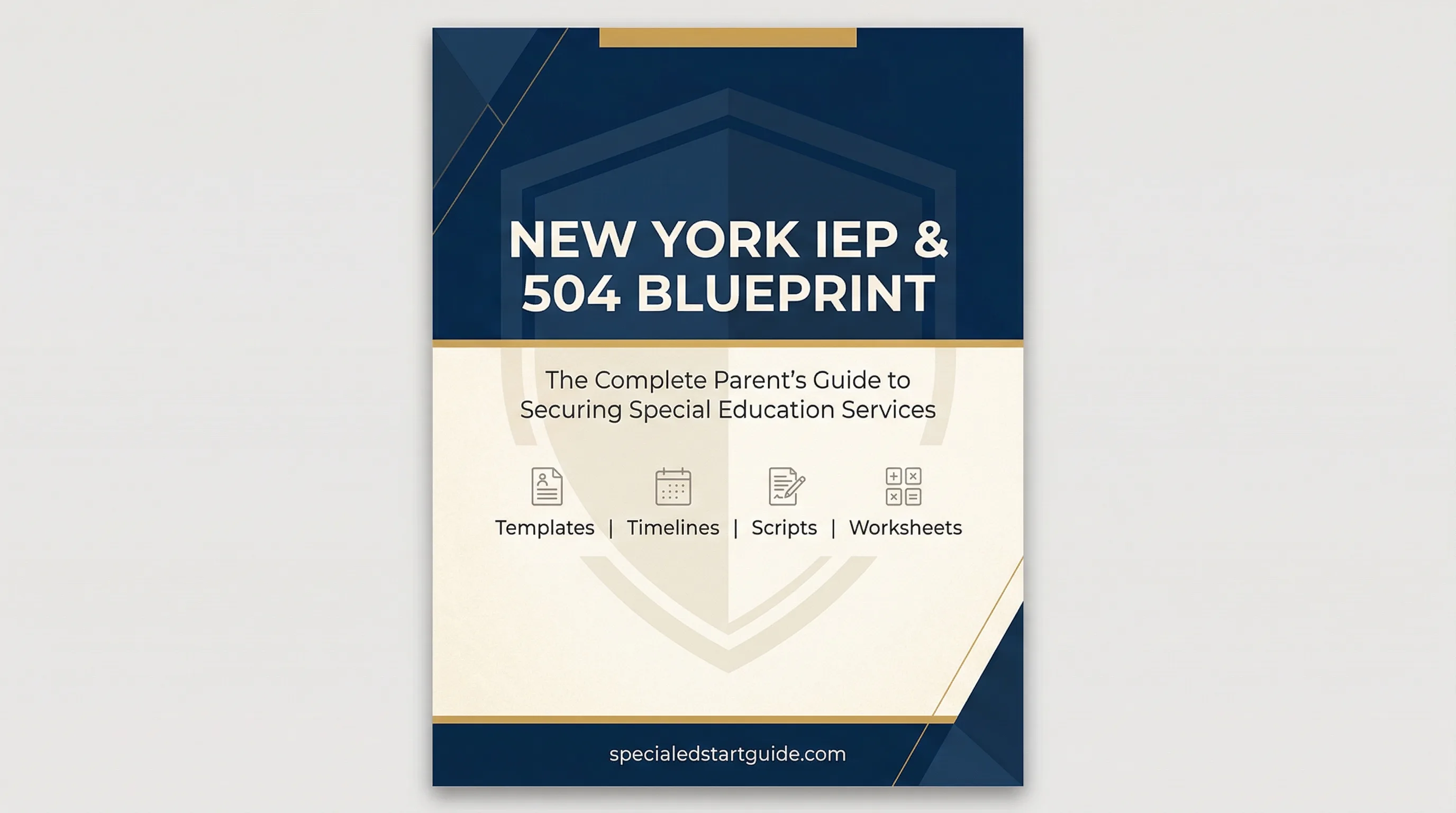
The New York IEP & 504 Blueprint is the tactical enforcement toolkit that bridges the gap between knowing your rights and actually exercising them — with every template, script, and checklist grounded in the New York State Part 200 Regulations of the Commissioner of Education.
What's Inside the Blueprint
The Copy-Paste Advocacy Letter Library
Every letter cites the exact New York regulation. Request a CSE evaluation under Part 200 and start the district's 60-school-day evaluation clock. Demand an Independent Educational Evaluation at public expense using the specific legal phrase that triggers the district's obligation to either pay or file for due process — there is no third option. Formally disagree with an IEP and request Prior Written Notice. These aren't generic federal templates — they're New York enforcement tools that create a legally binding paper trail the moment you hit send.
The CSE and CPSE Power Map
New York's Committee on Special Education is not a collaborative team — it's a budget-defense apparatus staffed by professionals who answer to the district, not your child. Most parents don't understand the internal dynamics: who controls the meeting, who writes the IEP recommendations, and why the "district representative" at the table is the person with the power to approve or deny every service you request. The Blueprint explains each role, their professional incentives, and specific strategies for navigating the committee as a parent who knows the law — not just a parent with concerns.
The 60-Day and 10-Day Timeline Tracker
The moment you submit a written evaluation request, the district has exactly 60 school days to complete all assessments, hold the CSE meeting, and develop the IEP — not 60 calendar days, not "when the psychologist has availability." If you request an explanation for a denial, the district must respond with Prior Written Notice within a reasonable timeframe. The Blueprint maps every milestone within these timelines, gives you the specific language to hold the district accountable at each checkpoint, and provides follow-up templates for when deadlines are missed — because in New York, they frequently are.
NYC DOE vs. Suburban District Navigation
Navigating the NYC DOE is fundamentally different from advocating in Westchester, Long Island, or upstate districts. In NYC, you need to understand District 75, the Central Based Support Team (CBST) for non-public school matching, the difference between SETSS push-in and pull-out, and ICT classroom dynamics. In suburban districts, you need strategies for classification disputes, BOCES program referrals, and out-of-district placement battles. The Blueprint covers both systems in depth — because a strategy that works in a Manhattan CSE meeting will fail in Scarsdale, and vice versa.
The "Turning 5" Transition Protocol
The CPSE-to-CSE transition is the most dangerous moment in your child's special education journey. Districts routinely slash intensive 1:1 preschool therapies to cheaper group sessions the moment a child enters kindergarten — not because the child no longer needs the services, but because kindergarten services cost the district more. The Blueprint provides the exact strategy for forcing the district to legally justify any reduction in services with fresh evaluation data, rather than rubber-stamping a cut based on administrative convenience.
IEP Meeting Scripts and Checklists
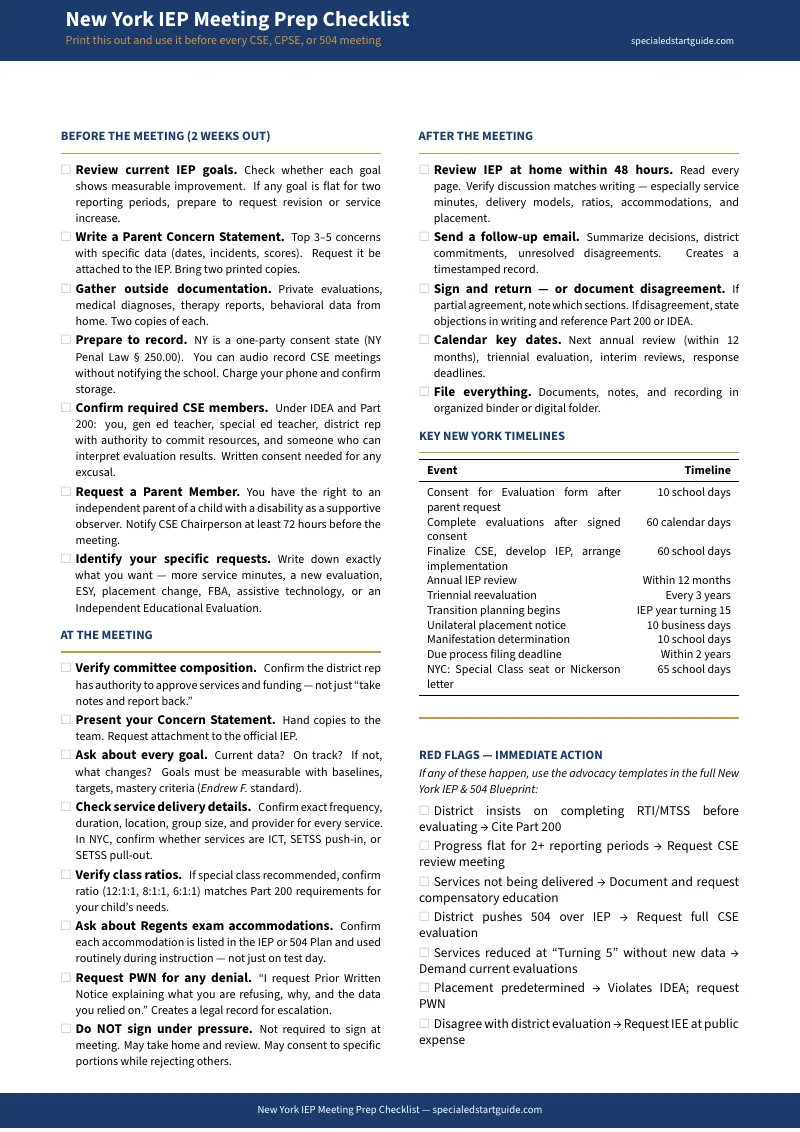
What to say when the CSE tells you your child is "making progress" but the data shows otherwise. What to say when they offer a 504 instead of an IEP. What to say when the district representative claims they can't add service minutes "because the budget is set." Each script cites the Part 200 section that proves them wrong — so you're not arguing opinions at the table, you're citing law. The pre-meeting checklist covers one-party consent recording rights under NY Penal Law § 250.00, committee composition verification, and the specific documents to bring.
The Carter Case Financial Shield
When the public school utterly fails to provide a Free Appropriate Public Education, parents have the legal right to place their child in a private special education school and seek tuition reimbursement from the district. In fiscal year 2025, Carter-case spending cost New York City $1.3 billion. But a single missed deadline — the strict 10-business-day notice requirement — can cost a family $50,000 or more in forfeited reimbursement. The Blueprint provides the exact notice template, the timeline, and the evidence trail required to preserve your rights under the Burlington-Carter standard.
Goal-Tracking Worksheets
IEP goals are legally required to be measurable — with baselines, targets, and mastery criteria that meet the Endrew F. standard. But many goals are written so vaguely that progress is impossible to track. The worksheets give you a structured format to log data between meetings, compare school-reported progress against your own observations, and arrive at the annual review with documentation that either confirms the program is working or proves it isn't.
The Dispute Resolution Roadmap
When informal advocacy fails, you have three formal options in New York: filing a State Complaint with NYSED, requesting mediation, or filing for a due process hearing before an Impartial Hearing Officer (IHO). If the IHO rules against you, you can appeal to a State Review Officer (SRO). Critically, in New York the burden of proof rests on the school district — not on you. The Blueprint explains when each option is appropriate, the timeline and costs involved, and how the paper trail you've been building becomes the evidence that wins your case.
Who This Blueprint Is For
- Parents preparing for their first CSE meeting who don't want to walk in blind against a committee that does this every day — and who need to understand the 60-day evaluation timeline before consent forms are pushed across the table
- Parents whose child has been evaluated but denied eligibility or services — and who need the legal language under Part 200 to challenge that determination
- Parents in NYC navigating the DOE's assembly-line CSE process, District 75 decisions, SETSS vs. ICT placement questions, and chronic related service shortages
- Parents in Westchester, Long Island, and Hudson Valley districts where programs look strong on paper but the district resists costly classifications, additional service minutes, or out-of-district placements
- Parents whose child is turning five and transitioning from CPSE to CSE — and who need to prevent the district from slashing preschool therapies at the kindergarten threshold
- Parents navigating the 504-to-IEP question — unsure whether their child's current accommodations are legally sufficient or whether they should push for a full CSE evaluation
- Military families transferring into New York State — and who need to understand how their child's existing IEP translates to Part 200 requirements
- Parents considering a Carter case private placement who cannot afford to miss the 10-business-day notice deadline
Why Not Just Use the Free Resources?
New York has strong free special education resources. Advocates for Children publishes a comprehensive guide. INCLUDEnyc offers workshops. NYSED distributes the Procedural Safeguards Notice. Disability Rights New York provides legal services. Here's why parents still struggle after consulting all of them:
- The AFC guide is a legal textbook, not a playbook. Advocates for Children's 45-page guide is authoritative and free. It covers NYC-specific mandates with deep legal detail. It does not include a single fill-in-the-blank template. It lacks a quick-start checklist for parents with a meeting in 48 hours. It redirects preschool parents to a separate guide, forcing you to manually aggregate critical information across multiple lengthy documents during a crisis.
- The Procedural Safeguards Notice is written for lawyers. NYSED's official document tells you the district has 60 school days to evaluate. It does not tell you what to say in the email to the CSE chairperson on Day 55 when nothing has happened. Research confirms it is functionally inaccessible to families without legal training. It is designed to ensure municipal legal compliance, not to educate or empower parents.
- INCLUDEnyc runs on fixed schedules. INCLUDEnyc is an excellent resource, but securing personalized help means navigating their program calendar and attending workshops during business hours. When the district sends an inadequate evaluation report on a Thursday and your CSE meeting is next week, you cannot wait for next month's webinar. The Blueprint is available the moment the crisis hits.
- Wrightslaw covers federal law — not New York's 200+ extra rules. Wrightslaw is the gold standard for IDEA. It does not address New York's Part 200 regulations, which mandate specific class size ratios (12:1:1, 8:1:1, 6:1:1), state-specific evaluation timelines, and CPSE/CSE committee structures that have no federal equivalent. Generic national advice leaves you vulnerable at a New York CSE table.
- TPT and Etsy planners organize paperwork — they don't enforce rights. A pastel IEP binder helps you keep documents in order. It won't explain what SETSS means, why the district is resisting your evaluation request, or how to cite Part 200 to force the referral. Generic federal templates use terminology that New York districts don't recognize — instantly marking you as unprepared.
The free resources explain what the law says. The Blueprint gives you the tools to make the district follow it.
— Less Than 3 Minutes of a Special Education Attorney
Special education attorneys in New York charge $500–$700 per hour. A private advocate runs $100–$300 per meeting. Even if you eventually need professional help, the meticulous paper trail you build with this Blueprint saves thousands in billable hours — because you're handing your attorney an organized case, not a folder of unsigned IEP copies and half-remembered conversations.
Your download includes the complete Blueprint guide plus standalone printable PDFs — every template, worksheet, script, and reference card, ready to print and bring to your next meeting.
- Complete Blueprint Guide — 12 chapters covering the NY special education landscape, IEP vs. 504, CSE/CPSE committee structures, referral and evaluation timelines, CSE meeting strategies, SETSS/ICT/related service delivery models, Independent Educational Evaluations, dispute resolution, Carter case private placement, bilingual special education and discipline protections, high school diploma options and transition planning, and key NY timelines and advocacy resources
- IEP Meeting Prep Checklist — the before/during/after checklist with New York timelines and Part 200 citations for every step
- Advocacy Letter Templates — copy-paste letters citing exact Part 200 sections for CSE referrals, evaluation requests, IEEs, Prior Written Notice demands, formal disagreements, and addendum meeting requests
- Goal-Tracking Worksheet — structured fillable worksheet for measurable progress monitoring between annual reviews
- New York Timeline Cheat Sheet — every legal deadline on one page: 60-day evaluation, 10-day notice rules, annual reviews, triennial reviews, and transition dates
- IEP Meeting Scripts — word-for-word responses to common CSE pushback tactics, each citing the specific Part 200 section
- Carter Case Notice Template — the 10-business-day notice letter with the exact language required to preserve tuition reimbursement rights
- Dispute Resolution Roadmap — your three formal options: State Complaint, mediation, and due process hearing — with burden-of-proof guidance and SRO appeal procedures
Instant PDF download. Print the templates tonight. Walk into tomorrow's meeting with the law on your side.
Money-back guarantee, no time limit. If the Blueprint doesn't change how you approach IEP meetings in New York, email us for a full refund. No questions asked.
Not ready for the full Blueprint? Download the free New York IEP Meeting Prep Checklist — a printable pre-meeting checklist with the NY timelines, CSE composition requirements, one-party consent recording rights, and red flags that require immediate action. It's enough to walk into your next meeting prepared, and it's free.
Your child's education is a legal right, not a favor. The district knows Part 200. After tonight, so will you.